Hindus targeted for their identity: Indian politician in Tamil Nadu reduces Brahmin community to “mosquitoes”, calls for mass genocide
 Tamil Nadu, India
  17 January, 2026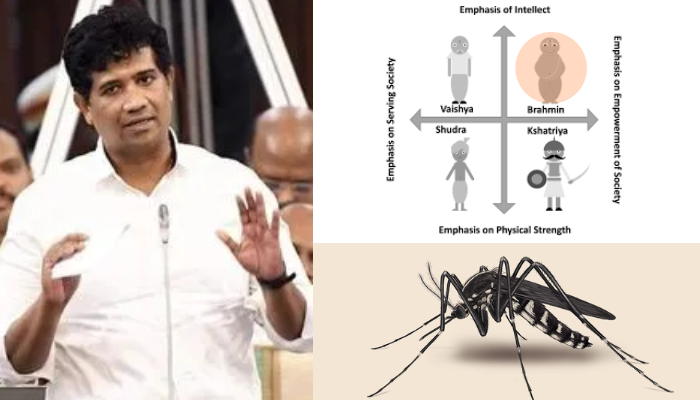
Case Summary
Hindu Brahmins faced hostility after a sitting Tamil Nadu legislator, Dr Ezhilan Naganathan, referred to them as “mosquitoes” and appeared to suggest their elimination during a social media exchange. The remark came in response to political commentator Sumanth Raman, who mocked the Dravida Munnetra Kazhagam’s record of poll promise keeping in office. On 18 January 2026, Sumanth Raman criticised the DMK government’s performance on its 2021 election manifesto on X. He wrote that the party’s manifesto committee could reuse the 2021 document for the 2026 election by changing the date, removing the few promises that had been fulfilled, and adding new welfare schemes. Responding to Raman’s post, Dr Ezhilan, the Thousand Lights MLA and DMK Medical Wing Secretary, quoted the tweet and wrote, “One of the many requests from the people to eliminate certain species of mosquitoes…”. The remark was widely interpreted as a dehumanising reference to Brahmins and triggered backlash online, with critics describing it as a veiled call for extermination. The controversy widened when Indian National Congress State Working Chairman for OBC, Dhivya Marunthiah, a political ally of the DMK, shared Dr Ezhilan’s post with a laughing emoji, signalling approval rather than condemnation. Legal observers noted that public dehumanisation or calls for elimination of a community raise serious concerns under constitutional protections, including equality and freedom of religion. Around the same time, attention also turned to Dhivya Marunthiah’s prior online conduct. It was reported that he had circulated an older video clip of Islamist extremist Ahmed Ali, also known as Palani Baba, in response to a post by Vedic scholar Dushyanth Sridhar concerning Thirupparankundram. In the clip, Ahmed Ali issued a warning stating, “I’m giving you a final warning, stay inside your house or else, I’ll turn into an extremist.” The January 2026 episode further revived scrutiny of earlier instances of anti Hindu and anti Brahmin rhetoric linked to DMK circles. In June 2022, DMK spokesperson Rajiv Gandhi publicly endorsed the views of Erode Venkata Ramaswamy Naicker, known as Periyar, including Periyar’s 1973 Karaikudi speech calling for the killing and elimination of Tamil Brahmins. In that speech, Periyar used derogatory language, advocated temple and idol destruction, and urged violence against Brahmins, while arguing that even collateral deaths among non Brahmins would be an acceptable tradeoff to eradicate the Brahmin community. Sumanth Raman later shared a clip of Periyar’s 1973 speech on X to underline the explicit nature of the hate. He added that the genocide did not take place due to the intervention of former Prime Minister Indira Gandhi and AIADMK leaders M G Ramachandran and J Jayalalithaa. Responding to this, DMK spokesperson Rajiv Gandhi wrote that if Shudras had carried out Periyar’s instructions, they would not have to struggle today for justice, employment, rights, education, and equality. He also remarked that Brahmins, whom he described as three per cent of the population, continued to occupy significant space. Separately, Dr Ezhilan has faced earlier criticism for remarks targeting Hindu religious texts, deities, and practices. In June 2021, DMK cadres organised an event directly in front of a Perumal Temple in Chennai to mark the ninety eighth birth anniversary of former Chief Minister M Karunanidhi. A stage was erected blocking the entrance, and chicken and mutton biryani were distributed during coronavirus restrictions. The event was attended by DMK MP Dayanidhi Maran and Dr Ezhilan, and it drew condemnation from Hindu organisations. In March 2025, at a book launch event for Dravidian Stock’s translation of Kalaignar’s Thirukkural, Dr Ezhilan mocked the Bhagavad Gita and the Upanishads. He questioned the placement of the Gita within the Mahabharata, ridiculed the idea of Lord Krishna advising Arjuna amid a battlefield, and compared the text unfavourably with other war literature. In the same speech, he claimed the Gita had been inserted to influence and kill people, used the phrase “Vachu Seiran”, and alleged that the text and the Upanishads were crafted to counter Buddhist influence. He also claimed the tradition contained mantras for destruction, diseases, urination, and constipation. In other recorded content associated with the Karuppar Koottam YouTube channel, Dr Ezhilan made derogatory remarks about Hindu deities. He described the sage Narada as sexually motivated, accused Lord Vishnu of acting as a pimp, and narrated a story involving Narada transforming into a woman to sleep with Lord Vishnu. In a separate clip, he referred to Hindus who apply sacred ash and thiruman as fools and mocked Hindu women for praying before stones to resolve issues related to their husbands. In February 2025, in a separate political context, Dr Ezhilan criticised the Union government over language policy and alleged discriminatory budgetary practices affecting Tamil Nadu, describing the approach as dictatorial and urging political unity to protect the state’s rights and dignity. Taken together, the January 2026 social media exchange involving Dr Ezhilan’s “mosquitoes” remark is presented as part of a longer run of rhetoric and actions by DMK linked figures that critics view as targeting Hindu religious identity and the Brahmin community. Critics argue that the lack of accountability for such remarks has contributed to the normalisation of hostility. At the time of documenting this incident, Dr Ezhilan and the DMK had not issued any clarification, apology, or response to the remark.
Why it is Hate Crime ?
This case has been documented under the selected primary category: Hate speech against Hindus. Under this, the selected secondary category is: Call for genocide/violence against Hindus/specific sects of Hindus. Hate speech is defined as any speech, gesture, conduct, writing, or display that is prejudicial against a specific individual and/or group of people, which leads to or may lead to violence, prejudicial action, or hate against that individual and/or group. Often, animosity against Hindus or a specific panth/sampradaya/group of Hindus or a specific ideology they hold manifests itself in hate speech and calls for genocide/violence against that specific section of Hindus. For example, it has often been seen that those who hold animosity against the Hindu faith use specific sects/sampradaya/panths of Hindus as a proxy to express hate against Hindus as a whole. It has been seen that the word ‘Hindutva’ has been used to call for violence against those who say they believe in ‘Hindutva’. It is observed that ‘Hindutva’ is only used as a proxy to call for violence against Hindus as a whole, as seen in the Dismantling Global Hindutva conference, where speakers admitted that ‘Hindutva’ cannot be eradicated till ‘Hinduism’ is eradicated. The eradication of an entire faith, in turn, is a genocidal call against the entire community that practices that faith. Further, it is also observed that violence against a specific section of Hindus is made, justifying these calls by weaving exaggerated tales of historical injustices. Often, those who hold animosity towards Hindus and their faith attempt to make their animosity more palatable by justifying their hate for a specific section, claiming that they are against that particular section because of their faith in the broader community and the religion they profess. Such calls for violence against specific sections of Hindus, as mentioned, are a proxy for their animosity against the entire community and the faith they profess, and therefore, would be considered hate speech under this category. The other sub-category selected is- Anti-Hindu slurs, mocking faith. Anti-Hindu slurs and the deliberate mocking of the Hindu faith owing to religious animosity involve the usage of derogatory terms, stereotypes, or offensive references to religious practices, symbols, or figures. One of the common anti-Hindu slurs used against Hindus is “cow-worshipper” and “cow piss drinker”. The intention of using this term is to demean and mock Hindus as a group and their religious beliefs since Hindus consider the cow holy. Additionally, some symbols and the slurs attached to them have a historical context that exacerbates the insult, hate, stereotyping, dehumanisation and oppression against Hindus. Cow worship has been used for centuries to denigrate Hindus, insult their faith and oppress Hindus specifically as a religious group. There has been overwhelming documentation about how cow slaughter has been used to persecute Hindus with cow meat being thrown in temples and places of worship. There has also been overwhelming documentation where cow meat (beef) has been force-fed to Hindus to either forcefully convert them to Islam or denigrate their faith. Apart from cow worship, the Swastika – which holds deep religious significance for the Hindus – has also been misinterpreted and distorted to use as a slur against Hindus. Similarly, the worship of the Shivling has been used by supremacist ideologies and religions to denigrate Hindus owing to religious animosity. Such slurs and denigration stem out of inherent animosity and hate towards Hindus and their faith, therefore, it is categorised as hate speech targeted at Hindus specifically owing to their religious identity. In this incident, a sitting DMK legislator used dehumanising, eliminationist language that was widely understood as directed at Hindu Brahmins by referring to the removal of a “species of mosquitoes.” This is not an ordinary political retort. Dehumanising a community as vermin shifts the frame from criticism of an individual or an argument to portraying a religious group as a public nuisance that should be eliminated. That rhetorical move normalises the idea that a Hindu community can be spoken about in exterminatory terms, lowering social inhibitions against discrimination and violence. The hate element is reinforced by the wider political ecosystem in which such remarks are not treated as disqualifying. When allied figures respond with approval or amusement, it signals social permission to degrade a Hindu community rather than to condemn the dehumanisation. That permissive reaction matters because hate speech becomes culturally potent not only through the original statement but through the establishment of impunity and normalisation around it. This episode also fits within a longer and well-documented trajectory of anti-Hindu rhetoric associated with DMK-linked discourse, where Hindu religious identity and symbols are repeatedly framed as obstacles to be removed rather than beliefs entitled to equal respect. Senior-level DMK rhetoric has included eradication language aimed at “Sanatan Dharma,” most notably Udhayanidhi Stalin’s widely reported “eradicate Sanatan” comments, which helped mainstream a vocabulary of elimination around Hindu faith traditions. When eradication framing is legitimised at high visibility levels, subsequent dehumanising statements aimed at specific Hindu communities, such as Brahmins, become easier to justify, defend, and repeat. The pattern is further strengthened by instances where DMK functionaries have defended or echoed earlier exterminationist discourse. Endorsing Periyar’s explicit call to kill and eliminate Tamil Brahmins, and portraying the non execution of such instructions as a missed corrective for society, reframes genocide talk as justice. That crosses from a critique of social hierarchy into legitimisation of violence against a Hindu community group, embedding elimination as an acceptable moral solution. Alongside this, the same legislator’s record of remarks targeting Hindu scriptures, deities, and devotional practices reinforces that the hostility is directed at Hindu faith itself, not merely a social category. Mocking the Bhagavad Gita and the Upanishads, portraying them as texts crafted to manipulate and harm, and using disgust-based ridicule to trivialise Hindu tradition work to delegitimise Hindu sacred foundations. Derogatory portrayals of Hindu deities through sexualised and criminal imagery aim to humiliate devotees by turning what is sacred into an object of contempt. Ridiculing visible Hindu markers such as sacred ash and thiruman and mocking Hindu women’s worship targets ordinary Hindus for practising their faith and encourages social scorn toward public expressions of Hindu identity. Even actions affecting Hindu worship spaces, such as disruptive conduct at a temple frontage, take on significance within this larger pattern because they communicate that Hindu religious life can be obstructed and disrespected without consequence. Taken together, the dehumanisation of Hindu Brahmins, the legitimisation of extermination discourse, the repeated denigration of Hindu texts and deities, and the ridicule of Hindu devotional practice form a coherent continuum of anti-Hindu hostility. For these reasons, this case is documented as a hate incident targeting Hindu Brahmins and Hindu faith, because it advances a pattern of rhetoric and behaviour that degrades a Hindu community, normalises eliminationist framing, and contributes to an environment where discrimination and violence against Hindus can be rationalised and socially validated.


Case Status
Unknown


Perpetrators Details
Perpetrators
State and Establishment
Perpetrators Range
From 2 To 5
Perpetrators Gender
male
 Sources




