Hindu religious custom defiled by the ruling party minister in the abode of temple in Tamil Nadu
 Tamil Nadu, India
  1 April, 2026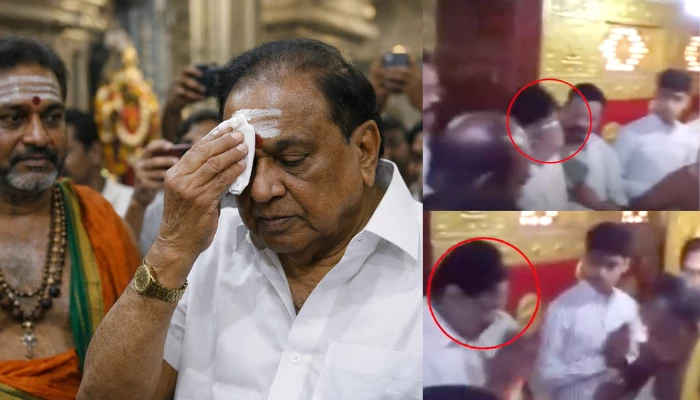
Case Summary
In Tamil Nadu, Hindu customs were desecrated and defiled by the ruling Dravida Munnetra Kazhagam (DMK) minister. A video of DMK General Secretary and Water Resources Minister Duraimurugan went viral on social media after he was seen wiping off vibhuti from his forehead immediately after it was applied by a temple priest during a temple visit. The incident took place on 2 April 2026 during what appeared to be election campaign-related activities. During the visit, the temple priest approached Duraimurugan and attempted to apply vibhuti on his forehead. The footage showed that he initially refused to accept it. The priest then applied the sacred ash on his forehead. Immediately thereafter, Duraimurugan was seen wiping the vibhuti off his forehead while still inside the temple premises. The video of this act was recorded and subsequently circulated widely on social media platforms. Following the circulation of the footage, the incident drew public criticism and sparked reactions from various quarters ahead of the 2026 Tamil Nadu Assembly elections. The incident was also compared by several commentators to a similar episode in June 2025, when VCK chief Thol. Thirumavalavan was seen on camera wiping vibhuti off his forehead during a visit to the Thiruparankundram Murugan Temple. This incident was not recorded in isolation. The Hinduphobia Tracker had previously documented instances in which leaders and political figures associated with the DMK and allied Dravidian parties have disrespected Hindu symbols, customs, and places of worship. For instance, on January 18, 2026, Hinduphobia recorded how a sitting Tamil Nadu legislator, Dr Ezhilan Naganathan, referred to Brahmins as “mosquitoes” and suggested their annihilation during a social media exchange. In March 2025, at a book launch event for Dravidian Stock’s translation of Kalaignar’s Thirukkural, Dr Ezhilan mocked the Bhagavad Gita and the Upanishads. He questioned the placement of the Gita within the Mahabharata, ridiculed the idea of Lord Krishna advising Arjuna amid a battlefield, and compared the text unfavourably with other war literature. In the same speech, he claimed the Gita had been inserted to influence and kill people, used the phrase “Vachu Seiran”, and alleged that the text and the Upanishads were crafted to counter Buddhist influence. He also claimed the tradition contained mantras for destruction, diseases, urination, and constipation Similarly, in Madurai on 22 December 2025, members of the Hindu community were subjected to abusive remarks and threats, and the revered Hindu symbol, the Vel, the sacred weapon of Lord Kartikeya/Murugan, was insulted by Dravidian politicians associated with the Viduthalai Chiruthaigal Katchi (VCK). The symbol was used in the course of political messaging and speeches directed against Hindu groups, which was recorded by the tracker as an incident involving disrespect towards a sacred Hindu representation. These earlier incidents were noted as part of a recurring pattern in which Hindu symbols, customs, and traditions had been drawn into political acts and public conduct in a manner that was perceived as insulting or disrespectful by the Hindu community.
Why it is Hate Crime ?
The primary category selected for the case is- Attack on Hindu religious representations. The subcategory selected is- Desecration of a Hindu religious symbol. Icons and symbols, or a religious representation of a spiritual ideal, are widely revered in Hinduism. Iconography is of vital significance in the Hindu milieu. It helps connect people’s spiritual beliefs with the real world. Iconography within the Hindu faith takes several shapes and forms. Murtis are of most significance to Hindus, to which daily rituals, prayers and offerings are done. Besides the murtis, there are several other symbols which have deep significance in the Hindu faith – the Om and Swastika, for example. Since these Hindu religious symbols hold paramount importance in Hinduism, any desecration of symbols, icons, murtis, religious representations and manifestations, is driven by animosity towards the faith itself, which manifests itself through these murtis, icons and symbols. Therefore, any desecration of these Hindu religious symbols and representations is considered a religiously motivated hate crime under this category. The other sub- category selected is- Defiling religious customs. Sanatan Dharma is not a religion of one book, which is to say that while it has religious scriptures that form the central tenets of the faith, there are several traditions followed through thousands of years, mostly passed from generation to generation orally. Several such customs and traditions are followed by various Hindus and Hindu sects. Defiling of these traditions and customs is a breach of an individual or group’s religious practices. Such practices can range from dietary restrictions like not eating non-vegetarian food for a certain period of the year, not eating non-vegetarian food at all, not eating beef since the cow is considered holy in Hinduism, the sanctity of religious customs followed in the house (like many ISCKON devotees), etc. Any malicious action leading to the breach of such traditions or defilement of these traditions owing to animosity towards the faith or for the sake of activism stems not only from the lack of faith in the religion itself but also from disregard for the faith of the devotees who follow the customs/traditions and implicit bias against the faith, the tradition itself. Since these specific traditions are central to the faith of the devotees of that specific sect of Hindus, any non-compliance with these traditional rules would be considered a religiously motivated hate crime. This case was added to the tracker as the conduct displayed a direct act of disrespect towards a sacred Hindu religious representation and a long-standing temple custom. At the outset, the vibhuti applied on the forehead by a temple priest was not an ordinary mark. In Hindu practice, it is a sacred religious symbol that signifies blessings, purity, and divine grace. When such a symbol is applied by a priest inside a temple, it forms part of a recognised and deeply revered religious custom. The act, therefore, carried both symbolic and ritual significance within the Hindu faith. In the present case, the minister had visited the temple of his own accord. The priest, in the course of customary temple practice, applied the sacred ash as a mark of blessing. Even after the priest initially showed reluctance, once the vibhuti had been placed, it immediately became a visible religious symbol. Wiping it off at once, and doing so inside the temple premises itself, amounted to a clear act of desecration of that Hindu religious symbol. Importantly, the timing and manner of the act intensified its impact. The sacred ash was removed immediately after application, in a manner that conveyed visible aversion, almost as if it were something impure or poisonous. Such conduct went beyond personal refusal and entered the realm of symbolic disrespect. The immediacy of the gesture conveyed contempt not only for the sacred mark but also for what it represented in Hindu belief and practice. Further, this was not done in a neutral public space but in the very abode of the deity. The temple is regarded by devotees as a sacred space where rituals, blessings, and customs are performed with reverence. To wipe off the vibhuti in that sanctified setting was a direct affront to the temple's sanctity. The act also reflected disrespect towards the priest and the religious custom he was performing. Priests in Hindu temples act as custodians of ritual practice and tradition. Rejecting and immediately removing the sacred ash after it had been applied by the priest undermined both the ritual act and the religious authority associated with it. This is precisely why the second category of defiling religious customs also squarely applies. The application of vibhuti by a temple priest is a long-standing Hindu custom passed through generations and followed by devotees as a mark of reverence and blessing. Any act that deliberately humiliates or nullifies this ritual within the temple space itself constitutes a defilement of that religious practice. Taken together, the conduct reflected disrespect towards the temple, the priest, and a central Hindu religious custom, thereby qualifying it as a religion-linked hate incident.


Case Status
Unknown


Perpetrators Details
Perpetrators
State and Establishment
Perpetrators Range
One Person
Perpetrators Gender
male
 Sources




