

In August 2026, the Hinduphobia Tracker documented 260 hate crime incidents involving Hindus, affecting 2,619 victims and resulting in 24 deaths. These numbers provide an overview of the scale of incidents recorded during the month, but they do not, by themselves, tell us what happened or how these incidents were distributed.
A closer examination of the data reveals a more complex picture. The incidents span different forms of hostility, from hate speech and attacks on Hindu religious representations to predatory proselytisation, crimes against women in relationships and physical violence. The scale of impact also varies sharply. While some incidents involved a single victim, a small number of cases involved hundreds or even thousands of people, making the relationship between the number of incidents and the number of victims particularly important.
This report moves beyond a case-by-case listing of incidents to examine the patterns within the data. It looks at what types of incidents were most common, where they occurred, who was affected, how the severity and impact varied, and which trends stand out when the 260 incidents are viewed together.
The analysis covers all incidents documented by the Hinduphobia Tracker during August 2026. The date on which an underlying incident began does not determine whether it is included in the August dataset.
August at a glance
The Hinduphobia Tracker documented 260 incidents involving Hindus in August 2026. These incidents involved 2,619 victims, including 24 deaths. While the number of incidents provides a measure of frequency, the number of victims shows the scale of their impact, and the two measures do not always move together.
- 260 incidents
- 2,619 victims
- 24 deaths
- 17 incidents resulted in death
The incidents were recorded across eight countries, with 214 incidents in India and 46 outside India. Within India, Uttar Pradesh recorded the highest number of incidents, followed by Maharashtra, Madhya Pradesh, Delhi, Rajasthan and Chhattisgarh.
Categories at a glance
- Hate speech against Hindus: 76 incidents
- Predatory Proselytisation: 54 incidents
- Attack on Hindu religious representations: 51 incidents
- Crimes against women in relationships and other sexual crimes: 50 incidents
- Attack not resulting in death: 35 incidents
- Undecided cases: 20 incidents
- Attack resulting in death: 9 incidents
- Men attacked for being associated with non-Hindu women: 4 incidents
- Restriction/ban on Hindu practices: 3 incidents
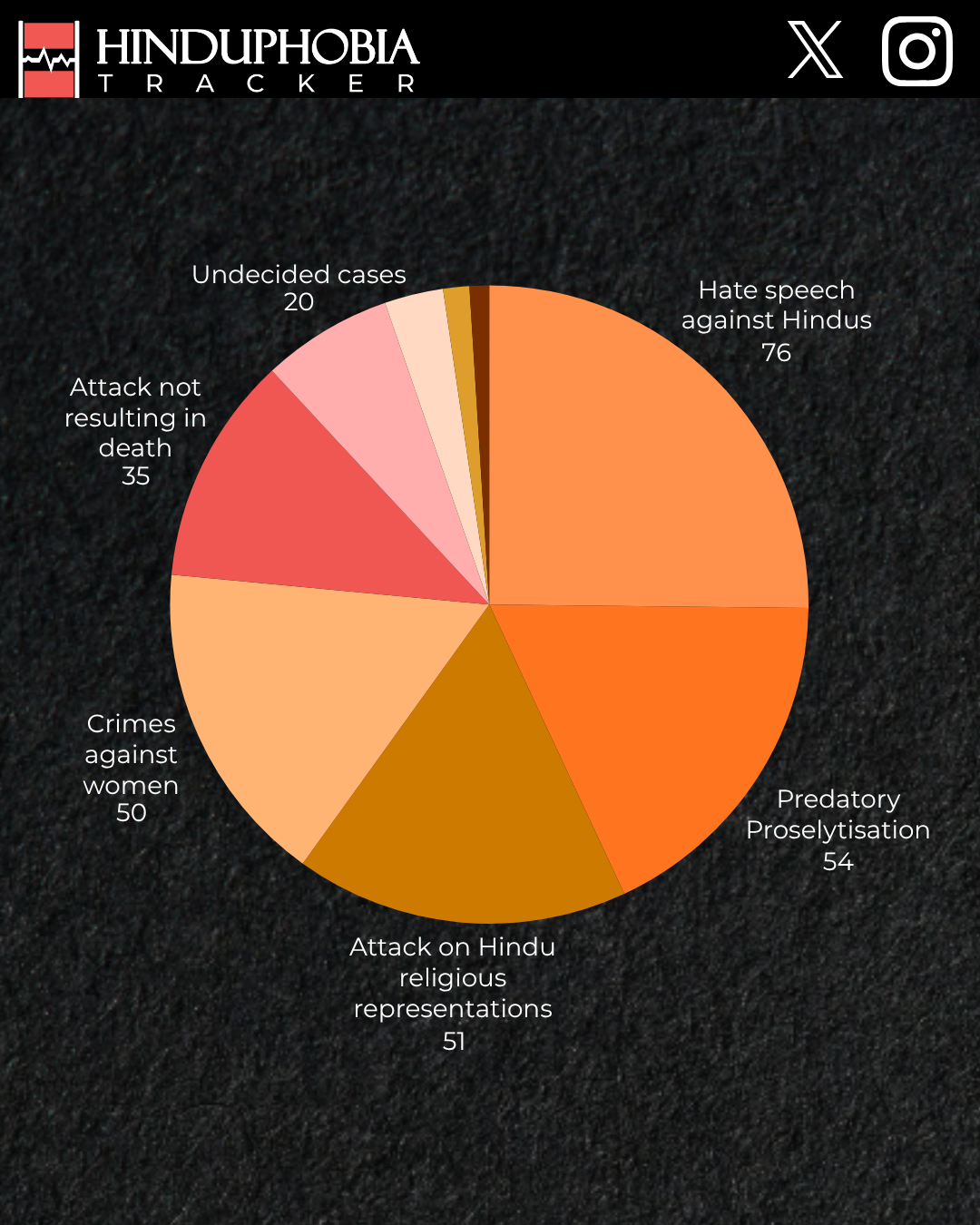
Incident counts tell only part of the story. Predatory proselytisation accounted for 54 incidents, but affected 2,290 people, largely because two cases alone involved exceptionally large groups. The contrast shows how a relatively small number of incidents can have a far greater reach than a much larger number of individual cases.
Note: Some incidents fall under more than one main category. Consequently, category counts are not additive and should not be treated as a breakdown of the 260 incidents.
Geographic Distribution
The incidents documented in August were geographically concentrated in India, which accounted for 214 of the 260 incidents, or 82.3% of the total. The remaining 46 incidents were recorded across other countries.
Within India, the distribution was far from even. Uttar Pradesh recorded 74 incidents, accounting for more than one-third of all incidents documented in the country. It was followed by Maharashtra with 27, Madhya Pradesh with 14, Delhi with 11, and Rajasthan and Chhattisgarh with 10 each.
Incidents by state
| State | Incidents |
|---|---|
| Uttar Pradesh | 74 |
| Maharashtra | 27 |
| Madhya Pradesh | 14 |
| Delhi | 11 |
| Rajasthan | 10 |
| Chhattisgarh | 10 |
| Tamil Nadu | 7 |
| Assam | 7 |
| Gujarat | 7 |
| West Bengal | 7 |
| Uttarakhand | 6 |
| Punjab | 5 |
| Karnataka | 5 |
| Jammu and Kashmir | 3 |
| Bihar | 3 |
| Telangana | 2 |
| Andhra Pradesh | 2 |
| Kerala | 2 |
| Jharkhand | 2 |
| Haryana | 1 |
| Odisha | 1 |
| State not specified | 8 |
The concentration in Uttar Pradesh is particularly notable. The state accounted for 34.6% of all incidents documented in India during August, meaning that more than one in every three India-based incidents in the dataset occurred there.
However, the number of incidents alone does not tell the full geographical story. The nature and scale of incidents varied considerably across locations. Maharashtra, for instance, had far fewer incidents than Uttar Pradesh but accounted for a disproportionately large number of recorded victims because of a single large-scale incident. This highlights why the report examines geographical distribution alongside the number of victims and the types of incidents recorded.
Victims and Deaths
These incidents involved 2,619 victims, including 24 people who died. The victims, however, were not spread evenly across the month’s cases. Two incidents of predatory proselytisation alone accounted for 2,200 victims, or 84% of the total. The remaining 258 incidents involved 419 victims.
There were 17 incidents in which people died, resulting in 24 deaths.
Who Was Affected?
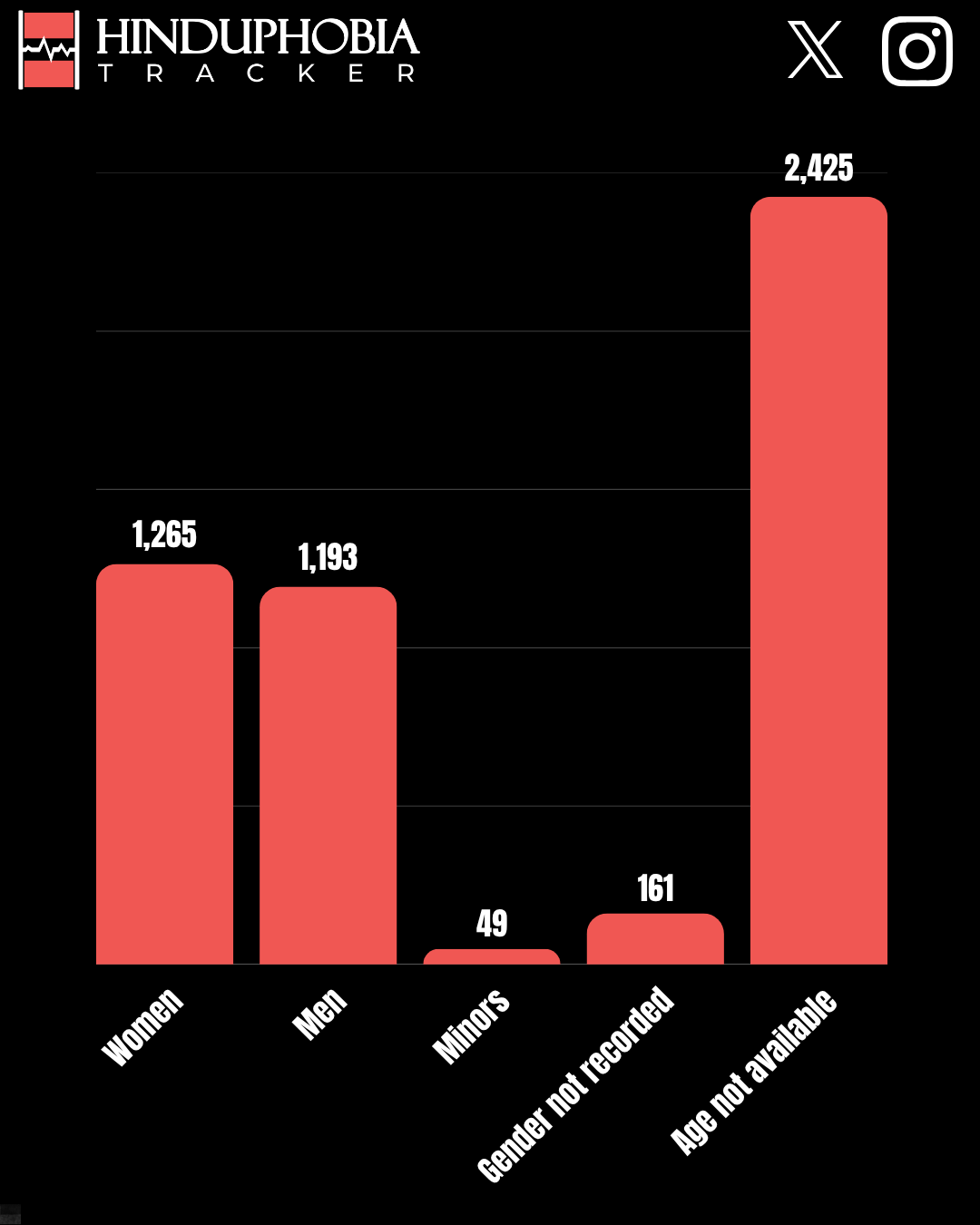
Of the 2,619 victims recorded in August, 1,265 were women, and 1,193 were men, while the gender of 161 victims was not recorded. Children accounted for 49 victims, while one victim was identified as a senior citizen. Age was unavailable for 2,425 victims, largely because the two large-scale incidents provided group counts rather than individual demographic details.
What Types of Incidents Were Most Common?
Hate speech was the most frequently recorded form of anti-Hindu incident in August, with 76 cases. It was followed by predatory proselytisation (54), attacks on Hindu religious representations (51) and crimes against women in relationships and other sexual crimes (50).
The victim count for hate speech is much lower because these incidents are not necessarily directed at specific individuals. Much of the hate speech documented by the Tracker targets Hinduism, Hindu beliefs, deities and the faith as a whole, rather than an identifiable individual. As a result, a single incident may be recorded as an instance of hate speech without there being a corresponding individual victim to count.
Predatory proselytisation presents the opposite picture. It accounted for 54 incidents but 2,290 recorded victims, largely because two cases involved very large groups. The contrast shows why incident counts and victim counts need to be read in the context of what each category actually measures.
Some incidents are classified under more than one category, so the category numbers do not add up to 260.
Fatal Incidents
In August, 17 of the 260 incidents recorded by the Tracker resulted in death, with 24 people killed. Fatal incidents accounted for 6.5% of all cases recorded during the month.
Of these, nine incidents were classified as “Attack resulting in death”, involving 14 deaths. The remaining eight fatal incidents were recorded under other categories. This is why looking only at the “Attack resulting in death” category would understate the number of cases in which a death occurred.
What Stands Out in August
When a Hindu identity was concealed
One striking pattern appears in cases involving Hindu women and relationships. 30 of the 50 incidents in the category “Crimes against women in relationships and other sexual crimes” involved the accused presenting himself as Hindu, using a Hindu name, symbols or other means to conceal his religious identity. Eleven of these cases involved minor victims, with 13 minors recorded in total.
The individual cases vary considerably, from women being lured into relationships and marriages to cases involving sexual exploitation, blackmail and pressure to convert. What links them in the dataset is the use of a false Hindu identity as part of the reported conduct.
Conversion attempts often went beyond persuasion
54 incidents of predatory proselytisation were recorded in August. Of these, 37 involved grooming, manipulation or subtle indoctrination, while 15 involved minors being targeted for conversion.
The cases also ranged widely in how conversion was pursued. The dataset includes reported use of financial inducements, promises of employment or healing, prayer meetings, pressure within relationships, threats and denigration of Hindu beliefs.
The category’s scale was also heavily influenced by two large cases. 2,290 of the recorded victims in predatory proselytisation came from 54 incidents, with one case involving 2,000 people and another involving 200.
Temple-related incidents were not limited to vandalism
There were 51 incidents involving attacks on Hindu religious representations, including 15 attacks on temples and eight cases involving encroachment or attempted takeover of temple land.
The incidents ranged from idols being vandalised or desecrated to temple premises being used in ways that violated religious practices. Several cases combined physical damage to a religious site with other forms of targeting. For example, one case in Tamil Nadu involved the demolition of a 200-year-old Vinayagar temple, with the incident recorded under attacks on Hindu religious representations.
Some incidents involved several forms of targeting at once
The database contains 37 incidents assigned to more than one main category. In nine cases, predatory proselytisation was recorded alongside crimes against women in relationships and other sexual crimes. Eight combined hate speech with a physical attack, while six combined an attack on a Hindu religious representation with an attack that did not result in death.
These overlaps matter because some incidents cannot be neatly described by a single label. A reported case may involve conversion pressure, sexual exploitation and the concealment of religious identity at the same time or combine hate speech with an attack on a temple or devotees.
Conclusion
The August data points to a pattern that cannot be captured by a single headline number. The incidents documented during the month varied significantly in their form, scale and circumstances, with some affecting individuals and others involving entire communities.
What the data makes possible is a closer look at these differences. It shows where incidents were concentrated, which forms of targeting appeared most often, which cases affected the largest numbers of people, and where different forms of targeting overlapped.
That is the purpose of the Hinduphobia Tracker’s monthly analysis: not simply to count incidents, but to examine the patterns within them and understand what the numbers reveal.