

Over the years, several Hindu women across India have approached the police, media, court, NGOs and social organisations, all with remarkably similar accounts. They reported how Muslim men, feigning love, often pretended to be Hindu and lured them. Others said they were promised marriage, only to later face pressure to convert to Islam. Still others described being emotionally manipulated, sexually assaulted, isolated from their families, blackmailed with intimate photographs, subjected to religious coercion, forced into nikah, forced fed cow meat, compelled to follow Islamic practices, all of it through coercion and pressure and not genuine consent.
Not every interfaith relationship falls into this category, nor should every allegation be accepted without scrutiny. However, the sheer volume of complaints, FIRs, victim testimonies, arrests, and court proceedings over the years has ensured that the issue remains a matter of public concern. Hinduphobia Tracker alone has documented nearly 1,200 such cases involving Hindu women being targeted for their faith, with approximately 1,170 of them involving Muslim perpetrators.
Here, it is imperative we know that, firstly, these 1200 documented cases of religious targeting of Hindu women, also commonly known as ‘Love Jihad’ or ‘Grooming Jihad’, are a dataset of only the last three years. Moreover, Hinduphobia Tracker heavily relies on secondary reports of such cases, as they appeared in local media. These are only incidents that entered the public domain through media reports, police disclosures, court records, or public complaints. There are numerous such occurrences that go unnoticed due to social stigma, fear of retaliation, family pressure, concerns about reputation, or simply because they occur in small towns and villages that rarely attract sustained media coverage. The documented cases, therefore, should not be viewed as the full extent of the problem, but as the visible portion of a much larger phenomenon.
Yet, despite this growing body of evidence, a section of commentators continues to dismiss the phenomenon not through investigation or factual rebuttal, but through ridicule. A recent example is the conversation between The Wire’s journalist Arfa Khanum Sherwani and former JNU professor Nivedita Menon, during a podcast Sherwani hosted in February 2026, named “The Anti-National Podcast”.
During the discussion, the two repeatedly portrayed Love Jihad not as a concern arising from allegations of deception, identity concealment, religious coercion, or conversion pressure, but as a manifestation of Hindu male insecurity. Menon argued that the very idea of Love Jihad reflects the “helplessness” of Hindu men, suggesting that those who raise such concerns are effectively insinuating that Muslim men are more successful in attracting Hindu women.
Arfa Khanum Sherwani amplified this argument through sarcasm and mockery, joking about handsome Muslim men wearing surma, riding motorcycles, and effortlessly winning over Hindu girls.
The discussion also suggested that concerns surrounding Love Jihad stem from a refusal to accept women’s autonomy and freedom of choice. According to this view, the phenomenon is largely a political construct designed to create fear of Muslims and reinforce the narrative that Hindus are under threat. The possibility that some relationships may involve deception, concealment of identity, coercive conversion, blackmail, or organised religious targeting received little serious consideration.
The central message emerging from the discussion was therefore straightforward: Love Jihad is not a real social concern, but a myth sustained by insecurity, prejudice, and the desire to control women.
The problem with this argument is not merely that it is dismissive but that it turns the lived experiences of Hindu women who have endured deception, identity concealment, conversion pressure, blackmail, and religious coercion into a subject of ridicule. Instead of asking why hundreds of women from different parts of the country have come forward with remarkably similar allegations, the discussion mocks the very premise of their complaints. The result is that evidence is ignored, victims are trivialised, and serious questions are brushed aside with sarcasm.
This article examines the claims made in that discussion and asks a simple question: Can hundreds of documented cases, supported by complaints, FIRs, arrests, and victim testimonies, really be explained away as nothing more than the imagination of insecure Hindu men?
Is love jihad really about ‘attractive Muslim men’?
The first thing that stands out in the discussion between Arfa Khanum Sherwani and Nivedita Menon is how quickly the conversation strays from what the victims have actually alleged. Instead of examining why hundreds of Hindu women and their families have approached the police with complaints of deception, identity concealment, conversion pressure, blackmail, and religious coercion, the discussion reduces the issue to a joke.
According to Menon, the Love Jihad phenomenon is essentially an expression of the “helplessness” of Hindu men. They concoct this ridiculous narrative that Hindu men are upset because Muslim men are somehow more successful in attracting Hindu women. Arfa Khanum Sherwani reinforces this argument through a sarcastic description of a handsome Muslim youth, wearing surma, riding a motorcycle, and effortlessly winning over Hindu girls.
But this raises an obvious question- Is that really what the debate is about?
Take a look at the nearly 1,200 cases documented by Hinduphobia Tracker over the last three years. The recurring allegations are not that Muslim men are more attractive than Hindu men. There are allegations of concealed identities, false promises of marriage, conversion pressure, forced nikah, blackmail, grooming of minors, and sexual exploitation being weaponised to secure conversion.
In many cases, the woman stated that she discovered the accused’s religious identity only after becoming emotionally involved. In others, conversion to Islam emerged as a prerequisite for marriage after the relationship had already progressed. Several women alleged that they were pressured to abandon Hindu practices, consume cow-meat, read Islamic texts, or adopt Islamic customs against their wishes. Some complained of threats and blackmail when they resisted. Others narrated how their faith was attacked, with Muslim men ridiculing the Hindu deities, throwing away idols, forcing the victims to remove religious markers like tattoos and adopting Islamic names.
A closer look at the database reveals the following patterns:
- 741 cases involved allegations that the accused concealed his religious identity and pretended to be Hindu.
- 434 cases involved pressure to convert to Islam before marriage.
- 173 cases involved pressure to convert after marriage.
- 217 cases involved allegations of forced Nikah.
- 337 cases involved minor Hindu girls.
- 480 cases involved allegations of sexual exploitation.
- 90 cases involved victims being forced to consume beef against their wishes.
- 23 cases involved desecration of Hindu religious symbols as part of conversion efforts.
- 29 victims died by suicide following sustained pressure to convert.
- 13 victims were murdered after refusing to convert to Islam.
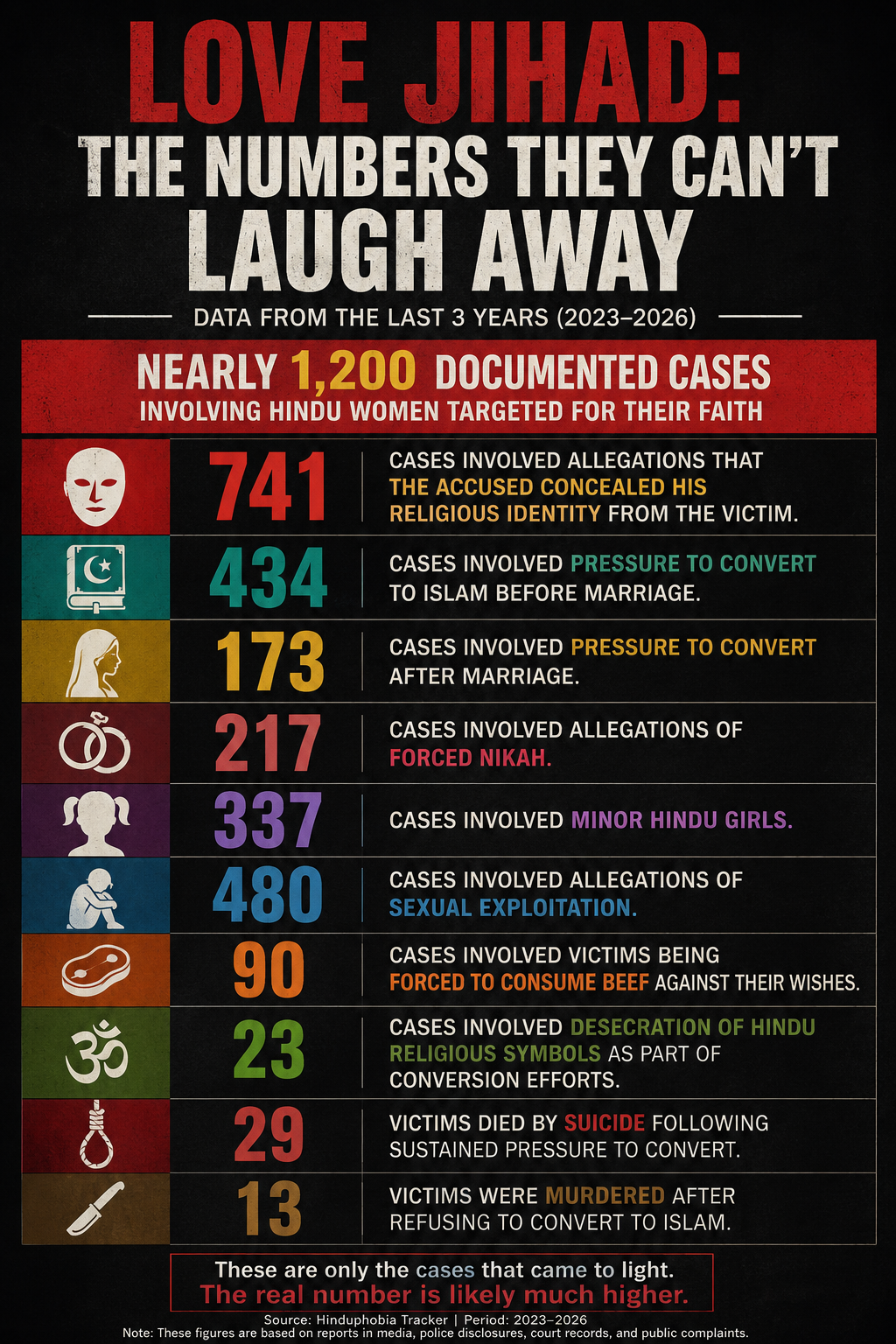
Each case must be judged on its own facts. If concerns surrounding love jihad are merely the product of insecurity, prejudice, or an inability to accept women’s choices, why do allegations of concealed identity appear in more than seven hundred cases? Why does conversion pressure repeatedly emerge both before and after marriage? Why are hundreds of minor Hindu girls appearing in these complaints? Why does religion continue to surface as a central point of conflict in all these cases?
These are the questions that lie at the heart of the debate. Yet, instead of examining the evidence and addressing the recurring patterns emerging from hundreds of documented cases, Arfa Khanum Sherwani and Nivedita Menon chose to look away from the facts and reduce the issue to a subject of mockery.
A Hindu father filing a police complaint because his daughter has disappeared is not saying Muslim men are too handsome. A woman stating that she was deceived about the religious identity of the man she was in a relationship with is not expressing jealousy of someone else’s romantic success. A victim who approaches the police after facing conversion pressure is not participating in a competition between Hindu and Muslim men. The concerns being raised are entirely different.
This is where the argument begins to fall apart. Instead of engaging with the allegations that recur in complaints and FIRs, the discussion substitutes a far easier target. Once the issue is reframed as insecure Hindu men being unable to compete with attractive Muslim men, it becomes easy to laugh at it. The actual concerns that need to be discussed and addressed disappear from the conversation altogether.
The issue is not whether Muslim men are attractive or unattractive. The issue is why so many Hindu women have reported identity concealment, conversion pressure, and religious coercion. Until that question is answered, jokes about surma, motorcycles, and romantic success cannot be treated as a serious rebuttal to the phenomenon itself.
Does recognising deception mean denying women’s agency?
The second major argument made by Nivedita Menon was that concerns surrounding Love Jihad are rooted in an inability to accept women’s freedom of choice. According to this line of thinking, anyone who speaks about Love Jihad believes Hindu women are incapable of making decisions for themselves.
However, a closer look at the documented incidents tells a very different story.
Nobody is arguing that women should not have the freedom to choose whom they marry. The real question is whether that choice is being made with complete information and without coercion.
There is a world of difference between a woman choosing to enter a relationship with a Muslim man, knowing exactly who he is, and a woman entering a relationship after being misled about his identity, intentions, or expectations regarding conversion.
This distinction is completely absent from the discussion.
Take the issue of concealed identity. Hinduphobia Tracker has documented 741 cases where the Muslim perpetrator hid his religious identity from the victim. In these cases, Hindu names were used during the initial stages of the relationship. Can a decision really be called informed when it is made on the basis of false information?
The same applies to conversion. In hundreds of documented cases, conversion to Islam emerged either before marriage or after marriage. Many victims stated that they only discovered later that conversion would become a condition for continuing the relationship or being accepted by the man’s family.
Nobody is questioning a woman’s right to make her own decisions. The question is whether those decisions were made after being told the truth or after being kept in the dark.
What makes the argument even harder to sustain is the number of minor victims.
The database contains 337 cases involving Hindu underage girls. These are not adults exercising informed choice. These are minors. The law itself recognises that children are more vulnerable to manipulation, grooming, and exploitation. Any discussion that reduces such cases to a question of women’s autonomy ignores a significant part of the problem.
The same applies to the 480 cases of Muslim men weaponising rape as a means to subjugate and coerce the Hindu woman into conversion. When a woman says she was deceived, exploited, blackmailed, or pressured to convert, invoking “agency” does not address her complaint. It simply sidesteps it.
The women whose cases populate the Hinduphobia Tracker database are not asking anyone to take away their freedom of choice. They are asking for their ordeals to be taken seriously. They are asking difficult questions about deception, coercion, religious pressure, and manipulation. The least that can be done is to engage with those questions honestly rather than dismiss them with rhetoric.
Recognising deception does not diminish women’s agency. Ignoring deception does.
More importantly, Nivedita Menon and Arfa’s argument leaves another question unanswered. If this is simply about personal choice, why does religion appear at the centre of all these incidents? Why do conversion demands surface so frequently? Why do victims repeatedly report pressure to abandon Hindu practices, undergo nikah, adopt Islamic customs, or sever ties with their religious identity? These are not incidental details. They are recurring features that appear across hundreds of documented cases.
Yet instead of examining why religion emerges so consistently in these complaints, the discussion treats it as an afterthought. The focus remains on the supposed insecurities of those raising concerns, while the recurring religious dimension of the allegations is left largely unexplored.
And that brings us to the next question: if religion is merely incidental, why does conversion appear in all these documented cases?
Is love jihad merely a tool to create fear of Muslims?
Another claim repeatedly made during the discussion was that Love Jihad is a political narrative designed to create fear of Muslims.
This argument confuses the misuse of an issue with the existence of the issue itself.
Even if politicians exploit the subject for electoral purposes, that does not explain away the experiences of hundreds of women who have approached the police alleging identity concealment, conversion pressure, blackmail, or coercion. A social problem does not cease to exist merely because political actors talk about it.
The real question is not whether the issue is discussed politically. The real question is whether the underlying complaints deserve investigation.
If religion is incidental, why do conversion demands keep appearing?
One of the most striking aspects of the discussion is how little attention is paid to conversion itself.
According to the Hinduphobia Tracker database, 434 documented cases involved pressure to convert before marriage, while another 173 involved pressure to convert after marriage. In 217 cases, victims reported being compelled to undergo nikah.
If religion is merely incidental to these relationships, why does conversion repeatedly emerge as a condition, expectation, or point of conflict?
This is a question that the discussion never seriously confronts.
The religious-targeting question that Arfa Khanum and Nivedita Menon never addressed?
The incidents documented in the database are not limited to relationships and marriage.
Victims have also reported being pressured to abandon Hindu practices, adopt Islamic customs, consume beef against their wishes, and distance themselves from their religious identity. Hinduphobia Tracker documented 90 such incidents involving forced beef consumption and 23 cases involving desecration of Hindu religious symbols.
These are not ordinary relationship disputes. They are explicitly religious acts. Yet the religious dimension of these incidents receives remarkably little attention in the discussion.
Why are Muslim perpetrators missing from the conversation?
The other striking aspect of the discussion is where its attention is directed. Arfa Khanum Sherwani and Nivedita Menon spend considerable time explaining why Hindus believe in Love Jihad, why concerns about it are raised, and why those concerns are supposedly rooted in insecurity and prejudice. The two journalists, however, devote little attention to the conduct and motivations of the Muslim perpetrators at the centre of these cases.
The discussion spends considerable time dissecting the mindset of those who raise concerns about Love Jihad. What they avoid discussing is why the same patterns keep recurring across hundreds of cases. Why do Muslim perpetrators repeatedly conceal their religious identity? Why does conversion to Islam emerge so frequently as a condition for marriage or continuation of the relationship? Why does nikah appear in case after case? Why do allegations involving pressure to abandon Hindu beliefs and practices surface with such regularity?
These questions go to the heart of the phenomenon. Yet they remain largely unanswered.
Instead of examining the accused’s recurring conduct, the discussion focuses almost entirely on the psychology of those raising concerns. The result is a curious imbalance. The motives of complainants are analysed at length, while the motives of the Muslim perpetrators accused of deception, conversion pressure, and religious coercion are completely ignored.
And perhaps that is the biggest weakness of the entire discussion.
Beyond the jokes and caricatures: what the discussion fails to address
In the entire section dedicated to ‘Love Jihad’, Arfa Khanum Sherwani and Nivedita Menon chose to treat the phenomenon, where vulnerable Hindu women are groomed to accept their own subjugation at the hands of Muslim men, as a subject of ridicule rather than investigation. Throughout the discussion, the phenomenon was reduced to jokes about attractive Muslim men, insecure Hindu men, and an inability to accept women’s choices. Yet the hundreds of incidents that form the basis of this debate tell a far more disturbing story.
Over the last three years alone, Hinduphobia Tracker has documented nearly 1,200 cases involving Hindu women, with approximately 1,170 involving Muslim perpetrators. Across these cases, the same allegations appear repeatedly: concealed identities, conversion pressure, forced nikah, sexual exploitation, grooming of minors, pressure to abandon Hindu practices, and hostility towards Hindu religious symbols.
The issue is not whether one likes the term “Love Jihad.” The issue is that hundreds of Hindu women across the country have reported remarkably similar experiences. Those complaints cannot simply be laughed away because they are politically inconvenient or ideologically uncomfortable.
At no point does mockery answer why 741 women reported concealed identities. It does not explain why conversion pressure appears in hundreds of cases. It does not explain why hundreds of minor Hindu girls feature in these complaints. Nor does it explain why religion repeatedly emerges as a point of conflict.
More importantly, the discussion reveals a striking double standard. Every effort is made to scrutinise the concerns of Hindus, the motives of those who speak about Love Jihad, and the politics surrounding the issue. However, no effort is made to scrutinise the conduct, methods, and motivations of the Muslim perpetrators accused in these complaints. That is not scepticism. That is prejudice masquerading as analysis.
A truly objective discussion would have approached the complaints with the same rigour, curiosity, and scepticism, regardless of who the victims and the accused were. Instead, the discussion chose to laugh at the phenomenon while looking away from the evidence.
The real question remains exactly where it was at the beginning of this debate: Why do the same patterns keep appearing across hundreds of unrelated complaints involving Muslim perpetrators and Hindu women? Until that question is honestly confronted, the phenomenon cannot simply be laughed away.