Hindus targeted in large-scale communal violence by armed Muslim mob; shops and vehicles set on fire, stone pelting reported
 Nuh, Haryana, India
  11 August, 2025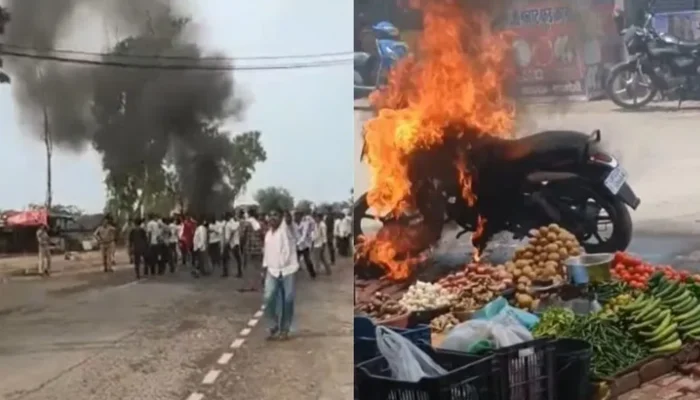
Case Summary
In the Mundaka village of Nuh district, Haryana, Hindus were attacked by an armed Muslim mob in a minor road scuffle that turned into a one-sided communal attack against Hindus. According to reports, the violence began when a Hindu man named Samay Singh Saini was on his way for a delivery when he encountered two Muslim men, Nassi and Luqman. The two Muslim men were drinking alcohol in their car, which was parked in the middle of the road and blocking the way. When Saini asked them to move the vehicle, Nassi got angry and said that the road did not belong to his (Saini’s) father, and struck Saini on his head with a glass liquor bottle, causing him to bleed heavily. Saini called his brothers, Chunni, Gopal, and Bir Singh, for help. At the same time, Nassi summoned a large group from Hajipur village in Rajasthan’s Alwar district, including Ramzan, Muharkhon, Rustam, Shamsher, Haroon, Subban, Ismail, Arshad, Kalu, Zubair, Yunus, Islam, Juhrudin, Umar, Sakrulla, Sahun, Karim, Safi, Subba, Yakub, and Junaid. The Muslim mob, armed with sticks, entered the Mundaka village and began attacking its residents. Announcements were also made from the mosque, after which a crowd gathered. The Muslim mob also pelted stones from rooftops, set multiple houses, shops, and a bike on fire, and assaulted Saini and his brothers. The Muslim mob set the entire village on fire. The village sarpanch, Ram Kishore, stated that this violence was pre-planned, as the Muslim mob had already stocked glass bottles and stones on the rooftops. Villagers reported that the Muslim community had animosity towards Hindus in the area due to the riots that took place in the same area in 2023. It is important to note here that the 2023 Nuh violence started after a Muslim mob attacked a Vishwa Hindu Parishad procession, killing five people, including two home guards, and injuring at least fifteen others. The Hinduphobia Tracker has documented the 2023 anti-Hindu violence in Nuh. In the current incident, the Muslim mob roamed the streets freely for nearly 2 hours, engaging in stone pelting and arson. Multiple police teams were deployed to control the situation. Videos started circulating on social media, which showed the Muslim mob pelting stones in full view of the police and even clashing with them. As of the date of writing this report, a case was registered against 40 people, and multiple arrests were made. The situation remained tense, and police maintained a heavy presence in the area to maintain order.
Why it is Hate Crime ?
This case has been added to the tracker under the primary category- Attack not resulting in Death. Within this, the subcategory selected is- Communal Clash/ Attack. Communal clash is a form of collective violence that involves clashes between groups belonging to different religious identities. For a communal clash between Hindus and non-Hindus to qualify as a religiously motivated hate crime, the trigger of the violence itself would have to be anti-Hindu in essence. For example, if there is a Hindu religious procession that comes under attack from a non-Hindu mob and after the initial attack, Hindus retaliate in self-defence, leading to a communal clash between the two religious communities. While at a later stage, both communities are involved in the clash/violence, the initial trigger of the violence was by the non-Hindu mob against the Hindus and therefore, it could safely be termed as an anti-Hindu violence. Further, the trigger would also have to be religiously motivated. In the cited example, the attack by the non-Hindu mob was against religious processions and therefore, can be concluded to be religiously motivated. In some cases, the trigger may be non-religious, however, it develops into religious violence against Hindus at a later stage. In such cases too, the foundational animosity towards Hindus becomes the motivating factor of the crime and therefore, it would be classified as a religiously motivated hate crime against Hindus under this category. The other subcategory selected is- Attacked for Hindu identity. In several cases, Hindus are attacked merely for their Hindu identity without any perceived provocation. A classic example of this category of religiously motivated hate crime is a murder in 2016. 7 ISIS terrorists were convicted for shooting a school principal in Kanpur because they got ‘triggered’ seeing the Kalava on his wrist and tilak that he had put. In this, the Hindu victim had offered no provocation except for his Hindu religious identity. The motivation for the murder was purely religious, driven by religious supremacy. Such cases where Hindus are targeted merely for their religious identity would be documented as a hate crime under this category. This case has been added to the tracker because Hindus were attacked by a Muslim mob after a minor road scuffle, which turned into a large-scale, one-sided communal assault against them. While the immediate trigger was a dispute over road space, the sheer disproportionate violence — calling in reinforcements, making announcements from the mosque, and beating the Hindu victim and others with sticks — raises serious concerns about deep-rooted religious animosity driving the mob’s actions. The attack was pre-planned, as the Muslim mob had already stocked glass bottles and stones on rooftops before the incident. This indicates the road dispute was merely an excuse; the actual goal was to target Hindus, possibly as revenge for the 2023 Nuh riots. This pattern has been seen time and again, where the Muslim community resorts to disproportionate violence over minor inconveniences or issues, especially against Hindus. This disproportionate reaction is often rooted in a mindset of Islamic supremacy, wherein Muslims view Hindus as socially and religiously inferior. This supremacist attitude fosters disdain and aggression, especially when a Hindu does not submit or ‘yield’ in a dispute. The belief that Hindus lack equal standing leads to violent enforcement of dominance, often under the pretence of minor disagreements. Even in this case, there was no provocation from the Hindu side. It was the two Muslim men who were blocking the road. When the Hindu man asked them to move their vehicle, they attacked him with a glass bottle. The violence then quickly escalated into a full-scale communal assault on Hindus. Announcements were even made from the mosque, which is often a way of calling for reinforcements by the Muslim community. Given the communal alignment of the Muslim attackers, the nature and intensity of the violence, and the broader social-religious context, this incident has been added to the hate crime database. The Hinduphobia Tracker has documented numerous similar instances where communal attacks on Hindus began over non-religious disputes but quickly escalated, leaving Hindu victims seriously injured. For example, on 22 June 2025, in Ghongade Basti, Solapur, Maharashtra, a Hindu man and his brother were brutally attacked by a Muslim mob following a minor road dispute. The incident quickly escalated into targeted communal violence against the local Hindu community. Another such instance occurred on 6 June 2025, in Kadabin Jinsi Haat Maidan, Indore, Madhya Pradesh, where a Dalit Hindu family was brutally attacked by a group of Muslims over a minor water dispute. The assailants also hurled caste-based slurs, and even women and a child were severely beaten. A similar case of communal attack occurred on 2 June 2025, in Saraiya, Varanasi, Uttar Pradesh, where a Dalit Hindu man named Vishal Sonkar was brutally assaulted by a group of Muslim youths after a minor disagreement over road space. He suffered severe head injuries from rods and sticks. A similar instance of communal violence was reported on 6 July 2025, in Deoband, Uttar Pradesh, where a Dalit Hindu wedding procession was attacked by a Muslim mob over the playing of DJ music while passing by a mosque. The victims were severely injured with sharp weapons and sticks. The above-mentioned cases clearly demonstrate a pattern of attacks against Hindus. Even if the conflict was a result of a non-communal issue, it often takes on a communal nature where Hindus are frequently targeted and brutally attacked by a large Muslim mob. Such acts of violence against Hindus are not isolated or spontaneous incidents; rather, they are driven by deep-seated religious animosity towards the Hindu community. These incidents show a clear pattern: even when the original dispute is not religious, the escalation overwhelmingly targets Hindus, with extreme, often pre-planned, violence. This is not random or spontaneous — it is communal. It is driven by religious hatred, a desire to intimidate, and the intent to enforce dominance over Hindus. Such attacks are hate crimes and must be documented and recognised as such. This case mirrors several others across the country. Time and again, small disagreements — over roads, water, music, or neighbourhood issues — turn into communal attacks, where large Muslim mobs target Hindus. The response is always premeditated and excessive, and the victims are left seriously injured, sometimes for life. The pattern is clear: Hindus are being deliberately targeted, even when the issue has nothing to do with religion. This kind of repeated violence is not just criminal — it is communal, as it stems from religious animosity with a desire to enforce dominance over the Hindu community.


Case Status
Case sub-judice


Perpetrators Details
Perpetrators
Muslim Extremists
Perpetrators Range
Unknown
Perpetrators Gender
male
 Sources




