Dalit Hindu wedding procession targeted and Hindus brutally attacked by Muslim mob over DJ dispute near mosque
 Saharanpur, Uttar Pradesh, India
  5 July, 2025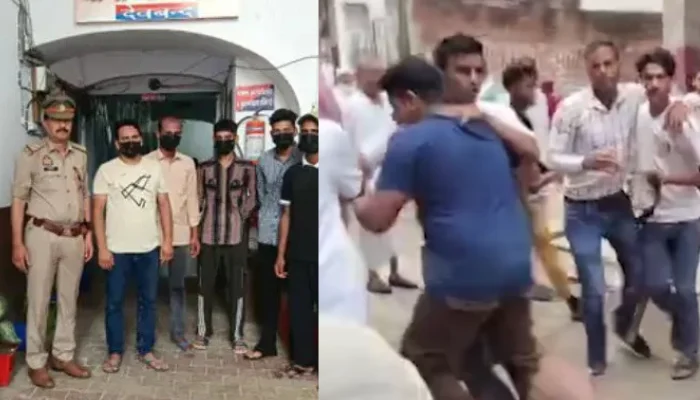
Case Summary
In the Deoband area of the Saharanpur district in Uttar Pradesh, a Dalit Hindu wedding procession was violently attacked by a Muslim group for playing DJ music near a mosque. According to reports, the conflict occurred during the wedding of the two Hindu daughters of a man named Mange Ram. One of the two wedding processions was passing from the Sadharanpur village and went past a mosque in Amarpur Gadhi village while playing DJ music. While the wedding procession was passing by the mosque, a group of Muslims demanded that the DJ be shut down as it was coinciding with the timings of namaz. This led to a verbal argument between the Hindus and Muslims, which further became heated. Soon after this, the Muslim group attacked the DJ equipment, broke instruments, and even attacked the people in the procession with sticks and sharp weapons. Some of the guests at the wedding were injured in the attack, including two Hindu men, Pankaj and Vansh, who were severely injured and were sent to a hospital in Meerut after receiving preliminary treatment in Deoband. After the incident, the bride’s father, Mange Ram, registered a complaint with the police. Based on the complaint, the police registered a case under section 191(2), 115(2), 352, 189(4) of the BNS and the SC/ST Act. As per reports, the wedding procession was attacked by more than a dozen Muslims. The police registered a case against 12 known individuals and 15 unknown people. Following this, the police arrested five accused, namely, Mohammad Abuzar, Asjad, Israr, Sadiq, and Faheem. The arrested accused were then sent to jail. Subsequently, a heavy police force was deployed in the village to prevent further violence. High officials were keeping a close watch on the situation, and routine patrols had begun. The authorities also appealed to both Hindu and Muslim communities to maintain peace and threatened stern action against any attempts to disrupt law and order.
Why it is Hate Crime ?
This case has been added to the tracker under the primary category- Attack not resulting in death. Within this, the subcategory selected is- Communal Attack/ Clash. Communal clash is a form of collective violence that involves clashes between groups belonging to different religious identities. For a communal clash between Hindus and non-Hindus to qualify as a religiously motivated hate crime, the trigger of the violence itself would have to be anti-Hindu in essence. For example, if there is a Hindu religious procession that comes under attack from a non-Hindu mob and after the initial attack, Hindus retaliate in self-defence, leading to a communal clash between the two religious communities. While at a later stage, both communities are involved in the clash/violence, the initial trigger of the violence was by the non-Hindu mob against the Hindus and therefore, it could safely be termed as an anti-Hindu violence. Further, the trigger would also have to be religiously motivated. In the cited example, the attack by the non-Hindu mob was against religious processions and therefore, can be concluded to be religiously motivated. In some cases, the trigger may be non-religious, however, it develops into religious violence against Hindus at a later stage. In such cases too, the foundational animosity towards Hindus becomes the motivating factor of the crime and therefore, it would be classified as a religiously motivated hate crime against Hindus under this category. Another subcategory selected in this case is- Attacked for crossing 'Muslim area'. One of the reasons that Hindus get attacked unprovoked specifically by Islamists is for crossing ‘Muslim areas’. Essentially, Muslim mobs often attack Hindus crossing or present in certain areas which have a majority Muslim population. It has often been cited as one of the reasons to blame Hindus for attacks against themselves, signalling that Hindus displaying religious symbols, taking our religious processions or crossing any area which is dominated by Muslim residents is a provocation in and of itself. These areas are mostly ghettoized areas where mobs mobilize quickly to attack Hindus for a variety of reasons like playing music during a religious procession, crossing a mosque, wearing a tilak or any other religious symbol in a Muslim-dominated area, praying at a local temple in that area etc. There have been cases where the few local Hindus of that area have been attacked on their way to the Temple for prayers as well, simply because the area is considered a Muslim-dominated area. Several times, it is entirely possible that the immediate trigger for the violence against Hindus was non-religious in nature, however, the violence became religiously motivated in nature because the area was Muslim dominated and the residents on the whole harboured animosity towards Hindus, evidenced from the actions of the mob, the slogans, and the nature of the attack. Such crimes are motivated by the religious identity of the victims and are therefore classified as hate crimes under this category. In this case, the violent attack on the Hindus in Saharanpur is a clear example of a crime motivated by religious hostility. Although the immediate trigger appeared to be a dispute over DJ music during a Hindu wedding procession, the disproportionate level of violence inflicted upon the Hindus by the Muslim group demonstrates that the attack had clear communal undertones. Notably, the assault occurred as the procession was passing by a mosque and allegedly coincided with namaz, reflecting an Islamist supremacist mindset—one where the Muslim group deemed their religious practice more important than the Hindu celebration. Importantly, the Hindu participants did not ask for namaz to be stopped; rather, it was the Muslim group that attempted to enforce their religious considerations on Hindus by trying to obstruct a once-in-a-lifetime Hindu wedding procession. In many similar cases, violence against Hindus has occurred in the vicinity of mosques or dargahs, often stemming from the belief within the Muslim community that areas surrounding these religious sites, or any locality with a Muslim majority, are automatically considered ‘Muslim areas’. This attitude reflects a mindset of religious supremacy and communal entitlement among Muslims. It goes beyond mere hostility; it fosters an environment where Hindus may be dictated, threatened, or attacked without fear of consequence. In such areas, Hindus are often targeted for simply conducting religious processions or organising non-religious events like wedding processions. In this case, the perpetrators viewed the area as an exclusive zone where non-Muslims, particularly Hindus, were unwelcome. This sense of entitlement and superiority not only reflects deep-seated prejudice but also highlights an attempt to assert religious dominance over public spaces. The assault on Hindus was motivated by this Islamic supremacist ideology, wherein Muslim radicals in the area look down upon Hindus and believe that they have the right to dictate how to conduct their wedding procession or rather any religious events. The act of violently attacking the Hindus for simply playing a DJ illustrates a dangerous mindset rooted in exclusion, intolerance, and religious animosity, making this case a clear example of a religiously motivated crime against Hindus. Another important point is that the Muslim mob was fully prepared, armed with sticks and sharp weapons, indicating that this was not a spontaneous instance of violence but rather a premeditated and targeted attack directed at Hindus. Often, violent crimes against Hindus by Muslim extremists originate from incidents that may appear non-religious at first. Nevertheless, the disproportionate and extreme violence reveals deeper layers of communal animosity towards the Hindu family and the larger Hindu community. Since this case meets the parameters of a religiously motivated crime, it is being added to the hate crime database. Disclaimer: Media reports do not mention the total number of victims; therefore, we are keeping the victim count as 'unknown'. Furthermore, the total number of Muslim perpetrators is not mentioned specifically. The police registered a case against 12 known people and 15 unidentified people. Therefore, for the purpose of documentation, we are keeping the perpetrator count '27'.


Case Status
Case sub-judice


Perpetrators Details
Perpetrators
Muslim Extremists
Perpetrators Range
From 10 to 100
Perpetrators Gender
unknown
 Sources




