Hindu religious custom defiled: Muslim men masquerade as Hindu Kanwariyas and rob Shiv devotees
 Muzaffarnagar, Uttar Pradesh, India
  13 July, 2025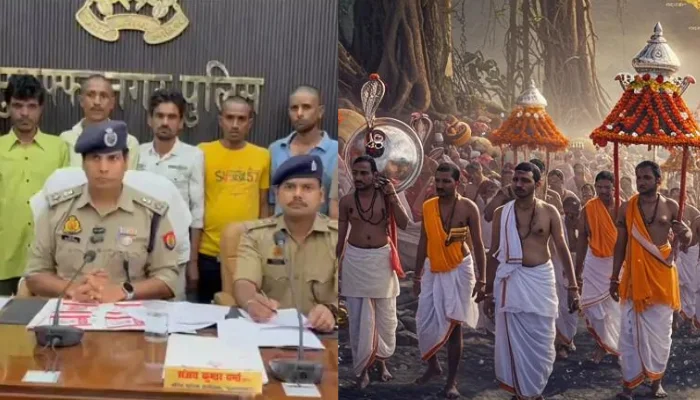
Case Summary
In Muzaffarnagar, Uttar Pradesh, the Hindu Kanwar Yatra, a sacred religious pilgrimage observed by devotees of Lord Shiva, was desecrated when a group of Muslim men posed as Hindus and attended the event. They committed theft against the devotees during the pilgrimage and caused communal tensions. The Kanwar Yatra is an annual pilgrimage in which devotees of Lord Shiva, known as Kanwariyas, travel to sacred sites such as Haridwar, Gaumukh, and Gangotri in Uttarakhand to collect holy water from the Ganga River, which they then offer to Lord Shiva in temples. This pilgrimage holds deep religious and cultural significance for Hindus. According to media reports, the Muzaffarnagar police prevented a conspiracy to incite religious sentiments, spread chaos, and commit theft by intercepting Muslim men who entered Kanwar Seva camps dressed as Shiva devotees. The police arrested five youths who had entered the camps using false Hindu names, aiming to blend in with the Kanwariyas and provoke communal tension. The arrested individuals were Suhail alias Chokad alias Sherkhan (22), Asif son of Afzal (20), Asif son of Shamshad (24), Shadab son of Noorhasan (20), and Abid son of Mahfooz (34). A case was registered against all of them at the Civil Lines police station under sections 298, 318(4), and 319(2) of the BNS. SSP Sanjay Verma stated that these individuals attempted to enter the camps disguised as devotees of Shiva, intending to steal mobiles and other valuables, offend religious sensibilities, and fuel animosity between the Muslim and Hindu communities. The police, remaining vigilant, apprehended them in time. Following this, an intensive six-day investigation revealed these Muslim men already had a history of criminal activity. Many had previous cases registered against them under theft and the Arms Act. By entering the camps in Hindu attire and pretending to participate in religious rituals, they conspired to steal the belongings of devotees. Given the seriousness of the incident, the police formed a Special Investigation Team (SIT) and began an enquiry with a joint team from the Local Intelligence Unit (LIU) and Civil Lines police station. In addition, a recommendation was made to open a history sheet on the accused and to take action under the Gangster Act.
Why it is Hate Crime ?
This case has been added to the tracker under the primary category- Attack on Hindu religious procession. Within this, the subcategory selected is- Defiling Religious customs. Sanatan Dharma is not a religion of one book, which is to say that while it has religious scriptures that form the central tenets of the faith, there are several traditions followed through thousands of years, mostly passed from generation to generation orally. There are several such customs and traditions that are followed by various Hindus and Hindu sects. Defiling of these traditions and customs is a breach of an individual or group’s religious practices. Such practices can range from dietary restrictions like not eating non-vegetarian food for a certain period of the year, not eating non-vegetarian food at all, not eating beef since the cow is considered holy in Hinduism, the sanctity of religious customs followed in the house (like many ISCKON devotees), etc. Any malicious action leading to the breach of such traditions or defilement of these traditions owing to animosity towards the faith or for the sake of activism stems not only from the lack of faith in the religion itself but also from disregard for the faith of the devotees who follow the customs/traditions and implicit bias against the faith, the tradition itself. Since these specific traditions are central to the faith of the devotees of that specific sect of Hindus, any non-compliance with these traditional rules would be considered a religiously motivated hate crime. This case in Muzaffarnagar demonstrated a targeted hate crime against the Hindu community, striking at the heart of religious identity and the sanctity of the Kanwar Yatra. The actions of the group of Muslim men, who deliberately posed as Hindus during the Yatra, went beyond ordinary criminality and sought to undermine one of Hinduism’s most revered traditions. In this case, the nature of the hate crime becomes evident in the very way the Muslim perpetrators infiltrated the Kanwar Yatra, disguising themselves as Hindu devotees to defile a sacred Hindu tradition. By masquerading as Hindus and entering the event under false religious pretences, the accused not only committed acts of deception but also intentionally defiled a sacred gathering. For countless Hindus, the Kanwar Yatra is more than a journey; it is a public demonstration of faith, a time of collective devotion and spiritual discipline. The deliberate impersonation of Shiva devotees to gain access, and ultimately to steal and disrupt, was an overt act designed to mock, undermine, and insult both Hindus and their traditions. It was not merely a case of theft at a crowded festival but a calculated intrusion into a ritual space with the clear intention to defile it, knowing the religious significance of the pilgrimage. Such actions are not isolated acts; rather, they are premeditated efforts to undermine and disrupt a sacred Hindu pilgrimage, rooted in religious animosity towards Hindus and their faith. Authorities, recognising the potentially explosive impact of the incident, responded with urgency. According to the police, the accused intended not only to rob Kanwar Yatra participants but also to create communal disharmony. By posing as Hindus and mingling with genuine devotees, the perpetrators risked sparking mistrust, suspicion, and ultimately tension between the Muslim and Hindu communities. The police emphasised that this subterfuge had the potential to escalate into widespread conflict. This could further lead to targeted attacks against Hindus for their religious identity. Notably, the Hinduphobia Tracker had previously documented numerous cases of hate crimes against Hindu Kanwariyas perpetrated by Muslims. In one incident from Muzaffarnagar, Uttar Pradesh, three Muslim men were arrested for circulating anti-Hindu fake news designed to provoke communal violence during the Kanwar Yatra, a revered Hindu pilgrimage. The individuals identified were Nadeem, Mansher, and Rahees. They shared a video originating from Pakistan on WhatsApp, falsely presenting it as footage of Hindu groups killing Muslims in Moradabad. In another case, Iqbal Mehmood, the Samajwadi Party MLA from Sambhal, delivered a hate speech against the sacred Kanwar Yatra. During a media interaction, Mehmood launched a vitriolic attack on the yatra and its participants, dismissing the pilgrimage as a gathering dominated by “hooligans” rather than devotees. An incident in Sarai Khwaja village of Prayagraj saw a group of Kanwariyas being subjected to a brutal attack by a Muslim mob, who used swords, sticks, and stones and hurled casteist abuse at the pilgrims. The mob also tore the saffron flag. This violence erupted following a minor dispute over devotional music played on a DJ system during the procession. In the Nandgram area of Ghaziabad, Uttar Pradesh, Hindu devotees participating in the Kanwar Yatra were served juice contaminated with urine and saliva by two Muslim youths, Zeeshan and Mahtab. Another incident occurred in Muzaffarnagar, Uttar Pradesh, where Hindu siblings and their friend, who were carrying kanwars, containers filled with the holy water of the Ganga river, were defiled by a Muslim man named Usman, who spat on them. In a similar case, also from Muzaffarnagar, a Muslim man named Shehzad spat on a kanwar carried by a Hindu woman. In this case, the perpetrator’s family attempted to defend his actions by claiming that he was mentally ill. In Lal Bazar, under Dhanwar police station in Jharkhand, a group of Muslims attacked and assaulted Hindu Kanwariyas, resulting in heightened tensions between the Hindu and Muslim communities in the area. This repeated pattern of violence and the targeting of the Kanwar Yatra by Muslims demonstrates that these are not random or isolated incidents; rather, they are premeditated and well-calculated attacks on the Hindu community and their sacred pilgrimage. Such actions are grounded in religious hostility towards Hinduism and its followers. These acts are committed by Muslim perpetrators as a result of indoctrination by the Islamic theology, which promotes the subjugation, harassment, and dehumanisation of non-Muslims, in this instance, Hindus. Therefore, incidents like the infiltration and attempted disruption of the Kanwar Yatra must be seen not as standalone crimes, but as part of a larger pattern of hate-driven aggression against Hindu practices and identity. Recognising these acts as hate crimes is crucial to understanding their deeper ideological roots and societal impact. They aim not only to harm individuals but to intimidate an entire community, undermine its religious freedoms, and erode the sanctity of its sacred traditions. Hence, this case, along with several previous attacks on Hindus by Muslims, stands as clear evidence of a religiously motivated hate crime, rooted in doctrinal animosity. Therefore, this case is being added to the hate crime database


Case Status
Arrested


Perpetrators Details
Perpetrators
Muslim Extremists
Perpetrators Range
From 2 To 5
Perpetrators Gender
male
 Sources




