Hindu pilgrimage targeted as fake video circulated to incite violence against Kanwar Yatra devotees and provoke hatred against Hindu organisation
 Muzaffarnagar, Uttar Pradesh, India
  20 July, 2025
Case Summary
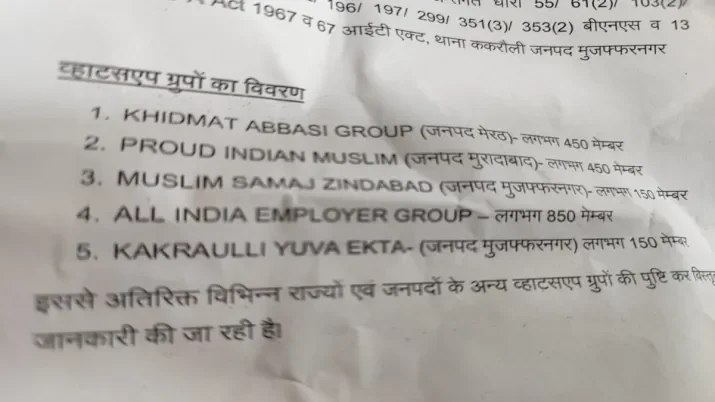
In Muzaffarnagar, Uttar Pradesh, three Muslim men were arrested for circulating anti-Hindu fake news intended to provoke communal violence during the Kanwar Yatra, a revered Hindu pilgrimage. The accused — Nadeem, Mansher, and Rahees — shared a video from Pakistan on WhatsApp, falsely presenting it as footage of Hindu groups killing Muslims in Moradabad. The Kanwar Yatra is an annual pilgrimage in which devotees of Lord Shiva, known as Kanwariyas, travel to sacred sites such as Haridwar, Gaumukh, and Gangotri in Uttarakhand to collect holy water from the Ganga River, which they then offer to Lord Shiva in temples. It holds deep religious and cultural significance for Hindus. The video circulated by the accused was originally recorded in Muzaffargarh, Pakistan, in April 2024. They edited and shared it in multiple WhatsApp groups, falsely claiming it showed Bajrang Dal members murdering Muslim women and children in Mansoorpur and surrounding areas. This deliberate distortion was aimed at portraying Hindus as aggressors and inciting retaliation. The police tracked the video’s dissemination to several WhatsApp groups, including Khidmat Abbasi Group (Meerut, 450 members), Proud Indian Muslim (Moradabad, 450 members), Muslim Samaj Zindabad (Muzaffarnagar, 150 members), All India Employer Group (850 members), and Kakraulli Yuva Ekta (Muzaffarnagar, 150 members). During interrogation, the accused admitted they had deliberately spread the fake video to inflame communal tensions during the Kanwar Yatra 2025. Police warned that such content had the potential to trigger mob lynchings or lone-wolf attacks, particularly due to the large gatherings of Hindu pilgrims at the time. DIG Singh confirmed that the video was part of a broader agenda. Investigators suspect cross-border coordination in spreading such inflammatory content, pointing to a larger propaganda network targeting Hindu festivals. At the time of writing this report, the matter was under investigation.
Case Images
Why it is Hate Crime ?
This case has been added to the tracker under the primary category- Hate Speech against Hindus. Within this, the subcategory selected is- Anti-Hindu subversion and prejudice. Within this, the tertiary category selected is- Anti-Hindu fake news or downplaying. Hate speech is defined as any speech, gesture, conduct, writing, or display that is prejudicial against a specific individual and/or group of people, which is leading to or may lead to violence, prejudicial action or hate against that individual and/or group. Media plays a specific and overarching reach in perpetuating prejudicial attitudes towards a community owing to unfair, untrue coverage and/or misrepresentation/misinterpretation, selective coverage and/or omission of facts of/pertaining to issues affecting a specific religious group. This type of bias can dehumanise the victim group, making it easier for others to justify harmful actions against them, which aligns with the objectives of hate speech laws aimed at preventing such harm. It is often observed that the media takes a prejudicial stand against the Hindu community driven by their need to shield the aggressor community which happens to be a numeric minority, however, is the one perpetrating violence against Hindus. For example, the media is often quick to contextualise religiously motivated crimes against Hindus, omit or misrepresent facts that point towards religiously motivated hate crimes, justify and/or downplay religiously motivated hate crimes or simply present fake news to stereotype Hindus. Such media bias leads to the denial of persecution and is often used to dehumanise Hindus, leading to justification for violence against them. For example, the media covered several fake allegations of Hindus targeting Muslims and forcing them to chant Jai Shree Ram. Most of these cases were proved false and fabricated after police investigation. These fake news reports were subsequently never retracted or clarified. Such fake news led to the justification of violence and dehumanisation of Hindus based on the argument that since Hindus targeted Muslims and forced them to chant Jai Shree Ram, the dehumanisation of Hindus and violence against them was par for the course and merely a retaliation. Such media bias leads to prejudicial portrayal of Hindus and offers a justification for violence against them and therefore, is considered hate speech under this category. The Muzaffarnagar case qualifies as a hate crime primarily because it involved the deliberate spread of anti-Hindu disinformation with the intent to incite violence against a religious community. The Muslim accused circulated a fake video—originating from Pakistan—falsely attributing it to Hindu groups, particularly Bajrang Dal, and presenting it as evidence of Hindus murdering Muslims in Uttar Pradesh. This was not a case of misinformation shared in ignorance but a calculated act designed to provoke prejudicial sentiment and retaliatory violence against Hindus. The choice of timing, content, and false attribution clearly indicates a targeted attempt to create communal unrest and vilify the Hindu community. In addition, the timing of the crime demonstrates a calculated attempt to incite violence during the Kanwar Yatra, a time of immense religious significance for Hindus. The Kanwar Yatra annually sees millions of Hindu devotees travelling for pilgrimage and worship. For centuries, it has been observed as a journey of devotion, discipline, and unity. Each year, several Hindu devotees take part in this pilgrimage in which they collect sacred water from the river Ganga and offer it to Lord Shiva. In this case, the Muslim perpetrators sought to take advantage of this sacred period, using misinformation as a weapon to deliberately provoke communal tensions. The perpetrators aimed to unleash violence against Hindus when they are most visible and vulnerable as pilgrims. Furthermore, the video was deliberately disseminated through multiple WhatsApp groups dominated by Muslim members. This targeted sharing was intended to provoke anger and resentment within the Muslim community against Hindus, increasing the chance of mob mobilisation or lone-wolf attacks against the Hindu community. Such actions by the Muslim perpetrators are done due to deep-seated hostility and contempt for the Hindu community, its religion, and their practices, making it an instance of a religiously motivated crime. Compounding the gravity of the offence, preliminary police investigations revealed a cross-border connection. It points to a larger conspiracy to destabilise India’s internal security and target Hindus and Hindu organisations. Involving hostile foreign elements in propagating anti-Hindu hate speech and misinformation constitutes a grave threat to the Hindu community. This showcases that the crime was not a random isolated act; rather, it was a well-calculated effort to target and unleash violence against Hindus, making it a crime motivated by religious hostility. Collectively, these actions make it clear that the Muslim perpetrators waged a hate-driven campaign against Hindus, aiming to vilify their religious organisations, provoke violence, and create deep communal rifts. Their efforts to use falsehoods and foreign influence to fuel communal discord underscore the seriousness of this hate crime against the Hindu community and warrant its inclusion in the hate crime database. Disclaimer: It is important to clarify that the report does not specify the exact date when the fake video was circulated. Therefore, for documentation purposes, we have recorded the date based on when the incident was reported in the media.


Case Status
Arrested


Perpetrators Details
Perpetrators
Muslim Extremists
Perpetrators Range
From 2 To 5
Perpetrators Gender
male
 Sources




