Hindu woman's sacred Kanwar defiled as Muslim man spits on it during pilgrimage, family of accused claim he was 'mentally ill'
 Muzaffarnagar, Uttar Pradesh, India
  6 July, 2025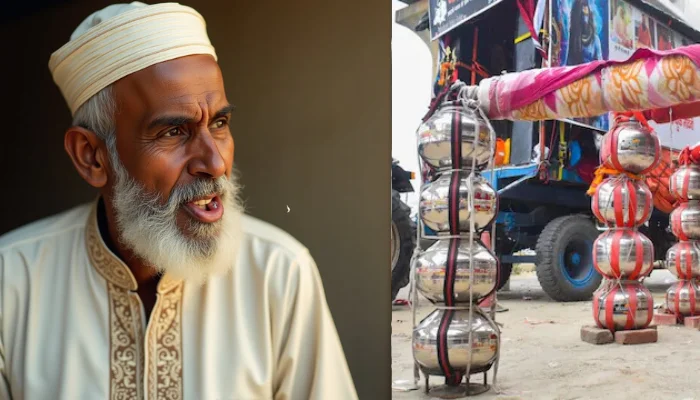
Case Summary
In Muzaffarnagar, Uttar Pradesh, a Muslim man named Shehzad spat on the kanwar carried by a Hindu woman, a sacred vessel filled with holy Ganga water meant for Lord Shiva. In Hinduism, the Kanwar Yatra is an annual pilgrimage observed by devotees of Lord Shiva, known as Kanwariyas. They travel to holy sites such as Haridwar, Gaumukh, and Gangotri in Uttarakhand to collect sacred water from the Ganga River and offer it to Lord Shiva, especially at Shiva temples in their local regions. This is a highly revered pilgrimage among Hindus. According to news reports, the incident occurred in the Jansath area of Muzaffarnagar, a region crowded with Kanwar Yatra pilgrims. On the day of the incident, the accused, Shehzad, defiled the Kanwar of a Hindu woman by spitting on it. This act immediately provoked strong reactions among local residents and Hindu pilgrims, leading to heightened tensions in the area. Following the incident, the police were alerted and promptly arrived at the scene to manage the situation and prevent any untoward incidents. The police responded swiftly, registered a case against the accused, and apprehended him. SP Atul Srivastav stated, “The accused has been taken into custody, and legal proceedings are underway. We have filed a case under sections pertaining to promoting enmity between groups and causing deliberate insult to religious sentiments.” During Shehzad's arrest, his family claimed that he was mentally ill and was receiving treatment for psychological issues. The police stated that the accused's mental health would be assessed and further legal action would follow based on the findings. Amidst the Kanwar Yatra, local authorities heightened security in the area and urged residents not to spread rumours. Additional police forces were deployed to prevent any disturbances and maintain peace.
Why it is Hate Crime ?
This case has been added to the tracker under the primary category- Attack on Hindu religious representations. Within this, the subcategory selected is- Desecration of Hindu religious symbols. Icons and symbols or a religious representation of a spiritual ideal are widely revered in Hinduism. Iconography is of vital significance in the Hindu milieu. It helps connect people’s spiritual beliefs with the real world. Iconography within the Hindu faith takes several shapes and forms. Murtis are of most significance to Hindus, to which daily rituals, prayers and offerings are done. Besides the murtis, there are several other symbols which have deep significance in the Hindu faith – the Om and Swastika for example. Since these Hindu religious symbols hold paramount importance in Hinduism, any desecration of symbols, icons, murtis, religious representations and manifestations, is driven by animosity towards the faith itself which manifests itself through these murtis, icons and symbols. Therefore, any desecration of these Hindu religious symbols and representations is considered religiously motivated hate crimes under this category. The other subcategory is- Defiling of religious customs. Sanatan Dharma is not a religion of one book, which is to say that while it has religious scriptures that form the central tenets of the faith, there are several traditions followed through thousands of years, mostly passed from generation to generation orally. There are several such customs and traditions that are followed by various Hindus and Hindu sects. Defiling of these traditions and customs is a breach of an individual or group’s religious practices. Such practices can range from dietary restrictions like not eating non-vegetarian food for a certain period of the year, not eating non-vegetarian food at all, not eating beef since the cow is considered holy in Hinduism, the sanctity of religious customs followed in the house (like many ISCKON devotees), etc. Any malicious action leading to the breach of such traditions or defilement of these traditions owing to animosity towards the faith or for the sake of activism stems not only from the lack of faith in the religion itself but also from disregard for the faith of the devotees who follow the customs/traditions and implicit bias against the faith, the tradition itself. Since these specific traditions are central to the faith of the devotees of that specific sect of Hindus, any non-compliance with these traditional rules would be considered a religiously motivated hate crime. This incident in Muzaffarnagar was not merely an attack on a physical object, but a deliberate desecration of a deeply sacred symbol in Hinduism. The Kanwar is a bamboo pole bearing pots filled with holy water from the Ganga River, which is carried on the shoulders of devotees during the Kanwar Yatra pilgrimage. This water is regarded as pure and spiritually potent, used in rituals and prayers to Lord Shiva. The Muslim perpetrator’s act of defiling such a sacred vessel by spitting on it showed a blatant disregard for the Hindu faith and the countless devotees who undertake this sacred journey, the Kanwar Yatra. Spitting on the Kanwar was a direct desecration of a sacred Hindu religious symbol. It was a conscious act of defilement that violated the sanctity of the pilgrimage and constituted a direct attack on the religious beliefs of Hindu devotees. Such an action goes far beyond a simple insult; it is a profound affront to the religious sentiments of Hindus. The pain caused by this act extended not only to the individual devotee involved but also to the wider Hindu community, for whom the Kanwar Yatra is a vital expression of their religious life. Acts of desecration and defilement of sacred Hindu representations by Muslim perpetrators are a result of religious animosity towards Hindus and their faith. Another point to note is that the use of the "mental illness" trope by the accused's family to justify the crime of defiling the sacred Kanwar raises critical questions. This is, in fact, one of the very common tools used to whitewash Muslim crimes. In several cases where Muslims have vandalised or desecrated Hindu religious symbols or places of worship, a recurring pattern has emerged: the accused is often portrayed as ‘mentally ill’ or ‘unstable’ in an attempt to deflect blame and downplay the seriousness of the crime. The police and the media, too, in many such cases, where the crime has been committed against the Hindu faith by a non-Hindu perpetrator, deny that the crime committed was in any way motivated by a religious bias and attribute it to the perpetrator’s mental health. In fact, there are many cases where this strategy has been used by the media to downplay such incidents where the crime was committed by a Muslim perpetrator, for example, the attack on the Gorakhnath temple or the incident in Telangana where two Muslim women wearing a burqa tried to damage temple and church idols. The use of the "mental illness" trope to justify crimes targeting Hindu temples or idols by Muslim perpetrators raises critical questions. If perpetrators are indeed mentally unstable, why do they specifically target Hindu idols and places of worship, leaving mosques untouched? This selective focus suggests that such acts are not driven by mental health issues but by religious animosity. The repeated use of this narrative to downplay crimes against Hindus reflects a strategic effort to whitewash religious hatred, obscuring the true motivations and intentions behind the attacks. This selective targeting of the sacred Kanwar suggests that such an act was not driven by mental health issues but by religious animosity. Therefore, it is being added to the hate crime database.
Victim Details
Total Victim
1
Deceased
0
Gender
- Male 0
- Female 1
- Third Gender 0
- Unknown 0
Caste
- SC/ST 0
- OBC 0
- General 0
- Unknown 1
Age Group
- Minor 0
- Adult 1
- Senior Citizen 0
- Unknown 0


Case Status
Arrested


Perpetrators Details
Perpetrators
Muslim Extremists
Perpetrators Range
One Person
Perpetrators Gender
male
 Sources




