Sacred Hindu temple ruthlessly demolished by state authorities in Tirunelveli, Tamil Nadu
 Tirunelveli, Tamil Nadu, India
  9 March, 2026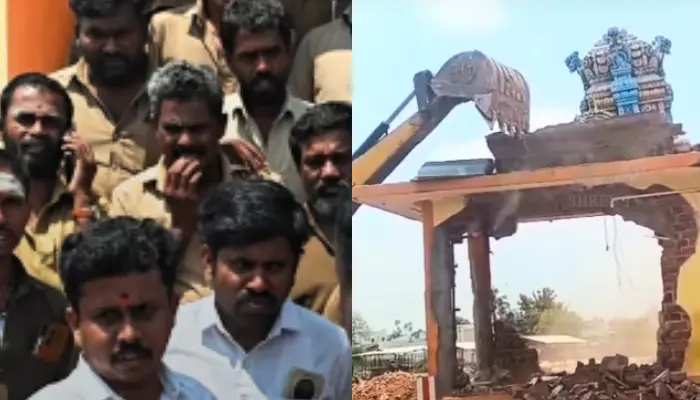
Case Summary
In Siddamalli, Tirunelveli district in Tamil Nadu, a Hindu temple dedicated to Lord Ganesha (Vinayagar) was demolished by state authorities on 10 March 2026. According to media reports, this demolition was carried out by officials from the revenue department with police security, triggering anger among local devotees. The temple was a sacred site that was visited daily by devotees from the surrounding area, who regularly conducted poojas, abhishekams, and religious festivals at the site. On 10 March 2026, officials from the revenue department, accompanied by police personnel, arrived at the location and began demolishing the temple structure. The demolition was carried out despite strong objections from local residents and devotees who gathered at the spot and attempted to stop the action. Police personnel present at the site removed the protesters and continued the demolition under heavy security arrangements. Following news of the demolition, members of Hindu Munnani, a Hindu organisation, rushed to the spot and joined devotees in protesting against the action. Devotees led by Manikanda Mahadevan, Tirunelveli district general secretary of the advocate wing of the organisation, opposed the demolition.
Why it is Hate Crime ?
The primary category selected in this case is- Attack on Hindu religious representations. The subcategory selected is- Attack on temples. In Hinduism, a temple is the abode of the Deity. The Deity in the Temple is consecrated, thereby, making it a real, breathing entity. Hindus believe that not just the Deity but the temple premises itself are sacred to Hindus since Hindus hold the faith that the entire Temple space is an amalgamation of the divine energy of the deity. Given the central significance of Temples in Hindu Dharma, any attack against a Hindu Temple or its peripheral premises is an attack on the faith itself and is born out of animosity towards the faith, of which, the Temple is a central tenet. Any manner of attack against a Temple and/or its premises would therefore be considered a religiously motivated hate crime. The other subcategory selected is- Desecration of Hindu religious symbol. Icons and symbols or a religious representation of a spiritual ideal are widely revered in Hinduism. Iconography is of vital significance in the Hindu milieu. It helps connect people’s spiritual beliefs with the real world. Iconography within the Hindu faith takes several shapes and forms. Murtis are of most significance to Hindus, to which daily rituals, prayers and offerings are done. Besides the murtis, there are several other symbols which have deep significance in the Hindu faith – the Om and Swastika for example. Since these Hindu religious symbols hold paramount importance in Hinduism, any desecration of symbols, icons, murtis, religious representations and manifestations, is driven by animosity towards the faith itself which manifests itself through these murtis, icons and symbols. Therefore, any desecration of these Hindu religious symbols and representations is considered religiously motivated hate crimes under this category. This case stands as a clear instance of a religiously motivated hate crime, as state authorities demolished the entire Hindu temple dedicated to Lord Ganesha in Tirunelveli district, Tamil Nadu. Demolishing and desecrating a Hindu temple in this manner exposed deep-seated institutionalised bias and religious animosity by the Tamil Nadu state authorities against Hinduism and Hindu temples. Temples hold profound significance for Hindus as sacred religious symbols and pillars of the faith, serving as centres for worship, community gatherings, and spiritual sustenance through daily poojas and festivals. The local revenue department authorities showed utter disregard for the right of this Hindu temple to exist, bulldozing it without respect for Hindu sentiments, which marks a blatant case of institutionalised prejudice and discrimination. If the state authorities faced any issues with the temple's land legality, they could have pursued legal channels, issuing notices to devotees, facilitating the safe relocation of idols, and allowing time for vacating the site. Instead, they arrived without prior warning, ransacked the structure, and demolished it entirely under police protection, ignoring protests from locals. This aggressive approach confirms it was not an administrative matter but pure anti-Hindu bias that drove the desecration. Temples represent one of the most sacred institutions and revered religious symbols in the Hindu faith. Such an attack on a temple and its desecration reveals the perpetrators' deep-seated religious animosity towards the Hindu community and faith. The demolition wounded the religious sentiments of countless Hindus who revered the site, making it a clear case of a religiously motivated hate crime. Notably, such attacks on the Hindu faith, temples, and community by the state administration are not new in Tamil Nadu. The Hinduphobia Tracker has recorded many similar anti-Hindu actions by the Tamil Nadu government, run by the Dravida Munnetra Kazhagam (DMK), in the past. For example, on 14 January 2024, Tamil Nadu Deputy Chief Minister Udhayanidhi Stalin and Chief Minister M. K. Stalin disrespected Hindu traditions during Pongal festival celebrations. Photos showed Udhayanidhi cooking Pongal alongside women wearing burqas and crosses, marginalising Hindu women. Udhayanidhi wore shoes while performing this sacred act, violating the festival's traditional norms. Similarly, in February 2021, Hindu temples in Krishnagiri district, Tamil Nadu, had properties worth approximately ten thousand crore rupees encroached upon. Radhakrishnan, trustee of the Thiruthondargal Trust, raised these concerns after inspecting the lands and assets of several temples. He stated that state officials coordinated with organised mafia groups, using systematic methods to appropriate temple property. In August 2025, in Kumbakonam, Tamil Nadu, a Christian Dravida Munnetra Kazhagam (DMK) functionary named Ramesh made vicious, inflammatory comments against the Hindu community, calling Hindus "sons of prostitutes". On 16 January 2024, Dravida Munnetra Kazhagam (DMK) leader Uma Ilakkiya made derogatory remarks targeting Lord Ram and the Ram Janmabhoomi Temple at Ayodhya. A video of her abusing Lord Ram went viral on social media. In 2023, DMK politician and Tamil Nadu Deputy Chief Minister Udhayanidhi Stalin, son of Chief Minister M. K. Stalin, equated Hinduism to dengue and malaria, calling for its annihilation. He stated, "Sanatana is like malaria and dengue, and so it must be eradicated, not opposed." Given that this case fits the pattern of past instances of anti-Hindu actions by the Tamil Nadu DMK government and meets the parameters of a hate crime, it is being added to the hate crime database of the Hinduphobia Tracker.


Case Status
Unknown


Perpetrators Details
Perpetrators
State and Establishment
Perpetrators Range
Unknown
Perpetrators Gender
male
 Sources




