Dalit Hindu families brutally attacked as Muslim mob stone-pelts their shops and houses in Tonk, Rajasthan
 Tonk, Rajasthan, India
  5 March, 2026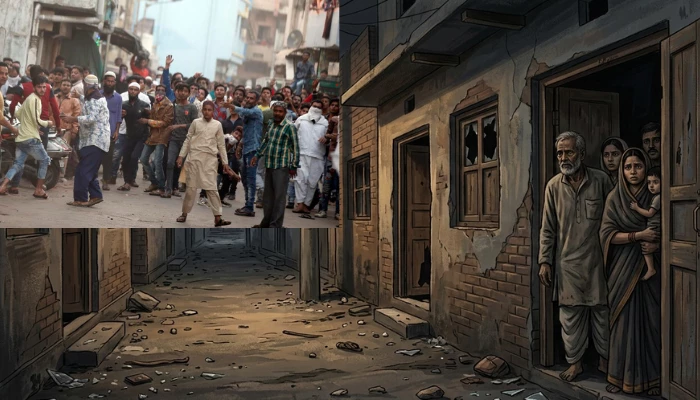
Case Summary
In Tonk, Rajasthan, a Hindu Dalit settlement was attacked by a mob of Muslim men with heavy stone-pelting. Several Hindu families were injured, and their houses and shops were vandalised. This incident occurred on 6 March 2026. A few Muslim men, after Taraweeh prayers, were returning home. They got into an argument with Hindu residents of the Valmiki settlement. The dispute escalated, and suddenly, heavy stone-pelting began on the Valmiki settlement from the Muslim men. Houses and shops belonging to the Valmiki Hindu community were damaged, and multiple people, including women and children, sustained injuries. One resident said that stones suddenly started raining on them, leaving families frightened. Parents of injured children expressed concern about their safety. Police forces from Tonk station reached the spot quickly and dispersed the crowd. Several individuals were detained for questioning. Officials confirmed that a First Information Report was registered against those involved. Additional police deployment was ordered in the area to prevent further escalation. Community representatives from the Hindu community demanded strict action against the accused and protection for their rights. The district administration announced that an enquiry was underway, and injured individuals were being treated at the local hospital. Police officials stated that arrests would continue based on evidence and eyewitness accounts. This was the second stone-pelting incident in Tonk within four days, raising concerns among residents about recurring communal clashes. Authorities maintained that law and order were under control while investigations proceeded. Earlier on the day of Holi, Hindus were attacked by a Muslim family over some old personal rivalry. Even in this case, the attack led to stone-throwing between the Hindu and Muslim sides. The Hinduphobia Tracker had previously reported this incident.
Why it is Hate Crime ?
This case is being added to the tracker under the primary category "Attack not resulting in death". The subcategory selected is- "Communal Clash/Attack". Communal clash is a form of collective violence that involves clashes between groups belonging to different religious identities. For a communal clash between Hindus and non-Hindus to qualify as a religiously motivated hate crime, the trigger of the violence itself would have to be anti-Hindu in essence. For example, if there is a Hindu religious procession that comes under attack from a non-Hindu mob and after the initial attack, Hindus retaliate in self-defence, leading to a communal clash between the two religious communities. While at a later stage, both communities are involved in the clash/violence, the initial trigger of the violence was by the non-Hindu mob against the Hindus, and therefore, it could safely be termed as an anti-Hindu violence. Further, the trigger would also have to be religiously motivated. In the cited example, the attack by the non-Hindu mob was against religious processions and therefore can be concluded to be religiously motivated. In some cases, the trigger may be non-religious; however, it develops into religious violence against Hindus at a later stage. In such cases, too, the foundational animosity towards Hindus becomes the motivating factor of the crime, and therefore, it would be classified as a religiously motivated hate crime against Hindus under this category. This incident clearly qualified as a hate crime due to its communal nature and the religion-fuelled disproportionate response by the Muslim assailants. What began as a minor dispute with Hindu residents of the Valmiki settlement in Tonk, Rajasthan, after Taraweeh prayers, which could have remained a simple disagreement between Hindu and Muslim individuals, was met with brutal violence by the Muslim mob. Their savage stone-pelting assault on the Hindu Dalit families, including women and children, left several injured and houses vandalised, an utterly unwarranted reaction that revealed deep-seated religious hostility. This disproportionate violence over a trivial issue exposed the underlying animosity within the Muslim perpetrators towards the victims due to their religious identity, reflecting a dangerous mindset of religious supremacy that demanded dominance by force. In such cases, minor non-religious provocations were met with aggressive retaliation when the victims were Hindu, revealing an alarming pattern of identity-driven hostility that defined such hate crimes. In this incident, after initiating the stone-pelting on the Valmiki settlement, the Muslim perpetrators did not limit their violence to the initial argument but escalated it against the entire Dalit Hindu community in the area. The attackers launched a heavy stone-pelting assault on the wider Hindu settlement, turning a dispute into a targeted attack on the entire community. This shift from a localised disagreement to the entire Valmiki Hindu residents demonstrated deliberate religious animosity and religion-based targeting grounded in Hindu identity, not the nature of the initial argument. By directing collective violence at the broader Hindu community, the perpetrators made it evident that the attack was motivated by hostility towards Hindus as a religious group, marking this a clear case of a religiously motivated crime. This sort of violent overreach stemmed from an Islamic supremacist ideology within certain Muslim circles, which viewed Hindus as socially and religiously inferior. This toxic belief bred contempt and aggression, especially when Hindus resisted submission or refused to yield in disputes. The readiness to use heavy stone-pelting over a minor post-prayer argument exposed the continuing threat Hindu communities faced, as these incidents were not isolated or spontaneous but part of an ongoing pattern of religiously motivated violence. The collective assault on the wider Dalit Hindu settlement after the initial clash further demonstrated how the violence escalated beyond the original dispute into a broader communal attack. Several past incidents underscore this grim reality. The 2019 Hauz Qazi violence is a glaring example. A simple parking dispute escalated into a full-scale communal attack against Hindus in the heart of Delhi. Hindu residents, including women and children and their sacred Durga Mandir were targeted mercilessly by Muslims. Hindu idols were destroyed, the temple desecrated, and the community subjected to physical assault. The disappearance of a 17‑year‑old Hindu boy during the violence highlighted the grave dangers Hindus endure, as he was beaten for his faith and forced to flee for his life. This incident exposed how routine conflicts are exploited to unleash communal violence against Hindus, leaving the community traumatised and demanding justice. Similarly, the Hinduphobia Tracker has previously documented numerous instances where non-religious triggers sparked communal violence against Hindus by Muslims. For example, on 30th May 2025, in Dewran Garhiya village, Farrukhabad, Uttar Pradesh, a minor verbal altercation between two Hindu men and a Muslim man escalated into a violent assault by a large Muslim mob, inflaming communal tensions. In another incident on 7th July 2025 in Bhavna Nagar, Raipur, Chhattisgarh, a Hindu family was brutally attacked by a Muslim mob of nearly 80 people following a simple dispute over garbage disposal. Victims suffered severe injuries from sharp weapons. Similarly, on 22nd June 2025 in Ghongade Basti, Solapur, Maharashtra, a minor road dispute led to a targeted communal assault on Hindus by a large Muslim mob, sparking widespread clashes. Given that this case meets the parameters of a religiously motivated hate crime, it is being added to the hate crime database of the tracker.


Case Status
Complaint registered


Perpetrators Details
Perpetrators
Muslim Extremists
Perpetrators Range
Unknown
Perpetrators Gender
male
 Sources




