Hindus assaulted and stone-pelted by Muslim family ahead of Holi festival in Tonk, Rajasthan
 Tonk, Rajasthan, India
  2 March, 2026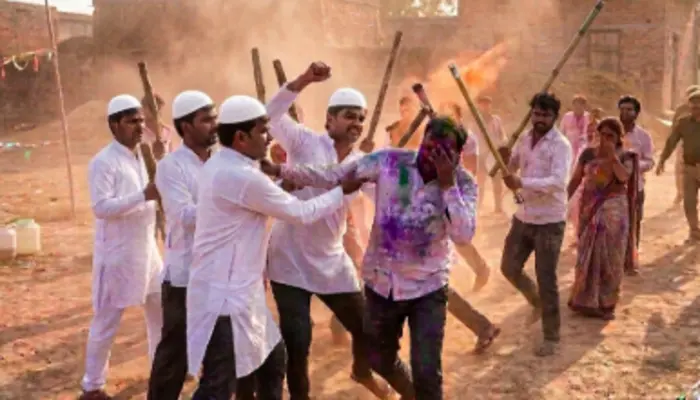
Case Summary
In Tonk district, Rajasthan, Hindus faced physical assault and stone-throwing by a Muslim family over a minor altercation stemming from an old rivalry, a day prior to Holi. This incident occurred on the night of 3 March 2026. According to media reports, the incident unfolded in the Sanghpura neighbourhood under the Old Tonk police station area in Tonk city. It began when the accused Muslim family returned home after performing their Islamic prayers. Following this, the Muslim family started quarrelling and creating a verbal altercation with local Hindus due to a longstanding rivalry. This escalated into violence, with fighting and stone-throwing between Hindus and Muslims in the area. A Hindu father and his daughter sustained injuries in the attack. Both received treatment at Saadat Hospital in Tonk, where a crowd soon gathered. Bharatiya Janata Party District President Chandraveer Singh Chauhan arrived at the scene, voiced strong disapproval, and demanded strict action against those responsible. Tonk Deputy Superintendent of Police Mrityunjay Mishra confirmed that a fight broke out between two groups, Hindus and Muslims, over an old rivalry. Tensions rose sharply afterwards. Police from City Kotwali, Old Tonk Police Station, and Sadar Police Station, supported by Rajasthan Armed Constabulary personnel, deployed at the site to maintain law and order. The situation remained peaceful under close monitoring by the police administration. He urged the public to ignore rumours.
Why it is Hate Crime ?
This case is being added to the tracker under the primary category- Attack not resulting in death. The subcategory selected is- Attacked for Hindu identity. In several cases, Hindus are attacked merely for their Hindu identity without any perceived provocation. A classic example of this category of religiously motivated hate crime is a murder in 2016. 7 ISIS terrorists were convicted for shooting a school principal in Kanpur because they got ‘triggered’ seeing the Kalava on his wrist and tilak that he had put. In this, the Hindu victim had offered no provocation except for his Hindu religious identity. The motivation for the murder was purely religious, driven by religious supremacy. Such cases where Hindus are targeted merely for their religious identity would be documented as a hate crime under this category. The other subcategory selected is- Communal Clash/Attack. Communal clash is a form of collective violence that involves clashes between groups belonging to different religious identities. For a communal clash between Hindus and non-Hindus to qualify as a religiously motivated hate crime, the trigger of the violence itself would have to be anti-Hindu in essence. For example, if there is a Hindu religious procession that comes under attack from a non-Hindu mob and after the initial attack, Hindus retaliate in self-defence, leading to a communal clash between the two religious communities. While at a later stage, both communities are involved in the clash/violence, the initial trigger of the violence was by the non-Hindu mob against the Hindus and therefore, it could safely be termed as an anti-Hindu violence. Further, the trigger would also have to be religiously motivated. In the cited example, the attack by the non-Hindu mob was against religious processions and therefore, can be concluded to be religiously motivated. In some cases, the trigger may be non-religious, however, it develops into religious violence against Hindus at a later stage. In such cases too, the foundational animosity towards Hindus becomes the motivating factor of the crime and therefore, it would be classified as a religiously motivated hate crime against Hindus under this category. This case stands as a clear instance of a religiously motivated hate crime, as Hindus suffered physical assault by a Muslim family over an old rivalry, just a day ahead of Holi. The deliberate timing, combined with the attack following the altercation and quarrelling, exposes the religious animus driving the violence. This overall pattern marks it unequivocally as a religiously motivated hate crime. The Muslim family chose to ignite this confrontation precisely a day prior to Holi, a festival deeply revered by Hindus as a celebration of spring, the victory of good over evil, and religious joy. Holi holds profound cultural and spiritual significance, uniting Hindu communities in vibrant festivities. Yet, on this eve, the Muslim family began quarrelling and fighting with local Hindus over some longstanding rivalry. This sparked a full communal clash and violence between Hindus and Muslims. Such actions reveal that the Muslim perpetrators intentionally sought to disrupt Holi celebrations. Selecting this precise timing, rather than any other day, showcases deep-seated religious animosity towards the Hindu community and their faith, making it a clear case of a religiously motivated hate crime. The altercation rapidly escalated communal tensions across the Sanghpura neighbourhood, erupting into widespread stone pelting, physical assaults, and chaotic clashes that left Hindus injured and terrified. This conflict, initiated by the Muslim family through their unprovoked quarrelling, verbal aggression, and direct attacks on local Hindus during the sacred lead up to Holi, one of their most revered festivals, underscores a perpetual, calculated intent to desecrate the sanctity of Holi and undermine Hindu celebrations. By terrorising Hindus through brutal assault, relentless stone throwing, and intimidation right in their own neighbourhood, the perpetrators aimed to sow deep fear, foster division, and assert dominance. This therefore showcases that Hindus were targeted and assaulted by Muslims precisely due to their Hindu identity and their festival, under the pretext of an old dispute. Such a violent clash amounts to a clear instance of a communal attack on Hindus during their revered festival, confirming the religiously motivated nature of this hate crime. Since this case meets the parameters of a hate crime, Hinduphobia Tracker is adding it to the hate crime database. Disclaimer: In this case, media reports do not specify the exact number of victims. They mention only two individuals: the Hindu father and daughter who sustained injuries. While the Hinduphobia Tracker acknowledges that several other Hindus were targeted in the attack, only these two have been clearly identified. Consequently, the victim count is recorded as '2' for precision. This serves documentation purposes only.
Victim Details
Total Victim
2
Deceased
0
Gender
- Male 1
- Female 1
- Third Gender 0
- Unknown 0
Caste
- SC/ST 0
- OBC 0
- General 0
- Unknown 2
Age Group
- Minor 0
- Adult 1
- Senior Citizen 0
- Unknown 1


Case Status
Unknown


Perpetrators Details
Perpetrators
Muslim Extremists
Perpetrators Range
Unknown
Perpetrators Gender
unknown
 Sources




