Hindu organisation's gathering disrupted, activists attacked, and anti-Hindu slogans raised by leftist groups in Visakhapatnam
 Visakhapatnam, Andhra Pradesh, India
  16 February, 2026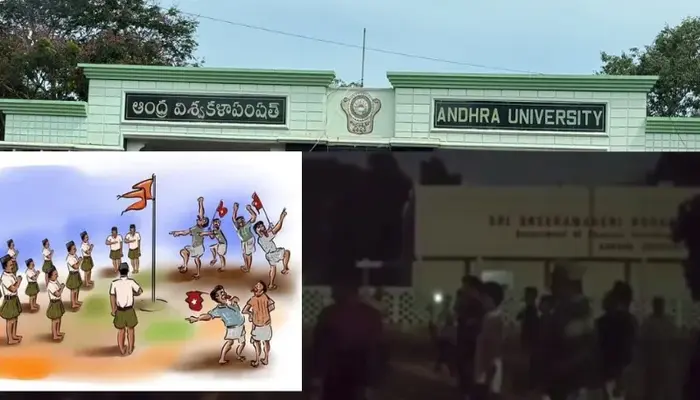
Case Summary
At Andhra University in Visakhapatnam, Andhra Pradesh, a Rashtriya Swayamsevak Sangh (RSS) shakha, a Hindu organisation's local gathering conducted on university grounds, was attacked by students from leftist organisations SFI (Students' Federation of India) and AISF (All India Students' Federation), both infamous for anti-Hindu demonstrations. RSS activists were brutally attacked, sustaining serious injuries. During the attack, the perpetrators also raised anti-Hindu slogans, calling Hindus 'terrorists'. The incident occurred on 17 February 2026, when RSS organised a shakha, a meeting, at the university campus. The shakha had commenced at around 6:30 pm near the basketball court and was nearing conclusion when approximately twenty students, who were members of the Left-wing student organisations SFI and AISF, reached the spot. They raised anti-RSS and anti-Hindu slogans, including “RSS go back”, “VC down down” and “Hindus are terrorists”, and entered into a violent confrontation with the participating swayamsevaks (RSS members), Hindu activists. The situation escalated into a violent clash, where SFI and AISF members began attacking RSS members, resulting in injuries, who were subsequently taken to King George Hospital for treatment. A complaint was lodged at the local police station by ABVP members, who submitted details of the incident along with the names of those involved, demanding strict legal action. The following day, 18 February 2026, protests were organised on campus as ABVP members submitted a representation to the university authorities demanding action and security for students. The RSS, through a press release issued by Visakha Mahaanagar Sanghchalak P. V. Narayana Rao, stated that the shakha had been conducted peacefully at Andhra University for many years as part of its regular activities and that swayamsevaks had been offering prayers to Bharat Mata and chanting patriotic slogans when the disruption occurred. The statement emphasised that the organisation’s programmes were conducted within the framework of the law and that its members maintained composure despite provocation, noting that the incident took place in the presence of police personnel. Simultaneously, members of AISF and SFI assembled at the university to submit a representation to officials, claiming that concerns had earlier been raised with the vice-chancellor regarding activities on campus that, in their view, fostered religious polarisation. They alleged that RSS had used the campus as a platform for organisational activities and that a confrontation broke out when students objected.
Why it is Hate Crime ?
This case has been added to the tracker under the primary category of - Attack not resulting in death. Within it, the sub-category selected is - Attacked for supporting/being part of perceived Hindu party/org or working for Hindu community. In several cases, Hindus are attacked specifically or tangentially for their association with parties or organisations perceived to be pro-Hindu and/or for working in favour of the Hindu community. One of the classic cases was the attack against a Bharatiya Janata Party Yuva Morcha (BJYM) worker Praveen Nettaru. Nettaru was attacked and hacked to death for his association with Hindu organizations and his work for the Hindu community. He was murdered by PFI, a terror organization which aimed to commit a genocide of Hindus, target Hindu leaders specifically and turn India into an Islamic Nation. In such cases, it is possible that the immediate trigger for the violence is non-religious – either according to the perpetrator or the police. However, there are surrounding circumstances from which the conclusion can be reached that the victim was attacked for his association with a Hindu organization. In a similar case, Rinku Sharma was attacked by radicals. He was a member of Bajrang Dal and regularly worked for the Hindu community. While the police cited a different non-religious trigger for the attack, it is true that he was associated to a Hindu organization and the family of Rinku Sharma specifically attributed his gruesome murder to him working for Bajrang Dal and raising Jai Shree Ram slogans. Such cases are intrinsically driven by religious hate and would therefore be documented as a hate crime under this category. The other sub-category selected - Attacked for Hindu identity. In several cases, Hindus are attacked merely for their Hindu identity without any perceived provocation. A classic example of this category of religiously motivated hate crime is a murder in 2016. 7 ISIS terrorists were convicted for shooting a school principal in Kanpur because they got ‘triggered’ seeing the Kalava on his wrist and tilak that he had put. In this, the Hindu victim had offered no provocation except for his Hindu religious identity. The motivation for the murder was purely religious, driven by religious supremacy. Such cases where Hindus are targeted merely for their religious identity would be documented as a hate crime under this category. The other primary category selected here is - Hate speech against Hindus. Within it, the sub-category selected is - Anti-Hindu-slurs, mocking faith. Anti-Hindu slurs and the deliberate mocking of the Hindu faith owing to religious animosity involve the usage of derogatory terms, stereotypes, or offensive references to religious practices, symbols, or figures. One of the common anti-Hindu slurs used against Hindus is “cow-worshipper” and “cow piss drinker”. The intention of using this term is to demean and mock Hindus as a group and their religious beliefs since Hindus consider the cow holy. Additionally, some symbols and the slurs attached to them have a historical context that exacerbates the insult, hate, stereotyping, dehumanisation and oppression against Hindus. Cow worship has been used for centuries to denigrate Hindus, insult their faith and oppress Hindus specifically as a religious group. There has been overwhelming documentation about how cow slaughter has been used to persecute Hindus with cow meat being thrown in temples and places of worship. There has also been overwhelming documentation where cow meat (beef) has been force-fed to Hindus to either forcefully convert them to Islam or denigrate their faith. Apart from cow worship, the Swastika – which holds deep religious significance for the Hindus – has also been misinterpreted and distorted to use as a slur against Hindus. Similarly, the worship of the Shivling has been used by supremacist ideologies and religions to denigrate Hindus owing to religious animosity. Such slurs and denigration stem out of inherent animosity and hate towards Hindus and their faith, therefore, it is categorised as hate speech targeted at Hindus specifically owing to their religious identity. The case has been added to the tracker because a Rashtriya Swayamsevak Sangh (RSS) shakha being conducted on the university grounds was deliberately attacked and disrupted by members of the Students’ Federation of India (SFI) and the All India Students’ Federation (AISF), leftists student organisation infamous for its anti-Hindu activities. It is essential to note that the RSS is a Hindu organisation founded on the ideology of Hindutva, a political, cultural, and civilisational movement aimed at protecting Hinduism from anti-Hindu forces such as Islamist fundamentalism, Khalistani extremism, aggressive Christian proselytisation, and left-liberal or Marxist ecosystems that promote anti-Hindu narratives. The ideology of Hindutva is not one of violence or suppression; it stands for unity, strength, and self-defence. It encourages Hindus, across caste and class lines, to unite in preserving their faith, dignity, and cultural identity. SFI and AISF are student organisations historically aligned with communist and Marxist political currents. Their ideological positioning frequently frames Hindu civilisational or nationalist organisations as regressive or communal. In this case, they not only disrupted the RSS meeting but also attacked RSS activists while raising anti-Hindu slogans explicitly. This demonstrated that the attack was targeted, rooted in animosity towards Hindu identity and organisations associated with Hindu assertion. The attack did not occur in the context of an academic seminar, policy discussion, or electoral contest within student politics; it occurred during a religious-cultural activity conducted by the Hindu organisation, thereby establishing the communal nature of the attack. RSS shakhas are structured gatherings that include physical exercises, prayers, and discussions intended to foster discipline, social service, and cultural awareness among participants. The disruption of such a gathering, accompanied by slogans vilifying Hindus as a community, reflected not merely opposition to an organisation but contempt directed at the Hindu religious identity itself, which the RSS represents. When violence followed immediately upon the raising of anti-Hindu slogans, the causal link between religion-based hostility and physical assault became evident. Furthermore, explicit anti-Hindu slogans were raised by the leftist organisations, who shouted “Hindus are terrorists” during the attack on the shakha. This slogan did not target an organisation’s policies or activities; it ascribed criminality and extremism to an entire religious community solely on the basis of religious identity. By branding all Hindus as “terrorists,” the slogan collectively vilified millions of people, reducing the Hindu community to a violent stereotype. It explicitly reflected their deep-seated animosity towards Hindu identity itself. Such slogans can result in the normalisation of hostility against Hindus, leading to aggression and violence against them. The use of such slogans constituted hate speech that directly fostered prejudice and hostility against Hindus, thereby forming a core element of a hate crime motivated by religious animus. The violence created an atmosphere of intimidation on campus, signalling that open expression of Hindu cultural or nationalist identity would be met with aggression. Such actions serve to silence and deter participation in Hindu religious or cultural activities through fear. The combination of targeted slogans, organised disruption, and physical violence indicated intent to delegitimise and suppress a Hindu gathering on the basis of its religious character. As previously stated, leftist student organisations such as the Students’ Federation of India (SFI) and the All India Students’ Federation (AISF) have a documented history of hostility towards expressions of Hindu identity. The Hinduphobia Tracker has previously recorded multiple instances in which similar groups targeted Hindu students, disrupted Hindu religious events, or raised inflammatory slogans against Hindu communities and organisations. For instance, at Allahabad University in Prayagraj, two Hindu youths, Bhavesh Dubey and Samrath Rai, were attacked after they objected to anti-Hindu slogans raised during a protest by the leftist organisation DISHA. In another case at Jawaharlal Nehru University (JNU), a Durga Puja idol immersion procession led by Hindu students was attacked by Left-wing student groups, including SFI. Thus, this was not an isolated case but reflected a broader pattern wherein assertions of Hindu cultural or religious identity were confronted with organised resistance and, at times, violence. The attack on the RSS activists occurred precisely because of what they represented, an organised and open assertion of Hindu identity and civilisational consciousness. Taken together, these elements demonstrated that the incident was not a neutral clash between rival student groups, but a religion-motivated attack directed at Hindu activists and the Hindu organisation. Thus, this case has been added to the Hinduphobia Tracker database.


Case Status
Complaint filed


Perpetrators Details
Perpetrators
Others
Perpetrators Range
Unknown
Perpetrators Gender
unknown
 Sources




