Hindu religious procession attacked, devotees assaulted, and deity's idol targeted by Leftist student groups in Delhi
 New Delhi, Delhi, India
  1 October, 2025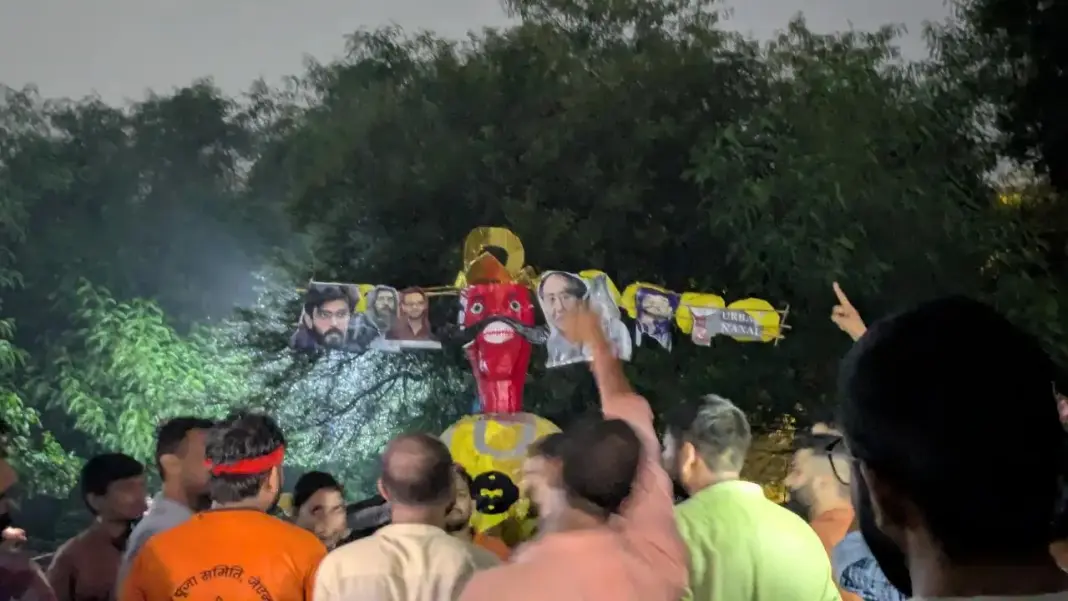
Case Summary
In Jawaharlal Nehru University (JNU), a Durga Puja idol immersion procession was attacked by Left-wing student groups. The procession was targeted because Hindu students had earlier burnt an effigy of Ravan with photographs of Umar Khalid and Sharjeel Imam, the co-conspirators of the anti-Hindu Delhi riots of 2020, staged under the pretext of the Citizenship Amendment Act (CAA) and National Register of Citizens (NRC). According to media reports, the incident took place around 7 pm on 2nd October 2025 near the Sabarmati T-Point, where Akhil Bharatiya Vidyarthi Parishad (ABVP) members were leading the immersion procession. ABVP confirmed that Left-wing student organisations, including AISA, SFI, and DSF, disrupted the event, hurled wooden blocks, and assaulted a female Hindu participant. The clashes stemmed from an earlier flashpoint when ABVP members from the Barak Hostel burnt a Ravan effigy carrying the faces of Sharjeel Imam and Umar Khalid. The act infuriated Left-aligned student groups, who staged a protest that was later shifted towards Sabarmati T-Point, the exact route of the immersion. When the procession reached the spot, verbal altercations escalated into physical violence. ABVP stated that the attack was orchestrated at the behest of Jawaharlal Nehru University Students' Union (JNUSU) president Nitish Kumar. They emphasised that the Leftist groups had deliberately moved their protest to intercept the immersion procession with the intent to provoke clashes. “Stones and wooden blocks were thrown at us. Even idols were targeted,” one ABVP member said. Campus authorities intervened to restore order, though the atmosphere remained tense. The JNU administration monitored the situation to prevent further escalation.
Case Images

Why it is Hate Crime ?
This case has been added to the tracker under the primary category- Attack not resulting in death. The subcategory selected is- Attack on religious procession. The outward celebration and display of religious symbols in an intrinsic part of Hinduism. Religious processions on various festivals are age-old traditions and a way to manifest faith and form a part of the religious practices of Hindus. On several occasions, such religious processions come under attack by non-Hindu mobs, in a manifestation of their animosity towards Hinduism and their practices. The reasons cited for such violent attacks are many and range from crossing a non-Hindu resident-dominated area to playing loud music, crossing from an area where there is a religious structure of another faith etc. The violent attacks are triggered by the outward display of religiosity by Hindus. The attacks are mainly a manifestation of religious supremacist doctrine which believes that idolatry, essentially the Hindu faith, is one that deserves to be annihilated since the very tenets of Hinduism, its practices and traditions are considered a sin in those doctrines. Since these attacks emanate from intrinsic and doctrinal animosity towards Hindus and Hinduism, it is considered a religiously motivated hate crime under this category. The other subcategory selected is- Attack against Hindu devotees. Hindu devotees are a few of the easiest targets of religiously motivated hate crimes because during the festival/procession/puja etc, for non-Hindus it is easy to profile their victims on the basis of religion. Hindu devotees come under attack on several occasions by individual non-Hindus or mobs of non-Hindus owing to their animosity against Hinduism, its symbols and tradition/practices. There are several instances of Hindu devotees being attacked while they worship in temples or temporary religious structures, during religious processions, doing bhajan/kirtan/puja in their own homes, in the residential society etc. These attacks are perpetrated by non-Hindus primarily because of their animosity towards Hindus and their faith. In some cases, the trigger for the violence may be non-religious, however, there are two elements that make these hate crimes. First, the Hindus who come under attack are attacked violently while indulging in religious activity. Whether they are in a place of worship or not is immaterial to the crime. When individuals are attacked while indulging in religious practices, the attack in itself is a hindrance to their freedom to practice religion and therefore constitutes a hate crime. Secondly, religious supremacist doctrines and ideologies deem religious practices of Hindus to be offensive ab initio since they are considered “sinful” by these ideologies, worthy to be annihilated by force or coercion. Driven by these religious supremacist ideologies and doctrines, the attacks against Hindu devotees stem from intrinsic animosity towards Hinduism. In some cases, the trigger for the violence may be non-religious, however, it develops into a religiously motivated crime during the course of the violence. Since these attacks stem from animosity towards Hindus and Hinduism, they are considered religiously motivated hate crimes under this category. Another primary category selected is- Attack on Hindu religious procession. The subcategory selected is- Desecration of Hindu religious symbol. Icons and symbols or a religious representation of a spiritual ideal are widely revered in Hinduism. Iconography is of vital significance in the Hindu milieu. It helps connect people’s spiritual beliefs with the real world. Iconography within the Hindu faith takes several shapes and forms. Murtis are of most significance to Hindus, to which daily rituals, prayers and offerings are done. Besides the murtis, there are several other symbols which have deep significance in the Hindu faith – the Om and Swastika for example. Since these Hindu religious symbols hold paramount importance in Hinduism, any desecration of symbols, icons, murtis, religious representations and manifestations, is driven by animosity towards the faith itself which manifests itself through these murtis, icons and symbols. Therefore, any desecration of these Hindu religious symbols and representations is considered religiously motivated hate crimes under this category. In this case, the attack on the Hindu Durga Puja idol immersion procession at JNU was clearly a case of anti-Hindu hate and religiously motivated hostility. The attackers targeted the procession because Hindu students had burnt a Ravan effigy carrying the pictures of Sharjeel Imam and Umar Khalid, who were co-conspirators of the 2020 anti-Hindu Delhi riots. Those riots had seen mobs of Muslims murdering Hindus amidst the frenzied chants of Islamic slogans like “Allahu Akbar” and “Nara-e-Takbir.” The Delhi riots themselves were deeply communal and religiously motivated attacks against Hindus. The fact that Left-wing students in JNU took offence to the effigy burning of these Muslim rioters demonstrates the anti-Hindu hostility they continue to harbour, while at the same time disregarding the lived trauma of Hindu victims of these riots. Secondly, the attack on the Durga idol immersion procession itself was an unmistakably religiously motivated hate crime. The immersion of the idol is a sacred and deeply important part of Durga Puja, marking the farewell of the Goddess after days of devotion. That Hindu devotees were attacked with stones and wooden blocks during this immersion shows a calculated act of violence not just against individuals but against Hindu religious traditions themselves. It reflects deep-seated hostility towards Hinduism, towards the Hindu community as a whole, and towards their religious festivals and processions. The targeting of the idol and the sacred act of immersion expose the anti-Hindu intent underlying this violence. Thirdly, the attack caused physical injuries to Hindu devotees, including a female Hindu student who was assaulted during the clashes. The fact that Hindu worshippers came under a violent assault while performing a sacred religious act highlights open and aggressive animosity directed towards Hindus. An attack on innocent devotees participating in their faith is not merely a political scuffle; it is an act of communal hatred directed at Hindus because of their religious identity. Fourthly, ABVP Hindu students also highlighted that even the Durga idol itself was specifically targeted by the Left-wing students, which constitutes a clear hate crime against Hindus. In Hinduism, the idol of Goddess Durga is not merely a symbolic figure but is revered as the living embodiment of Shakti, the supreme divine feminine power responsible for upholding righteousness and destroying evil. During Durga Puja, millions of Hindus across the world engage in prayers, rituals, and processions to honour the goddess, whose idol becomes the central focus of devotion, love, and spiritual protection. Attacking or desecrating such an idol is seen as an attack on the faith itself and on the sacred traditions cherished by devotees. The targeting or destruction of Hindu idols exposes deep-seated religious animosity and is recognised as a grave affront to Hindu sentiments and religious identity. Additionally, the institutional atmosphere of JNU cannot be separated from this incident. JNU has long been a hub for Muslim extremist sympathisers and anti-Hindu Leftist ideologues. It has repeatedly witnessed events ridiculing and mocking Hindu traditions, such as the infamous “Mahishasur Martyrdom Day”, which insulted Goddess Durga and outraged Hindus nationwide. On multiple occasions, Hindu students have been targeted, intimidated, and suppressed on the campus. Even in this case, the violent attack on the Durga Puja idol immersion procession joined a long chain of incidents where the university grounds became a platform for anti-Hindu activity. Given that this attack targeted a Hindu religious procession, desecrated a sacred tradition, was rooted in hostility to Hindu identity, and resulted in violence against Hindu devotees, it squarely meets the parameters of a religiously motivated hate crime. For this reason, it is being documented and added to the hate crime database of the Hinduphobia Tracker.
Victim Details
Total Victim
1
Deceased
0
Gender
- Male 0
- Female 1
- Third Gender 0
- Unknown 0
Caste
- SC/ST 0
- OBC 0
- General 0
- Unknown 1
Age Group
- Minor 0
- Adult 1
- Senior Citizen 0
- Unknown 0


Case Status
Unknown


Perpetrators Details
Perpetrators
Others
Perpetrators Range
Unknown
Perpetrators Gender
unknown
 Sources




