Hindu students brutally assaulted for opposing anti-Hindu slogans raised by leftist student organisation in Uttar Pradesh
 Prayagraj (Allahabad), Uttar Pradesh, India
  3 February, 2026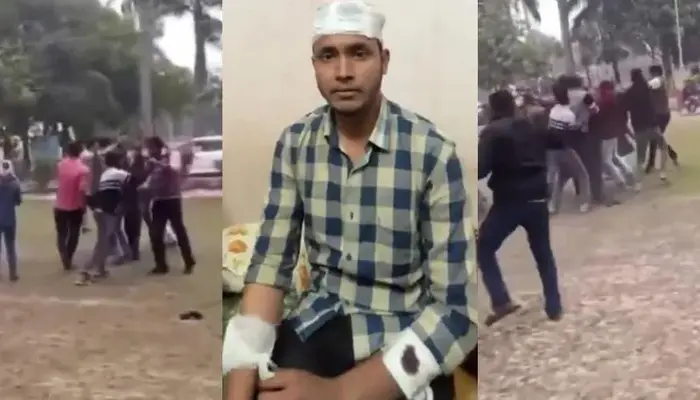
Case Summary
At the Allahabad University in Prayagraj, Uttar Pradesh, two Hindu youths named Bhavesh Dubey and Samrath Rai were brutally attacked after they opposed anti-Hindu slogans raised by members of the Disha organisation, a leftist student organisation. The incident occurred on 4 February 2026, following tensions linked to protests over the Supreme Court’s stay on the new University Grants Commission (UGC) Regulations 2026. The confrontation occurred at the Banyan Lawn, where members of the Disha student organisation were holding a protest without prior permission and raising slogans against the University Grants Commission (UGC) regulations. During the course of the protest, Disha members raised anti-Hindu slogans like "Savarno ki kabar khudegi Prayagraj ki dharti par" (The graves of upper-caste Hindus will be dug on the land of Prayagraj) and exhortations telling upper-caste students to leave India and the university. The situation further escalated into a physical clash, during which students were seen punching, kicking, and abusing each other, with several women also involved in the altercation. Videos of the violence circulated on social media, showing open scuffles and the use of abusive language on campus. Bhavesh Dubey, a university student, stated that he and his friend Samrath Rai heard these provocative slogans while they were on their way to attend classes and went to the protest site to object to the slogans. This resulted in a violent response by Disha members in which Samrath Rai was assaulted and bitten on the hand by a female student, causing a deep injury. Meanwhile, others who attempted to intervene were also beaten by Disha members. He further stated that threats were issued to damage vehicles, force students out of the campus gates, and invoke provisions of the Scheduled Castes and Scheduled Tribes (SC/ST) Act. Akhil Bharatiya Vidyarthi Parishad (ABVP) students intervened during the clash, and videos later showed Bhavesh Dubey with visible injuries. The Disha organisation, on the other hand, made claims that a group of around 30 to 40 young men entered the protest site, abused participants, used casteist slurs, misbehaved with women, and physically attacked students, prompting others to gather and force the attackers to retreat. The university administration confirmed that the protest had been conducted without permission and that the confrontation began when other students objected to the slogans being raised. The injured third-year Bachelor of Arts (BA) student who had been bitten was taken to the hospital for treatment. A police complaint was registered, and an investigation was initiated into the incident. The university stated that violence, abusive language, caste-based hostility, or misogynistic behaviour would not be tolerated on campus and that strict action would be taken against those found responsible after the completion of the inquiry.
Why it is Hate Crime ?
This case has been added to the tracker under the primary category of - Hate speech against Hindus. Within it, the sub-category selected here - Anti-Hindu slurs, mocking faith. Anti-Hindu slurs and the deliberate mocking of the Hindu faith owing to religious animosity involve the usage of derogatory terms, stereotypes, or offensive references to religious practices, symbols, or figures. One of the common anti-Hindu slurs used against Hindus is “cow-worshipper” and “cow piss drinker”. The intention of using this term is to demean and mock Hindus as a group and their religious beliefs since Hindus consider the cow holy. Additionally, some symbols and the slurs attached to them have a historical context that exacerbates the insult, hate, stereotyping, dehumanisation and oppression against Hindus. Cow worship has been used for centuries to denigrate Hindus, insult their faith and oppress Hindus specifically as a religious group. There has been overwhelming documentation about how cow slaughter has been used to persecute Hindus with cow meat being thrown in temples and places of worship. There has also been overwhelming documentation where cow meat (beef) has been force-fed to Hindus to either forcefully convert them to Islam or denigrate their faith. Apart from cow worship, the Swastika – which holds deep religious significance for the Hindus – has also been misinterpreted and distorted to use as a slur against Hindus. Similarly, the worship of the Shivling has been used by supremacist ideologies and religions to denigrate Hindus owing to religious animosity. Such slurs and denigration stem out of inherent animosity and hate towards Hindus and their faith, therefore, it is categorised as hate speech targeted at Hindus specifically owing to their religious identity. The other sub-category selected is - Violent threats. Violent threats, explicit, implicit or implied, is the most dangerous form of hate speech since it goes beyond discriminatory and prejudicial language to express the intent of causing harm to an individual or a group of people based on their religious identity and faith. There could be several different kinds of threats that are issued to Hindus based on religious animosity. An explicit threat would mean the direct threat of violence towards an individual Hindu, a group of Hindus or Hindus at large. Physical violence, death threats, threats of destruction of property belonging to Hindus and threats of genocide would mean explicit threats against Hindus for their religious identity. Implicit threats may not be a direct threat but implied through the use of symbols of actions – for example – in the Nupur Sharma case, other than explicit threats, there were also implicit threats when Islamists took to the streets to burn and beat her effigies. It implies that they want to do the same to Nupur Sharma – thereby is considered an implicit threat. Violent threats can be delivered in person, through letters, phone calls, graffiti, or increasingly through social media and other online platforms. It would be important to understand that a threat – explicit or implicit, online or offline – to an individual who happens to be a Hindu does not qualify as a religiously motivated threat. Such a threat, while vile and dangerous, could be owing to non-religious reasons and/or personal animosity. To qualify as a religiously motivated threat, it would need to exhibit an indication that the individual is being targeted for religious reasons and/or owing to his/her religious identity as a Hindu. The second primary category selected here is - Attack not resulting in death. Within it, the sub-category selected here is - Attacked for opposing radicals or trying to save victim. In several cases, Hindus are attacked for opposing religiously motivated crimes being committed against a fellow Hindu or simply for voicing an opinion opposing radical elements, who either have in the past or continue to persecute Hindus. In such cases, the initial attack against the victim, against which the Hindu was trying to defend the victim, would also need to be classified as a religiously motivated hate crime. Since the initial crime itself was religiously motivated and the subsequent crime of attempting to save the victim or speaking against the radical elements ends up inviting a violent attack, it would also be classified as a religiously motivated hate crime under this category. The case has been added to the tracker because two Hindu students, Bhavesh Dubey and Samrath Rai, were targeted and assaulted by Disha members, following a confrontation linked to protests against the Supreme Court’s stay on the UGC Regulations 2026. Members of the Disha student organisation had gathered to protest without prior administrative permission, where they raised provocative slogans, including, "Savarno ki kabar khudegi Prayagraj ki dharti par". The slogans raised during the protest were explicitly anti-Hindu and anti–upper caste in nature. Disha members, which is a left-leaning student organisation, raised these provocative slogans, directly calling for the symbolic annihilation of upper-caste Hindus, along with exhortations telling upper-caste students to leave India and the university. These slogans were not issue-based criticism of policy but were directed at a specific religious and caste identity. As a left-leaning student organisation, Disha framed its protest as opposition to UGC regulations, yet the slogans went far beyond regulatory dissent and instead attempted to fracture Hindu society by pitting upper-caste and lower-caste Hindus against each other. The deliberate use of inflammatory language against “Savarno” (upper caste) demonstrated an intent to dehumanise and demonise a defined group on the basis of caste and religious identity, transforming the protest into a platform for targeted hatred against Hindus. Furthermore, the slogans were raised by Disha members, which is a left-leaning student organisation. Organisations of this nature frequently position themselves as movements aimed at eradicating caste discrimination; however, their actions and rhetoric often demonstrate a pattern that goes beyond opposing caste hierarchy and instead targets Hindu identity itself. By using provocative language against “Savarno” Hindus, calling for their exclusion from public spaces, and framing Hindu society as inherently illegitimate and casteist, the protest functioned not as a campaign for social reform but as an exercise in delegitimising and eroding Hindu religious and civilisational identity. The selective targeting of the Hindu identity itself indicated that the stated goal of social justice was used as a pretext, while the practical outcome and underlying intent manifested as hostility towards Hinduism. When Bhavesh Dubey and Samrath Rai, both Hindu students, opposed these slogans and questioned their legitimacy, the response was not verbal disagreement or peaceful protest but immediate violence. The violence was triggered solely by the students’ objection to hate-filled slogans and their Hindu identity, rather than any provocation, misconduct, or aggressive behaviour on their part. This direct causal link between identity-based opposition and physical assault is a key indicator of a hate crime. The perpetrators further escalated the hostility by issuing threats and intimidation. Statements were made threatening damage to vehicles, forcibly expelling students from the campus, and using legal instruments such as the SC/ST Act as a means of intimidation rather than justice. Slogans and verbal abuse included statements such as “upper caste, leave India,” reinforcing the exclusionary and discriminatory intent behind the violence. These threats and actions created an atmosphere of fear aimed at silencing Hindu students who opposed divisive rhetoric, demonstrating a pattern of coercion rooted in identity-based hostility rather than spontaneous campus unrest. Taken together, the assault on Hindu youths and the provocative slogans were not incidental but the direct outcome of anti-Hindu hostility expressed under the pretext of social reforms by the leftist organisation. The case, therefore, constituted a clear instance of religion-based violence motivated by prejudice and hatred for the Hindu community, rather than a neutral clash over student politics or policy disagreement. It has thus been added to the hate crime database of the Hinduphobia Tracker. Disclaimer: While the tracker acknowledges that multiple Hindu individuals were subjected to assault during the incident, only two victims, Bhavesh Dubey and Samrath Rai, were explicitly identified and named in available reports. Accordingly, for the purpose of accuracy and verifiability, the victim count for this case has been recorded as two. This is a conservative estimate, as the total number of Hindu victims could be higher.
Victim Details
Total Victim
2
Deceased
0
Gender
- Male 2
- Female 0
- Third Gender 0
- Unknown 0
Caste
- SC/ST 0
- OBC 0
- General 2
- Unknown 0
Age Group
- Minor 0
- Adult 2
- Senior Citizen 0
- Unknown 0


Case Status
Complaint registered


Perpetrators Details
Perpetrators
Others
Perpetrators Range
Unknown
Perpetrators Gender
both
 Sources




