Hindu families forced to flee due to sustained harassment by local Muslim community in Malpura, Rajasthan
 Malpura, Rajasthan, India
  18 December, 2025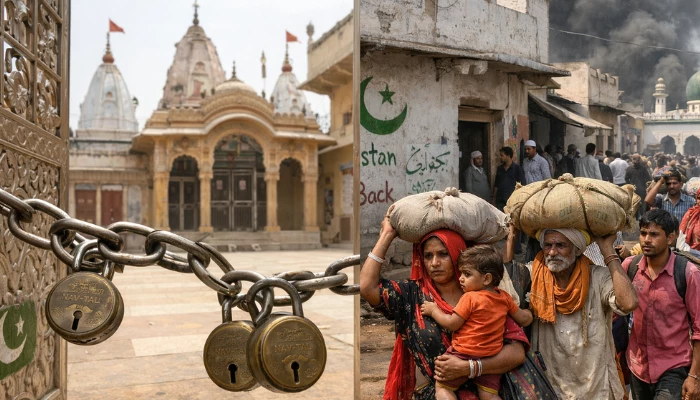
Case Summary
In Malpura, over 800 Hindu families were forced to flee their homes and migrate due to sustained harassment by the local Muslim community. According to the Hindu Harmony Forum, 800 families had migrated over the past 75 years. A video released on social media displayed how the Hindu community in Malpura had endured the pain of migration for a long time. The video stated that families from various communities, including Brahmins, had either left the old city and settled in New Malpura or had departed with their entire families to other cities. One victim explained that boys from the Muslim community drove recklessly through their lanes, and when Hindus objected, they called others to fight those who resisted. Furthermore, boys on motorbikes teased Hindu minor girls on their way to school. A minor in the video stated that Muslim boys lured Hindu minors and beat them severely. They also throw stones from their homes at Hindu residents. Additionally, Muslim men prevented Hindus from performing their daily aarti and pooja, objecting to the singing and ringing of bells in temples, claiming it caused them disturbance. Another victim reported that pieces of meat were thrown onto Hindu houses, and that Hindu men and women caught outside their homes at night were harassed. Fearing for their families’ lives, Hindus sold their properties at very low prices and began living in rented accommodation nearby. In some cases, families had abandoned their homes entirely and migrated to other cities.
Why it is Hate Crime ?
This case has been added to the tracker under the primary category of: - Attack resulting in death. Within it, the sub-category selected is: Attacked for Hindu identity. Any sort of physical attack against a Hindu or a group of Hindus, resulting in death, due to religious motivations of Abrahamics would be included in this category. This would include local communal clashes, attacks due to Abrahamic blasphemy, Hindus crossing through so-called "Muslim areas", refusal to convert, and any other religious supremacy reasons. The cases categorised here should have resulted in the death of a Hindu victim. Since the attack itself is motivated by religious considerations, the crime would be considered a hate crime. In cases where the trigger of the violence is not religious, however, the conflict takes on a religious nature, and during the course of the violence would also be categorised as a hate crime. The other primary category selected is - Attack on Hindu religious representations. The sub-category selected is - Defiling religious customs. Sanatan Dharma is not a religion of one book, which is to say that while it has religious scriptures that form the central tenets of the faith, there are several traditions followed through thousands of years, mostly passed from generation to generation orally. Several such customs and traditions are followed by various Hindus and Hindu sects. Defiling of these traditions and customs is a breach of an individual or group’s religious practices. Such practices can range from dietary restrictions like not eating non-vegetarian food for a certain period of the year, not eating non-vegetarian food at all, not eating beef since the cow is considered holy in Hinduism, the sanctity of religious customs followed in the house (like many ISCKON devotees), etc. Any malicious action leading to the breach of such traditions or defilement of these traditions owing to animosity towards the faith or for the sake of activism stems not only from the lack of faith in the religion itself but also from disregard for the faith of the devotees who follow the customs/traditions and implicit bias against the faith, the tradition itself. Since these specific traditions are central to the faith of the devotees of that specific sect of Hindus, any non-compliance with these traditional rules would be considered a religiously motivated hate crime. This case qualifies as a hate crime because the displacement of over 800 Hindu families from Malpura was not the result of isolated criminal acts but the cumulative outcome of sustained, identity-based targeting that made continued residence unsafe. Over decades, Hindu residents were subjected to intimidation, harassment, obstruction of religious practices, and social pressure that collectively forced migration. The scale and duration of the exodus demonstrate that this was not a series of private disputes but a pattern that reshaped the demographic character of the town. Historically, Malpura had been inhabited by Hindus who revered its temples, and its cultural identity was deeply shaped by these religious institutions. The Dadabadi Jain Temple, built in memory of Shri Jinkushalsurishwarji, had long drawn followers of the Khartargach sect of Shwetambar Jains from across Rajasthan. The 4th century Shri Adinath Digamber Jain Mandir had likewise served as a centre of devotion and pilgrimage. Devotees from different regions visited Malpura to seek blessings, reinforcing its standing as a recognised spiritual destination. The gradual departure of hundreds of Hindu families, therefore, represents not merely demographic change but the erosion of a historically rooted religious and cultural presence. A central religious marker in this case is the reported interference with Hindu worship. Hindus were allegedly prevented from performing daily aarti and pooja, with objections raised to temple singing and the ringing of bells. Restricting routine devotional practices within one’s own locality constitutes direct interference with religious freedom. When a minority community is pressured to silence its religious expression, it signals hostility toward its faith identity. The targeting of Hindu minors and women further reflects a coercive environment. Reports that Hindu girls were harassed on their way to school, that minor boys were lured and beaten, and that intimidation was directed at youth indicate a strategy that destabilises families and accelerates migration. When children are made unsafe, the decision to leave becomes a survival response rather than a voluntary relocation. Acts such as throwing pieces of meat onto Hindu homes carry religious symbolism beyond ordinary vandalism. For many Hindus, dietary practices are inseparable from religious observance. Deliberately throwing meat at residences functions as a form of humiliation and religious provocation aimed at undermining faith identity. Such conduct is designed to insult and intimidate on religious grounds. Additional patterns of harassment, including reckless driving through Hindu neighbourhoods followed by collective confrontation, stone throwing, and intimidation of residents found outside at night, indicate sustained territorial pressure. These behaviours collectively create an atmosphere where the Hindu community feels unwelcome and unsafe. Over time, such persistent hostility compels distressed sales of property and abandonment of homes, as families prioritise safety over heritage. The combined elements of religious obstruction, symbolic provocation, targeted harassment of minors and women, and forced economic displacement establish a pattern of systematic identity-based targeting. The large-scale migration of Hindu families from a historically significant religious town reflects the impact of sustained communal hostility. These factors meet the threshold of a hate crime and warrant documentation in the tracker as a case of coercive displacement of a Hindu minority community. Disclaimer: In this case, it was mentioned that members of 800 Hindu families were forced to flee their homes after sustained harassment. However, the exact number of individuals was not specified. Due to this lack of clarity, we relied on the most recent Indian census data, which indicated that the average family size in India was approximately 4.8 members per household. To ensure a standardised estimation, we opted to consider an average of 5 members per family. Based on this approach, the estimated total number of victims in this case was calculated as 4,000 individuals. This was recorded as the indicative victim count. In this case, media reports stated that around 4,000 Hindu residents, including men and women, were targeted in an urban locality, but no gender‑wise breakdown was provided. For documentation clarity, the Hinduphobia Tracker applied a proportional demographic estimate based on India’s Census 2011 and NFHS‑5 (2019–21) urban population data. Accordingly, the 4,000 participants were estimated as 2,080 men (52%) and 1,920 women (48%), reflecting the slightly higher male proportion consistent with typical urban demographics. As the age‑wise segregation was also not specified in the media report, the Hinduphobia Tracker used a proportional demographic estimate derived from the same data sources. Accordingly, the 4,000 participants were estimated as 3,200 adults (80%) and 800 children (20%). The Hinduphobia Tracker records incidents based on when the crime occurs, or the victims' ordeal begins, rather than media reporting dates. In this case, media reports did not specify the exact start of the ordeal. Therefore, 19 December 2026 has been selected as the indicative incident date, the date when it was first reported in the media. This date is recorded for documentation purposes only.


Case Status
Unknown


Perpetrators Details
Perpetrators
Muslim Extremists
Perpetrators Range
Unknown
Perpetrators Gender
unknown
 Sources




