Hindu families subjected to repeated harassment and assault by Muslim family; victims forced to flee for their safety
 Agra, Uttar Pradesh, India
  1 February, 2026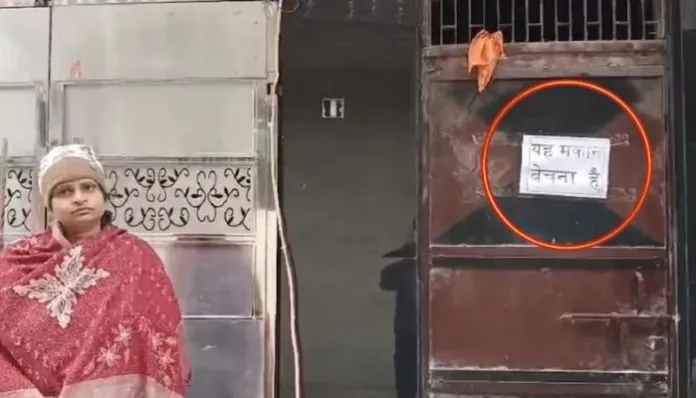
Case Summary
In Agra, Uttar Pradesh, forty Hindu families were selectively targeted by the Muslim family of a man named Mohammad Shahbaz. The accused's family regularly pelted stones at Hindu women and children and harassed their families. This repeated targeting and attacks forced the Hindu families to put up “House for Sale” posters and plan to migrate elsewhere for safety. According to media reports, this came to light when several Hindu families living in Bhagwan Nagar Block A under the Kamala Nagar area of Agra decided to leave their homes. They were facing continuous problems from Mohammad Shahbaz. Nearly 40 families put up “house for sale” posters outside their houses. Residents stated that daily fights and tension had made normal life very difficult, especially for women and children. A video of a local Hindu woman surfaced in which she said that only one Muslim family lived in their colony, while more than 35 Hindu families resided there. She said that Shahbaz often threw stones and bricks at the Hindu families, leaving people injured and scared. Some local people said that Mohammad Shahbaz and his son Sunny frequently argued and fought with Hindu families. On 2 February 2026, during a Hindu family function, Sunny entered a Hindu house and attacked a resident, who later required stitches during his recovery. Hindu women in the area also complained about molestation, misbehaviour and harassment from the Muslim perpetrators. Hindu residents said they approached the police many times, but instead of help, they were threatened, leaving them with no option but to sell their homes. Local councillor Hariom Baba Agarwal also said no action was taken even after complaints. Meanwhile, ACP Sheshmani Upadhyay said police inquiry found that Shahzad was staying in the house of a widow, Sitara Begum, who wanted him to leave. He added that Shahzad had agreed to vacate, and the issue had been settled as a family matter.
Why it is Hate Crime ?
The primary category selected in this case is: Attack not resulting in death. The chosen sub-category is: Attacked for Hindu identity. In several cases, Hindus are attacked merely for their Hindu identity without any perceived provocation. A classic example of this category of religiously motivated hate crime is a murder in 2016. 7 ISIS terrorists were convicted for shooting a school principal in Kanpur because they got ‘triggered’ seeing the Kalava on his wrist and the tilak that he had put. In this, the Hindu victim had offered no provocation except for his Hindu religious identity. The motivation for the murder was purely religious, driven by religious supremacy. Such cases where Hindus are targeted merely for their religious identity would be documented as a hate crime under this category. In this case, it was evident that only Hindu families were selectively targeted and harassed by the Muslim perpetrators precisely because of their Hindu identity. The harassment was directed solely at them, with no non-Hindu families in the colony facing similar attacks, stone-throwing, or intimidation. This blatant selectivity, sparing others while attacking Hindus, marks a textbook hate crime, where religious bias drives the choice of victims. Under hate crime standards, such targeted attacks proves taht the attack was rooted in animus against Hinduism, not mere personal grudges. More importantly, the Hindu families were targeted explicitly to facilitate their migration from the colony, evidencing a religiously motivated displacement strategy. The continuous harassment, stone-throwing at Hindu women and children, misbehaviour, molestation, and brutal physical attacks, such as Sunny's assault requiring stitches, created an unbearable environment of fear and insecurity. This relentless pressure compelled nearly 40 families to put up “House for Sale” posters and plan to flee their homes. The intent to ethnically cleanse the area of Hindus through sustained attacks, intimidation and terror elevates this to a hate crime, as it weaponises religious hatred to alter community composition. This incident reflected a broader, documented pattern across multiple regions where Muslim perpetrators harass and disturb Hindus specifically to force them to leave, thereby enabling Muslims to occupy the vacated land or property. Tactics like repeated fights, threats, and violence target Hindu resilience, aiming to break it through religious contempt. Police inaction despite complaints further enabled this, but the core motivation, driving out Hindus to claim space, demonstrates religious animus, fitting hate crime profiles of coercive demographic shifts fuelled by anti-Hindu animosity and Islamic supremacy. Additionally, the acts of attacking residents during Hindu family functions, stone-throwing, molesting and harassing Hindu women, disrupting Hindu gatherings, and physically assaulting Hindus showcased that the violence arose clearly from religious animosity, aimed at instilling maximum fear, humiliation, and intimidation among the victims, hallmarks of a hate crime. These weren't isolated brawls; rather, they were targeted attacks on Hindus for their faith identity, making it a hate-driven crime. This is not the first time targeted harassment and assaults on Hindus by Muslims have forced families to flee their homes. The Hinduphobia Tracker has previously recorded multiple such instances. One example occurred in Bhopal's Muslim-dominated Housing Board Colony, Old Subhash Nagar, Madhya Pradesh, where a Hindu lawyer, Advocate Veena Gautam and her family endured sustained harassment from local Muslims. The perpetrators selectively targeted them due to their Hindu identity and to drive the family away, part of broader Hindu displacements due to religious intimidation in the area. Similarly, in another instance in Madhya Pradesh's Ratlam district, Hindu villagers from Surana threatened to abandon their homes amidst persecution by the Muslim community and official inaction. In this village of around 2,200, predominantly Muslim with Hindus comprising 40%, longstanding peace was shattered as victims faced attacks, abuse, and fake FIRs, compelling them to sell properties and flee for safety. In conclusion, in this case, the harassment of 40 Hindu families in Agra formed part of this ongoing pattern of Hinduphobia, where Hindus were deliberately targeted due to their religious identity and compelled to vacate homes and colonies. This underscores the need for documentation and recognition, so the case has been added to the Hinduphobia Tracker's hate crime database. Disclaimer: In this case, it is mentioned that members of 40 Hindu families were forced to put up 'on sale' posters after the harassment by Muslim neighbours. However, the exact number of individuals is not specified. Due to this lack of clarity, we have relied on the most recent Indian census data, which indicates that the average family size in India is approximately 4.8 members per household. To ensure a standardised estimation, we have opted to consider an average of 5 members per family. Based on this approach, the estimated total number of victims in this case is calculated as 200 individuals. This is recorded as the indicative victim count. In this case, media reports stated that around 200 Hindu residents, including men and women, were targeted for conversion in an urban locality, but no gender-wise breakdown was provided. For documentation clarity, the Hinduphobia Tracker has applied a proportional demographic estimate based on India’s Census 2011 and NFHS-5 (2019–21) urban population data. Accordingly, the 200 participants were estimated as 104 men (52%) and 96 women (48%), reflecting the slightly higher male proportion consistent with typical urban demographics. As the age-wise segregation was also not specified in the media report, the Hinduphobia Tracker has used a proportional demographic estimate derived from the same data sources. Accordingly, the 200 participants were estimated as 160 adults (80%) and 40 children (20%). Another important aspect to highlight is that reports in this case specified that the Hindu families were targeted by the Muslim family of Shahbaz, including his son Sunny. However, reports did not detail the total number of perpetrators within the family. They only named Shahbaz and Sunny explicitly. Henceforth, these two are considered the indicative perpetrators for this case. The perpetrator count is recorded as two (2) for documentation purposes. This is a conservative estimate, as the actual number could be higher. The Hinduphobia Tracker records incidents based on when the crime occurs, or the victims' ordeal begins, rather than media reporting dates. In this case, media reports did not specify the exact start of the ordeal but noted 2 February 2026 as the recent date when Shahbaz's son attacked a Hindu resident. Henceforth, 2 February 2026 has been selected as the indicative incident date. This date is recorded for documentation purposes only.
Victim Details
Total Victim
200
Deceased
0
Gender
- Male 104
- Female 96
- Third Gender 0
- Unknown 0
Caste
- SC/ST 0
- OBC 0
- General 0
- Unknown 200
Age Group
- Minor 40
- Adult 160
- Senior Citizen 0
- Unknown 0


Case Status
Complaint filed


Perpetrators Details
Perpetrators
Muslim Extremists
Perpetrators Range
From 2 To 5
Perpetrators Gender
male
 Sources




