Hinduism and Hindu organisation vilified by Indian politician: calls it violent and opposed to social progress
 Mysore, Karnataka, India
  17 October, 2025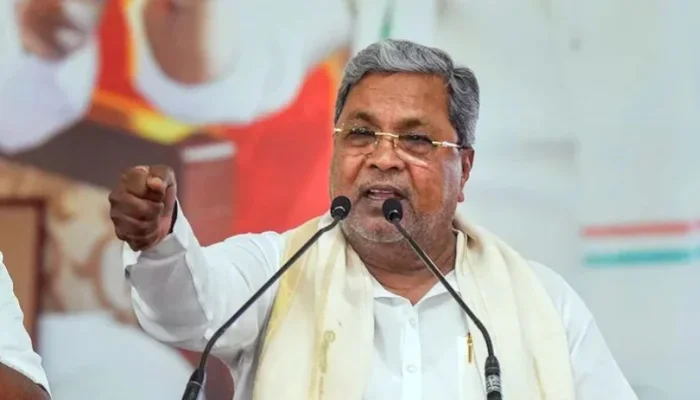
Case Summary
Karnataka Chief Minister Siddaramaiah vilified Hinduism by claiming that Sanatan Dharma and the Rashtriya Swayamsevak Sangh (RSS) are opposed to social change. During the silver jubilee celebrations of Mysore University, Siddaramaiah's comments drew widespread attention for their hostility towards Sanatan Dharma and the Hindu organisation. Speaking at the event, he urged people to be cautious about the company they kept, advising them to associate only with those who supported social reform and to stay away from Sanatanis and the RSS. He said, “Keep your company right. Associate with those who stand for society, not with those who oppose social change or with Sanatanis.” His remarks were interpreted as a direct attack on the ideological foundation of Sanatan Dharma and organisations aligned with it. In his speech, Siddaramaiah also referred to an incident in which a shoe had been thrown at Chief Justice of India BR Gavai, claiming that the perpetrator was a Sanatani. He claimed that this episode revealed the continued presence of orthodox and regressive elements within society and urged that such acts should be condemned not only by Dalits but by all sections of society, asserting that only collective disapproval could lead to meaningful social progress. To support his narrative of caste bias, he further claimed that the RSS had historically opposed the Constitution drafted by Dr BR Ambedkar and continued to do so. He claimed that the RSS was distorting Ambedkar’s political legacy and spreading falsehoods about his electoral history. “They are spreading lies that the Congress defeated Ambedkar in the elections. But the truth is what Ambedkar himself wrote in his own handwriting, ‘Savarkar and Dange defeated me.’ Such truths must be placed before society to expose the falsehoods of the Sangh Parivar,” Siddaramaiah claimed. In recent years, Congress leaders, including Siddaramaiah, Priyank Kharge and Mallikarjun Kharge, have repeatedly argued that India should be the land of Basavanna, Buddha and Ambedkar, all invoked in political contexts that distance themselves from Hinduism. Priyank Kharge had, in fact, recently called for a ban on RSS programmes in educational premises. State BJP president BY Vijayendra criticised Siddaramaiah’s statements, highlighting that the Congress had previously imposed bans on the RSS only to later revoke them. He described the government’s actions as politically motivated, aimed at appeasing the Gandhi family, and argued that the Congress lacked the authority or conviction to enforce such prohibitions.
Why it is Hate Crime ?
This case has been added to the tracker under the primary category- Hate Speech against Hindus. The subcategory selected is- Anti-Hindu slurs, mocking faith. Anti-Hindu slurs and the deliberate mocking of the Hindu faith owing to religious animosity involve the usage of derogatory terms, stereotypes, or offensive references to religious practices, symbols, or figures. One of the common anti-Hindu slurs used against Hindus is “cow-worshipper” and “cow piss drinker”. The intention of using this term is to demean and mock Hindus as a group and their religious beliefs since Hindus consider the cow holy. Additionally, some symbols and the slurs attached to them have a historical context that exacerbates the insult, hate, stereotyping, dehumanisation and oppression against Hindus. Cow worship has been used for centuries to denigrate Hindus, insult their faith and oppress Hindus specifically as a religious group. There has been overwhelming documentation about how cow slaughter has been used to persecute Hindus with cow meat being thrown in temples and places of worship. There has also been overwhelming documentation where cow meat (beef) has been force-fed to Hindus to either forcefully convert them to Islam or denigrate their faith. Apart from cow worship, the Swastika – which holds deep religious significance for the Hindus – has also been misinterpreted and distorted to use as a slur against Hindus. Similarly, the worship of the Shivling has been used by supremacist ideologies and religions to denigrate Hindus owing to religious animosity. Such slurs and denigration stem out of inherent animosity and hate towards Hindus and their faith, therefore, it is categorised as hate speech targeted at Hindus specifically owing to their religious identity. The second subcategory selected is- Mocking/denigrating Hindu leaders. Hate speech is defined as any speech, gesture, conduct, writing, or display that is prejudicial against a specific individual and/or group of people, which is leading to or may lead to violence, prejudicial action or hate against that individual and/or group. Religious leaders are often seen as representatives of the community, especially, the community’s religious faith and beliefs. Mocking or denigrating a religious leader specifically owing to his religious identity and/or the religious rituals he observes can be considered hate speech because the motivating factor of the speech is animosity and/or dislike for what he represents – the religious beliefs and faith of the community. It is important to note that mere insulting words against an individual do not constitute hate speech. It is entirely possible that insulting words are used for an individual, however, the specific speech is not the result of religious hate and/or animosity towards the professed faith of the religious leader, but the individual himself. For the speech to be considered hate speech, the speech itself or the motivating factor behind the speech has to be religious in nature. Such speech which denigrates Hindu religious leaders specifically owing to animosity towards the faith they profess and the community faith they represent will be treated as hate speech under this category. This case represents a clear instance of anti-Hindu hate speech directed against Hindus and their religious and cultural organisations. Karnataka Chief Minister Siddaramaiah publicly vilified Sanatan Dharma and the Rashtriya Swayamsevak Sangh (RSS), urging people to avoid associating with Sanatanis and the RSS. By equating adherence to Hindu traditions with opposition to social change and portraying them as regressive, he targeted Hinduism and Hindus collectively, depicting their faith as backward and socially obstructive. The RSS is a Hindu organisation founded on the ideology of Hindutva — a civilisational movement dedicated to safeguarding Hinduism from forces seeking to weaken or erase it, including Islamist fundamentalism, Khalistani extremism, aggressive Christian proselytisation, and Marxist or left-liberal ecosystems that propagate anti-Hindu narratives. Hindutva does not advocate domination but promotes unity, self-respect, and collective self-defence, urging Hindus across caste and class lines to preserve their faith and cultural identity. The repeated targeting of “Hindutva” and organisations like the RSS in political rhetoric functions as a socially acceptable proxy for attacking Hindus themselves. By framing opposition to Hindutva as a progressive stance, figures like Siddaramaiah create space where hostility toward Hindu beliefs and identity is normalised. This allows Hinduphobia to masquerade as ideological criticism, turning “Hindutva” into a euphemism for vilifying Hindus. The anti-Hindu intent behind such framing was evident in the “Dismantling Global Hindutva” conference in the United States, where participants admitted that Hindutva and Hinduism are inseparable — meaning dismantling one entails dismantling the other. During his speech, Siddaramaiah also invoked the shoe-throwing incident targeting Chief Justice of India B.R. Gavai, claiming that the person who threw the shoe was a “Sanatani” who attacked a “Dalit” judge. By using the term “Sanatani,” he equated it with upper-caste Hindu orthodoxy and attempted to pit Sanatanis against Dalits, manufacturing caste conflict where none existed. His framing falsely implied that an upper-caste Hindu had targeted a Dalit judge, whereas CJI Gavai is a Buddhist, and the man who hurled the shoe, Rakesh Kishore, is himself a Dalit. This distortion shows how Siddaramaiah used the term “Sanatani” as a political tool to vilify Hindu society and inject caste divisions into a matter rooted solely in religious sentiment. The incident stemmed from a petition concerning the restoration of Lord Vishnu’s idol at the Javari Temple in Khajuraho, Madhya Pradesh. When the bench led by Justice Gavai dismissed the plea with sarcasm, remarking, “This is purely publicity interest litigation. Go and ask the deity itself to do something now” — it hurt Hindu sentiments deeply. The 71-year-old advocate Rakesh Kishore’s shoe-throwing was a spontaneous emotional outburst directed at someone who had openly insulted his faith, not an act of caste hostility. By branding Rakesh Kishore a “Sanatani” and linking his act to orthodoxy, Siddaramaiah portrayed Hinduism as inherently oppressive. This misrepresentation, echoed by leftist and Islamist voices, seeks to fragment Hindu unity by reframing a faith-driven reaction as a caste conflict. Such narratives erode the unifying force of Hindu identity, which transcends caste and region, by promoting the false notion that Hinduism itself is tyrannical and intolerant. These distortions not only vilify Hindus but also normalise prejudice against the majority faith, creating a climate where defending Hinduism is portrayed as extremism. Siddaramaiah’s comments, along with the stance of the Congress party, must be understood in the larger context of selective outrage and double standards in India’s public discourse on religion. When members of other faiths, particularly Islamist groups, publicly issue beheading threats or raise slogans such as Sar tan se juda against perceived insults to their religion, political, judicial, and media responses are often muted. High-profile cases, including the controversies surrounding Nupur Sharma and Umesh Kolhe, show that when Hindus assert their religious rights or defend their faith, they are disproportionately scrutinised, vilified, or criminalised, while comparable acts by others are ignored or even justified. Siddaramaiah’s rhetoric aligns with this pattern, amplifying hostility against Hindus for asserting their religious dignity while overlooking similar behaviour from other communities. By contrast, Siddaramaiah’s narrative punished a Hindu man for an emotional outburst in response to an insult to his religion. His comments effectively painted self-defence of Hindu identity as aggression, contributing to an environment where Hindus are delegitimised for expressing religious devotion while similar actions by others are tolerated. Framing this incident as evidence of systemic “orthodoxy” and “regressiveness” within Hindu society not only misrepresented the event but also served a broader ideological purpose: to delegitimise Hindu society, portray Hindus as intolerant, and normalise the notion that defending one’s faith is inherently problematic. Siddaramaiah then invoked Ambedkar and Ambedkarite ideology in an attempt to pit the Rashtriya Swayamsevak Sangh (RSS) against the legacy and vision of Dr B.R. Ambedkar. By framing the RSS as historically opposed to Ambedkar and his Constitution, Siddaramaiah sought to portray the Hindu organisation as fundamentally antagonistic to progressive social reform. His comments also implied that RSS was against the Constitution simply because it was written by Ambedkar, who was a Dalit. This invocation was not merely rhetorical; it was strategically used to delegitimise the RSS and, by extension, Hindu social and religious institutions, presenting them as anti-constitutional, casteist, and regressive. It is important to understand here that Ambedkarism, as a political and social ideology, has a documented history of adopting an anti-Hindu stance under the pretext of combating casteism. From the burning of sacred Hindu texts such as the Manusmriti to the verbal denigration of Hindu deities, numerous Ambedkarite activists and organisations have openly expressed disdain for Hindu beliefs, practices, and traditions. This ideological influence has repeatedly framed Hinduism as oppressive or discriminatory, often exaggerating caste hierarchies or social injustices to discredit the Hindu faith as a whole. In his statements, Siddaramaiah misrepresented historical facts about Ambedkar’s political and electoral history. He accused the RSS of opposing Ambedkar’s Constitution, implying that the RSS opposed the Constitution primarily because Ambedkar was a Dalit. By framing the issue in this way, Siddaramaiah sought to present the RSS as an organisation inherently antagonistic to Dalits and lower-caste communities, thereby casting Hindus more broadly as oppressive and discriminatory. In reality, the RSS never formally rejected the Constitution nor campaigned against its implementation. While the organisation expressed reservations about certain provisions it considered incompatible with India’s civilisational identity, these disagreements were legal and ideological in nature, rather than aimed at a person. By claiming otherwise, Siddaramaiah misrepresented the role and stance of the RSS in India’s constitutional history. Moreover, Siddaramaiah distorted Ambedkar’s electoral record to further vilify the RSS. He suggested that Ambedkar was defeated by RSS-backed forces, creating the impression that the RSS had actively worked against him. Historical records show that it was Congress MLA Narayan Sadoba Kajrolkar who defeated Ambedkar in that election, not the RSS. By falsely attributing Ambedkar’s electoral loss to the RSS, Siddaramaiah constructed a narrative in which a major Hindu organisation and Hindutva ideology were framed as anti-constitutional, casteist, and regressive. Siddaramaiah’s statements mischaracterised the social and cultural work of the RSS, an organisation that conducts educational, social service, disaster relief, and community development activities across India. By portraying the RSS and those aligned with Sanatan Dharma as “opposers of social change” and morally regressive, he cast Hindu faith, values, and self-organisation in a negative light, spreading prejudice against the Hindu community. Moreover, the Chief Minister’s rhetoric fuels communal hostility by equating Hindu orthodoxy with societal harm and framing Hindu belief systems as antithetical to rationality and progress. His statements actively stigmatise Hindus for practising their faith, participating in cultural organisations, and promoting social discipline within their communities. This vilification constitutes hate speech because it maligns an entire religious community and encourages discrimination against Hindus based on their faith. Given his position as Chief Minister, Siddaramaiah’s statements carry significant influence and risk normalising hostility against Hindus and Hindu organisations. By portraying Sanatan Dharma and the RSS as obstacles to social reform and progress, he not only misrepresents Hindu ideology but also creates an environment in which Hindus and their institutions can be publicly denigrated or marginalised. Therefore, this incident constitutes clear anti-Hindu hate speech and is being recorded as such in the Hinduphobia Tracker, highlighting the broader societal impact of public statements by political leaders that vilify Hindu identity, faith, and institutions.


Case Status
Complaint not filed


Perpetrators Details
Perpetrators
State and Establishment
Perpetrators Range
One Person
Perpetrators Gender
male
 Sources




