Hindu organisation unfairly vilified: Buddhist politician calls for RSS ban, labels it against India’s secular ethos
 Karnataka, India
  3 October, 2025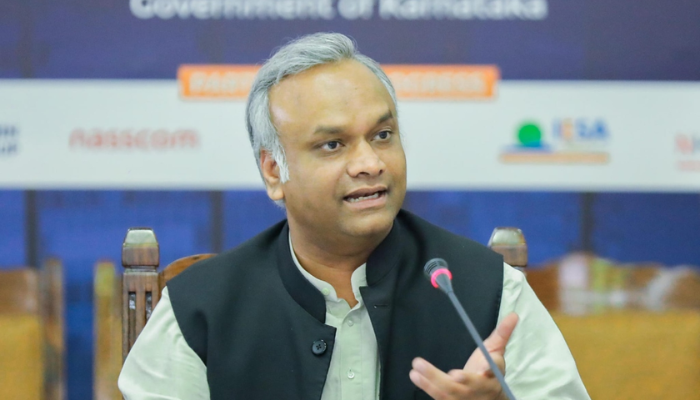
Case Summary
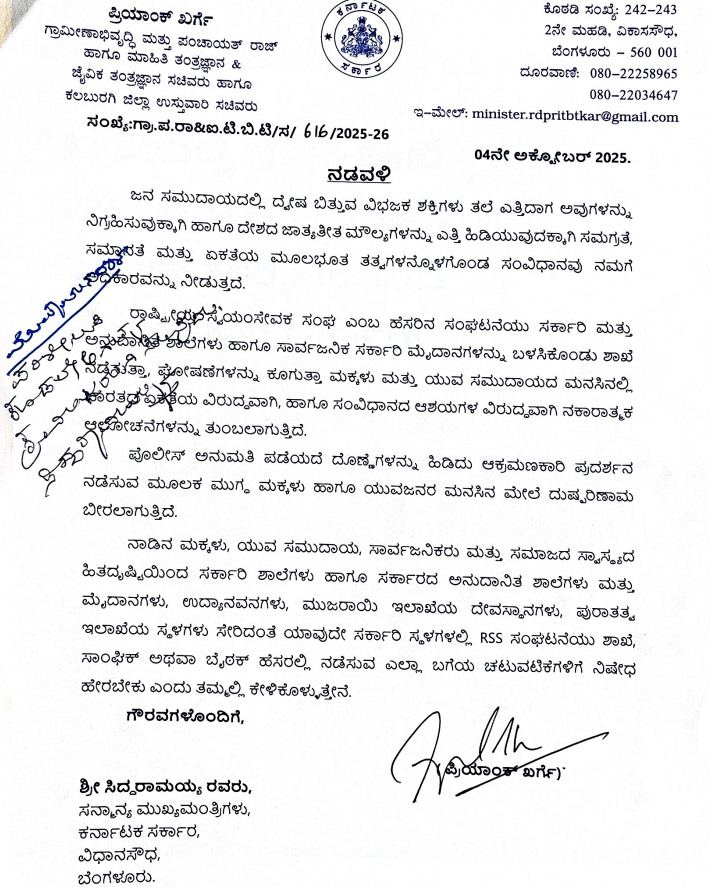
In Karnataka, a reputable Hindu organisation, Rashtriya Swayamsevak Sangh (RSS), were vilified by Karnataka Minister Priyank Kharge, a Buddhist by faith and a follower of Ambedkarism, an anti-Hindu political movement. According to media reports, on 4th October 2025, the minister wrote a letter to Chief Minister Siddaramaiah, requesting that the Rashtriya Swayamsevak Sangh be barred from hosting any programmes or activities in government offices and public institutions in the state. Kharge claimed that these activities were contrary to India’s unity and the spirit of the Constitution. He expressed concern over RSS shakhas (branch meetings) being held in government and government-aided schools, public parks, and other public areas. He claimed that during such programmes, slogans were raised and negative thoughts were imparted into the minds of children and young people. The Chief Minister’s Office released the letter to the media on 5th October 2025. In the letter, Kharge described the RSS ideology as inconsistent with India’s ideals of unity and secular tradition. He further claimed that some of these events were organised without police permission and that participants were equipped with sticks and behaved aggressively, which he believed could have a detrimental psychological effect on children and youth. Kharge added that whenever polarising forces spreading hatred started gaining ground, it was the responsibility of the government to intervene. He declared that the Constitution, based on honesty, equality, and brotherhood, gave the government the authority to take action against such forces and protect secular values. Calling for immediate government action, Kharge urged the Chief Minister to prohibit all RSS activities conducted under the names ‘shakha’, ‘sanghik’, or ‘baithak’. He demanded that the ban should apply to government schools, government-aided schools, public playgrounds, parks, Muzrai temples, archaeological monuments, and any other government buildings. He noted that both citizens and the state had the duty to safeguard the country’s secular and democratic values. He warned that allowing groups that promote divisive thinking to operate freely in public spaces could weaken the nation’s social fabric. Kharge concluded by claiming that his recommendation was not an act of political rivalry, but a step to protect children, young people, and society from ideologies that may create division. At the time of writing this report, the Chief Minister has yet to issue an official response to the letter. However, the matter has already sparked political debate across Karnataka.
Case Images
Why it is Hate Crime ?
This case has been added to the tracker under the primary category- Hate Speech against Hindus. The subcategory selected is- Anti-Hindu slurs, mocking faith. Anti-Hindu slurs and the deliberate mocking of the Hindu faith owing to religious animosity involve the usage of derogatory terms, stereotypes, or offensive references to religious practices, symbols, or figures. One of the common anti-Hindu slurs used against Hindus is “cow-worshipper” and “cow piss drinker”. The intention of using this term is to demean and mock Hindus as a group and their religious beliefs since Hindus consider the cow holy. Additionally, some symbols and the slurs attached to them have a historical context that exacerbates the insult, hate, stereotyping, dehumanisation and oppression against Hindus. Cow worship has been used for centuries to denigrate Hindus, insult their faith and oppress Hindus specifically as a religious group. There has been overwhelming documentation about how cow slaughter has been used to persecute Hindus with cow meat being thrown in temples and places of worship. There has also been overwhelming documentation where cow meat (beef) has been force-fed to Hindus to either forcefully convert them to Islam or denigrate their faith. Apart from cow worship, the Swastika – which holds deep religious significance for the Hindus – has also been misinterpreted and distorted to use as a slur against Hindus. Similarly, the worship of the Shivling has been used by supremacist ideologies and religions to denigrate Hindus owing to religious animosity. Such slurs and denigration stem out of inherent animosity and hate towards Hindus and their faith, therefore, it is categorised as hate speech targeted at Hindus specifically owing to their religious identity. The other subcategory selected is- Mocking/denigrating Hindu leaders. Hate speech is defined as any speech, gesture, conduct, writing, or display that is prejudicial against a specific individual and/or group of people, which is leading to or may lead to violence, prejudicial action or hate against that individual and/or group. Religious leaders are often seen as representatives of the community, especially, the community’s religious faith and beliefs. Mocking or denigrating a religious leader specifically owing to his religious identity and/or the religious rituals he observes can be considered hate speech because the motivating factor of the speech is animosity and/or dislike for what he represents – the religious beliefs and faith of the community. It is important to note that mere insulting words against an individual do not constitute hate speech. It is entirely possible that insulting words are used for an individual, however, the specific speech is not the result of religious hate and/or animosity towards the professed faith of the religious leader, but the individual himself. For the speech to be considered hate speech, the speech itself or the motivating factor behind the speech has to be religious in nature. Such speech which denigrates Hindu religious leaders specifically owing to animosity towards the faith they profess and the community faith they represent will be treated as hate speech under this category. This case clearly represents an instance of anti-Hindu hate speech directed towards Hindus and their organisations. The accused, Priyank Kharge, who follows Buddhism, called for a ban on a highly reputed Hindu organisation, the Rashtriya Swayamsevak Sangh (RSS). It is essential to note that the RSS is a Hindu organisation founded on the ideology of Hindutva — a political, cultural, and civilisational movement aimed at protecting Hinduism from anti-Hindu forces such as Islamist fundamentalism, Khalistani extremism, aggressive Christian proselytisation, and left-liberal or Marxist ecosystems that promote anti-Hindu narratives. The ideology of Hindutva is not one of violence or suppression; it stands for unity, strength, and self-defence. It encourages Hindus, across caste and class lines, to unite in preserving their faith, dignity, and cultural identity. By calling for a ban on the RSS and branding its activities as being contrary to India’s unity and the spirit of the Constitution, Priyank Kharge engaged in rhetoric that vilified a major Hindu organisation and, by extension, the Hindu community. His statements portrayed Hindutva, a movement that promotes strength and self-respect among Hindus, as divisive and dangerous, perpetuating negative stereotypes about Hinduism and its cultural expressions. Such remarks not only distort the ideology of Hindutva but also demonise the efforts of Hindu organisations working to unite and uplift their community. Kharge also accused the RSS of holding shakhas in government and government-aided schools, parks, and public areas, alleging that “negative thoughts” were being instilled in the minds of children. This accusation constitutes direct hate speech against Hindus because it frames Hindu cultural education, awareness, and discipline as dangerous or extremist behaviour. The RSS conducts social service, disaster relief, education, cow protection, and community development activities across India. Teaching Hindu children to be disciplined, aware of their faith, and prepared to defend themselves in times of crisis cannot be equated with spreading hate or propaganda. Depicting such moral and cultural education as “negative indoctrination” shows the deep-seated religious prejudice that fuels anti-Hindu sentiment. The minister further claimed that RSS participants were armed with sticks and displayed aggression, supposedly creating psychological harm to children and youth. This, again, is a baseless accusation. The physical training carried out during RSS shakhas is similar to community drills and discipline-building exercises found in schools and sports training. Portraying these as signs of aggression reinforces harmful stereotypes and incites bias and hatred against Hindu organisations. Kharge’s remarks describing the RSS as “polarising” and its ideology as “antithetical to the Constitution and secular values” undeniably amount to hate speech. Such statements vilify Hindutva, paint patriotic Hindu organisations as a societal threat, and directly fuel intolerance against Hindus. His call for a complete ban on RSS activities in schools, temples, and public spaces is not only a violation of freedom of speech and association but also an attempt to suppress Hindu political and cultural expression. These remarks can breed animosity, discrimination, and even violence towards Hindus by portraying them as inherently divisive or intolerant when, in reality, they are engaged in self-preservation and community service efforts. It is also crucial to consider the ideological background of the accused. Priyank Kharge’s Ambedkarite leanings explain his hostility towards the RSS and to Hindus more broadly. Ambedkarism, as a political ideology, has a long record of adopting an anti-Hindu stance under the pretext of fighting casteism. From burning sacred Hindu texts such as the Manusmriti to verbal abuse against Hindu deities, numerous Ambedkarite activists have expressed open disdain for Hindu beliefs and traditions. This ideological influence makes it evident that Kharge’s attack on the RSS was not about governance or secularism but emerged from a deep-rooted animosity towards the Hindu faith itself. Therefore, this incident constitutes clear anti-Hindu hate speech — directed against a Hindu organisation, the idea of Hindutva, and the Hindu community at large. By misrepresenting Hindutva as hate-driven and calling for a ban on RSS activities, the minister propagated prejudice and hostility towards Hindus. His statements seek not only to silence Hindu voices but also to stigmatise their identity and beliefs as incompatible with the Indian nation. Hence, this case has been recorded as an act of anti-Hindu hate speech and is being added to the hate crime database of the Hinduphobia Tracker.


Case Status
Unknown


Perpetrators Details
Perpetrators
Others
Perpetrators Range
One Person
Perpetrators Gender
male
 Sources




