Anti-Hindu violence during Ganesh Visarjan downplayed by Indian politician, calls it ''small incidents''
 Karnataka, India
  8 September, 2025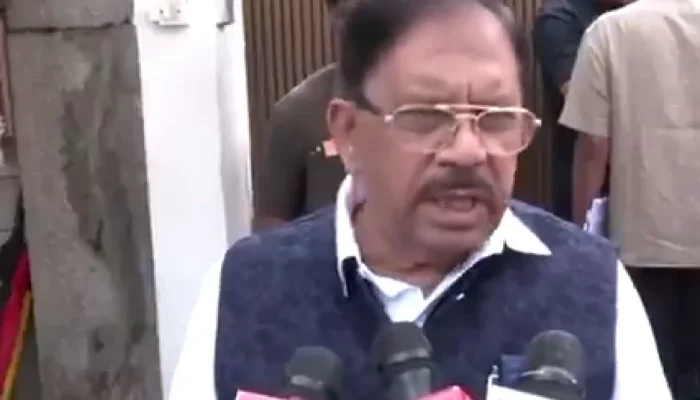
Case Summary
In Karnataka, anti-Hindu violence during the Ganesh Visarjan, a Hindu religious procession, was downplayed by Congress politician and Karnataka Home Minister G. Parameshwara. He described the deliberate targeting of the religious procession and the anti-Hindu violence unleashed against the Hindu devotees as "small incidents". Notably, the Hinduphobia Tracker had earlier reported two incidents of violence during Ganesh Visarjan in Karnataka. In the first incident, a Hindu religious procession was attacked by Muslims with stones in Mandya on 7th September 2025, during Ganesh Visarjan. The violence broke out as the immersion procession passed near a mosque, where stones were hurled from within its premises at the Hindu devotees. The attack left at least eight Hindus seriously injured, all of whom were rushed to the hospital for treatment. In the second incident, a Hindu religious procession was targeted during Ganesh Visarjan in Sagar town of Shivamogga district. This incident unfurled on 7th September 2025, when two Muslim youths spat on the idol of Lord Ganesha. The procession, organised by the Jai Bhuvaneshwari Yuva Sangh, was passing through Jannat Nagar when the act was committed, sparking outrage among the devotees and heightening tensions in the area. Police quickly intervened, assured strict legal action against the culprits, and appealed for peace. Despite this, Congress politician and Karnataka Home Minister G. Parameshwara downplayed the anti-Hindu attacks. He stated: "An incident has happened in Maddur town, Mandya, a stone-pelting incident, which is now under control. The police have already arrested a few people... Section 144 has been imposed. One or two small incidents also happened in the state. One stabbing incident has also happened; everything is under control. The police have taken all the necessary steps."
Why it is Hate Crime ?
This case has been added to the tracker under the primary category- Hate Speech against Hindus. Within this, the subcategory selected is- Anti-Hindu subversion and prejudice. The tertiary category selected is- Anti-Hindu fake news or downplaying. Hate speech is defined as any speech, gesture, conduct, writing, or display that is prejudicial against a specific individual and/or group of people, which is leading to or may lead to violence, prejudicial action or hate against that individual and/or group. Media plays a specific and overarching reach in perpetuating prejudicial attitudes towards a community owing to unfair, untrue coverage and/or misrepresentation/misinterpretation, selective coverage and/or omission of facts of/pertaining to issues affecting a specific religious group. This type of bias can dehumanise the victim group, making it easier for others to justify harmful actions against them, which aligns with the objectives of hate speech laws aimed at preventing such harm. It is often observed that the media takes a prejudicial stand against the Hindu community driven by their need to shield the aggressor community which happens to be a numeric minority, however, is the one perpetrating violence against Hindus. For example, the media is often quick to contextualise religiously motivated crimes against Hindus, omit or misrepresent facts that point towards religiously motivated hate crimes, justify and/or downplay religiously motivated hate crimes or simply present fake news to stereotype Hindus. Such media bias leads to the denial of persecution and is often used to dehumanise Hindus, leading to justification for violence against them. For example, the media covered several fake allegations of Hindus targeting Muslims and forcing them to chant Jai Shree Ram. Most of these cases were proved false and fabricated after police investigation. These fake news reports were subsequently never retracted or clarified. Such fake news led to the justification of violence and dehumanisation of Hindus based on the argument that since Hindus targeted Muslims and forced them to chant Jai Shree Ram, the dehumanisation of Hindus and violence against them was par for the course and merely a retaliation. Such media bias leads to prejudicial portrayal of Hindus and offers a justification for violence against them and therefore, is considered hate speech under this category. The Karnataka Home Minister, G. Parameshwara, downplayed the anti-Hindu attacks on Hindu processions during the Ganesh Visarjan by labelling them as "small incidents" and insisting that the situation was under control. This approach reflects a deeply troubling attitude, as it minimises the severity of violence directed specifically at the Hindu community, undermining the lived experiences of the victims and their grievances. When such attacks are dismissed by a high-ranking official, it sends a message that violence against Hindus is not considered a serious concern, thereby normalising such acts and emboldening the Muslim perpetrators. Incidents of anti-Hindu violence like the stone-pelting at the Mandya procession and the desecration of a Lord Ganesha idol in Shivamogga are examples of targeted hostility towards Hindus that demand urgent and decisive action. By trivialising these incidents, the Home Minister indirectly signals tolerance towards hate crimes and fosters an environment where violence against Hindus is overlooked or excused. Downplaying such incidents encourages an atmosphere in which it seems acceptable to attack Hindu festivals and individuals participating in them. It weakens the state's responsibility to protect Hindus, effectively allowing communal hostility to fester. This sends a dangerous message that anti-Hindu violence is tolerable or inevitable, thereby perpetuating an environment hostile to Hindu religious expression and practice. By brushing off incidents involving desecration of a Hindu deity and brutal assaults on devotees as routine or minor, the minister not only downplayed the Hinduphobic nature of these crimes but also signalled a lack of empathy for Hindu sentiments. This selective minimisation betrays a clear bias, revealing how anti-Hindu prejudice operates at a political level by normalising or excusing violence when Hindus are the victims.


Case Status
Unknown


Perpetrators Details
Perpetrators
State and Establishment
Perpetrators Range
One Person
Perpetrators Gender
male
 Sources




