Ganpati Visarjan procession attacked with stones near mosque, Ganesha idol targeted
 Mandya, Karnataka, India
  6 September, 2025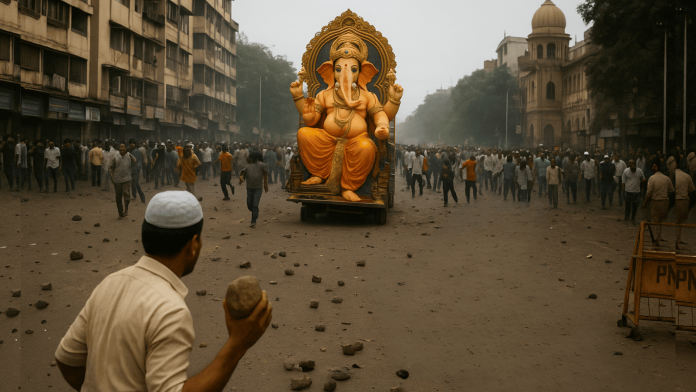
Case Summary
A Hindu religious procession was attacked with stones in Mandya, Karnataka, on 7 September 2025, during Ganesh Visarjan. The violence broke out as the immersion procession passed near a mosque, where stones were hurled from within the premises at the devotees. The attack left at least eight Hindus seriously injured, and all were rushed to the hospital for treatment. Eyewitnesses confirmed that the Lord Ganesha idol being carried for immersion was also targeted during the assault. The sudden attack caused panic, and clashes broke out between the two communities, escalating tensions in the area. 21 people were arrested by the Police, and Section 163 was imposed in the area. Communal violence during Ganesh Visarjan processions has a history in Mandya district. In 2024, a procession in Nagamangala was marred by a violent clash, marked by heavy stone-pelting and widespread unrest. Several shops and vehicles were set ablaze, spreading fear and chaos throughout the area.
Why it is Hate Crime ?
The first primary category in this case is: Attack not resulting in death. The first subcategory under this: Attack on religious procession. The outward celebration and display of religious symbols in an intrinsic part of Hinduism. Religious processions on various festivals are age-old traditions and a way to manifest faith and form a part of the religious practices of Hindus. On several occasions, such religious processions come under attack by non-Hindu mobs, in a manifestation of their animosity towards Hinduism and their practices. The reasons cited for such violent attacks are many and range from crossing a non-Hindu resident-dominated area to playing loud music, crossing from an area where there is a religious structure of another faith etc. The violent attacks are triggered by the outward display of religiosity by Hindus. The attacks are mainly a manifestation of religious supremacist doctrine which believes that idolatry, essentially the Hindu faith, is one that deserves to be annihilated since the very tenets of Hinduism, its practices and traditions are considered a sin in those doctrines. Since these attacks emanate from intrinsic and doctrinal animosity towards Hindus and Hinduism, it is considered a religiously motivated hate crime under this category. The second subcategory under this is: Attacked for crossing 'Muslim area.' One of the reasons that Hindus get attacked unprovoked specifically by Islamists is for crossing ‘Muslim areas’. Essentially, Muslim mobs often attack Hindus crossing or present in certain areas which have a majority Muslim population. It has often been cited as one of the reasons to blame Hindus for attacks against themselves, signalling that Hindus displaying religious symbols, taking our religious processions or crossing any area which is dominated by Muslim residents is a provocation in and of itself. These areas are mostly ghettoised areas where mobs mobilise quickly to attack Hindus for a variety of reasons like playing music during a religious procession, crossing a mosque, wearing a tilak or any other religious symbol in a Muslim-dominated area, praying at a local temple in that area etc. There have been cases where the few local Hindus of that area have been attacked on their way to the Temple for prayers as well, simply because the area is considered a Muslim-dominated area. Several times, it is entirely possible that the immediate trigger for the violence against Hindus was non-religious in nature, however, the violence became religiously motivated in nature because the area was Muslim dominated and the residents on the whole harboured animosity towards Hindus, evidenced from the actions of the mob, the slogans, and the nature of the attack. Such crimes are motivated by the religious identity of the victims and are therefore classified as hate crimes under this category. The third subcategory under this is: Attack against Hindu devotees. Hindu devotees are a few of the easiest targets of religiously motivated hate crimes because during the festival/procession/puja etc, for non-Hindus it is easy to profile their victims on the basis of religion. Hindu devotees come under attack on several occasions by individual non-Hindus or mobs of non-Hindus owing to their animosity against Hinduism, its symbols and tradition/practices. There are several instances of Hindu devotees being attacked while they worship in temples or temporary religious structures, during religious processions, doing bhajan/kirtan/puja in their own homes, in the residential society etc. These attacks are perpetrated by non-Hindus primarily because of their animosity towards Hindus and their faith. In some cases, the trigger for the violence may be non-religious, however, there are two elements that make these hate crimes. First, the Hindus who come under attack are attacked violently while indulging in religious activity. Whether they are in a place of worship or not is immaterial to the crime. When individuals are attacked while indulging in religious practices, the attack in itself is a hindrance to their freedom to practice religion and therefore constitutes a hate crime. Secondly, religious supremacist doctrines and ideologies deem religious practices of Hindus to be offensive ab initio since they are considered “sinful” by these ideologies, worthy to be annihilated by force or coercion. Driven by these religious supremacist ideologies and doctrines, the attacks against Hindu devotees stem from intrinsic animosity towards Hinduism. In some cases, the trigger for the violence may be non-religious, however, it develops into a religiously motivated crime during the course of the violence. Since these attacks stem from animosity towards Hindus and Hinduism, they are considered religiously motivated hate crimes under this category. The fourth subcategory under this is: Communal clash/attack. Communal clash is a form of collective violence that involves clashes between groups belonging to different religious identities. For a communal clash between Hindus and non-Hindus to qualify as a religiously motivated hate crime, the trigger of the violence itself would have to be anti-Hindu in essence. For example, if there is a Hindu religious procession that comes under attack from a non-Hindu mob and after the initial attack, Hindus retaliate in self-defence, leading to a communal clash between the two religious communities. While at a later stage, both communities are involved in the clash/violence, the initial trigger of the violence was by the non-Hindu mob against the Hindus and therefore, it could safely be termed as an anti-Hindu violence. Further, the trigger would also have to be religiously motivated. In the cited example, the attack by the non-Hindu mob was against religious processions and therefore, can be concluded to be religiously motivated. In some cases, the trigger may be non-religious, however, it develops into religious violence against Hindus at a later stage. In such cases too, the foundational animosity towards Hindus becomes the motivating factor of the crime and therefore, it would be classified as a religiously motivated hate crime against Hindus under this category. The second category selected here is- Attack on Hindu religious representation, and within this, the relevant subcategory is- Desecration of Hindu religious symbol Icons and symbols or a religious representation of a spiritual ideal are widely revered in Hinduism. Iconography is of vital significance in the Hindu milieu. It helps connect people’s spiritual beliefs with the real world. Iconography within the Hindu faith takes several shapes and forms. Murtis are of most significance to Hindus, to which daily rituals, prayers and offerings are done. Besides the murtis, there are several other symbols which have deep significance in the Hindu faith – the Om and Swastika for example. Since these Hindu religious symbols hold paramount importance in Hinduism, any desecration of symbols, icons, murtis, religious representations and manifestations, is driven by animosity towards the faith itself which manifests itself through these murtis, icons and symbols. Therefore, any desecration of these Hindu religious symbols and representations is considered religiously motivated hate crimes under this category. This case has been added to the tracker because it is a clear instance of a religiously motivated hate crime targeting Hindus during a sacred festival. The attack in Mandya was not an isolated altercation but an organised act of hostility against a Hindu religious procession engaged in Ganesh Visarjan rituals. The mob attack began as soon as the procession passed a mosque, and stones were deliberately hurled from within its premises at Hindu devotees, resulting in serious injuries and damage to the Lord Ganesha idol itself. This choice of timing, location, and method underscores deliberate provocation rooted in animosity toward Hindu religious practices. The incident fits multiple hate-crime subcategories. It is an attack on a religious procession, as the assault was directed at devotees participating in an age-old Hindu tradition. Hindu festivals and processions are central to cultural and spiritual life, and targeting them reflects hostility toward outward displays of Hindu faith. It also represents an attack for crossing a Muslim-majority area, a recurring pattern across India where Hindus are assaulted for passing through localities dominated Muslims. Such violence reflects a deeply entrenched mindset that considers Hindu worship and processions in these areas as a provocation, effectively treating public spaces as segregated zones. This normalisation of aggression against Hindus crossing certain neighbourhoods shows religious supremacist tendencies. Further, this is an attack on Hindu devotees. The mob violence was directed specifically at individuals engaged in worship and ritual, interfering with their constitutional right to freely practice religion. Hindu worshippers were not merely collateral victims; they were targeted because of their religious identity and actions. The assault on the idol adds another layer of desecration, aiming to humiliate and demoralise the Hindu community. A minimum of 8 devotees were injured in the incident. Finally, while clashes later escalated between communities, the initial trigger was a planned assault by a Muslim mob. This sequence of events establishes the attack as an anti-Hindu hate crime. Even when retaliatory actions follow in self-defence, the foundational aggression, slogans, and actions stemmed from religious hostility. This attack reflects a broader, repeated pattern of aggression against Hindu processions and festivals. Across India, stone-pelting, violence, and desecration of idols often occur during Hindu celebrations, particularly in areas with a history of communal tension. These incidents are rarely spontaneous; they arise from a doctrinal animosity towards Hinduism, with idolatry and ritual worship often vilified as sinful or offensive. The Mandya attack is a textbook example of this mindset, showing how Hindu spaces, symbols, and devotees are systematically targeted. Documenting and categorising this case as a religiously motivated hate crime is essential to recognising these patterns of persecution of Hindus. This event demonstrates not only a violation of peace but a deliberate attempt to undermine Hindu religious expression and intimidate devotees through violence.
Victim Details
Total Victim
8
Deceased
0
Gender
- Male 0
- Female 0
- Third Gender 0
- Unknown 8
Caste
- SC/ST 0
- OBC 0
- General 0
- Unknown 8
Age Group
- Minor 0
- Adult 0
- Senior Citizen 0
- Unknown 8


Case Status
Arrested


Perpetrators Details
Perpetrators
Muslim Extremists
Perpetrators Range
From 10 to 100
Perpetrators Gender
unknown
 Sources




