Revered Hindu festival comes under attack: Muslim minors spit on Lord Ganesha idol during immersion procession in Shivamogga, Karnataka
 Shimoga, Karnataka, India
  6 September, 2025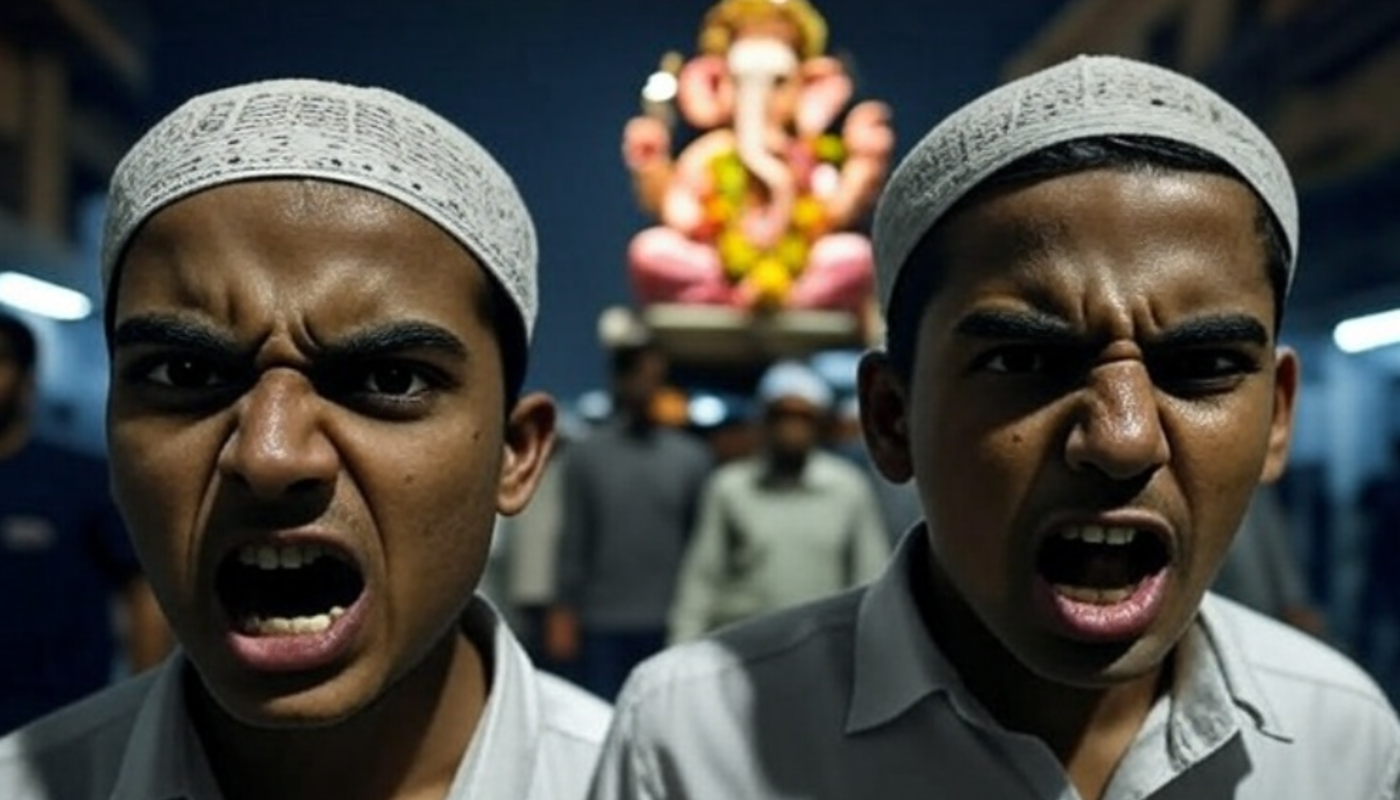
Case Summary
A Hindu religious procession was targeted during Ganesh Visarjan in Sagar town of Shivamogga district, Karnataka, on 07 September 2025, when two Muslim minor boys spat on the idol of Lord Ganesha. The procession, organised by the Jai Bhuvaneshwari Yuva Sangh, was passing through Jannat Nagar when the act was committed, sparking outrage among the devotees and heightening tensions in the area. Police quickly intervened, assured strict legal action against the culprits, and appealed for peace. This incident came on the heels of violent attacks on Ganesh visarjan processions in Mandya district on the same day. The Hinduphobia Tracker documented this incident in Mandya, where a Ganesh immersion procession passed near a mosque, and stones were hurled at the devotees from within the mosque premises, seriously injuring at least eight Hindus. Eyewitnesses reported that the idol of Lord Ganesha was also targeted in the assault. The unprovoked attack created panic and triggered a clash. Police responded swiftly in Mandya, deploying heavy security, hospitalising the injured, and arresting 21 individuals involved in the violence. Authorities imposed prohibitory orders across the affected area to prevent escalation.
Why it is Hate Crime ?
The primary category in this case is: Attack not resulting in death. The first subcategory under this: Attack on religious procession. The outward celebration and display of religious symbols in an intrinsic part of Hinduism. Religious processions on various festivals are age-old traditions and a way to manifest faith and form a part of the religious practices of Hindus. On several occasions, such religious processions come under attack by non-Hindu mobs, in a manifestation of their animosity towards Hinduism and their practices. The reasons cited for such violent attacks are many and range from crossing a non-Hindu resident-dominated area to playing loud music, crossing from an area where there is a religious structure of another faith etc. The violent attacks are triggered by the outward display of religiosity by Hindus. The attacks are mainly a manifestation of religious supremacist doctrine which believes that idolatry, essentially the Hindu faith, is one that deserves to be annihilated since the very tenets of Hinduism, its practices and traditions are considered a sin in those doctrines. Since these attacks emanate from intrinsic and doctrinal animosity towards Hindus and Hinduism, it is considered a religiously motivated hate crime under this category. Another category in this case is: Attack on Hindu religious representations. The subcategory under this is: Desecration of Hindu religious symbol. Icons and symbols or a religious representation of a spiritual ideal are widely revered in Hinduism. Iconography is of vital significance in the Hindu milieu. It helps connect people’s spiritual beliefs with the real world. Iconography within the Hindu faith takes several shapes and forms. Murtis are of most significance to Hindus, to which daily rituals, prayers and offerings are done. Besides the murtis, there are several other symbols which have deep significance in the Hindu faith – the Om and Swastika for example. Since these Hindu religious symbols hold paramount importance in Hinduism, any desecration of symbols, icons, murtis, religious representations and manifestations, is driven by animosity towards the faith itself which manifests itself through these murtis, icons and symbols. Therefore, any desecration of these Hindu religious symbols and representations is considered religiously motivated hate crimes under this category. The incident in Shivamogga’s Sagar town, where Muslim youths spat upon a sacred idol during the Ganesh Visarjan procession, constitutes a deliberate and sacrilegious assault upon the Hindu faith. The targeted nature of this act, carried out in a public procession that is central to Hindu worship and tradition, demonstrates a calculated attempt to humiliate and desecrate a revered religious symbol. Such conduct is not an isolated affront but part of a pattern of behaviour rooted in religious animosity, wherein outward displays of Hindu faith are met with hostility. By choosing a moment of communal devotion to insult a religious icon, the perpetrators sought to demean an entire community’s beliefs and provoke unrest. The violence in Mandya district, where Hindu devotees were attacked with stones as they conducted the immersion of Lord Ganesha’s idol, reinforces this interpretation. The procession was not merely obstructed; the idol itself was a target, and the devotees sustained injuries during a planned assault from within a religious structure. This incident falls within two principal categories of religiously motivated hate crimes. First, it constitutes an attack on a Hindu religious procession, which is a direct affront to the freedom of Hindus to express their faith in public spaces. Religious processions are intrinsic to Hindu tradition, and hostility towards them reflects a broader disdain for Hindu religiosity. Second, the deliberate desecration of a murti represents a deeper symbolic violence. Within Hinduism, icons are not mere objects but living embodiments of divinity, and attacks on them are assaults on the faith itself. The targeted desecration in Sagar demonstrates ideological contempt for Hindu worship, marking this act as an explicit expression of Hinduphobia.


Case Status
Arrested


Perpetrators Details
Perpetrators
Muslim Extremists
Perpetrators Range
From 2 To 5
Perpetrators Gender
male
 Sources




