Hindu community targeted with caste-based hate by Samajwadi Party supporter
 Uttar Pradesh, India
  14 October, 2025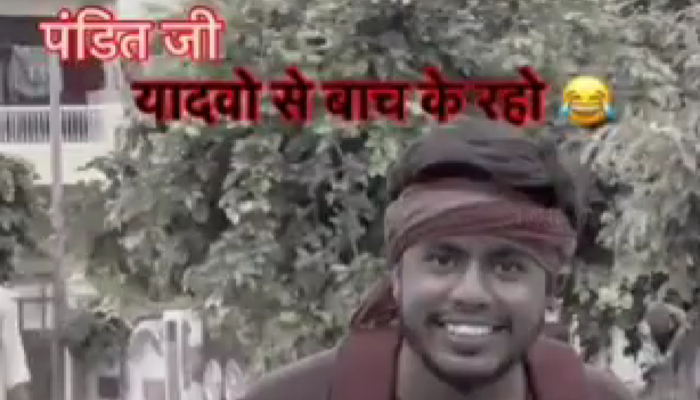
Case Summary
A Samajwadi Party supporter named Lalit Yadav, who runs an Instagram account under the handle @lalit_ydv3201 with nearly 25,000 followers, made a deeply disturbing statement that openly targeted the Brahmin community. In a video post, he said that he would “offer milk to Brahmins” and then mockingly asked whether he should mix it with water or poison, a clear expression of caste-based hatred and incitement to violence. His words carried a sinister undertone, normalising hate speech against a specific Hindu caste group and presenting it as casual humour before a large online audience.
Why it is Hate Crime ?
The primary category in this case is: Hate speech against Hindus. The subcategory under this is: Anti-Hindu slurs, mocking faith. Anti-Hindu slurs and the deliberate mocking of the Hindu faith owing to religious animosity involve the usage of derogatory terms, stereotypes, or offensive references to religious practices, symbols, or figures. One of the common anti-Hindu slurs used against Hindus is “cow-worshipper” and “cow piss drinker”. The intention of using this term is to demean and mock Hindus as a group and their religious beliefs since Hindus consider the cow holy. Additionally, some symbols and the slurs attached to them have a historical context that exacerbates the insult, hate, stereotyping, dehumanisation and oppression against Hindus. Cow worship has been used for centuries to denigrate Hindus, insult their faith and oppress Hindus specifically as a religious group. There has been overwhelming documentation about how cow slaughter has been used to persecute Hindus with cow meat being thrown in temples and places of worship. There has also been overwhelming documentation where cow meat (beef) has been force-fed to Hindus to either forcefully convert them to Islam or denigrate their faith. Apart from cow worship, the Swastika – which holds deep religious significance for the Hindus – has also been misinterpreted and distorted to use as a slur against Hindus. Similarly, the worship of the Shivling has been used by supremacist ideologies and religions to denigrate Hindus owing to religious animosity. Such slurs and denigration stem out of inherent animosity and hate towards Hindus and their faith, therefore, it is categorised as hate speech targeted at Hindus specifically owing to their religious identity. The inclusion of the Lalit Yadav episode in the Hinduphobia Tracker is necessitated by the unmistakable pattern of hate speech and caste-based denigration that forms part of a wider continuum of anti-Hindu hostility. Lalit Yadav’s statement, delivered publicly through an account with over 25,000 followers, did not merely mock a caste group but invoked imagery of poisoning, a metaphor historically associated with extermination and harm. His words, “Should I mix the milk with water or poison?”, carried an overt suggestion of violence against Brahmins, and by extension, against Hindus as a religious collective. Within the Hindu social structure, Brahmins are historically custodians of rituals, learning, and priestly duties; therefore, hate directed toward them is not confined to caste antagonism but extends into religious hostility. This expression of hate speech must therefore be categorised as a religiously motivated act targeting Hindus for their faith and practices, not merely as social commentary. The Samajwadi Party’s repeated indulgence in anti-Hindu rhetoric amplifies this pattern. The party and individuals associated with it have, on multiple occasions, normalised derision of Hindu traditions, texts, and deities in political discourse. The case of Rajkumar Bhati, a spokesperson of the Samajwadi Party, exemplifies this. In his YouTube interview with The Red Ink, Bhati deliberately distorted sacred Hindu scriptures and mocked revered deities, turning theological discourse into targeted denigration. His portrayal of Lord Ram’s act of slaying Bali as “cowardly” was not a literary reinterpretation but a blasphemous distortion aimed at dismantling the moral foundation of Hindu epics. The denigration of Manusmriti by Bhati as a “garbage text” follows the same ideological trajectory. The text, though complex and subject to historical reinterpretation, remains an integral part of Hindu philosophical discourse. Labelling it as filth is not academic criticism but a tactic of cultural defamation intended to sever Hindus from their textual heritage. When these statements are examined in sequence, they reveal an organised ideological effort by individuals affiliated with the Samajwadi Party to systematically ridicule Sanatan Dharma under the guise of progressivism and social critique. This is not intellectual dissent but religious antagonism cloaked in political rhetoric. The anti-Hindu speech by Ram Achal Rajbhar, another Samajwadi Party MLA, reinforces this broader trend. In his speech, Rajbhar praised E.V.R. Ramaswamy (Periyar) for burning the Ramayana, one of the holiest texts in Hinduism, and claimed that Periyar’s own version was the “true” Ramayana. This act of glorifying the burning of a scripture sacred to over a billion people is not a political opinion—it is an act of religious provocation, akin to burning the Quran or Bible to mock Muslims or Christians. Rajbhar’s further remarks mocking Hindu saints, deriding the Kumbh Mela, and disparaging Ayodhya—the birthplace of Lord Ram—represent not isolated outbursts but deliberate attempts to injure Hindu religious sentiments and undermine their cultural identity. These statements, viewed cumulatively, reflect a deep-seated animosity towards Hinduism that transcends individual expression and enters the realm of organised hate. Caste differences in India have long been manipulated as a tool to attack and fragment Hindu society. By highlighting historic tensions between upper-caste and lower-caste groups, certain actors exploit these divisions to delegitimise Hindu identity and foster resentment within the community. Targeting Brahmins, for instance, is often framed as a critique of “oppression,” yet it is frequently used as a pretext to insult Hindus collectively, attack their religious practices, and incite animosity. Such rhetoric does not merely critique social structures but weaponises caste identities to perpetuate hate, undermine Hindu unity, and normalise hostility toward the Hindu faith. This form of caste-based targeting is particularly insidious because it cloaks religious animosity under the guise of social justice or historical grievance, while ultimately threatening the broader Hindu community. Such incidents, when left unchecked, contribute to a culture of normalised Hinduphobia, where hatred against Hindus is trivialised and embedded into political speech. The tone and content of Yadav’s, Bhati’s, and Rajbhar’s statements demonstrate that these are not coincidental provocations but manifestations of a systemic narrative that delegitimises Hinduism as a religion and demonises its followers. The mockery of Hindu symbols such as the cow, the Swastika, and the Shivling—each carrying immense sacred value—illustrates how derision becomes an instrument of dehumanisation. Historically, cow slaughter, temple desecration, and mockery of Hindu rituals have been used as expressions of religious domination and subjugation. The verbal violence represented by these statements is a continuation of the same cultural hostility, adapted for the digital and political spheres. Lalit Yadav, the Samajwadi Party supporter responsible for the disturbing posts against Brahmins, has a substantial presence on Instagram under the handle @lalit_ydv3201, with nearly 25,000 followers. His profile contains multiple videos and posts explicitly supporting the Samajwadi Party, often praising party leaders and promoting its ideology. Through these posts, he not only amplifies the party’s political messaging but also uses his influence to normalise anti-Hindu rhetoric, framing it as political allegiance or satire. This connection demonstrates a troubling pattern where partisan affiliation is intertwined with religiously motivated hate speech, providing both a platform and a perceived shield for targeting Hindu communities online. Hence, the Lalit Yadav case merits inclusion in the Hinduphobia Tracker because it captures a disturbing evolution of anti-Hindu sentiment: from mockery and slur to ideological hatred. The intent behind these statements is not dialogue but desecration—designed to alienate Hindus from their identity, ridicule their beliefs, and provoke social unrest. By targeting Brahmins, scriptures, saints, and sacred texts, these actors collectively aim to fracture Hindu social cohesion and foster disdain toward Sanatan Dharma. The pattern is unmistakable: what begins as jest on social media becomes an echo of centuries-old animosity against Hindus, manifesting today as digital abuse, hate propaganda, and calls for violence. This cumulative hostility, political in tone but religious in essence, firmly categorises these acts as hate crimes against Hindus—targeted not for what they have done, but for who they are and what they believe in. Disclaimer: The exact date of the incident is unknown. For documenting purposes, 15 October 2025 has been selected, as this was the date when the video was shared in the media.


Case Status
Unknown


Perpetrators Details
Perpetrators
Others
Perpetrators Range
One Person
Perpetrators Gender
male
 Sources




