Anti-Hindu speech: Indian politician supports burning of revered Hindu scripture, denigrates Hindu saints and Kumbh Mela
 Ambedkar Nagar, Uttar Pradesh, India
  12 October, 2025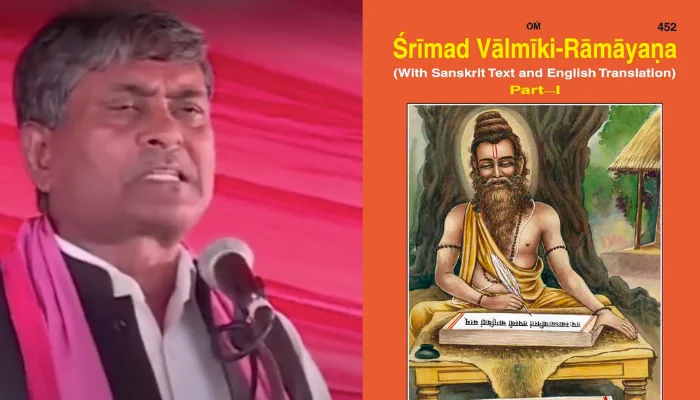
Case Summary
An anti‑Hindu speech was delivered by Samajwadi Party Member of the Legislative Assembly (MLA) Ram Achal Rajbhar. In his remarks, the accused praised the burning of the Ramayana, a revered Hindu scripture, by E.V.R. Ramaswamy (Periyar), an openly anti‑Hindu politician from Tamil Nadu. He further claimed that Periyar had authored the “true” Ramayana, directly challenging and undermining the sanctity of the scripture. Rajbhar went on to denigrate Hindu religious saints and leaders, mock the Kumbh Mela, one of the largest Hindu religious congregations, and disparage Ayodhya, the holy birthplace of Lord Ram. A controversial video of Ram Achal Rajbhar, MLA from Ambedkar Nagar, Uttar Pradesh, and former Transport Minister, surfaced online. In the video, he praised individuals who had burned the Ramayana and made objectionable comments about Sanatan Dharma. In this 27‑second clip, Rajbhar said, “There are many things to say. Whether it was Sant Gardagil or Periyar Ramaswami Naicker, who belonged to the Shepherd community, they were the first to burn the Ramayana in South India. Periyar Lalai Yadav wrote the ‘true Ramayana.’” The Samajwadi Party leader further denigrated the Kumbh Mela, a major Hindu religious congregation, as well as Hindu leaders. He said, “Read the history of your saints, great men, and gurus; then your mind will open. Then you will not go to the Kumbh Mela or Ayodhya, but instead you will send your children to school and to the Pathshaala so that they can become Indian Administrative Service (IAS) officers.” A poster for a Progressive Democratic Alliance (PDA) event was visible in the background of the video. The exact time and location of the recording had not yet been confirmed. Following these statements, the Bharatiya Janata Party and Hindu organisations strongly objected, demanding Ram Achal Rajbhar’s resignation and expulsion from the Samajwadi Party.
Why it is Hate Crime ?
This case has been added to the tracker under the primary category- Hate Speech against Hindus. The subcategory selected is- Anti-Hindu slurs, mocking faith. Anti-Hindu slurs and the deliberate mocking of the Hindu faith owing to religious animosity involve the usage of derogatory terms, stereotypes, or offensive references to religious practices, symbols, or figures. One of the common anti-Hindu slurs used against Hindus is “cow-worshipper” and “cow piss drinker”. The intention of using this term is to demean and mock Hindus as a group and their religious beliefs since Hindus consider the cow holy. Additionally, some symbols and the slurs attached to them have a historical context that exacerbates the insult, hate, stereotyping, dehumanisation and oppression against Hindus. Cow worship has been used for centuries to denigrate Hindus, insult their faith and oppress Hindus specifically as a religious group. There has been overwhelming documentation about how cow slaughter has been used to persecute Hindus with cow meat being thrown in temples and places of worship. There has also been overwhelming documentation where cow meat (beef) has been force-fed to Hindus to either forcefully convert them to Islam or denigrate their faith. Apart from cow worship, the Swastika – which holds deep religious significance for the Hindus – has also been misinterpreted and distorted to use as a slur against Hindus. Similarly, the worship of the Shivling has been used by supremacist ideologies and religions to denigrate Hindus owing to religious animosity. Such slurs and denigration stem out of inherent animosity and hate towards Hindus and their faith, therefore, it is categorised as hate speech targeted at Hindus specifically owing to their religious identity. The other subcategory selected is- Subversion of scriptures. Subverting the religious scriptures of Hindus has particularly devastating consequences. Subversion of the scriptures of Hindus is often done to justify or promote hatred, discrimination, or violence against specific individuals or groups of Hindus. Religious scriptures are often nuanced and those who harbour religious animosity towards Hindus often misquote or misrepresent the scripture to legitimise their animosity and hate towards the faith and its adherents. Any such misquoting of scriptures or subversion to justify hate, violence and discrimination against Hindus owing to religious animosity is hate speech and is categorised as such. Hate speech is defined as any speech, gesture, conduct, writing, or display that is prejudicial against a specific individual and/or group of people, which is leading to or may lead to violence, prejudicial action or hate against that individual and/or group. The other subcategory selected is- Mocking/denigrating Hindu leaders. Religious leaders are often seen as representatives of the community, especially, the community’s religious faith and beliefs. Mocking or denigrating a religious leader specifically owing to his religious identity and/or the religious rituals he observes can be considered hate speech because the motivating factor of the speech is animosity and/or dislike for what he represents – the religious beliefs and faith of the community. It is important to note that mere insulting words against an individual do not constitute hate speech. It is entirely possible that insulting words are used for an individual, however, the specific speech is not the result of religious hate and/or animosity towards the professed faith of the religious leader, but the individual himself. For the speech to be considered hate speech, the speech itself or the motivating factor behind the speech has to be religious in nature. Such speech which denigrates Hindu religious leaders specifically owing to animosity towards the faith they profess and the community faith they represent will be treated as hate speech under this category. The speech delivered by Samajwadi Party MLA Ram Achal Rajbhar constituted a clear case of hate speech directed against Hindus. In the video, the accused openly praised the burning of the Ramayana, a revered Hindu epic, by E.V.R. Ramaswamy (Periyar), an anti‑Hindu politician from Tamil Nadu. The Ramayana holds an unparalleled place of reverence within Hinduism, depicting the life, values, and dharma of Lord Ram. It is not merely a religious text but a profound spiritual guide and cultural foundation that has shaped moral life across generations. Endorsing the act of burning such a sacred scripture demonstrated a deep disrespect for the Hindu faith, its followers, and its spiritual heritage. By praising this desecration, the accused revealed his deep‑rooted religious animosity towards Hindus and their beliefs. Secondly, Rajbhar attempted to further defame and subvert the Ramayana by claiming that “Periyar Lalai Yadav wrote the true Ramayana” instead of Maharishi Valmiki. This deliberate distortion of a central Hindu scripture was not just an insult; it served as a calculated move to delegitimise its sanctity and rationalise its destruction. By asserting that Lalai Yadav’s version was the “real” Ramayana, the accused effectively rejected the scripture written by Rishi Valmiki — one of the most venerated sages in Hindu tradition — and labelled it as wrong or false. The Ramayana, authored by Maharishi Valmiki, remains one of the most sacred and foundational texts in Hinduism, embodying truth, virtue, and devotion. Rajbhar’s claim, in conjunction with his praise for burning the epic, clearly indicated his intent to normalise and encourage the desecration of the authentic Valmiki Ramayana. Such incitement to destroy a sacred text reflected an orchestrated attempt to provoke hatred and inflict emotional harm upon the Hindu community. Thirdly, the accused went on to denigrate the Kumbh Mela — a significant Hindu religious congregation and pilgrimage — as well as Hindu religious teachers and spiritual leaders. He stated that after studying the history of saints, great men, and gurus, people “will not go to Kumbh Mela or Ayodhya” but would instead send their children to school. The Kumbh Mela stands as one of the world’s largest peaceful gatherings, where millions of devotees unite on the banks of sacred rivers to perform holy rituals of purification and renewal. Ayodhya, revered as the birthplace of Lord Ram, holds deep spiritual and cultural significance for Hindus. Hindu gurus and saints, similarly, are regarded as moral and spiritual guides to the community. By mocking these sacred symbols and belittling core aspects of Hindu faith, Rajbhar revealed an entrenched antipathy towards Hinduism and attempted to ridicule its spiritual institutions. His remarks were not expressions of critique but contempt rooted in prejudice and disregard for the dignity of Hindu tradition. Each of these actions — glorifying the destruction of a revered text, distorting its sacred authorship, and ridiculing holy places and religious leaders — reflected a consistent pattern of hostility aimed at insulting and provoking the Hindu community. This rhetoric represented deliberate hate speech, crafted to erode reverence for Hinduism, demean its adherents, and foster division based on religion. Accordingly, this case is being recorded in the hate crime database of the Hinduphobia Tracker as an instance of targeted hate speech motivated by religious animosity. Disclaimer: The Hinduphobia Tracker records the date of an incident based on when the crime occurred rather than when it was reported by the media. In this case, media sources reported the matter on 13th October 2025. However, as the exact date of occurrence was not specified in media reports, for documentation purposes, an indicative date of 13th October 2025 is being recorded as the date of the incident. Media reports also did not clearly specify the exact location of the incident. Therefore, for documentation purposes only, the place of the incident is being recorded as Ambedkar Nagar, Uttar Pradesh, which is the constituency from where the accused is a Member of the Legislative Assembly (MLA).


Case Status
Unknown


Perpetrators Details
Perpetrators
Others
Perpetrators Range
One Person
Perpetrators Gender
male
 Sources




