Hindu victims mocked: Ambedkarite woman insults Brahmins, denies Kashmiri Pandit genocide, and ridicules The Kerala Story
 India
India  12 October, 2025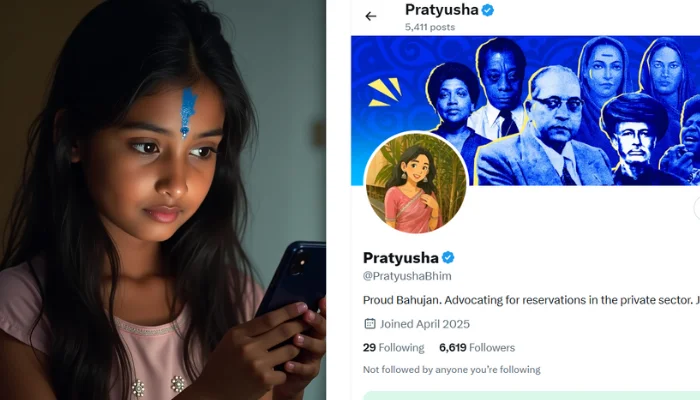
Case Summary
An anti-Hindu social media post targeting the Brahmin community, denying the genocide of Kashmiri Pandits, and mocking the movie 'The Kerala Story', was made by an Ambedkarite woman, a follower of the political ideology of Ambedkarism, an anti-Hindu political movement. This incident occurred on X (formerly Twitter) when an Ambedkarite woman named Pratysusha Bhim mocked the Brahmin community while asserting that all Brahmins had horribly treated Savitribai Phule, a social reformer. The accused promoted a movie named 'Phule', which showcased the life of Savitribai Phule, a Dalit social reformer. A scene in the movie showed Brahmins throwing cow dung on her. The accused shared pictures of this scene to assert that all Brahmins treated Savitribai badly and tried to ignite hatred against the Brahmins, and by extension, the Hindu community. The accused further denied the genocide of Kashmiri Pandits by calling the movie 'The Kashmir Files' propaganda. She also denied the religiously motivated targeting of Hindu women by Muslim men, who use coercion, deceit, and force to trap Hindu women in romantic relationships or marriages for achieving the underlying agenda of sexual exploitation or religious conversion. On her X account on 13th October, the accused wrote: "This is how the Brahmins treated Maa Savitribai Phule. The Censor Board has removed several scenes depicting the mistreatment of Maa Savitribai by Brahmins, while permitting propaganda films like The Kerala Story, Kashmir Files, etc. Never Forget Never Forgive!" This tweet went viral on social media with more than 284,100 views. It is also important to note that the movie 'The Kashmir Files' depicted the horrific genocide of the Kashmiri Hindu Pandits in the Kashmir Valley in 1990 by radical Muslim terrorists. In that year, Kashmiri Hindus were brutally massacred and faced an ultimatum: convert to Islam, flee the region, or be killed. Mosques in Kashmir declared slogans such as "Raliv, Tsaliv, Galiv", meaning “either leave, convert, or die.” The Muslim radicals in Kashmir chanted anti-Hindu slogans like, “O! Merciless, O! Kafirs leave our Kashmir. Anyone wanting to live in Kashmir will have to convert to Islam. From East to West, there will be only Islam. O! Muslims, Arise, O! Kafirs, scoot. Islam is our objective, Quran is our constitution, Jehad is our way! We will turn Kashmir into Pakistan along with Kashmiri Pandit women, but without their men.” This decree was directed at the Kashmiri Pandits, during which thousands of Pandits were killed and hundreds of thousands were forced to evacuate Kashmir. Multiple instances of Kashmiri Hindus being brutally assassinated and Hindu women being raped by Muslim extremists occurred. This was a clear case of ethnic cleansing and anti-Hindu genocide, which the movie 'The Kashmir Files' depicted. Similarly, 'The Kerala Story' portrayed the real-life stories of non-Muslim women, particularly Hindu women, who were deceived by Muslim men under the pretext of romantic relationships. These women were targeted for religious conversion and sexual exploitation, and sent to join terrorist organisations such as ISIS. The film is based on actual incidents where Hindu women were religiously profiled and systematically targeted by Muslim men for conversion or exploitation. This process of grooming Hindu women, widely referred to as “Love Jihad” or “Grooming Jihad,” has a basis in reality. Even the Kerala High Court in 2009 acknowledged these coercive conversions, stating that under the guise of love, such deceptive and compulsory conversions should be prohibited. The targeting of Hindu women under this pretext is a verified social issue involving religious and sexual coercion.
Why it is Hate Crime ?
This case has been added to the tracker under the primary category- Hate Speech against Hindus. The subcategory selected is- Anti-Hindu slurs, mocking faith. Anti-Hindu slurs and the deliberate mocking of the Hindu faith owing to religious animosity involve the usage of derogatory terms, stereotypes, or offensive references to religious practices, symbols, or figures. One of the common anti-Hindu slurs used against Hindus is “cow-worshipper” and “cow piss drinker”. The intention of using this term is to demean and mock Hindus as a group and their religious beliefs since Hindus consider the cow holy. Additionally, some symbols and the slurs attached to them have a historical context that exacerbates the insult, hate, stereotyping, dehumanisation and oppression against Hindus. Cow worship has been used for centuries to denigrate Hindus, insult their faith and oppress Hindus specifically as a religious group. There has been overwhelming documentation about how cow slaughter has been used to persecute Hindus with cow meat being thrown in temples and places of worship. There has also been overwhelming documentation where cow meat (beef) has been force-fed to Hindus to either forcefully convert them to Islam or denigrate their faith. Apart from cow worship, the Swastika – which holds deep religious significance for the Hindus – has also been misinterpreted and distorted to use as a slur against Hindus. Similarly, the worship of the Shivling has been used by supremacist ideologies and religions to denigrate Hindus owing to religious animosity. Such slurs and denigration stem out of inherent animosity and hate towards Hindus and their faith, therefore, it is categorised as hate speech targeted at Hindus specifically owing to their religious identity. The other subcategory selected is- Denial or mocking of genocide/large-scale persecution. Denial or mocking of genocide/large-scale persecution/ethnic cleansing refers to the act of denying or minimizing the fact of the ethnic cleansing and/or genocide and/or religious persecution of Hindus. This often involves denying the scale, mechanisms, religious intent, or even the occurrence of the ethnic cleansing and/or genocide and/or religious persecution of Hindus. Hate speech of this kind involves the dissemination of falsehoods that deny or distort established historical facts or mock the suffering of Hindus by saying that they deserved the persecution, motivated by Hinduphobia. Denying such atrocities is not only about the denial of facts or rewriting/revising history, but it also delegitimises the religiously motivated persecution of Hindus, the religious hate/motivation/animosity that led to the persecution, and dehumanises Hindus as a religious group. Such denial of ethnic cleansing and/or genocide and/or religious persecution of Hindus not only denies the suffering but also paves the way for future/present atrocities and hate speech, inciting prejudice and violence against Hindus. It also provides a justification for violence by delinking religious animosity from religiously motivated crimes committed against Hindus. Since such denial and/or mocking of genocide/ethnic cleansing/atrocities motivated by religious animosity leads to present and future ramifications of creating more hate speech, violence, dehumanisation and delegitimisation, it would be considered hate speech under this category. In this case, firstly, the accused mocks the Brahmin community by using Savitribai Phule, a social reformer, as a shield. She refers to historical instances of caste disputes involving various castes, including Brahmins and Dalits, as a pretext to attack Brahmins today. By stating, "This is how Brahmins treated Savitribai Phule. Never forget and never forgive,” she revives past caste issues to incite hatred against the Brahmin community in the present. This manipulation of historical caste conflicts serves as a deliberate tool to perpetuate deep-seated animosity towards the Hindu community. The upper-caste versus lower-caste narrative is often exploited as a means to attack Hindus collectively. Such caste-based rhetoric is used to portray Hinduism as oppressive and tyrannical, aiming to discredit and divide Hindu society. It encourages alienation within the community, prompting certain groups to distance themselves from Hinduism, thereby weakening Hindu unity. This manufactured division is part of a concerted attempt to delegitimise the Hindu faith, dehumanise its followers, and propagate religious animosity. The accused’s association with Ambedkarite ideology further underscores this religious hostility. Ambedkarism is a political ideology fundamentally opposed to Hinduism. Under the guise of fighting casteism, it actually attacks Hinduism and the Hindu community. There have been numerous incidents where Ambedkarites have abused Hindus under the pretext of opposing Brahminism, including desecrating Hindu temples and scriptures such as the Manusmriti and the Ramcharitmanas. Hindu deities have been repeatedly insulted. Moreover, Ambedkarites maintain alliances with leftist and Islamist groups, strategically using identity politics to fragment the Hindu community along caste lines and destroy its unity. This clearly reveals a religiously motivated campaign aimed at undermining Hindu identity and cohesion, amounting to religiously motivated crime. Secondly, the accused, Pratyusha, also denied the persecution of the Kashmiri Pandits in 1989 by dismissing the movie 'The Kashmir Files'. The movie depicted the genocide of Kashmiri Hindu Pandits in 1989 by Muslim terrorists supported by Pakistan and the Kashmiri Muslim locals. The film included real-life incidents of brutal massacres and the forcible evacuation of Kashmiri Pandits amidst the slogans "Raliv, Tsaliv, Galiv", meaning "either leave, convert, or die." It documented religious profiling, religious profile-based killings, and rapes of Kashmiri Pandit men and women. The movie showcased a systematic attempt to erase the Kashmiri Hindus from the valley. The genocide forced the Kashmiri Pandits to leave Kashmir, making it an anti-Hindu genocide motivated by religious animosity. The Muslim extremists and the local Muslim population targeted Kashmiri Pandits due to their Hindu identity, attempting to erase an entire community from a geographical area based on religious grounds—a clear-cut case of religiously motivated genocide. In this case, the accused Pratyusha completely denied the genocide of the Kashmiri Pandits by dismissing the movie 'The Kashmir Files' as mere propaganda. By claiming that 'The Kashmir Files' was propaganda, the accused was dismissing this well-documented atrocity, an act that insults the pain and suffering of the Kashmiri Hindu community. Such denial not only trivialises their persecution but showcases her profound religious hostility towards Hindus, making her stance a blatant form of hate speech rooted in religious animosity. Thirdly, the accused also denied the sufferings of Hindu women who are religiously profiled, targeted, and exploited under the pretext of romantic or marital relationships by Muslim men. She dismissed the reality of forcible religious conversions and sexual exploitation by branding the movie 'The Kerala Story' as mere propaganda. This claim is entirely false. The movie 'The Kerala Story' explicitly showcases the plight of Hindu girls who are lured into romantic relationships by Muslim men, forcibly converted to Islam, sexually exploited, and subsequently married off to Muslim men. Some were even sent to Afghanistan to join ISIS. The film detailed the systematic persecution and brainwashing targeted at Hindu girls and women, exposing the underlying agenda to forcibly convert them. It presented a truthful account of the persecution they endured and is far from propaganda. Islamists and the left-liberal cabal have argued that the movie’s storyline is fabricated, but even the Kerala High Court admitted that these practices are true. In 2009, the Kerala High Court directed the government to enact laws to prevent the forcible conversion of non-Muslim women by Muslim men through romantic or marital coercion. The court explicitly acknowledged this issue, recognising it as a real and ongoing problem. Additionally, the Hinduphobia Tracker has documented numerous instances where Hindu women have been religiously targeted under similar pretexts for conversions. This is a documented and undeniable reality, reflecting a grave social issue faced by Hindu women. By completely denying these sufferings and calling 'The Kerala Story' propaganda, the accused demonstrates deep-seated religious animosity towards Hindu women and the Hindu community at large. Hindu women, targeted for their religious identity, have suffered sexual exploitation and forced conversions at the hands of Muslim men. Denying these atrocities not only whitewashes their pain but also indicates a hateful agenda that seeks to undermine and dismiss the reality of religious persecution against Hindus. Such denial, particularly when made by someone aligned with anti-Hindu ideologies, stands as a clear example of religiously motivated hate speech. As previously reported, the Hinduphobia Tracker has documented multiple incidents in which Hindu women were targeted by Muslim men under the guise of romantic relationships, often concealing underlying motives of religious conversion or sexual exploitation. For example, in Haldibari city of Cooch Behar district, West Bengal, a Hindu college girl was deceived by a Muslim man named Ashik Islam, who posed as a Hindu to lure her into a relationship. After gaining her trust, he sexually exploited her, secretly recorded obscene videos and photographs, and later blackmailed her with the material when she discovered his real identity and tried to leave him. Distressed by the harassment and threats, the victim attempted to end her life on 22nd June 2025. In another case in Ernakulam, Kerala, six Hindu women, including minors, were coerced into romantic relationships by Muslim men who subsequently trafficked them for sex. The perpetrators were identified as Akbar Ali, Shafeeq, and Mansoor Ali. Similarly, in Baghpat, Uttar Pradesh, a Hindu woman was blackmailed, raped, and forced into religious conversion and Nikah (Islamic marriage) by a Muslim man named Altaf Malik, who was part of an organised conversion racket and subjected her to prolonged abuse and threats. In another incident in Maihar, Satna district, a 21-year-old Hindu girl was deceived into a relationship, sexually exploited, and pressured to convert and undergo Nikah by a Muslim man named Sonu Khan, who posed as a Hindu, made her wear a burqa, and threatened to kill her. This case meets multiple parameters of religiously motivated hate speech, as it involves the accused denigrating Brahmins under the guise of historical caste disputes between Brahmins and Dalits, denying the genocide of Kashmiri Pandits, and religiously profiling, targeting, sexual exploitation, and forced conversion of Hindu women by Muslim men under the pretext of romantic or marital relationships. Taken together, these elements constitute hate speech driven by deep-seated religious animosity towards the Hindu community. Therefore, this case has been added to the Hinduphobia Tracker’s hate crime database.


Case Status
Unknown


Perpetrators Details
Perpetrators
Others
Perpetrators Range
One Person
Perpetrators Gender
female
 Sources




