AI-doctored image used to target RSS: Karnataka minister links Hindu organisation to ammunition smuggling, calls members ‘Sanghi terrorists’
 India
 9 November, 2026
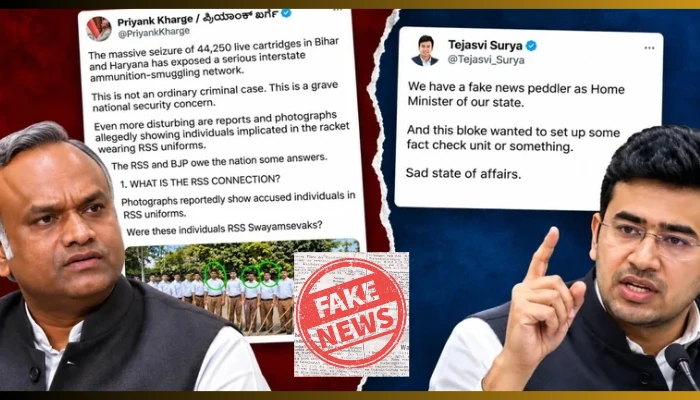
Case Summary
On 10 November 2026, Karnataka Home Minister and Congress leader Priyank Kharge deliberately maligned the reputation of the prominent HIndu organisation Rashtriya Swayamsevak Sangh (RSS), by falsely linking an ammunition-smuggling network to it. Kharge circulated an AI-manipulated photograph to falsely portray all four accused in the Bihar-Haryana ammunition-smuggling case as RSS members, thereby attempting to associate the Hindu organisation with a criminal network. In his post, he also attached a picture that read "Four RSS-linked Sanghi terroists caught smuggling 44,000 live cartridges." The controversy arose after police operations in Bihar and Haryana resulted in the seizure of 44,250 live cartridges in two separate operations. Police arrested 11 accused across the two operations. Following the arrests, a photograph showing four men wearing RSS uniforms began circulating on social media, accompanied by claims that all four accused were members of the organisation. Kharge used the photograph to target the RSS and the BJP. In his social media post, he questioned whether the accused were RSS Swayamsevaks, what positions they held within the organisation, and why the RSS had not responded to the allegations. He also demanded answers regarding the ammunition-smuggling network and called for the formal registration of the RSS. Among the arrested, five people were Muslims from Badaun in Uttar Pradesh, including a woman. Police named them as Afifuddin alias Munna Khan (49), Asim Rais (33), Sabloo Khan (32), Arbaz Ali (27) and Zeenat (33). Preliminary investigation showed Munna Khan ran a gun house in the Civil Lines area of Badaun. Police identified the other arrested individuals as Chandan Tiwari (26), Saras Kumar (27) and Laltu Kumar (38). Police said the accused could not produce valid documents for the ammunition. Police arrested the key link, Vijay Goel, in Sirsa, Haryana. However, the photograph used to establish this association was AI-manipulated. Investigators traced the original image to an Instagram post by Abhishek Tiwari, one of the accused, published on 29 March 2026. The original photograph showed a group of men in normal clothing, while only Tiwari was wearing an RSS uniform. The viral version had been digitally altered to make several other individuals appear in identical RSS uniforms, falsely suggesting that all accused were associated with the organisation. A comparison of the original and manipulated photographs revealed several discrepancies, including changes to facial features, clothing, and object placement. The altered image thus exposed itself as fabricated visual evidence rather than proof of any organisational association between the accused and the RSS. BJP MP Tejasvi Surya criticised Kharge for circulating the fabricated photograph and spreading false claims about the RSS. He also questioned Kharge's credibility, given his earlier proposal to establish a fact-checking unit.
Why it is Hate Crime ?
This case has been added to the tracker under the primary category of Hate speech against Hindus. Within it, the sub-category selected here is Anti-Hindu subversion and prejudice, with the tertiary category being Anti-Hindu fake news. Hate speech is defined as any speech, gesture, conduct, writing, or display that is prejudicial against a specific individual and/or group of people and leads to, or may lead to, violence, prejudicial action, or hate against that individual and/or group. Media plays a specific and overarching role in perpetuating prejudicial attitudes towards a community owing to unfair, untrue coverage and/or misrepresentation/misinterpretation, selective coverage and/or omission of facts of/about issues affecting a specific religious group. This type of bias can dehumanise the victim group, making it easier for others to justify harmful actions against them, which aligns with the objectives of hate speech laws aimed at preventing such harm. It is often observed that the media takes a prejudicial stance against the Hindu community, driven by their need to shield the aggressor community, which happens to be a numeric minority, and is the one perpetrating violence against Hindus. For example, the media is often quick to contextualise religiously motivated crimes against Hindus, omit or misrepresent facts that point towards religiously motivated hate crimes, justify and/or downplay religiously motivated hate crimes, or simply present fake news to stereotype Hindus. Such media bias leads to the denial of persecution and is often used to dehumanise Hindus, leading to justification for violence against them. For example, the media covered several fake allegations of Hindus targeting Muslims and forcing them to chant Jai Shree Ram. Police investigations later proved most of these cases false and fabricated. These fake news reports were subsequently never retracted or clarified. Such fake news led to the justification of violence and dehumanisation of Hindus based on the argument that since Hindus targeted Muslims and forced them to chant Jai Shree Ram, the dehumanisation of Hindus and violence against them was par for the course and merely retaliation. Such media bias leads to a prejudicial portrayal of Hindus and offers a justification for violence against them and, therefore, is considered hate speech under this category. This incident represents a deliberate attempt to malign a prominent Hindu organisation through fabricated claims and manipulated visual evidence. Karnataka Home Minister Priyank Kharge shared an AI-manipulated photograph seeking to falsely associate the Rashtriya Swayamsevak Sangh (RSS) with an ammunition-smuggling network and criminal activity. He further described those associated with the organisation as "Sanghi terrorists". The manipulated image created the impression that the accused were RSS members, despite no established organisational connection. The identities of the accused make the fabricated association particularly significant. Five men arrested in Haryana were identified in police reports as Afifuddin alias Munna Khan, Aasim Rais, Sablou Khan, Arbaz Ali and Zeenat, while three others were arrested separately in Bihar. The religious identities of the accused do not, by themselves, establish or disprove organisational membership. However, no evidence established a connection to the RSS. By circulating a manipulated photograph to suggest otherwise, Kharge sought to shift the focus of a criminal investigation towards a prominent Hindu organisation and portray it as being involved in terrorism and organised crime. The anti-Hindu dimension of this targeting becomes clearer when the identity and significance of the RSS are examined. The RSS is one of India's most prominent Hindu socio-cultural organisations, with its activities centred on Hindu unity, cultural preservation, social mobilisation and the advancement of Hindu civilisational identity. It represents an important institutional expression of Hindu collective identity and has a substantial following among Hindus. Consequently, associating the organisation and its members with terrorism and criminality serves to discredit not merely an institution but also the broader Hindu constituency that identifies with it. The expression "Sanghi terrorists" further extends this vilification to individuals associated with the organisation, branding them as terrorists on account of their affiliation. This incident also follows a longer history of Congress leaders associating the RSS with terrorism and extremism. In October 2010, Rahul Gandhi compared the RSS with the banned Students Islamic Movement of India (SIMI), describing both as fanatical organisations with fundamentalist views. He subsequently described the RSS as a fascist organisation and, in 2023, called it a "fundamentalist and fascist organisation" while comparing its organisational structure to that of the Muslim Brotherhood. A particularly significant episode occurred in December 2010, when Congress General Secretary Digvijaya Singh inaugurated the book 26/11 RSS Ki Saazish? (26/11, An RSS Conspiracy?) authored by Urdu journalist Aziz Burney. The book advanced conspiracy theories blaming the RSS for the November 2008 Mumbai terror attacks, which were carried out by Pakistan-based Lashkar-e-Taiba terrorists. Singh publicly endorsed the book and made statements suggesting that Hindu extremist elements and the RSS were responsible for the circumstances surrounding ATS chief Hemant Karkare's death. The Congress leadership also adopted a political resolution in December 2010 calling for investigations into alleged links between the RSS and terrorist activities. Burney subsequently issued a public clarification and apology in January 2011, expressing regret over linking the RSS to the 26/11 attacks. Other Congress leaders, including former Union Home Minister Sushilkumar Shinde, popularised the terminology of "Hindu terror" and "saffron terror" to associate Hindu organisations with terrorism. In August 2010, then Home Minister P. Chidambaram had referred to the phenomenon of "saffron terrorism" while addressing a conference of police chiefs. Shinde subsequently amplified this terminology at the Congress Chintan Shivir in Jaipur on January 20, 2013, where he accused the RSS and BJP of running terror-training camps and promoting "Hindu terrorism". When questioned, Shinde reiterated that he meant "saffron terrorism". Several Congress leaders initially defended his remarks. Although the party subsequently distanced itself from the terminology and Shinde expressed regret in February 2013, the episode demonstrated how the language of terrorism was being publicly attached to Hindu identity and a prominent Hindu organisation by senior political leaders. Digvijaya Singh repeatedly used the expression "Sanghi terrorism", while in 2018 he claimed that all 'Hindu terrorists' arrested so far had some association with the RSS. These statements contributed to a recurring political narrative portraying a prominent Hindu organisation and its members as terrorist and extremist elements. Another significant example emerged in May 2024, when Congress leader Vijay Wadettiwar claimed that Hemant Karkare had been killed by an RSS-linked police officer rather than Ajmal Kasab, one of the Lashkar-e-Taiba terrorists involved in the 26/11 attacks. He also questioned the public prosecutor's conduct in the case. The remarks sought to redirect responsibility for the killing towards an RSS-linked individual despite the established findings of the investigation and judicial proceedings. Congress leader Ramesh Chennithala later distanced the party from Wadettiwar's statement, calling it his personal opinion. The present incident follows the same pattern of drawing the RSS into criminal and terrorist controversies without establishing its involvement. By using fabricated imagery to associate the organisation with an ammunition-smuggling network, Kharge shifted public attention towards a Hindu institution rather than allowing the investigation to establish individual responsibility. It also risked shielding the actual accused by manufacturing an association with a Hindu organisation and portraying the latter as the perpetrator. The fundamental hostility in this case was directed at a prominent institution representing Hindu collective identity and those associated with it. Repeatedly branding the RSS and its members as terrorists through fabricated or unsubstantiated claims contributes to the broader demonisation of Hindu organisations and their supporters. By using manipulated visual evidence and the authority of his public office to portray a prominent Hindu organisation as a criminal outfit, Kharge reinforced a narrative that seeks to vilify Hindu collective identity and shift criminal culpability onto Hindus. This deliberate targeting makes the incident relevant for inclusion in the Hinduphobia Tracker.


Case Status
Unknown


Perpetrators Details
Perpetrators
State and Establishment
Perpetrators Range
One Person
Perpetrators Gender
male
 Sources



