Hindus and Hindu organisations publicly targeted, urged to be wiped out by Muslims during speech by Congress President
 Delhi, Delhi, India
  6 April, 2026
Case Summary
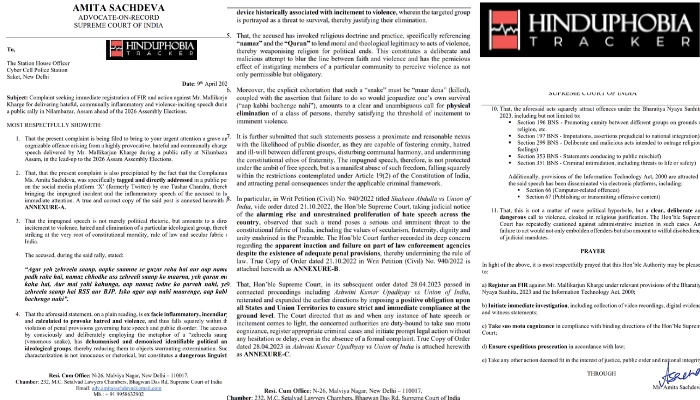
A genocidal call against Hindus and the Hindu organisation was made by Congress President Mallikarjun Mapanna Kharge in a speech delivered during a public rally at Nilambazar, Assam, ahead of the 2026 Assam Assembly elections. The case came to light when a video of the speech went viral on social media on 7th April, 2026. In the video, Kharge, while referring to Hindus, Rashtriya Swayamsevak Sangh, and Bhartiya Janata Party, cited the Quran and said, “Agar yeh zehreela saanp, aapke saamne se guzar raha hai aur aap namaz padh rahe hai, namaz chhodke uss zehreeli saanp ko maarna, yeh quran mai kaha hai, Aur mai yahi kahunga, aap namaz todne ko parvah nahi, yeh zehreela saanp hai RSS aur BJP. Isko agar aap nahi maarenge, aap kabhi bachenge nahi,” roughly translating in English as, "if a poisonous snake crosses someone’s path during Namaz, the prayer should be stopped and the snake killed. “The RSS and the BJP are that poisonous snake. If you do not kill them, you will not survive.” Based on the video, a complaint was submitted by Adv Amita Sachdeva before the Station House Officer, Cyber Cell Police Station, Saket, New Delhi, seeking the immediate registration of an FIR and action against Mallikarjun Kharge in relation to a speech. The team at Hinduphobia Tracker secured a copy of the complaint from Advocate Amita. The complaint stated that the speech referred to “namaz” and the “Quran” while making the above remarks, and that it explicitly described RSS and BJP as a “zehreela saanp” and stated that if such a “snake” was not killed, survival would not be possible. The complaint also recorded that the statement was disseminated through electronic platforms and social media. In the complaint, the complainant cited multiple legal provisions of the Bharatiya Nyaya Sanhita, including Section 196 for promoting enmity between different groups on grounds of religion, Section 197 for imputations and assertions prejudicial to national integration, Section 299 for deliberate and malicious acts intended to outrage religious feelings, Section 353 for statements conducing to public mischief, and Section 351 for criminal intimidation, including threats to life or safety. Additionally, the complaint stated that provisions of the Information Technology Act, 2000, were also attracted on account of the dissemination of the speech through electronic means, including Section 66 relating to computer-related offences and Section 67 relating to publishing or transmitting offensive content. The complaint also referred to the order of the Hon’ble Supreme Court in Writ Petition (Civil) No. 940/2022, titled Shaheen Abdulla vs Union of India, dated 21 October 2022. It stated that the Court had taken judicial notice of the alarming rise and unrestrained proliferation of hate speech across the country and had observed that such a trend posed a serious and imminent threat to the constitutional fabric of India, including the values of secularism, fraternity, dignity and unity enshrined in the Preamble. The complaint further referred to the subsequent order of the Hon’ble Supreme Court dated 28 April 2023, passed in connected proceedings, including Ashwini Kumar Upadhyay vs Union of India. It stated that the Court had reiterated and expanded its earlier directions by imposing a positive obligation upon all States and Union Territories to ensure strict and immediate compliance with the law in cases involving hate speech and incitement. The complainant lastly stated that the speech was not a matter of political hyperbole but a deliberate and dangerous call to violence, and sought prompt registration of an FIR and action by the police authorities. Meanwhile, the Bharatiya Janata Party (BJP) and RSS condemned the remark made by the senior Congress leader. BJP spokesperson Shehzad Poonawala accused the Congress leader of inciting the minority community to kill BJP and RSS members, while pointing to Kharge’s inciting remarks at a minority community event. “This is the lowest ebb for Congress. It is the most undemocratic, emergency-minded statement. Shameful! The Election Commission must act now," Poonawalla said in his post. Rashtriya Swayamsevak Sangh (RSS) on April 8, 2026 (Wednesday) lodged complaints at two police stations in Assam against Kharge. The complaints were filed seeking legal action over his “derogatory, provocative, and communally sensitive statement made during a recent election rally in south Assam, an RSS spokesperson said.
Case Images
Why it is Hate Crime ?
This case is added to the tracker under the primary category- Hate Speech against Hindus. The subcategory selected is- Violent Threats. Violent threats, explicit, implicit or implied, are the most dangerous form of hate speech since it goes beyond discriminatory and prejudicial language to express the intent of causing harm to an individual or a group of people based on their religious identity and faith. There could be several different kinds of threats that are issued to Hindus based on religious animosity. An explicit threat would mean the direct threat of violence towards an individual Hindu, a group of Hindus or Hindus at large. Physical violence, death threats, threats of destruction of property belonging to Hindus and threats of genocide would mean explicit threats against Hindus for their religious identity. Implicit threats may not be a direct threat but implied through the use of symbols of actions – for example, in the Nupur Sharma case, other than explicit threats, there were also implicit threats when Islamists took to the streets to burn and beat her effigies. It implies that they want to do the same to Nupur Sharma, which is considered an implicit threat. Violent threats can be delivered in person, through letters, phone calls, graffiti, or increasingly through social media and other online platforms. It would be important to understand that a threat – explicit or implicit, online or offline – to an individual who happens to be a Hindu does not qualify as a religiously motivated threat. Such a threat, while vile and dangerous, could be owing to non-religious reasons and/or personal animosity. To qualify as a religiously motivated threat, it would need to exhibit an indication that the individual is being targeted for religious reasons and/or owing to his/her religious identity as a Hindu. Another sub-category selected is: Mocking/denigrating Hindu leaders. Hate speech is defined as any speech, gesture, conduct, writing, or display that is prejudicial against a specific individual and/or group of people, which is leading to or may lead to violence, prejudicial action or hate against that individual and/or group. Religious leaders are often seen as representatives of the community, especially, the community’s religious faith and beliefs. Mocking or denigrating a religious leader specifically owing to his religious identity and/or the religious rituals he observes can be considered hate speech because the motivating factor of the speech is animosity and/or dislike for what he represents – the religious beliefs and faith of the community. It is important to note that mere insulting words against an individual do not constitute hate speech. It is entirely possible that insulting words are used for an individual, however, the specific speech is not the result of religious hate and/or animosity towards the professed faith of the religious leader, but the individual himself. For the speech to be considered hate speech, the speech itself or the motivating factor behind the speech has to be religious in nature. Such speech which denigrates Hindu religious leaders specifically owing to animosity towards the faith they profess and the community faith they represent will be treated as hate speech under this category. This incident qualifies as a religiously motivated hate crime because the speech did not remain within the limits of political criticism. Instead, it used language that encouraged violence and framed it in a way that could influence people along religious lines. The first important marker is the use of a metaphor to dehumanise the target. By calling the RSS and BJP a “zehreela saanp” (poisonous snake), the speaker was not just criticising them but portraying them as something dangerous that must be eliminated. Such language is significant because it reduces people associated with these groups to a threat, making violence against them appear justified. In this context, the metaphor sends a clear message that those linked to these organisations are to be treated as enemies who must be removed. The second marker is the direct call to violence. Saying that the “snake” must be killed goes beyond symbolic speech. It is a clear endorsement of physical harm. When such statements are made in a public rally by a senior leader, they carry weight and can influence how people think and act. The third and most serious marker is the religious framing of this call for violence. The reference to the Quran and namaz suggests that even religious prayer can be stopped to carry out this act. This is important because it presents violence as something that is not only acceptable but also justified within a religious context. When combined with the “poisonous snake” metaphor, this framing works as a way of urging Muslim listeners to act against those identified with Hindu organisations. The fourth marker is the nature of the target itself. The Rashtriya Swayamsevak Sangh is closely associated with Hindu society and works around Hindu identity and community interests. Many Hindus are directly or indirectly connected to it. Because of this, a call to “kill” the RSS cannot be seen as limited to an organisation alone. It naturally extends to Hindus who are part of or associated with it. This means the threat is not just institutional but also communal. Another important aspect is how this speech creates tension between communities. By using religious references while calling for violence against a Hindu-linked group, the speech sets up a situation where one community is encouraged to see another as a threat, increasing the risk of hostility and conflict. By using such language and framing, the Congress leader’s remarks go beyond political disagreement and reflect a deeper disregard for Hindu beliefs and those associated with them. The combination of dehumanising language, calls for violence, and religious justification indicates a level of hostility that is not incidental but directed at a group identified with Hindu identity and interests. The impact of such speech goes beyond words. It can create fear among Hindus who are associated with such organisations and make them feel unsafe. It also contributes to an environment where violence against a particular community can begin to seem acceptable. For all these reasons, this case has been included in the tracker as a religiously motivated hate crime against Hindus.


Case Status
Complaint filed


Perpetrators Details
Perpetrators
State and Establishment
Perpetrators Range
One Person
Perpetrators Gender
male
 Sources




