Hindu nationalism falsely vilified by US government body, who calls for ban on revered Hindu organisation
 United States
  15 March, 2026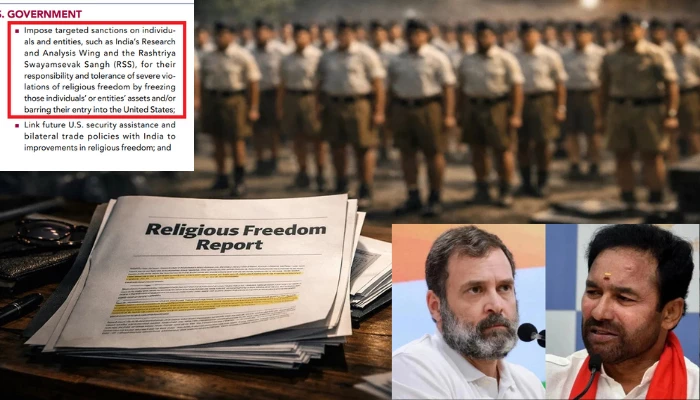
Case Summary
On 16th March 2026, Hindu organisation RSS( Rashtriya Swayamsevak Sangh) and India’s internal intelligence agency, the Research and Analysis Wing (R&AW), were targeted by the United States Commission on International Religious Freedom (USCIRF). A report released by USCIRF attacked India and recommended banning the RSS. The report also vilified Hindu nationalism and claimed that it had worsened the lives of religious minorities in India. The Indian National Congress seized the opportunity to criticise the RSS, promoting the report as justification for banning the organisation. The USCIRF, a federal body established under the International Religious Freedom Act of 1998, released its 2026 annual report, claiming to assess the state of religious freedom in India. In its report, USCIRF recommended that India be designated as a “Country of Particular Concern”. The report further claimed, “Targeted sanctions should be imposed on individuals and entities, such as India’s Research and Analysis Wing (R&AW) and the Rashtriya Swayamsevak Sangh (RSS), for their responsibility for, or complicity in, severe violations of religious freedom. These sanctions should be implemented by freezing assets and/or barring entry into the United States.” The commission claimed that the RSS was a principal organisation representing 'Hindu nationalism' in India and claimed that its influence had contributed to the deterioration of the condition of religious minorities. The report further claimed that the overall state of religious freedom in India had worsened in recent years. It criticised legislative and policy measures, including the Citizenship Amendment Act (CAA), anti-conversion laws, and cow protection laws, placing them within its assessment of supposed religious freedom violations. The report also referred to political developments and public discourse in India. It mentioned Prime Minister Narendra Modi and Home Minister Amit Shah, claiming that before elections, speeches and rhetoric targeting Muslims had been made. It further revisited historical issues, including the 1992 Babri structure demolition, linking it to the construction of the Ram Temple, while making only a limited reference to the Supreme Court judgment on the matter. USCIRF’s report additionally discussed anti-conversion laws, stating that out of 28 Indian states, 12 had either introduced new laws or strengthened existing provisions against religious conversions. It cited instances such as cases involving alleged forced conversions by a Christian pastor in Chhattisgarh, legislative measures like the Assam Healing (Prevention of Evil) Practices Bill, and laws in Rajasthan and Gujarat addressing conversion and related concerns. The commission also recommended that the United States administration consider restrictions on defence cooperation with India, including the possibility of halting arms sales. It raised questions regarding the functioning of both RSS and R&AW and urged action against them. This was not the first instance of USCIRF making such observations regarding India. Over several years, the commission had repeatedly released reports categorising India as a country where religious freedom was under threat. The Government of India had consistently rejected these reports, describing them as “biased” and “motivated by a political agenda.” Following the release of the report, reactions emerged within India. Union Minister G Kishan Reddy criticised the Congress party for supporting the USCIRF recommendations. In a public statement, he stated that the party was “degrading itself into a brazen anti-national party that is targeting institutions that are protecting India.” He highlighted that the report had been firmly rejected by the Government of India. The Ministry of External Affairs also responded to the report, stating that USCIRF continued to misrepresent facts about India and calling upon the body to instead take note of “alarming instances of assaults and vandalism on Hindu temples in the United States,” along with the “growing intolerance and intimidation of members of the Indian diaspora” in that country. Minister Reddy further described the conduct of the Congress party as “baffling” in light of these developments and criticised its leadership, stating that it had repeatedly taken positions that undermined national institutions. He also accused the leadership of spreading fear and misinformation during times of national difficulty. At the same time, the report’s recommendations were welcomed by sections of left-leaning media, Congress, and Islamic organisations in India, who portrayed it as validation of their claims regarding religious freedom in the country. It was also noted that on multiple occasions in the past, including in 2020, the United States government itself had not accepted USCIRF’s recommendations regarding India. This raised questions in public discourse about the influence, credibility, and consistency of the commission’s assessments, as well as the repeated focus on India in its reports.
Why it is Hate Crime ?
The primary category selected in this case is Hate speech against Hindus. The sub-category selected is: Anti-Hindu subversion and prejudice. Hate speech is defined as any speech, gesture, conduct, writing, or display that is prejudicial against a specific individual and/or group of people, which leads to or may lead to violence, prejudicial action or hate against that individual and/or group. Media plays a specific and overarching role in perpetuating prejudicial attitudes towards a community owing to unfair, untrue coverage and/or misrepresentation/misinterpretation, selective coverage and/or omission of facts of/about issues affecting a specific religious group. This type of bias can dehumanise the victim group, making it easier for others to justify harmful actions against them, which aligns with the objectives of hate speech laws aimed at preventing such harm. It is often observed that the media takes a prejudicial stand against the Hindu community, driven by their need to shield the aggressor community, which happens to be a numeric minority; however, that is the one perpetrating violence against Hindus. For example, the media is often quick to contextualise religiously motivated crimes against Hindus, omit or misrepresent facts that point towards religiously motivated hate crimes, justify and/or downplay religiously motivated hate crimes, or simply present fake news to stereotype Hindus. Such media bias leads to the denial of persecution and is often used to dehumanise Hindus, leading to justification for violence against them. For example, the media covered several fake allegations of Hindus targeting Muslims and forcing them to chant Jai Shree Ram. Most of these cases were proved false and fabricated after police investigation. These fake news reports were subsequently never retracted or clarified. Such fake news led to the justification of violence and dehumanisation of Hindus based on the argument that since Hindus targeted Muslims and forced them to chant Jai Shree Ram, the dehumanisation of Hindus and violence against them was par for the course and merely a retaliation. Such media bias leads to prejudicial portrayals of Hindus and offers a justification for violence against them and, therefore, is considered hate speech under this category. The other sub-category selected is: Mocking/denigrating Hindu leaders. Hate speech is defined as any speech, gesture, conduct, writing, or display that is prejudicial against a specific individual and/or group of people, which leads to or may lead to violence, prejudicial action or hate against that individual and/or group. Religious leaders are often seen as representatives of the community, especially the community’s religious faith and beliefs. Mocking or denigrating a religious leader specifically owing to his religious identity and/or the religious rituals he observes can be considered hate speech because the motivating factor of the speech is animosity and/or dislike for what he represents – the religious beliefs and faith of the community. It is important to note that mere insulting words against an individual do not constitute hate speech. Insulting words may be used for an individual; however, the specific speech is not the result of religious hate and/or animosity towards the professed faith of the religious leader, but the individual himself. For the speech to be considered hate speech, the speech itself or the motivating factor behind the speech has to be religious in nature. Such speech, which denigrates Hindu religious leaders specifically owing to animosity towards the faith they profess and the community faith they represent, will be treated as hate speech under this category. This case is a clear instance of religiously motivated hate speech because the United States Commission on International Religious Freedom (USCIRF) deliberately vilified Hindu nationalism and a key Hindu organisation, the Rashtriya Swayamsevak Sangh (RSS), by framing it as a threat to religious freedom and a “principal” force behind the deterioration of religious minorities in India. The report presented RSS and Hindu nationalism (Hindutva) not as legitimate cultural, civilisational movements but as inherently oppressive and exclusionary, which amounts to ideological delegitimisation of a major segment of Hindu identity and activism. By singling out RSS and Hindu nationalism in this way, the USCIRF echoed and amplified anti‑Hindu narratives that portray Hindu revivalism itself as a form of bigotry, even though RSS members and Hindutva proponents see their work as a defence of Hindu civilisational continuity and national unity. The Rashtriya Swayamsevak Sangh (RSS) is a Hindu nationalist, voluntary organisation founded in 1925 in Nagpur with the stated aim of strengthening Hindu society and Indian nationhood. For Hindus, the RSS is not merely a political actor but a cultural and moral force deeply rooted in the idea of dharma, the Hindu concept of duty, righteousness and social order. The organisation runs shakhas (daily training sessions) where members practise discipline, physical fitness and moral formation, often drawing from Hindu texts, epics and historical figures. RSS is widely seen among its supporters as the backbone of the larger “Sangh Parivar” ecosystem, which includes educational, religious, and social organisations working across India. Its religious significance lies in its role as a guardian of Hindu identity, mobilising Hindus around a sense of shared heritage, temples, gurus, and social institutions. Apart from this, the RSS and its affiliated bodies run extensive welfare activities, including relief work during natural disasters, medical camps, blood donation drives and educational support for underprivileged children. Through grassroots volunteers, the organisation also participates in community development initiatives such as clean‑water projects, sanitation drives and support for rural livelihoods, framing these efforts as expressions of Hindu social responsibility and service to the nation. In the USCIRF report, RSS is falsely depicted as the main driver of the “deterioration of religious minorities” in India. This is a classic hate‑speech tactic: identifying a central Hindu institution and painting it as the source of systematic oppression, thereby criminalising large sections of the Hindu population sympathising with or supporting it. In reality, the RSS frames its mission as a civilisational and national cause, emphasising India’s cultural unity, social cohesion and development across political, social and economic spheres, with a particular focus on moral and social reform. The organisation has long spoken about Hindutva (Hindu nationalism), a term that is fundamentally political and cultural rather than theocratic or exclusionary. Hindutva, as articulated by the RSS and like‑minded groups, is a unifying ideology for Hindus, born out of the need to preserve and reclaim a cultural identity that was eroded through Islamic invasions, British colonisation, Christian theological impositions and mass conversions. It is not a destructive or supremacist doctrine but a civilisational framework that seeks to unite Hindus as a community, encourage constructive participation in India’s democracy, economy and society, and foster pride in their shared heritage. Hindutva is frequently used by anti-Hindu bigots as a euphemism to mask and legitimise the targeting of Hindus and their religious identity. By reframing Hindu self‑assertion as “Hindutva”, critics can pretend they are attacking an ideology rather than a people, thereby making anti‑Hindu animus appear neutral and analytical. The “Dismantling Global Hindutva” conference in the USA made this subtext explicit: speakers openly stated that Hindutva and Hinduism are indistinguishable and that dismantling one effectively means dismantling the other. This reveals that the label Hindutva is not a neutral descriptor but a semantic weapon deployed to justify the dehumanisation and persecution of Hindus under the guise of ideological critique. Presenting Hindutva/Hindu nationalism as inherently discriminatory in the USCIRF report is, therefore, not a legitimate assessment but a deliberate act of religiously motivated hate speech designed to vilify Hindus and their civilisational worldview. Turning this misrepresentation into an official‑looking report gives it the veneer of authority, which is why the USCIRF output constitutes hate speech in effect. By labelling RSS and Hindu nationalism as responsible for “severe violations of religious freedom” and recommending sanctions and bans, the commission is not just analysing policy but attacking a Hindu worldview and its key organisational expression. This kind of discourse stigmatises the RSS as a “dangerous” entity, links it to the supposed victimisation of minorities, and encourages foreign governments and domestic actors to treat Hindu organisations as suspect. Such delegitimisation of a dominant Hindu civilisational force, while ignoring or downplaying attacks on Hindu communities abroad and at home, is inherently asymmetric and anti‑Hindu in its impact. The report also targets laws that are, in its own framing, connected to Hindu majoritarian sentiment, such as the Citizenship Amendment Act (CAA), anti‑conversion laws, and cow protection laws. The USCIRF treats these as evidence of growing religious hostility, but from a Hindu perspective, they are framed as measures addressing historical injustices, internal security concerns and social stability. The CAA, for example, is defended by its supporters as a humanitarian gesture toward persecuted minorities from neighbouring countries, not as an attack on Indian Muslims. Anti‑conversion laws are justified as safeguards against forced or induced conversions, which many Hindus see as a form of religious exploitation. Cow protection laws reflect deep‑rooted Hindu sentiments about the sacred status of the cow and are tied to religious, agrarian and cultural realities. By presenting these as “religious freedom violations,” the report sides with a narrative that views Hindu‑sensitive legislation as inherently oppressive, ignoring the Hindu religious and cultural logic behind such laws and thereby reinforcing an anti‑Hindu bias. The USCIRF’s attempt to reinterpret speeches by Prime Minister Narendra Modi and Home Minister Amit Shah as “anti‑Muslim” rhetoric is another aspect of this hate‑speech pattern. The report implies that their political messaging is primarily aimed at marginalising Muslims, whereas in reality such speeches are part of broader national‑security and policy debates, often framed in the language of integration, development and law and order. By selectively quoting and decontextualising political language to suggest that Hindu leaders are ideologically opposed to Muslims, the commission contributes to a stereotype that Hindu nationalism is inherently hostile to Islam. This, in turn, feeds a global narrative that Hindu‑majority India is becoming an illiberal theocracy, even though the Indian state itself is constitutionally secular and Muslim Indians continue to hold public office, participate in politics, and practice their religion. Painting Hindu leaders’ speeches as anti‑Muslim is therefore not neutral criticism but a form of ideological weaponisation that delegitimises Hindu‑centric political discourse and falsely vilifies the entire Hindu community. Taken together, these elements, vilifying RSS and Hindutva, misrepresenting Hindu‑sensitive laws, and reframing political speeches as religious bigotry, constitute a pattern of hate speech against Hindus. The USCIRF report does not present RSS or Hindu nationalism as complex, internally diverse movements but reduces them to simplistic, negative caricatures. It ignores the positive roles played by RSS‑linked organisations in education, disaster relief, and social service, while foregrounding alleged links to communal tensions. It also omits any parallel critique of Islamist or separatist tendencies that may affect Hindu communities, instead focusing disproportionately on Hindu institutions as the primary source of religious tension. This imbalance, combined with the recommendation of sanctions and possible restrictions on defence cooperation, turns the report into a tool for delegitimising and marginalising Hindu civilisational politics on the global stage. For Hindus, RSS and Hindutva are legitimate expressions of their cultural and religious identity; such a report is not a neutral critique but a targeted act of discursive hate speech justified under the label of “religious freedom.” Given that this case meets the parameters of religiously motivated hate speech, it is being added to the hate crime database of the tracker.


Case Status
Unknown


Perpetrators Details
Perpetrators
State and Establishment
Perpetrators Range
Unknown
Perpetrators Gender
unknown
 Sources




