Hindu sentiments outraged; derogatory poster depicting Goddess Durga feeding mutton biryani to Lord Ganesha placed in Kolkata, West Bengal
 Kolkata, West Bengal, India
  6 October, 2026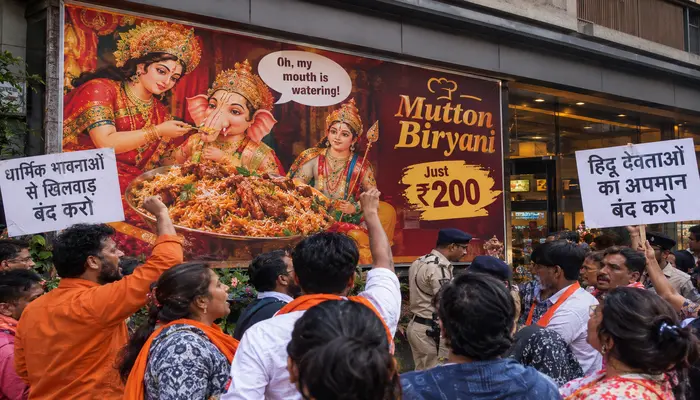
Case Summary
In Dum Dum, Kolkata, West Bengal, a derogatory poster featuring Hindu deities was put up outside a restaurant opposite Diamond Plaza as part of its promotion for mutton biryani. The poster depicted Goddess Durga feeding mutton biryani to Lord Ganesha, with the text alongside Ganesha reading, “My mouth is watering just by looking at it.” It also featured an image of Lord Kartikeya. According to media reports, the poster was first noticed by Hindu social worker Abhijit Das while he was travelling by car through the area in the morning. He recorded a video of the poster and subsequently posted it on his Facebook account. In the video, Das objected to the portrayal of Lord Ganesha, Goddess Durga and Lord Kartikeya in the context of eating meat, stating that the depiction had offended his religious sentiments. He also called for a protest against the poster. Following the circulation of the video and growing public attention to the poster, local Hindu residents gathered outside the restaurant to protest against it. A video of the protest subsequently went viral on social media, showing local Hindu residents, including men and women, expressing outrage over the depiction. During the protest, residents questioned how Hindu religious sentiments could be ridiculed despite a Hindutva-oriented government (BJP) having been elected in West Bengal in the 2026 Assembly elections, and asked whether they were living in Bangladesh or Pakistan for their faith to be targeted in such a manner. They objected to Hindu deities, including Lord Ganesha, being shown eating non-vegetarian food and used in a promotional advertisement for mutton biryani, and demanded that the poster be removed. Some protesters subsequently entered the restaurant and questioned the person at the reception about the poster. The situation became heated as arguments broke out between the receptionist and local Hindu residents over the derogatory depiction of Hindu deities, further stirring tensions in the area. Police intervened as the situation escalated, following which the posters were removed from the locations where they had been displayed. The incident subsequently sparked outrage among local Hindu residents over the use of Hindu religious imagery to commercially promote mutton biryani. This was not the first instance of Hindu deities being depicted in a derogatory manner alongside non-vegetarian food. The Hinduphobia Tracker had previously documented several such cases in which Hindu deities were shown eating, serving or being associated with non-vegetarian food. For example, during the Ganesh Chaturthi celebrations in Tamil Nadu in 2026, a derogatory promotional banner featuring Lord Ganesha cooking and eating meat was displayed by a restaurant near the V.M. Chathiram Bridge in Tirunelveli city. The banner was put up in connection with a special food promotion just days before the Ganesh Chaturthi celebrations. A similar pattern was seen during the Vishu celebrations in April 2026. During that period, the Hinduphobia Tracker documented five separate incidents in which Lord Krishna was depicted in promotional material for non-vegetarian food. These included a Vishu poster by My Raydan Restaurant in Malappuram, Nadawi Mandi in Bengaluru, Meher Mandi and Grills in Cherthala, Yamama Shawaya Hotel near Poradam Bridge in Malappuram, and Arabian Majlis Restaurant in Malappuram. The posters depicted Lord Krishna eating, serving or appearing alongside meat-based dishes, including chicken, biryani and kuzhi mandi.
Why it is Hate Crime ?
This case is being added to the tracker under the primary category: Attack on Hindu religious representations. The subcategory selected is: Iconoclastic representation of Hindu Gods/Goddesses. An icon is a symbol of someone or something that is revered, or a religious representation of a spiritual ideal. Iconography is of vital significance in the Hindu milieu. It helps connect people’s spiritual beliefs with the real world. Iconography within the Hindu faith takes several shapes and forms. Murtis are of most significance to Hindus, to which daily rituals, prayers and offerings are done. Besides the murtis, there are several other symbols which have deep significance in the Hindu faith – the Om and Swastika for example. Any iconoclastic representation of these symbols, images and murtis is an affront to the religious beliefs and faith of the Hindu community itself since the symbols and icons are deeply religious in nature. In this sub-category of crime, we would record hate crimes and iconoclastic representations, in words, art, or any other form of representations of symbols that hold religious significance for the Hindu community. Since these symbols, icons and murtis are central to the Hindu faith, any iconoclastic representation of these symbols is born out of animosity towards the faith itself, manifesting itself through these symbols and therefore, these representations would be considered religiously motivated hated crimes. The other primary category selected is: Hate speech against Hindus. The subcategory selected is: Anti-Hindu slurs, mocking faith. Anti-Hindu slurs and the deliberate mocking of the Hindu faith owing to religious animosity involve the usage of derogatory terms, stereotypes, or offensive references to religious practices, symbols, or figures. One of the common anti-Hindu slurs used against Hindus is “cow-worshipper” and “cow piss drinker”. The intention of using this term is to demean and mock Hindus as a group and their religious beliefs since Hindus consider the cow holy. Additionally, some symbols and the slurs attached to them have a historical context that exacerbates the insult, hate, stereotyping, dehumanisation and oppression against Hindus. Cow worship has been used for centuries to denigrate Hindus, insult their faith and oppress Hindus specifically as a religious group. There has been overwhelming documentation about how cow slaughter has been used to persecute Hindus with cow meat being thrown in temples and places of worship. There has also been overwhelming documentation where cow meat (beef) has been force-fed to Hindus to either forcefully convert them to Islam or denigrate their faith. Apart from cow worship, the Swastika – which holds deep religious significance for the Hindus – has also been misinterpreted and distorted to use as a slur against Hindus. Similarly, the worship of the Shivling has been used by supremacist ideologies and religions to denigrate Hindus owing to religious animosity. Such slurs and denigration stem out of inherent animosity and hate towards Hindus and their faith, therefore, it is categorised as hate speech targeted at Hindus specifically owing to their religious identity. This case is a clear example of a religiously driven hate crime because a derogatory poster featuring Hindu deities was created and publicly displayed as part of a commercial promotion for mutton biryani. The poster showed Goddess Durga feeding mutton biryani to Lord Ganesha, with Lord Kartikeya also depicted alongside them, while the accompanying text portrayed Lord Ganesha as saying that his mouth was watering at the sight of the food. The use of revered Hindu deities to advertise meat, particularly by portraying them as consuming or desiring it, went beyond ordinary commercial advertising and amounted to a deliberate distortion of their sacred identities. The manner in which the imagery was presented demonstrates hostility towards Hindu religious beliefs and directly offends Hindu sentiments. Goddess Durga is revered as the Divine Mother and as a manifestation of Shakti, representing divine power, protection and the destruction of evil. Lord Ganesha is worshipped as the remover of obstacles and the embodiment of wisdom, auspiciousness and discernment. Lord Kartikeya, also known as Skanda, Murugan and Subrahmanya, is revered as a divine warrior associated with courage, strength and the destruction of negative forces. Their distinct forms, iconography, and attributes carry specific religious meanings and are deeply revered by Hindu devotees. In mainstream Hindu worship, purity is an important religious principle governing the worship and representation of deities. Meat, fish and alcohol are generally regarded as impure substances within this devotional framework and are therefore kept separate from the worship and representation of revered deities, particularly in temples and domestic shrines where ritual purity is observed. This separation reflects the understanding that substances considered impure should not defile the sacred space or the divine presence associated with a deity. Consequently, the manner in which a deity is represented is closely connected with notions of purity, sanctity and religious reverence. Against this religious framework, the deliberate depiction of Goddess Durga feeding meat to Lord Ganesha, together with the statement that Ganesha’s mouth was watering at the sight of it, desecrated the sanctity and reverence associated with these Hindu deities. By portraying Lord Ganesha as desiring meat and placing Goddess Durga and Lord Kartikeya in the same incongruous context, the poster deliberately distorted and degraded the sacred representation of Hindu gods and goddesses. Such a depiction was deeply offensive to Hindu devotees, violated their religious sensibilities and hurt Hindu sentiments. The deliberate use of revered deities in this manner amounted to an iconoclastic representation of Hindu gods and goddesses and constituted a deliberate attempt to mock and ridicule Hindu faith, its sacred figures and the religious reverence accorded to them. It could be argued by some that the depiction should not be considered offensive because certain Hindu traditions, including those practised in parts of West Bengal, involve offerings of animal sacrifice (paśubali) and non-vegetarian substances to deities. It is important to recognise that paśubali is a legitimate and scripturally sanctioned form of worship within certain Shakta Hindu traditions, and offerings of meat, fish and alcohol are prescribed within particular Hindu ritual frameworks. Such practices are not arbitrary or separate from Hindu religious tradition; where prescribed, they are carried out in accordance with established Hindu religious texts, specific rituals and procedures governing the preparation, purification, consecration and offering of the substance to the deity. They therefore carry a specific theological and ritual significance within the traditions that practise them. However, these sacred practices cannot be equated with the casual depiction of a deity eating meat in a commercial advertisement. A ritually prescribed offering made to a deity through an established religious ceremony is fundamentally different from using the sacred form of a deity to promote a commercially prepared meat dish. Mutton biryani displayed as a commercial food product therefore cannot reasonably be equated with paśubali or any other ritually sanctioned non-vegetarian offering. The existence of these legitimate Hindu traditions does not justify portraying revered deities as consuming or craving meat for the purpose of commercial promotion, and the two contexts are therefore not comparable. The incident also reflected a recurring pattern documented by the Hinduphobia Tracker during Hindu festivals, including Ganesh Chaturthi and Vishu, in which Hindu deities were depicted consuming, serving or being associated with non-vegetarian food in commercial promotional material. The repetition of such imagery indicated a broader pattern of placing Hindu deities in commercial contexts that disregarded their religious significance and sacred forms. In this case, the use of Goddess Durga, Lord Ganesha and Lord Kartikeya to promote mutton biryani, coupled with the depiction of Ganesha as craving the food, crossed the boundary from commercial promotion into religious denigration. The incident therefore constituted a clear case of religiously driven hostility towards Hinduism and was added to the Hinduphobia Tracker’s hate crime database. Disclaimer: The Hinduphobia Tracker records incident dates based on when an incident occurs, rather than when it is reported by the media. However, in this case, media reports do not specify the exact date on which the incident occurred. Therefore, 7 October 2026, the date on which the incident was reported by the media, is being selected as the indicative incident date for documentation purposes only. At the time of documentation, the identity of the person responsible for putting up the poster was not known. Although protesters questioned the receptionist about the poster, there was no information establishing his involvement in putting it up. Henceforth, the perpetrator count and identity have been recorded as “Unknown”.


Case Status
Unknown


Perpetrators Details
Perpetrators
Unknown
Perpetrators Range
Unknown
Perpetrators Gender
unknown
 Sources




