Hindu faith mocked; Muslim-owned restaurant in Malappuram shares derogatory poster of Lord Krishna during Vishu celebrations
 Malappuram, Kerala, India
  19 April, 2026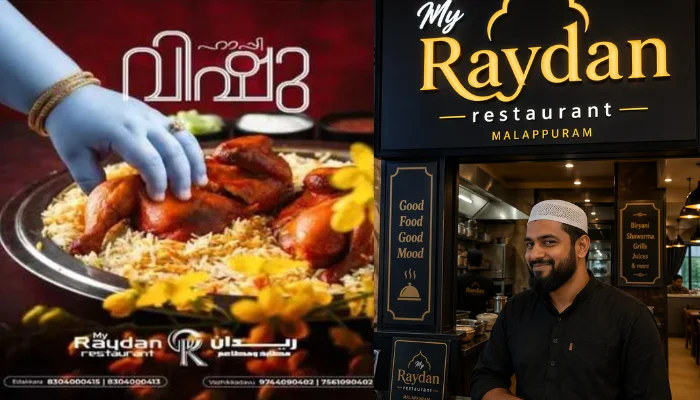
Case Summary
In the Kottakkal area in Malappuram district, Kerala, Hindu faith was derided as a Muslim-owned restaurant named "My Raydan Restaurant" shared a derogatory poster of Lord Krishna on its social media handle. This occurred during the Vishu celebrations in Kerala. Vishu, the Malayalam New Year, is a deeply significant festival for Hindus in Kerala, centred on rituals like the Vishukkani, which symbolises prosperity, purity and divine blessings for the year ahead. Hindu families prepare the Vishukkani the night before by arranging auspicious items, such as rice, gold ornaments, fruits, flowers, coins, a mirror, and sacred texts, in a darkened room lit by a traditional lamp. The first sight upon waking determines one's fortune for the coming year, emphasising renewal, hope, and spiritual purity through this time-honoured tradition. According to media reports, the Raydan restaurant owns multiple branches across Kerala and various Gulf countries. The controversy arose after a Vishu greeting poster showing chicken pieces placed before Lord Krishna's image circulated widely on social media from the restaurant's official handle. The poster depicted a blue-skinned hand styled to resemble Lord Krishna picking up a piece of cooked chicken from a plate of biryani. The visual featured a festive Vishu backdrop with flowers and traditional elements alongside the restaurant's branding details. Raydan Restaurant shared this poster on all its social media platforms. This derogatory poster created massive outrage on the internet and led to legal complaints from a local resident. According to the complaint filed by a Malappuram native, the depiction was offensive to Hindu religious sentiments, particularly in the context of Vishu, where the Vishu Kani ritual holds deep cultural and spiritual significance. Acting on the complaint, police registered a case under Section 192 of the Bharatiya Nyaya Sanhita, which deals with intentional or malicious acts that may provoke unrest. Officials initiated a probe into the origin, design, and dissemination of the poster, including the role of those handling the digital platforms of the establishments.
Why it is Hate Crime ?
This case has been added to the tracker under the primary category - Attack on Hindu religious representations. Within this, the subcategory selected is - Desecration of Hindu religious symbol. Icons and symbols or a religious representation of a spiritual ideal are widely revered in Hinduism. Iconography is of vital significance in the Hindu milieu. It helps connect people’s spiritual beliefs with the real world. Iconography within the Hindu faith takes several shapes and forms. Murtis are of most significance to Hindus, to which daily rituals, prayers and offerings are done. Besides the murtis, there are several other symbols which have deep significance in the Hindu faith – the Om and Swastika for example. Since these Hindu religious symbols hold paramount importance in Hinduism, any desecration of symbols, icons, murtis, religious representations and manifestations, is driven by animosity towards the faith itself which manifests itself through these murtis, icons and symbols. Therefore, any desecration of these Hindu religious symbols and representations is considered religiously motivated hate crimes under this category. The other subcategory selected is- Iconoclastic representation of Hindu Gods/Goddesses. An icon is a symbol of someone or something that is revered, or a religious representation of a spiritual ideal. Iconography is of vital significance in the Hindu milieu. It helps connect people’s spiritual beliefs with the real world. Iconography within the Hindu faith takes several shapes and forms. Murtis are of most significance to Hindus, to which daily rituals, prayers and offerings are done. Besides the murtis, there are several other symbols which have deep significance in the Hindu faith – the Om and Swastika for example. Any iconoclastic representation of these symbols, images and murtis is an affront to the religious beliefs and faith of the Hindu community itself since the symbols and icons are deeply religious in nature. In this sub-category of crime, we would record hate crimes and iconoclastic representations, in words, art, or any other form of representations of symbols that hold religious significance for the Hindu community. Since these symbols, icons and murtis are central to the Hindu faith, any iconoclastic representation of these symbols is born out of animosity towards the faith itself, manifesting itself through these symbols and therefore, these representations would be considered religiously motivated hated crimes. This case stands as a clear example of a religiously motivated hate crime, as the "My Raydan Restaurant" posted a derogatory image on social media of Lord Krishna placed before meat while wishing Vishu greetings. The post showed Lord Krishna, a central deity in Hinduism, revered for his divine purity as depicted in scriptures, with chicken pieces positioned before his image, a blue-skinned hand styled like the deity near a plate of biryani, against a festive Vishu backdrop with flowers and traditional elements, turning a sacred figure into profane mockery that wounded the faith of Hindu devotees. Vishu, the Malayalam New Year, holds deep spiritual meaning through rituals like Vishukkani, where Hindu families arrange symbols of prosperity, purity, fruits, gold and divine images to seek blessings, making this timed insult a deliberate attack on Hindu traditions and proving its hateful intent. The act of portraying Lord Krishna with meat amounts to desecration of sacred Hindu symbols since Hindu deities command utmost reverence with temples and homes barring meat, alcohol and all impurities to uphold ritual sanctity. The poster's blend of this impure element, chicken pieces, with Krishna during Vishu greetings profaned Hinduism's holiest icons, stripping away the devotion Hindus offer their gods as living faith embodiments. This act stabbed at the spiritual heart of Hindu families, confirming it as a religiously motivated hate crime that defiled and desecrated a sacred figure Hindus revere most. This showcases the perpetrator's deep-seated animosity towards Hinduism and the Hindu community, making this a clear instance of a religiously motivated crime. By depicting Krishna alongside meat, the poster committed iconoclasm against Hindu gods whose forms appear in exact detail across scriptures like the Bhagavad Gita and Puranas as perfect divine beings free from human flaws. Straying from this scriptural purity to link Krishna with impure substances like meat outraged devotees' deepest beliefs, causing emotional pain to Hindu communities who cherish such depictions. This intentional distortion marked the incident as a religiously motivated hate crime crafted to provoke outrage through a beloved deity's degradation. The occurrence right during the Vishu festival reveals the perpetrators' vicious plan to shatter the celebration's holiness, a sacred season when Kerala Hindus unite in time-honoured family rites like preparing Vishukkani arrangements, offering temple prayers at dawn, and sharing festive feasts such as Vishu sadhya that evoke hope, renewal and divine grace for the year ahead. Striking at this joyful peak when families gather in devotion maximised devastation to Hindu sentiments among those honouring the Malayalam New Year with pure hearts and traditional observances. Such precise timing laid bare a calculated scheme to erode a vital cultural and religious rite central to Hindu identity, establishing this as a classic religiously motivated hate crime that pierced Hindu communal bonds and undermined collective faith. The poster's spread through social media guaranteed exposure to millions of Hindus actively sharing festival warmth online through greetings, family photos and sacred updates, a digital space meant purely for joy and celebration, not an assault on beliefs. This broad public launch on social media platforms exposed the creators' deliberate goal to inflict mass hurt on the Hindu majority by flooding their feeds with sacrilege precisely when festive content dominated, circulating widely and creating massive outrage. Leveraging social media's vast scale turned private malice into collective trauma across Hindu communities, rendering this a prime example of a religiously motivated hate crime aimed at wounding Hindu devotees widely and amplifying outrage through viral dissemination. Given that this case ticks every hallmark of a religiously motivated offence, it is being added to the hate crime database of the Hinduphobia Tracker. Disclaimer: The Hinduphobia Tracker records the dates of incidents based on when the crime occurs rather than when it is reported by the media. In this case, media reports have not stated the exact date when the social media post was made by the accused. Henceforth, the date when it was first reported by the media, that is, 20 April 2026, is selected as the indicative incident date. This date is recorded for documentation purposes only.


Case Status
Complaint registered


Perpetrators Details
Perpetrators
Muslim Extremists
Perpetrators Range
Unknown
Perpetrators Gender
unknown
 Sources




