Hindu sentiments mocked; Muslim hotel owner posts banner showing Lord Krishna eating non-veg during Malayalam new year
 Cherthala, Kerala, India
  16 April, 2026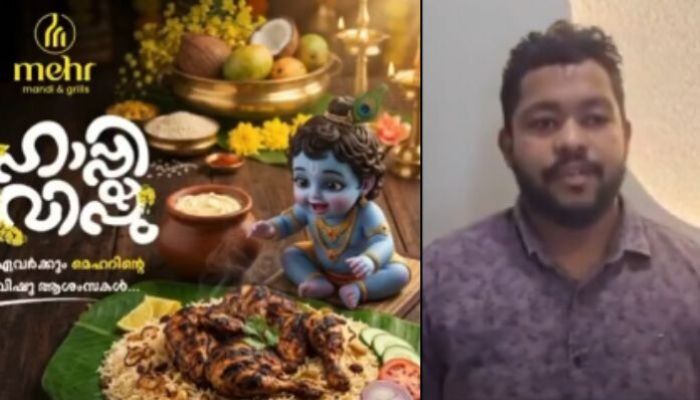
Case Summary
A Hindu religious symbol was depicted in a manner that caused distress during a festival period in Cherthala, Kerala. A promotional poster circulated online showed Lord Krishna eating non-vegetarian food. The imagery spread rapidly across WhatsApp, drawing attention during a sacred time for Hindu devotees. The incident emerged in Alappuzha district amid rising local tensions. On 17th April 2026, a promotional poster linked to a restaurant named Meher Mandi and Grills was circulated on WhatsApp. The poster depicted Lord Krishna, a central and revered deity in Hinduism, seated in front of a serving of kuzhi mandi, a non-vegetarian Arabian dish. The visual presentation combined a sacred Hindu figure with imagery associated with meat consumption. The poster was created as part of a Vishu-themed promotional campaign. Vishu marks the Malayalam New Year and holds deep religious and cultural importance for the Hindus in Kerala. The timing of the poster’s circulation coincided with this festival period, when devotional practices and reverence towards deities are heightened. The restaurant was located in Cherthala in the Alappuzha district. It was identified as being owned by a Muslim man, Mohammed Shemir. The establishment operated near the North Market Central Juma Masjid. The promotional content was disseminated digitally, allowing it to spread across multiple groups and reach a wider audience in a short time. The imagery in the poster presented Lord Krishna in a manner that associated the deity with a non-vegetarian dish. In Hindu tradition, Lord Krishna is worshipped with strictly vegetarian offerings. The depiction, therefore, placed a sacred figure in a context that diverged from established religious practices and beliefs. As the poster circulated, it drew reactions from members of the Hindu community. The content was shared repeatedly across messaging platforms, increasing its visibility. The poster's distribution extended beyond the original point of publication, amplifying its reach during a religiously significant period. Following the circulation, two individuals were taken into custody on 17th April 2026 for sharing the poster on WhatsApp. The First Information Report recorded that the poster had been circulated with the intent to hurt the religious sentiments of the Hindu community. The dissemination of the poster occurred alongside announcements of a protest march by a Hindu organisation. The march was directed towards the restaurant premises. The situation developed in a context of increasing public reaction and mobilisation. Police registered a case under Section 192 of the Bharatiya Nyaya Sanhita and formally recorded the arrests of two individuals. Authorities initiated precautionary measures to maintain law and order in the area. The restaurant owner issued a public apology and claimed that the poster design had been outsourced to a third party. He claimed that the imagery resulted from a designer error. The investigation remained ongoing, with authorities monitoring the situation and assessing what further action to take.
Why it is Hate Crime ?
This case has been added to the tracker under the primary category - Attack on Hindu religious representations. Within this, the subcategory selected is - Desecration of Hindu religious symbol. Icons and symbols or a religious representation of a spiritual ideal are widely revered in Hinduism. Iconography is of vital significance in the Hindu milieu. It helps connect people’s spiritual beliefs with the real world. Iconography within the Hindu faith takes several shapes and forms. Murtis are of most significance to Hindus, to which daily rituals, prayers and offerings are done. Besides the murtis, there are several other symbols which have deep significance in the Hindu faith – the Om and Swastika for example. Since these Hindu religious symbols hold paramount importance in Hinduism, any desecration of symbols, icons, murtis, religious representations and manifestations, is driven by animosity towards the faith itself which manifests itself through these murtis, icons and symbols. Therefore, any desecration of these Hindu religious symbols and representations is considered religiously motivated hate crimes under this category. The other subcategory selected is- Iconoclastic representation of Hindu Gods/Goddesses. An icon is a symbol of someone or something that is revered, or a religious representation of a spiritual ideal. Iconography is of vital significance in the Hindu milieu. It helps connect people’s spiritual beliefs with the real world. Iconography within the Hindu faith takes several shapes and forms. Murtis are of most significance to Hindus, to which daily rituals, prayers and offerings are done. Besides the murtis, there are several other symbols which have deep significance in the Hindu faith – the Om and Swastika for example. Any iconoclastic representation of these symbols, images and murtis is an affront to the religious beliefs and faith of the Hindu community itself since the symbols and icons are deeply religious in nature. In this sub-category of crime, we would record hate crimes and iconoclastic representations, in words, art, or any other form of representations of symbols that hold religious significance for the Hindu community. Since these symbols, icons and murtis are central to the Hindu faith, any iconoclastic representation of these symbols is born out of animosity towards the faith itself, manifesting itself through these symbols and therefore, these representations would be considered religiously motivated hated crimes. This case qualified as a religiously motivated hate crime because a Hindu deity was depicted in a manner that conflicted directly with established religious beliefs and practices. A Muslim owned establishment circulated imagery showing Lord Krishna alongside non vegetarian food during a sacred Hindu festival. The act centred on a figure of deep religious reverence and introduced elements known to be offensive within Hindu worship traditions. The timing, content, and method of circulation together demonstrated that religion was not incidental but central to the act. The primary religious marker was the depiction of a Hindu deity in a manner that conflicted with core religious practices. The poster showed Lord Krishna seated before a non-vegetarian dish. Lord Krishna is worshipped through rituals that emphasise purity, devotion, and vegetarian offerings. This made the imagery religiously significant because it directly contradicted how the deity is traditionally honoured. The perpetrator chose to combine a sacred figure with a context that is widely understood to be inappropriate within Hindu practice. This was not a neutral artistic choice but a deliberate juxtaposition. By placing the deity in this setting, the act transformed a revered symbol into one that could provoke discomfort and offence among Hindu devotees. This choice revealed an intent to target the religious identity of Hindus by altering the meaning of a sacred figure in a way that would not occur in a non-religious context. The second religious marker was the timing of the act during a major Hindu festival. The poster was circulated during Vishu, a period of heightened religious devotion in Kerala. Vishu holds deep spiritual significance, with rituals centred on auspicious beginnings, offerings, and reverence for deities, including Lord Krishna. This made the timing religiously significant because the emotional and spiritual connection to the deity is strongest during this period. The perpetrator chose to release and circulate the imagery at a time when Hindu religious sentiments were at their peak. This timing maximised the likelihood of impact and ensured that the depiction would be encountered in a heightened devotional context. This choice revealed an intent to amplify harm by aligning the act with a sacred moment, indicating that the targeting of Hindu identity was deliberate and calculated. The third religious marker was the method of dissemination through mass digital circulation. The poster was shared widely on WhatsApp, allowing it to spread rapidly across communities. This made the act religiously significant because it ensured that the depiction would reach a large number of Hindu individuals during a religious period. The perpetrator chose a medium that enabled rapid and repeated exposure, increasing the scale of impact. The circulation was not confined to a private or limited setting but was extended into public digital spaces. This choice revealed an intent to magnify the harm beyond a single instance, ensuring that the altered depiction of the deity would be repeatedly viewed and discussed, thereby intensifying its effect on Hindu religious sentiment. Hinduism reveres and regards its deities as sacrosanct. Using the images of the Hindu deities in a context that is deemed inappropriate or disrespectful, in this case, showing Lord Krishna eating non-veg food, is considered sacrilegious and driven by a deep-seated animosity towards Hinduism. Given that this case met the parameters of a religiously motivated hate crime, it was added to the hate crime database of the tracker.


Case Status
Arrested


Perpetrators Details
Perpetrators
Muslim Extremists
Perpetrators Range
One Person
Perpetrators Gender
male
 Sources




