Historic Pushkarani of 1,400‑year‑old Bhavani Shankar temple demolished by State authorities in Hubballi, Karnataka
 Hubli, Karnataka, India
  21 August, 2026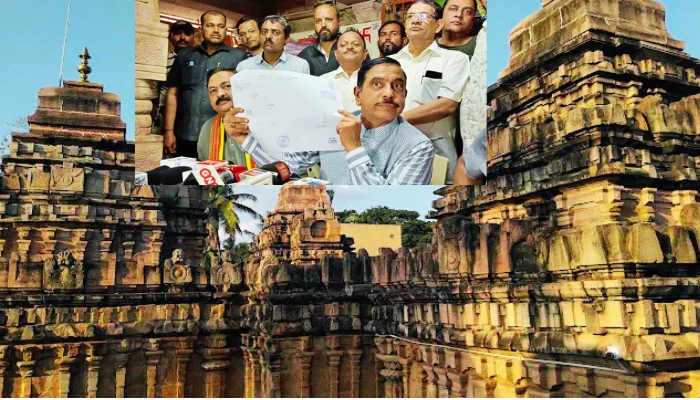
Case Summary
In Hubballi, Karnataka, the heritage structure of a Hindu temple’s historic Pushkarani (temple pool of water) belonging to the Bhavani Shankar Temple was demolished by state authorities. The ancient Pushkarni was destroyed to make way for a road. The move outraged Hindus, hurting their religious sentiments and triggered massive protests. The incident came to light after the construction of the road over the historic Pushkarani of the Bhavani Shankar Temple was exposed. The Pushkarani is a traditional, sacred stepped water tank or reservoir in Hindu temples. The Bhavani Shankar Temple Pushkarani was a part of the temple complex and was associated with the Kalyana Chalukya period. Hindu organisations and local residents objected to the construction, stating that the temple tank was a historic and religious heritage structure that should have been protected. They questioned how the road work was permitted despite earlier objections and demanded that the road be removed and the Pushkarani restored. On Saturday, 22 August 2026, a large protest was held in front of Chennapet Garden demanding the removal of the road and restoration of the Pushkarani. BJP MLAs Aravind Bellad and Mahesh Tenginkai, MLC Pradeep Shettar, Sri Ram Sene chief Pramod Muthalik, and several BJP leaders and Hindu activists participated in the protest. The protesters maintained that the Pushkarani formed part of the ancient temple complex and demanded a detailed survey of the site, verification of historical and revenue records, and clarification of the land's ownership and legal status. They also demanded an inquiry into the approvals granted for the road construction and action against officials responsible if violations were established. As the protesters attempted to move towards the Bhavani Shankar Temple to remove the road, tension prevailed in the area. Dalit and Muslim organisations opposed the demand to remove the road. Police imposed prohibitory orders under Section 163 of the Bharatiya Nagarik Suraksha Sanhita within a 500-metre radius of the Bhavani Shankar Temple. More than 1,500 police personnel were deployed to prevent any untoward incident. Hubballi-Dharwad Police Commissioner N. Shashikumar personally monitored the security arrangements. Around 200 protesters were taken into custody at Channapet in Old Hubballi while attempting to proceed towards the temple. The police detained the protesters as they marched towards the Bhavani Shankar Temple in connection with the dispute over the Pushkarani. Union Minister Pralhad Joshi visited the disputed site on Saturday, 22 August 2026, inspected the site and condemned the construction. The temple was around 1,400 years old and situated in a protected area. He stated that restrictions were in place on construction and activities, such as mining, within 100 metres of the temple, and questioned how construction work was carried out in the restricted zone. He also questioned whether the road construction received proper approval from the Hubballi-Dharwad Municipal Corporation and disputed whether the corporation had passed any resolution approving the road work. He further stated that local residents and organisations had informed the authorities that a Pushkarani had existed at the site several decades ago. He further stated that the temple had faced repeated attacks in the past. The Bharatiya Janata Party members and Hindu organisations demanded that the government protect the temple property, verify the historical and legal records, and act against those responsible if violations were established. They maintained that the issue concerned the protection of an ancient Hindu religious and heritage structure and the restoration of its traditional water body, rather than merely the removal of a road. They further demanded that the Pushkarani be excavated, that its original boundaries and condition be established, and that the site be restored to its original status. BJP leaders accused the government of prioritising appeasement politics over the protection of Hindu heritage and questioned why the authorities proceeded with the road construction despite objections. They demanded that the government act impartially and ensure the protection of the Bhavani Shankar Temple and its associated heritage property.
Why it is Hate Crime ?
The primary category for this case is: Attack on Hindu religious representations. The subcategory for this case is: Encroachment or illicit takeover of temple land/ land near a temple. In Hinduism, a temple is the abode of the Deity. The Deity in the Temple is consecrated, thereby making it a real, breathing entity. Hindus believe that not just the Deity but the temple premises themselves are sacred to Hindus since Hindus hold the faith that the entire Temple space is an amalgamation of the divine energy of the deity. Not only the Temple but the Temple premises in their entirety are considered sacred by Hindus. In several cases, the premises of the Temple and/or religious centre are illicitly taken over by institutions belonging to other faiths – like the Waqf board or the Church. Other times, the temple property, land or the property of religious centres are illicitly encroached by non-Hindu groups. Any illicit takeover or encroachment is a crime an initio; however, when non-Hindu groups illicitly take over or encroach the sacred land of Hindus, it is an affront to the Hindu community and is therefore classified as a religiously motivated hate crime under this category. This incident was included in the Hinduphobia Tracker because the construction of a road over the historic Pushkarani of a Hindu temple directly affected property that formed part of a sacred religious space. In Hinduism, a temple is not limited to the structure housing the Deity. Its entire premises, including traditional water bodies associated with the temple, are regarded as sacred and form part of the religious environment in which worship and devotion take place. The destruction and displacement of such a historically significant part of the temple premises therefore caused religious harm to Hindus and diminished the sanctity of their place of worship. Furthermore, a temple with a history of around 1,400 years could not, by any reasonable measure, be treated as an obstacle to road construction. Its antiquity and religious significance demanded preservation, with development planned around the protected heritage rather than by destroying or altering it. The decision to construct over a historic Pushkarani associated with such an ancient Hindu temple showed a serious disregard for the preservation of Hindu religious heritage. Moreover, continuing the work despite objections from residents and organisations displayed a callous disregard for Hindu religious sentiments. The issue was not merely the loss of an old water structure, but the destruction of an integral part of a sacred Hindu temple complex. Treating such temple property as ordinary land available for construction devalued its religious significance and demonstrated contempt for the Hindu community's attachment to its sacred heritage. This incident also carried a wider impact for Hindus. It showed the community that even ancient temples and their associated sacred spaces could be ravaged or altered despite their religious and historical importance. The Hinduphobia Tracker had recorded a plethora of cases in Karnataka where Hindu temples and religious heritage were damaged, demolished or encroached upon. The repeated ravaging of such spaces created a pattern in which Hindu religious heritage was treated as expendable, causing deep and continuing hurt to Hindu sentiments. For instance, in April, 2026, a Hindu temple's sacred land was illegally occupied by a few encroachers in Belur Hosapalya village under Hindiskere Gram Panchayat in Tumakuru district, Karnataka. The encroachers used the temple premises for private purposes, turning it into a space for tying cattle and goats, storing footwear, and parking vehicles, thereby violating the sanctity of the Hindu temple. They also obstructed the construction of a compound wall around the temple and intimidated devotees who objected to the encroachment or attempted to protect the temple property. In another instance in July, 2026, an ancient statue of Goddess Saraswati at the Saraswati temple within the historic Trikuteshwara temple complex was vandalised by unknown miscreants. The Archaeological Survey of India (ASI) officials attempted to conceal the damage by applying black paint over the defaced portion in Gadag, Karnataka. Such deliberate encroachment of temple-associated property, despite its historic and religious significance, reflected a conscious disregard for Hindu religious rights. The conduct showed that development at the cost of a Hindu temple was prioritised, paying no heed to the religious feelings of Hindus and their traditions. It conveyed that Hindu temples could be sacrificed for any purpose and held little value. Such treatment devalued Hinduism, disregarded the sentiments of its devotees, and constituted a religiously motivated attack on Hindu religious heritage. Disclaimer: The Hinduphobia Tracker records 22 August 2026, the date on which the incident was reported, as the date of the incident, because the report did not mention the exact date on which the demolition began.


Case Status
Unknown


Perpetrators Details
Perpetrators
State and Establishment
Perpetrators Range
Unknown
Perpetrators Gender
unknown
 Sources




