Hindu temple land illegally occupied, devotees intimidated for opposing encroachment in Tumakuru, Karnataka
 Tumkur, Karnataka, India
  10 April, 2026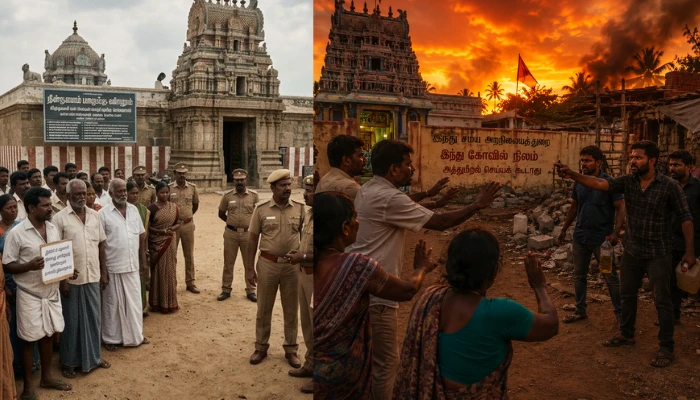
Case Summary
In Belur Hosapalya village under Hindiskere Gram Panchayat in Tumakuru district, Karnataka, a Hindu temple's sacred land was illegally occupied by a few encroachers. The accused were identified as Naveen Kumar and his family, who occupied around 40 feet of land surrounding the Sri Renuka Yallammadevi Temple and falsely asserted ownership over it. The encroachers used the temple premises for private purposes, turning it into a space for tying cattle and goats, storing footwear, and parking vehicles, thereby violating the sanctity of the Hindu temple. They also obstructed the construction of a compound wall around the temple and intimidated devotees who objected to the encroachment or attempted to protect the temple property. The incident came to light after hundreds of local Hindu villagers and devotees staged a protest demanding the removal of the encroachment and action against those responsible. According to the protesters, the Sri Renuka Yallammadevi Temple was constructed around 40 years earlier, in 1986, on land donated by local residents, and a temple account had already been established in its name. However, Naveen Kumar and his family, who resided adjacent to the temple, occupied part of the temple land and continued to assert ownership over it. The devotees stated that whenever they questioned the encroachment, the family abused, threatened, and intimidated them, and picked fights with those visiting or moving around the temple premises. They further stated that the family prevented devotees from freely accessing and maintaining the temple and obstructed efforts to construct a protective compound wall. Despite complaints being submitted to the Gram Panchayat, no action was taken by the authorities. The protesters demanded that Gram Panchayat officials immediately inspect and measure the temple land, remove the encroachment, restore the land to the temple, and initiate appropriate legal action against those responsible.
Why it is Hate Crime ?
The primary category selected in this case is "Attack on Hindu religious representations." The selected subcategory is: Encroachment or illicit takeover of temple land/land near the temple. In Hinduism, a temple is the abode of the Deity. The Deity in the Temple is consecrated, thereby making it a real, breathing entity. Hindus believe that not only the Deity but also the temple premises themselves are sacred, since the entire Temple space is an amalgamation of the deity's divine energy. Not only the Temple but the Temple premises in their entirety are considered sacred by Hindus. In several cases, the premises of the Temple and/or religious centre are illicitly taken over by institutions belonging to other faiths – like the Waqf board or the Church. Other times, the temple property, land or the property of religious centres are illicitly encroached by non-Hindu groups. Any illicit takeover or encroachment is a crime an initio; however, when non-Hindu groups illicitly take over or encroach the sacred land of Hindus, it is an affront to the Hindu community and is therefore classified as a religiously motivated hate crime under this category. The case was included in the Hinduphobia Tracker because the perpetrator's actions were directed against the land and premises of a Hindu temple, which are regarded as sacred in Hinduism. A Hindu temple is not merely a physical structure, but the abode of a consecrated deity, and the sanctity of the temple extends to its entire premises, including the land dedicated to its religious use. The illegal occupation of this sacred land for private purposes was therefore not simply an encroachment upon property but an intrusion into a space held sacred by Hindu devotees. By appropriating temple land and interfering with its preservation, the encroachers disrupted the religious rights of Hindus to maintain and protect their place of worship. The conduct extended well beyond an ordinary land dispute because the temple premises were consciously treated as private property despite their recognised religious character. The encroachers occupied the land surrounding the temple, asserted ownership over it, and obstructed the construction of a protective compound wall intended to safeguard the temple. These actions undermined the temple's religious purpose by preventing devotees and temple authorities from preserving the integrity, dignity, and sanctity of the site, thereby interfering with the continued religious use of the temple. The manner in which the temple premises were used further demonstrated a profound disregard for the sanctity of the Hindu place of worship. The sacred land was converted into a space for tying cattle and goats, storing footwear, and parking vehicles, reducing land dedicated to Hindu worship to an area for mundane and impure activities. In Hindu tradition, temple premises are revered as sacred, and using them in this manner reflected a clear disregard for their religious significance. Such actions demonstrated a mindset that failed to recognise or respect the sanctity of the temple and amounted to a deliberate desecration of a space held sacred by the Hindu community. Moreover, the treatment of devotees who sought to protect the temple reinforced the religious dimension of the incident. Those who questioned the encroachment or attempted to safeguard the temple property were abused, threatened, intimidated, and prevented from securing the premises. Obstructing devotees from protecting a Hindu place of worship and intimidating them for asserting the temple's rights reflected hostility towards the temple's continued religious use rather than a mere disagreement over property. These actions directly impeded Hindus from freely preserving and maintaining their sacred site. Overall, since this case meets the parameters of a religiously driven hate crime, it is being added to the hate crime database of the tracker. Disclaimer: Hinduphobia Tracker records incidents from the date the crime occurs, rather than the date of reporting. As the date of the incident was not mentioned in the available sources, 11 April 2026, the date on which the incident was reported in the public domain, has been used for documentation purposes. The perpetrator count in this case was kept at 1(one) because only Naveen Kumar was specifically identified in the available sources. Although his family members were also involved in the incident, their number and identities were not specified. Therefore, the said number was recorded for documentation purposes. It does not reflect the total number of perpetrators; the actual perpetrator count can be higher.


Case Status
Complaint filed


Perpetrators Details
Perpetrators
Others
Perpetrators Range
One Person
Perpetrators Gender
male
 Sources




