Hindu teachers suspended by state authorities in Karnataka for participating in activities of prominent Hindu organisation
 Yadgir, Karnataka, India
  19 August, 2026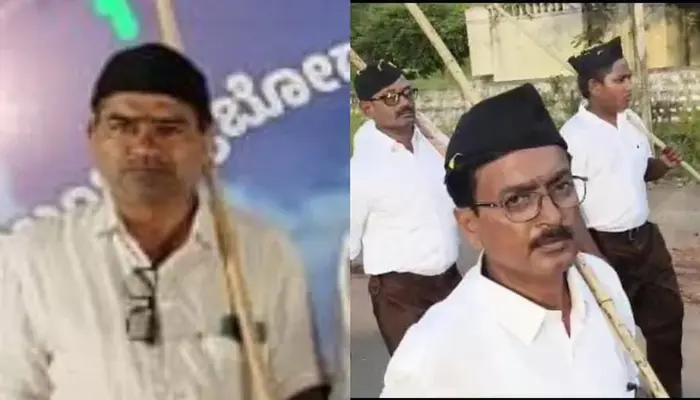
Case Summary
In Yadgir district, two Hindu school teachers were suspended by the Karnataka Education Department pending departmental inquiries for participating in Rashtriya Swayamsevak Sangh (RSS) Patha Sanchalana (route marches). According to reports, the suspended teachers are Gururaj Joshi, an assistant teacher at Government Girls' High School in Hunasagi, and Anna Saheb Deshmukh, head teacher at Government Lower Primary School in Kuppi, Surpur taluk. The departmental proceedings claimed that their participation prima facie amounted to dereliction of duty and violated Rules 3(1), 3(2), 3(3), 5(1) and 7 of the Karnataka Civil Services (Conduct) Rules, 2021. Therefore, the Hindu teachers were suspended on 20 August 2026. The proceedings against Joshi concerned his participation in an RSS Patha Sanchalana held in Talikoti, Vijayapura district, on 12 October 2025. A photograph showing his participation had appeared in Vijaya Karnataka, following which a complaint seeking disciplinary action was submitted by Jumanna Gudimani, district president of Ambedkar Swabhimani Sene. The Education Department issued Joshi a show-cause notice on 13 March 2026. In his written response, Joshi stated that the programme had taken place on a Sunday, outside working hours, and was a cultural rather than political programme. The department rejected his explanation and suspended him under Rule 10(1) of the Karnataka Civil Services (Classification, Control and Appeal) Rules, 1957, pending a departmental inquiry. In Deshmukh's case, the proceedings concerned his participation in an RSS Patha Sanchalana held at Hunasagi on 10 October 2025. Gudimani had also approached Rural Development and Panchayat Raj and Information Technology Minister Priyank Kharge, who was the Kalaburagi district in-charge minister, seeking disciplinary action against Deshmukh. Following a show-cause notice, Deshmukh gave a written explanation similar to Joshi's, stating that the RSS programme had been held outside working hours and was cultural rather than political. The Education Department rejected the explanation and ordered his suspension pending a departmental inquiry. The suspension orders stated that government employees were prohibited from being members of political parties or organisations involved in politics, associating themselves with such organisations or participating in agitations. The department further stressed that teachers were expected to serve as role models for society and uphold the standards of the Education Department.
Why it is Hate Crime ?
This case has been added to the tracker under the primary category of - Attack not resulting in death. Within it, the sub-category selected here is - Attacked for supporting/being part of perceived Hindu party/org or working for Hindu community. In several cases, Hindus are attacked specifically or tangentially for their association with parties or organisations perceived to be pro-Hindu and/or for working in favour of the Hindu community. One of the classic cases was the attack against a Bharatiya Janata Party Yuva Morcha (BJYM) worker Praveen Nettaru. Nettaru was attacked and hacked to death for his association with Hindu organizations and his work for the Hindu community. He was murdered by PFI, a terror organization which aimed to commit a genocide of Hindus, target Hindu leaders specifically and turn India into an Islamic Nation. In such cases, it is possible that the immediate trigger for the violence is non-religious – either according to the perpetrator or the police. However, there are surrounding circumstances from which the conclusion can be reached that the victim was attacked for his association with a Hindu organization. In a similar case, Rinku Sharma was attacked by radicals. He was a member of Bajrang Dal and regularly worked for the Hindu community. While the police cited a different non-religious trigger for the attack, it is true that he was associated to a Hindu organization and the family of Rinku Sharma specifically attributed his gruesome murder to him working for Bajrang Dal and raising Jai Shree Ram slogans. Such cases are intrinsically driven by religious hate and would therefore be documented as a hate crime under this category. The incident had a religious dimension because the disciplinary action was directed at the Hindu teachers specifically for their participation in the activities of the Rashtriya Swayamsevak Sangh (RSS), an organisation closely associated with Hindu collective identity, cultural mobilisation and the preservation of Hindu civilisational interests. Participation in an RSS Patha Sanchalana was therefore not merely an ordinary workplace activity being scrutinised in isolation; it concerned the teachers’ association with a prominent Hindu organisation and its ideological and cultural framework. The action became discriminatory in character where participation in an organisation associated with Hindu identity was treated as grounds for punitive state action, thereby placing a particular form of Hindu social and cultural association under adverse official scrutiny. The Rashtriya Swayamsevak Sangh (RSS) holds considerable cultural and social significance within Hindu society and is one of the most prominent organisations associated with Hindu collective identity and social mobilisation. Founded in 1925, the RSS has worked towards strengthening Hindu social unity, cultural consciousness and national identity through organisational and community activities. Its ideological framework of Hindutva emphasises the preservation and advancement of Hindu civilisational identity and interests. Consequently, participation in an RSS Patha Sanchalana constituted an expression of association with a major Hindu social and cultural organisation, rather than an activity devoid of religious or civilisational significance. The discriminatory dimension arose from the fact that the two teachers faced suspension specifically because of their participation in an RSS Patha Sanchalana, even though the programme had taken place outside their official working hours. Nevertheless, their participation in an RSS activity was treated as misconduct warranting disciplinary proceedings. This distinction was significant because the adverse action was not triggered by neglect of teaching responsibilities or disruption of school functioning, but by their participation in an activity associated with a prominent Hindu organisation in their personal time. Such treatment conveyed hostility towards their association with the RSS and, by extension, towards a form of Hindu cultural and civilisational expression. This was significant because their association with the RSS was not merely a political preference detached from their religious identity; the organisation represents an important strand of Hindu social and civilisational mobilisation. Penalising such participation therefore had the effect of treating a Hindu-associated cultural affiliation as something warranting official sanction. It could also have a chilling effect on Hindu employees who wished to participate in RSS activities or other organisations connected with Hindu cultural life, as it signalled that such association could expose them to adverse consequences even when undertaken outside working hours. The targeting thus extended beyond the individual teachers and implicated their freedom to express and participate in a form of Hindu collective identity. The broader context of the action was also significant given the continuing opposition to the RSS from by the Congress leaders in India's political landscape. In October 2025, Karnataka Minister Priyank Kharge urged Chief Minister Siddaramaiah to prohibit RSS activities on government premises, including schools, colleges, public grounds and other government spaces, and subsequently sought strict action against government employees participating in RSS programmes. At the national level, Congress president Mallikarjun Kharge reiterated in October 2025 that the RSS should be banned. These positions demonstrated that opposition to the RSS was not an isolated or incidental feature of the present case but formed part of a broader political stance within the Congress leadership in Karnataka. The fact that the present disciplinary action concerned participation in an RSS march, in circumstances closely resembling the restrictions advocated by Kharge, therefore provided important context for understanding why affiliation with the RSS had been singled out for adverse treatment. Congress leaders and governments have also continued to politically oppose Hindutva and organisations associated with it. The RSS's association with Hindu nationalism and its ideological influence have repeatedly made it a target of criticism from Congress and other political opponents. In this context, the action by the authorities extended political opposition to the RSS into adverse treatment of Hindus participating in its activities. The incident therefore qualified as a hate crime within the tracker's framework because the adverse treatment was connected to the victims' participation in an organisation that occupies an important place in Hindu collective and cultural life. The teachers were not being punished for an act performed in the discharge of their teaching responsibilities; the action arose from their association with an RSS march conducted outside working hours. When affiliation with a prominent Hindu organisation becomes the basis for punitive treatment, it has implications beyond the individuals concerned, as it can discourage Hindus from openly participating in organisations and activities through which their cultural and civilisational identity is expressed. The incident therefore reflected hostility towards Hindu-associated collective expression and warranted classification as an instance of anti-Hindu targeting.
Victim Details
Total Victim
2
Deceased
0
Gender
- Male 2
- Female 0
- Third Gender 0
- Unknown 0
Caste
- SC/ST 0
- OBC 0
- General 0
- Unknown 2
Age Group
- Minor 0
- Adult 2
- Senior Citizen 0
- Unknown 0


Case Status


Perpetrators Details
Perpetrators
State and Establishment
Perpetrators Range
N/A
Perpetrators Gender
unknown
 Sources




