‘Hinduphobia is a myth’: Leftist professor dismisses religious persecution and hostility faced by Hindus
 Uppsala County, Sweden
  17 August, 2026
Case Summary
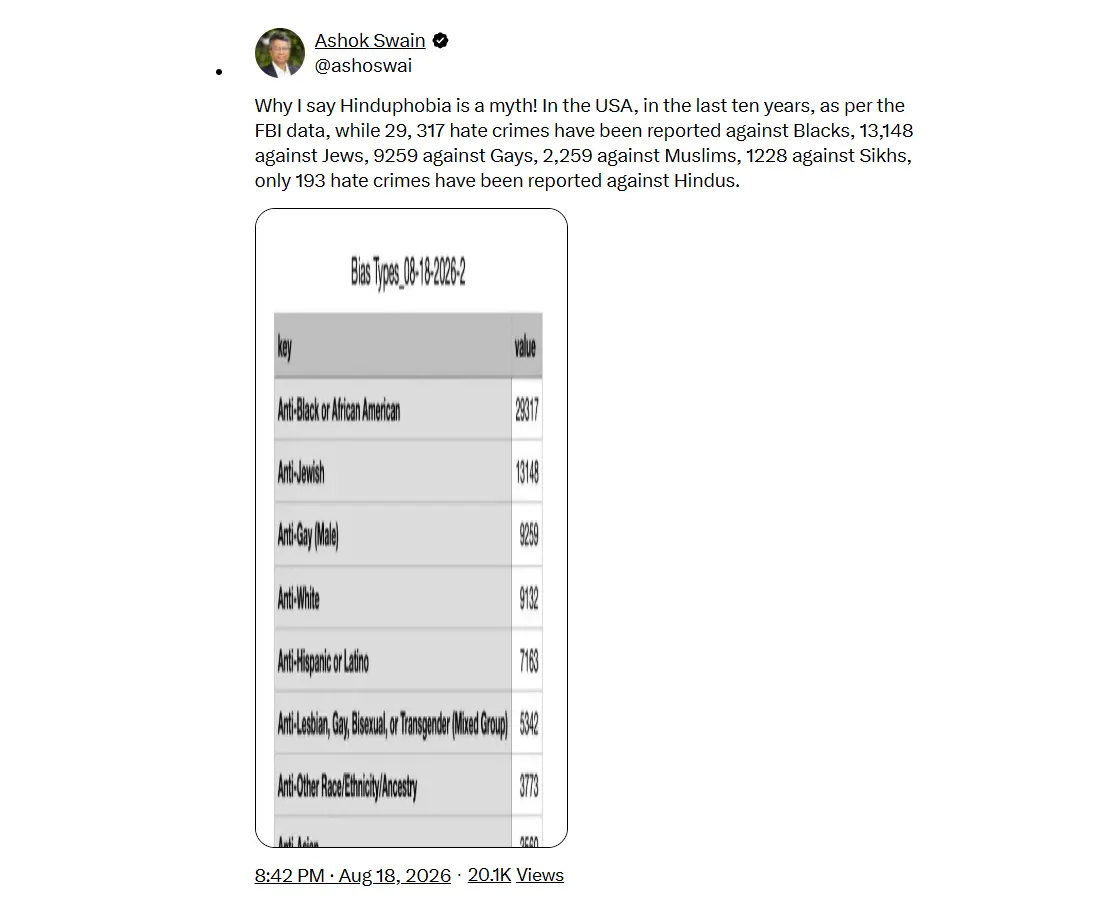
Anti-Hindu hate was displayed on social media by a leftist professor, Ashok Swain. The perpetrator dismissed the hostility and persecution faced by Hindus around the world and described Hinduphobia as a 'myth'. Notably, Ashok Swain is an Indian-born Swedish professor and a professor of Peace and Conflict Research at the Department of Peace and Conflict Research at Uppsala University in Uppsala, Sweden. In 2017, he was appointed as the United Nations Educational, Scientific and Cultural Organisation (UNESCO) Chair on International Water Cooperation, becoming the first UNESCO Chair at Uppsala University. Swain is also well known for his social media activism against the Hindu community, the Indian state and the Indian government led by Prime Minister Narendra Modi. On 18 August 2026, Swain posted an anti-Hindu message on his official X (formerly Twitter) handle in which he dismissed the religious hostility and persecution faced by Hindus. He wrote, “Why I say Hinduphobia is a myth! In the USA, in the last ten years, as per the FBI data, while 29,317 hate crimes have been reported against Blacks, 13,148 against Jews, 9,259 against Gays, 2,259 against Muslims, 1,228 against Sikhs, only 193 hate crimes have been reported against Hindus.” The post went viral on social media and triggered a response from Hindu users globally. The Coalition of Hindus of North America (CoHNA), a Hindu organisation, responded to Swain by condemning and countering his remarks. It wrote, “The irony is hard to miss here. A professor who has repeatedly dismissed concerns about Hinduphobia, and who gained fame from attacking a young Hindu NASA intern simply for having Hindu deities visible on her desk at home, is now arguing that Hinduphobia effectively doesn’t exist. Why? Because ‘only’ 193 anti-Hindu hate crimes appear in the FBI database. Apparently, American Hindus need to suffer more hatred and violence before their experiences count.” The organisation then cited various cases of anti-Hindu hate crimes documented by it, along with other studies, which highlighted the growing instances of Hinduphobia in the United States. CoHNA further highlighted, “These numbers tell only part of the story. Anti-Hindu incidents are frequently underreported, misclassified as anti-Indian or anti-Asian hate, or never reported at all, particularly within an immigrant-heavy community where victims may hesitate to approach authorities. Nor do hate-crime statistics capture the bullying, harassment, and religious stereotyping Hindu children can face in schools. Yet the response from some academics and activists remains the same: move the goalposts, minimise the evidence and demand an ever-higher body count before acknowledging Hinduphobia. That isn’t scholarship. It’s denial. And no amount of data will ever be enough for people determined to whitewash anti-Hindu hate.” Notably, this was not an isolated instance in which Ashok Swain had made derogatory remarks about Hindu religious expression. In July 2021, when the National Aeronautics and Space Administration (NASA) shared a photograph of Indian-American Hindu intern Pratima Roy, whose workspace featured murtis and images of Hindu gods and goddesses, Swain objected to her visible display of Hindu faith and wrote, “Why do Hindus need to be surrounded by their gods? Can’t they do anything without them?” His remarks came amidst a wider wave of social media attacks targeting Roy and questioning her scientific temperament merely because she openly displayed her religious identity, demonstrating that his dismissal and ridicule of Hindu beliefs were not isolated instances.
Case Images
Why it is Hate Crime ?
In this case, the primary category selected is: Hate Speech against Hindus. The subcategory selected is: Anti-Hindu prejudice and subversion. Hate speech is defined as any speech, gesture, conduct, writing, or display that is prejudicial against a specific individual and/or group of people, which is leading to or may lead to violence, prejudicial action or hate against that individual and/or group. Media plays a specific and overarching reach in perpetuating prejudicial attitudes towards a community owing to unfair, untrue coverage and/or misrepresentation/misinterpretation, selective coverage and/or omission of facts of/pertaining to issues affecting a specific religious group. This type of bias can dehumanise the victim group, making it easier for others to justify harmful actions against them, which aligns with the objectives of hate speech laws aimed at preventing such harm. It is often observed that the media takes a prejudicial stand against the Hindu community driven by their need to shield the aggressor community which happens to be a numeric minority, however, is the one perpetrating violence against Hindus. For example, the media is often quick to contextualise religiously motivated crimes against Hindus, omit or misrepresent facts that point towards religiously motivated hate crimes, justify and/or downplay religiously motivated hate crimes or simply present fake news to stereotype Hindus. Such media bias leads to the denial of persecution and is often used to dehumanise Hindus, leading to justification for violence against them. For example, the media covered several fake allegations of Hindus targeting Muslims and forcing them to chant Jai Shree Ram. Most of these cases were proved false and fabricated after police investigation. These fake news reports were subsequently never retracted or clarified. Such fake news led to the justification of violence and dehumanisation of Hindus based on the argument that since Hindus targeted Muslims and forced them to chant Jai Shree Ram, the dehumanisation of Hindus and violence against them was par for the course and merely a retaliation. Such media bias leads to prejudicial portrayal of Hindus and offers a justification for violence against them and therefore, is considered hate speech under this category. This case is a clear instance of anti-Hindu hate speech, as the perpetrator outright denied the persecution and hostility faced by Hindus across the world by describing Hinduphobia as a “myth”. He attempted to support this assertion by selectively citing statistics from the United States, arguing that Hindus had faced the lowest number of officially recorded hate crimes among the communities he listed. However, reducing the question of whether a form of religious hatred exists globally to a selective set of crime statistics from one country distorted the issue entirely. By presenting this selective data as proof that Hinduphobia did not exist, the perpetrator sought to construct a narrative in which the persecution, discrimination and hostility faced by Hindus did not matter, did not deserve recognition and did not deserve to be heard. Such selective use of data, deployed to dismiss the experiences of an entire religious community, demonstrated clear hostility towards Hindus and their religious identity. Hinduphobia refers to hostility, prejudice, discrimination or hatred directed against Hindus because of their Hindu religious identity and against Hinduism itself. Hinduism is a diverse religious tradition encompassing multiple forms of worship, deities, philosophical traditions, rituals and religious practices. Across different parts of the world, Hindus have faced religious discrimination, violent attacks, killings, attacks on places of worship, desecration of Hindu religious representations, restrictions on religious practices, coercive conversion, sexual crimes and other forms of hostility linked to their religious identity. The existence and documentation of such incidents cannot be erased simply by declaring Hinduphobia to be a “myth”. By attempting to dismiss the persecution and hostility faced by an entire religious community as imaginary, the perpetrator promoted the narrative that Hindu suffering did not warrant recognition. Given his position as an academic with a substantial public platform, the dissemination of such a narrative carried particular significance, as it sought to normalise the dismissal of documented anti-Hindu hostility and undermine recognition of Hindus as victims of religiously motivated prejudice. In this context, his remarks constituted an instance of anti-Hindu hate speech. Contrary to the perpetrator's assertion, Hinduphobia Tracker regularly documents incidents involving hostility, prejudice and violence directed against Hindus and Hindu religious identity. The Tracker classifies qualifying incidents under eight primary categories and multiple sub-categories. These categories include ‘Crimes against women in relationships and other sexual crimes’, which cover cases commonly described in public discourse as ‘love jihad’ or ‘grooming jihad’, in which Hindu women and girls are targeted by non-Hindu men, predominantly Muslim men, who trap them in relationships and sexually exploit or abuse them, with many such cases also involving coercion or pressure to convert to Islam. In several cases, the perpetrators use deception, including concealing or misrepresenting their religious identity, to establish relationships with Hindu women and subsequently subject them to exploitation, coercion or forced religious conversion. These cases are documented under this category where the evidence indicates that the victim's Hindu religious identity is a factor in the targeting, exploitation, coercion or subsequent attempt to convert her. ‘Hate speech against Hindus’ covers speech that propagates hatred, prejudice, stigmatisation, dehumanisation or other hostility against Hindus on the basis of their Hindu religious identity. ‘Men attacked for being associated with non-Hindu women’ documents cases in which Hindu men face violence because of their religious identity and for their associations or romantic relationships with non-Hindu women, mostly Muslim women. ‘Predatory Proselytisation’ covers incidents involving coercion, force, deception or other forms of predatory conduct aimed at forced religious conversion of Hindus. ‘Attack resulting in death’ and ‘Attack not resulting in death’ document physical attacks on Hindus in which the Hindu identity, actual or perceived, of the victim constitutes an explicit or implicit bias factor. ‘Restriction/ban on Hindu practices’ covers actions or policies that specifically obstruct Hindu religious expression, including rituals, processions, festivals and the display or practice of religious identity. Finally, ‘Attack on Hindu religious representations’ covers deliberate attacks on Hindu religious symbols, iconography, sacred spaces, places of worship and other manifestations of Hindu religious faith. The Tracker's framework identifies eight primary categories and several sub-categories, with an incident capable of falling under more than one category where the available evidence supports such classification. It is also important to understand how the Hinduphobia Tracker database is compiled and why the documented incidents in our database directly challenge the suggestion that the persecution and hostility faced by Hindus can be dismissed through a narrow reading of official crime statistics from a single country. Our database is not presented as an exhaustive record of every anti-Hindu incident that takes place across the world. Instead, we document and assess cases on the basis of available evidence and apply specific parameters before determining whether an incident qualifies for inclusion in our hate-crime database. The cases documented by Hinduphobia Tracker are based on multiple forms of secondary and supporting evidence, including mainstream and local media reports, reports published by recognised news organisations, videos, photographs, social media posts and other publicly available material. Where available, cases may also be supported by police records, First Information Reports, court documents, chargesheets, victim testimonies and other official records. In certain cases, information may also emerge through activists, family members or other individuals directly connected to an incident, following which the available evidence is assessed before the case is documented. Each incident is assessed against our defined parameters, and the explanation outlining why a particular case qualifies as an instance of anti-Hindu hate or a hate crime is subject to editorial review. Importantly, Hinduphobia Tracker does not classify every crime involving a Hindu victim and a non-Hindu perpetrator as a hate crime. The religious identity of the victim or perpetrator, by itself, is not sufficient for inclusion in our hate-crime database. For a case to qualify, there must be evidence indicating explicit or implicit religious bias, hostility or prejudice connected to the incident. We assess whether a Hindu individual was targeted because of their actual or perceived Hindu identity, whether Hindu religious symbols, practices, institutions or places of worship were specifically targeted, or whether the circumstances surrounding the crime reveal a religiously motivated bias against Hindus or Hinduism. This distinction is crucial because our database is not a collection of every crime committed against a Hindu individual. We apply defined parameters to distinguish ordinary crimes, in which the religious identity of the victim has no established connection to the offence, from incidents in which there is sufficient evidence of anti-Hindu bias, hostility or religious targeting. Cases that do not meet the required parameters are therefore not automatically included in the hate-crime database simply because the victim happens to be Hindu. The existence of our ‘Undecided database’ further demonstrates this distinction. Incidents may be placed in the ‘Undecided database’ when the available evidence does not permit a conclusive determination as to whether the incident meets the parameters for classification as an anti-Hindu hate crime. This allows us to document such incidents without prematurely categorising them as hate crimes while maintaining a distinction between cases for which religious hostility has been sufficiently established and those for which the available evidence remains inconclusive. Therefore, the perpetrator's attempt to use the relatively low number of incidents recorded in one particular official database to declare Hinduphobia a ‘myth’ ignored the fundamental limitations of such an argument. No single country's official hate-crime statistics can serve as a complete measure of the persecution, discrimination, violence and religious hostility experienced by Hindus across the world. Moreover, even our database is not presented as an exhaustive record of every incident that occurs, as Hinduphobia Tracker can only document cases that come to light and for which sufficient information is available to assess them against our parameters. Consequently, the absence of an incident from a particular official database, or the existence of a comparatively smaller number of officially recorded cases, cannot logically be used to establish that hostility towards an entire religious community does not exist. Hinduphobia Tracker has documented nearly 7,625 cases of crimes against Hindus globally between 1 August 2023 and 21 August 2026. Of these, more than 6,643 cases have been classified as definitive hate crimes, in which there is evidence that Hindu victims were targeted because of their religious identity, Hindu temples or religious sites were attacked or desecrated, Hindu religious practices or festivals were targeted or restricted, or other manifestations of Hindu faith and identity were subjected to discrimination, hostility or violence. This data documents the global nature and scale of anti-Hindu hostility and stands in direct contrast to the perpetrator's assertion that Hinduphobia is a “myth”. India accounts for 5,693 of the documented cases, followed by Bangladesh with 591 cases and Pakistan with 163 cases. It is important to note that documenting incidents from Pakistan presents additional challenges because detailed and independently accessible media reporting is not always readily available. In several such cases, videos of the incidents emerge on social media, while Hindu activists and Hindu organisations based in Pakistan share information and evidence regarding the attacks. Such material is assessed alongside other available evidence before a case is documented. Therefore, the number of incidents recorded in the database should not be interpreted as an exhaustive measure of every crime committed against Hindus in Pakistan or elsewhere, but rather as cases that have come to light and for which sufficient information has been available for assessment under Hinduphobia Tracker's parameters. The scale of victimisation reflected in this data is particularly significant. Across the 7,625 documented cases, there have been more than 12,204 female victims and 3,824 minor victims. The database has also documented more than 713 incidents involving mob violence against Hindus, more than 2,544 cases involving forced or coercive religious conversion, more than 806 attacks on Hindu temples and more than 372 Hindu deaths in attacks in which their religious identity constituted a documented bias factor. These figures demonstrate the diverse forms in which anti-Hindu hostility manifests itself, ranging from violence and killings to forced conversion, attacks on Hindu women and children, mob violence, and attacks on Hindu places of worship. This data alone demonstrates the fundamental flaw in the perpetrator's argument. Even if one were to accept the FBI figures cited by him at face value, statistics from a single country cannot logically be used to determine whether religious hostility against a community exists across the world. Hinduphobia Tracker's global database documents thousands of incidents involving anti-Hindu hostility across multiple countries and categories. By selectively relying on a limited set of official statistics from the United States and using them to dismiss the documented persecution, discrimination and violence faced by Hindus globally as a “myth”, the perpetrator reduced the experiences of an entire religious community to a narrow and selective statistical comparison. This dismissal of documented anti-Hindu hostility and persecution, particularly when amplified through his public platform, demonstrated a clear attempt to undermine the recognition of Hindus as victims of religiously motivated hatred and violence, making his remarks an instance of anti-Hindu hate speech. Further, even if one were, for a moment, to consider the figures cited by Ashok Swain in relation to the United States, his argument would still be fundamentally inaccurate and misleading. He asserted that only 193 hate crimes against Hindus had been recorded in the United States over the past ten years and used this figure to argue that Hinduphobia was a “myth”. However, anti-Hindu hatred is not always documented or recognised specifically as anti-Hindu hate. In countries such as the United States, incidents targeting Hindus several times are inaccurately categorised more broadly as anti-Indian hate, anti-Asian hate, racism or hostility towards brown people, even where the underlying targeting includes a clear religious dimension. In several cases, what appears on the surface to be a racist or anti-Indian attack constitutes an act of anti-Hindu hostility when Hindu religious identity, symbols, beliefs or practices are specifically targeted. For example, on 27 July 2026, a Hindu doctor named Karishma Reddy was subjected to severe online trolling and abuse over her Hindu identity after wearing a bindi. She was subjected to anti-Hindu, anti-Indian and racist slurs, while her faith was mocked and denigrated through derogatory references to cow dung and cow urine. The incident was widely presented as an instance of anti-Indian hostility or racism directed against a brown woman. However, such a characterisation failed to capture an important religious dimension of the abuse. The victim's bindi, a visible symbol associated with Hindu religious and cultural identity, became a specific target of the abuse, while Hindu beliefs and practices were also directly mocked. Therefore, although the attack could, at a surface level, be categorised as racist or anti-Indian, the specific targeting of her Hindu religious identity and the ridicule directed at her faith also established a clear anti-Hindu element. Similarly, the attacks on the two Hindu temples demonstrate how anti-Hindu hostility is obscured when such incidents are viewed solely through the lens of ‘anti-India’ or political hate. On 10 August 2025, the BAPS Shri Swaminarayan Mandir in Greenwood, Indiana, and in March 2025, the BAPS Hindu Temple in Chino Hills, California, were both desecrated with anti-India and anti-Modi slogans written on their walls. However, if the perpetrators merely intended to express hostility towards India or its political leadership, they had numerous other places through which to do so, including Indian diplomatic or state institutions, or other spaces associated with the Indian community. Instead, in both instances, Hindu temples, places of worship and institutions representing Hindu religious identity, were specifically selected as the targets. The fact that two Hindu temples were targeted in the same year with anti-India and anti-Modi slogans demonstrates that the hostility expressed through these acts cannot be viewed solely as political or anti-India hate while ignoring their religious dimension. By deliberately choosing Hindu places of worship as the sites for this expression of hostility, the perpetrators also targeted and desecrated Hindu religious institutions. Such incidents are often subsumed under the broader label of ‘anti-India’ hate, despite containing a clear anti-Hindu element, thereby illustrating how the actual extent of anti-Hindu hostility remains underrepresented when official or public classifications focus only on the apparent political or national dimension of an attack. These incidents illustrate a fundamental limitation in relying exclusively on officially recorded categories of hate crime to measure the extent of Hinduphobia. A single incident may simultaneously involve racism, anti-Indian hostility and anti-Hindu religious prejudice. However, if such an incident is recorded primarily under one of the broader categories, its anti-Hindu dimension may disappear from statistics specifically designated as “anti-Hindu” hate crimes. Consequently, citing only the number of incidents formally categorised under one particular label, without examining the nature and circumstances of the underlying incidents, produces an incomplete and misleading picture. Thus, the figure cited by Swain cannot, by itself, establish that anti-Hindu hatred is insignificant or that Hinduphobia does not exist. Apart from these examples, Hinduphobia Tracker alone has documented nearly 81 incidents classified as anti-Hindu hate crimes in the United States between 1 January 2023 and 21 August 2026. This is particularly significant when compared with Ashok Swain's assertion that only 193 hate crimes against Hindus were recorded in the United States over a period of ten years. The fact that Hinduphobia Tracker has documented nearly 81 definitive anti-Hindu hate crimes within a period of less than four years demonstrates the limitations of relying solely on official statistics that may not adequately identify, classify or record the anti-Hindu dimension of an incident. It further shows why Swain's selective reliance on a single set of statistics cannot reasonably be used to dismiss Hinduphobia altogether. By citing these figures as supposed proof that Hinduphobia is a “myth”, while ignoring documented incidents that reveal the varied and often overlooked manifestations of anti-Hindu hostility, Swain reduced the persecution and suffering faced by Hindus to a narrow statistical comparison. This selective use of statistics served to minimise the documented experiences of Hindu victims and deny the existence of a form of religious hostility that continues to manifest in different ways and under different classifications, demonstrating his clear anti-Hindu bias and making his remarks an instance of anti-Hindu hate speech. Swain's previous conduct towards Hindu religious expression provides important context for assessing the nature of his present remarks. In July 2021, he mocked an Indian-American NASA intern for displaying murtis and images of Hindu deities in her workspace, questioning why Hindus needed to be “surrounded by their gods”. While the incident itself involved the expression of a personal religious identity, his decision to single out and ridicule a Hindu woman's visible religious practice demonstrated hostility towards ordinary Hindu religious expression. Rather than treating the expression of Hindu faith with the same legitimacy accorded to other religious identities, he reduced Hindu beliefs and practices to an object of ridicule. This is significant because it demonstrates that his present dismissal of Hinduphobia as a “myth” was not an isolated expression, but was consistent with a broader pattern of trivialising and belittling Hindu religious identity. His conduct reflects a mindset in which Hindu beliefs and practices are treated with contempt, while hostility directed towards Hindus is simultaneously minimised or denied. This recurring pattern of disparaging Hindu religious expression and dismissing the persecution faced by Hindus demonstrates clear anti-Hindu hostility and provides further context for classifying his present remarks as anti-Hindu hate speech. Overall, considering the documented global incidence of anti-Hindu hostility, the substantial number of definitive hate crimes documented by Hinduphobia Tracker in the United States, the manner in which anti-Hindu incidents can be obscured under broader classifications such as anti-India or racist hate, and Swain's established history of disparaging Hindu religious expression, his assertion that Hinduphobia is a “myth” cannot be regarded as a neutral interpretation of available data. His selective presentation of statistics to dismiss the persecution and hostility faced by Hindus, combined with his repeated disparagement of Hindu religious identity, demonstrates a clear pattern of anti-Hindu hostility. The present case therefore constitutes an instance of anti-Hindu hate speech and is accordingly being documented in the hate crime database of the Hinduphobia Tracker. Disclaimer: Based on publicly available records, Uppsala, Sweden, has been selected as the location of the incident for documentation purposes in the Hinduphobia Tracker database. This location is indicative and is based on publicly available information establishing Ashok Swain's association and presence in Uppsala. It has been recorded solely for the purpose of documenting the incident in the database.


Case Status
Unknown


Perpetrators Details
Perpetrators
Others
Perpetrators Range
One Person
Perpetrators Gender
male
 Sources




