Hindu temple vandalised with anti-Hindu and anti-India graffiti ahead of Janmashtami in Greenwood, United States
 Greenwood, Indiana, United States
  9 August, 2025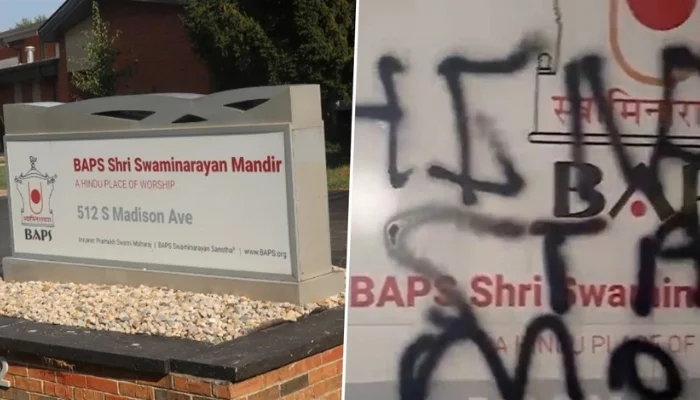
Case Summary
In Greenwood, Indiana (USA), a Hindu temple named the BAPS Shri Swaminarayan Mandir was vandalised and defaced with hateful slurs against India. The desecration included the message “Hindustan, Modi Murdabad”, meaning “Death to Hindustan and Modi,” referring to India’s Prime Minister, Narendra Modi. According to reports, the Greenwood Police Department treated the incident as criminal mischief, according to a police report. The Hindu American Foundation, a Hindu American group, posted visuals on X (formerly Twitter) of the vandalised temple in Greenwood. They stated that such vandalism is carried out by Khalistani separatists, Sikh extremists who propagate anti-India and anti-Hindu narratives. In confirming the incident, the Hindu American Foundation wrote, “For the 4th time in less than a year, a Hindu Mandir (temple) has been desecrated.” The post added, “Vandalising temples with anti-India graffiti is a tactic often used by pro-Khalistan separatist activists, and a stark reminder of how slurring American Hindus as ‘Hindutva’ fuels hate like this.” The Hindu American Foundation urged the elected officials to take action against the offenders and hold perpetrators accountable. The volunteers at the temple described the incident as an act of hate and intolerance against Hindus. The vandalism occurred days before Krishna Janmashtami on 16th August 2025. Marmik Brahmbhatt, a longtime Indiana resident and temple volunteer in the suburb of Greenwood, stated, “I was shocked that this could happen to our mandir, because we have such a great community relationship.” He further stated, “I would not have expected this to happen in Greenwood.” This was not the first such incident in the USA. In March 2025, another BAPS Hindu temple in Chino Hills, California, was targeted. Following a similar pattern, the walls of the temple were vandalised with anti-India slogans. Notably, the Hinduphobia Tracker had previously reported this case, and this incident occurred just days before the scheduled "Khalistani referendum", a Sikh separatist and anti-Hindu referendum, in Los Angeles.
Why it is Hate Crime ?
This case has been added to the tracker under the primary category - Attack on Hindu religious representations. Within this, the first subcategory selected is- Desecration of Hindu religious symbol. Icons and symbols or a religious representation of a spiritual ideal are widely revered in Hinduism. Iconography is of vital significance in the Hindu milieu. It helps connect people’s spiritual beliefs with the real world. Iconography within the Hindu faith takes several shapes and forms. Murtis are of most significance to Hindus, to which daily rituals, prayers and offerings are done. Besides the murtis, there are several other symbols which have deep significance in the Hindu faith – the Om and Swastika for example. Since these Hindu religious symbols hold paramount importance in Hinduism, any desecration of symbols, icons, murtis, religious representations and manifestations, is driven by animosity towards the faith itself which manifests itself through these murtis, icons and symbols. Therefore, any desecration of these Hindu religious symbols and representations is considered religiously motivated hate crimes under this category. The other subcategory selected is- Attack on temples. In Hinduism, a temple is the abode of the Deity. The Deity in the Temple is consecrated, thereby, making it a real, breathing entity. Hindus believe that not just the Deity but the temple premises itself are sacred to Hindus since Hindus hold the faith that the entire Temple space is an amalgamation of the divine energy of the deity. Given the central significance of Temples in Hindu Dharma, any attack against a Hindu Temple or its peripheral premises is an attack on the faith itself and is born out of animosity towards the faith, of which, the Temple is a central tenet. Any manner of attack against a Temple and/or its premises would therefore be considered a religiously motivated hate crime. Another primary category relevant in this case is- Hate Speech against Hindus. Within this, the subcategory selected is- Anti-Hindu slurs, mocking faith. Anti-Hindu slurs and the deliberate mocking of the Hindu faith owing to religious animosity involve the usage of derogatory terms, stereotypes, or offensive references to religious practices, symbols, or figures. One of the common anti-Hindu slurs used against Hindus is “cow-worshipper” and “cow piss drinker”. The intention of using this term is to demean and mock Hindus as a group and their religious beliefs since Hindus consider the cow holy. Additionally, some symbols and the slurs attached to them have a historical context that exacerbates the insult, hate, stereotyping, dehumanisation and oppression against Hindus. Cow worship has been used for centuries to denigrate Hindus, insult their faith and oppress Hindus specifically as a religious group. There has been overwhelming documentation about how cow slaughter has been used to persecute Hindus with cow meat being thrown in temples and places of worship. There has also been overwhelming documentation where cow meat (beef) has been force-fed to Hindus to either forcefully convert them to Islam or denigrate their faith. Apart from cow worship, the Swastika – which holds deep religious significance for the Hindus – has also been misinterpreted and distorted to use as a slur against Hindus. Similarly, the worship of the Shivling has been used by supremacist ideologies and religions to denigrate Hindus owing to religious animosity. Such slurs and denigration stem out of inherent animosity and hate towards Hindus and their faith, therefore, it is categorised as hate speech targeted at Hindus specifically owing to their religious identity. This act of vandalising and defacing a Hindu temple wall with hateful slurs clearly constituted a hate crime against Hindus. It targeted a sacred space at the heart of the Hindu community’s religious and cultural life, sending a stark message of intolerance and hostility towards Hindu beliefs and those who practise them. It was not merely about property damage; it was intended to instil fear, undermine dignity, and marginalise an entire faith group, in this instance, Hindus, making this a religiously motivated crime. In the Hindu worldview, a temple (mandir) is not simply a physical structure; it is a consecrated, divine space that is an embodiment of the spiritual universe and a living home for a deity within. This sanctity extended to the entire structure, including walls, entrances, courtyards and surrounding premises. Any defilement of its surfaces, especially with hateful intent, therefore amounted to desecration motivated by religious animosity. Although the attack featured overtly anti-India language, the choice of attack, a Hindu temple, made it, above all, a communal and religiously motivated attack. The perpetrators could have scrawled the messages elsewhere, but by selecting a temple, they demonstrated a deliberate intent to insult and provoke Hindus specifically in their place of worship. The context and location rendered the act fundamentally anti-Hindu, communicating exclusion and contempt not merely on ethnic grounds but with the purpose of intimidating and marginalising the Hindu community. Hinduphobia Tracker previously reported an instance in Chino Hills, California, where a BAPS Hindu temple was vandalised with anti-India and anti-Modi slogans, demonstrating that such incidents were not isolated. The repeated targeting of Hindu temples suggested a coordinated effort to attack and desecrate places of worship due to underlying religious animus towards Hinduism and the Hindu community. It was also important to note that, while Hindu groups attributed these acts to Khalistanis, there was no conclusive evidence identifying the perpetrators in this specific case. However, even though the perpetrators are unidentified, the nature of the attack, the choice of a temple, the particular slurs and the desecration of a sacred site made it abundantly clear that it was anti-Hindu in nature. Therefore, this case is being added to the hate crime database.


Case Status
Complaint filed


Perpetrators Details
Perpetrators
Unknown
Perpetrators Range
Unknown
Perpetrators Gender
unknown
 Sources




