Hindu couple brutally attacked in Muslim-dominated locality following minor dispute over Qurbani in Meerut
 Meerut, Uttar Pradesh, India
  27 May, 2026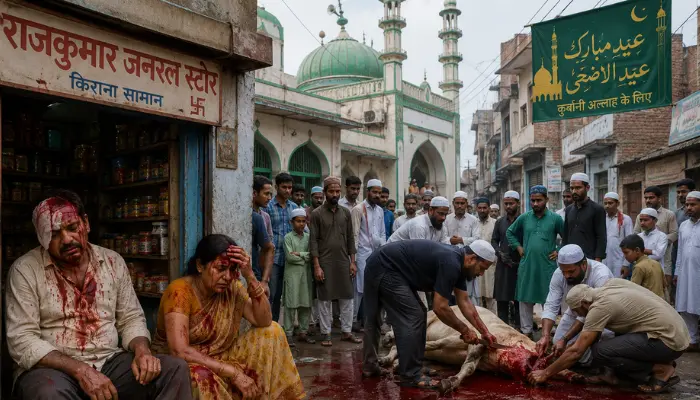
Case Summary
In the Muslim-dominated locality of Pohli village in Meerut, Uttar Pradesh, a Hindu couple was brutally assaulted by several members of the Muslim community following a verbal dispute about Qurbani. The argument, centred on the clogging of drains and blood from sacrificed animals spilt all over the road, escalated into the attack. The incident occurred on 28 May 2026 in the Sardhana police station area of Meerut. A dispute broke out over blood flowing through a drain following a Qurbani sacrifice, a religious sacrifice of animals done by Muslims on the occasion of Eid al-Adha. The Hindu victim, Anil Kashyap, a grocery merchant, lived with his family in Pohli village, which falls under the jurisdiction of Sardhana police station. His shop was located in a Muslim-dominated locality. According to Anil Kashyap, blood flowing from the drain after the sacrifice had spilt onto the road due to a blockage in the drainage system. He objected to this, which led to a dispute with local Muslims. The controversy escalated rapidly. Following the objection, several people from the Muslim community gathered at the scene. An altercation ensued between Anil Kashyap and members of the Muslim community, and the situation quickly became tense. Anil stated that several Muslims forcibly entered his shop, verbally abused him, and attempted to brutally assault him. Anil Kashyap's wife, Jitendri, who arrived at the scene after hearing the commotion, was also assaulted and subjected to indecent behaviour. Following the incident, chaos descended upon the area. Upon receiving information about the incident, Sardhana police arrived at the scene and pacified both sides. The police also took several individuals to the police station for questioning. In view of the tension in the village, police surveillance was increased, and the situation continued to be closely monitored. Inspector-in-Charge Dinesh Pratap Singh stated that a complaint had been received in the matter and that the police were investigating the entire incident. He further stated that, based on the findings of the investigation, a case would be registered against the accused and necessary legal action would be taken.
Why it is Hate Crime ?
The primary category selected in this case is: Attack not resulting in death. The subcategory selected is: Communal Clash/Attack. Communal clash is a form of collective violence that involves clashes between groups belonging to different religious identities. For a communal clash between Hindus and non-Hindus to qualify as a religiously motivated hate crime, the trigger of the violence itself would have to be anti-Hindu in essence. For example, if there is a Hindu religious procession that comes under attack from a non-Hindu mob and after the initial attack, Hindus retaliate in self-defence, leading to a communal clash between the two religious communities. While at a later stage, both communities are involved in the clash/violence, the initial trigger of the violence was by the non-Hindu mob against the Hindus and therefore, it could safely be termed as an anti-Hindu violence. Further, the trigger would also have to be religiously motivated. In the cited example, the attack by the non-Hindu mob was against religious processions and therefore, can be concluded to be religiously motivated. In some cases, the trigger may be non-religious, however, it develops into religious violence against Hindus at a later stage. In such cases too, the foundational animosity towards Hindus becomes the motivating factor of the crime and therefore, it would be classified as a religiously motivated hate crime against Hindus under this category. The other subcategory selected is: Attacked for crossing 'Muslim area'. One of the reasons that Hindus get attacked unprovoked specifically by Islamists is for crossing ‘Muslim areas’. Essentially, Muslim mobs often attack Hindus crossing or present in certain areas which have a majority Muslim population. It has often been cited as one of the reasons to blame Hindus for attacks against themselves, signalling that Hindus displaying religious symbols, taking our religious processions or crossing any area which is dominated by Muslim residents is a provocation in and of itself. These areas are mostly ghettoized areas where mobs mobilize quickly to attack Hindus for a variety of reasons like playing music during a religious procession, crossing a mosque, wearing a tilak or any other religious symbol in a Muslim-dominated area, praying at a local temple in that area etc. There have been cases where the few local Hindus of that area have been attacked on their way to the Temple for prayers as well, simply because the area is considered a Muslim-dominated area. Several times, it is entirely possible that the immediate trigger for the violence against Hindus was non-religious in nature, however, the violence became religiously motivated in nature because the area was Muslim dominated and the residents on the whole harboured animosity towards Hindus, evidenced from the actions of the mob, the slogans, and the nature of the attack. Such crimes are motivated by the religious identity of the victims and are therefore classified as hate crimes under this category. This incident has been categorised as a hate crime due to the apparent communal nature of the violence and the disproportionate response directed at a Hindu couple following a dispute connected to Qurbani. The conflict arose after a Hindu grocery merchant objected to blood from sacrificed animals flowing through clogged drains and onto a public road in a Muslim-dominated locality. Rather than remaining a local civic or sanitation-related disagreement, the situation escalated into communal violence, with members of the Muslim community mobilising and gathering in large numbers and assaulting the Hindu couple. The severity of the response to what began as a minor verbal dispute demonstrated that communal undertones played a role in escalating the dispute to physical violence. When Hindus are targeted following a disagreement linked to the practices of another community, and the response is grossly disproportionate to the initial trigger, it showcases religious prejudice and communal hostility acting as motivators for the violence. The act of Qurbani is an important religious practice for Muslims, and individuals are entitled to observe their faith. However, public roads, drains, and other civic spaces are shared by all members of society irrespective of their religion. In this case, the objection raised by the Hindu victim was related to the overflow of blood from sacrificed animals into public areas due to clogged drains, a matter that affected the surrounding locality. Such concerns fall within the realm of public hygiene and civic inconvenience and are not, in themselves, an attack on any religion. However, instead of the issue being resolved through discussion or local administrative intervention, the dispute escalated into an assault on the Hindu couple. The attack on both the male victim and his wife, including indecent behaviour towards the female victim, significantly intensified the seriousness of the incident. The fact that violence followed an objection relating to the manner in which a religious practice affected a shared public space demonstrates that the response was disproportionate and reflective of underlying communal tensions. Attacking Hindus for raising concerns about the manner in which a religious ritual impacts public spaces undermines the principles of coexistence in a plural society. Disagreements over civic issues are ordinarily addressed through dialogue, compromise, or legal mechanisms. Resorting to violence against a Hindu couple over such an objection transformed what could have remained a local dispute into an incident of a communal attack rooted in anti-Hindu animosity. The disproportionate nature of the response, the communal identities of those involved, and the collective violence showcase that the attack was rooted in hostility towards the Hindu victims for their faith identity. To understand how minor disputes can escalate into identity-based communal violence, often leaving Hindus as victims, it is important to recall the 2019 Hauz Qazi incident. The incident illustrates how a seemingly ordinary, non-communal altercation escalated into a targeted communal attack once religious identity became the focal point. What began as a minor dispute over parking was rapidly transformed through mobilisation, rumour circulation, and identity-based consolidation into a large-scale attack directed at a Hindu locality and its place of worship. The congregation of a large Muslim mob at the entrance of the Hindu-dominated lane, the stone pelting, desecration of the Durga Mandir, and the targeting of residents indicate that the conflict was no longer about the original dispute but about asserting religious dominance over the Hindu minority within a Muslim-majority area. The shift was further evident in the use of religious slogans, the confinement of Hindus to a single lane, and repeated instances of prior targeting, all of which pointed towards a pattern where demographic imbalance creates an environment of vulnerability for Hindus. In such contexts, even trivial triggers can be communalised, with religious identity becoming the basis for collective mobilisation and violence, reflecting deeper underlying tensions and anti-Hindu hostility that manifest when an opportunity arises. The Hinduphobia Tracker has documented numerous similar instances where communal attacks on Hindus began over non-religious disputes but quickly escalated, leaving Hindu victims seriously injured. For example, on 22nd June 2025, in Ghongade Basti, Solapur, Maharashtra, a Hindu man and his brother were brutally attacked by a Muslim mob following a minor road dispute. The incident quickly escalated into targeted communal violence against the local Hindu community. Another such instance occurred on 6th June 2025, in Kadabin Jinsi Haat Maidan, Indore, Madhya Pradesh, where a Dalit Hindu family was brutally attacked by a group of Muslims over a minor water dispute. The assailants also hurled caste-based slurs, and even women and a child were severely beaten. A similar case of communal attack occurred on 2nd June 2025, in Saraiya, Varanasi, Uttar Pradesh; a Dalit Hindu man named Vishal Sonkar was brutally assaulted by a group of Muslim youths after a minor disagreement over road space. He suffered severe head injuries from rods and sticks. A similar instance of communal violence was reported on 6th July 2025 in the Deoband area of Saharanpur, Uttar Pradesh; a Dalit Hindu wedding procession was attacked by a Muslim mob over the playing of DJ music while passing by a mosque. The victims were severely injured with sharp weapons and sticks. The above-mentioned cases clearly demonstrate a pattern of attacks against Hindus. Even if the conflict is a result of a non-communal or a minor religious issue, it often takes on a communal nature where Hindus are frequently targeted and brutally attacked by several members of the Muslim community. These attacks are not random or spontaneous acts of violence, but are indeed crimes motivated by hatred for the Hindu community due to their faith identity. Another important aspect to address in this case is that the incident occurred in the Muslim-dominated locality of Pohli village, which distinctly showcases the religious markers of the crime. Muslims often consider regions near mosques, dargahs, or where their community is in the majority as exclusive zones for Muslims, a perspective that inherently breeds exclusion and hatred for non-Muslims. In this specific case, the fact that the attackers took offence at a Hindu resident, Anil Kashyap, merely objecting to sacrificial blood clogging the public drains in an area they considered a "Muslim area" reveals a disturbing sense of Islamic supremacy harboured by the perpetrators. They viewed this predominantly Muslim-occupied region as an exclusive zone where non-Muslims, particularly Hindus, were unwelcome to voice objections regarding shared infrastructure. This sense of entitlement and superiority not only reflects deep-seated prejudice but also highlights a deliberate attempt to assert religious dominance over public spaces. Ultimately, the assault on Anil Kashyap and his wife, Jitendri, was motivated by this Islamic supremacist ideology, where Muslims in the area looked down upon Hindus and believed they held the right to dictate who could speak out or operate freely within the community. This act of storming the Hindu victim's shop and attacking the couple for simply demanding clean public space illustrates a dangerous mindset rooted in exclusion, intolerance, and religious animosity, making this case an ideal example for inclusion in a hate tracker. Overall, since this case meets multiple parameters of a religiously driven hate crime, it is being added to the hate crime database of the Hinduphobia Tracker.
Victim Details
Total Victim
2
Deceased
0
Gender
- Male 1
- Female 1
- Third Gender 0
- Unknown 0
Caste
- SC/ST 0
- OBC 0
- General 2
- Unknown 0
Age Group
- Minor 0
- Adult 2
- Senior Citizen 0
- Unknown 0


Case Status
Complaint filed


Perpetrators Details
Perpetrators
Muslim Extremists
Perpetrators Range
Unknown
Perpetrators Gender
unknown
 Sources




