Hindu community targeted with "Sar Tan Se Juda" slogans in Bhopal; Muslim mob openly threatens to drag Hindus to streets and lynch them
 Bhopal, Madhya Pradesh, India
  12 May, 2026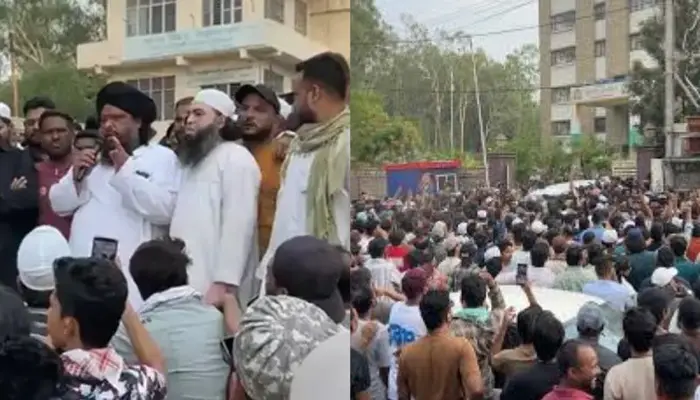
Case Summary
In the Govindpura area of Bhopal, Madhya Pradesh, the Hindu community faced targeting with "Sar Tan Se Juda" slogans (Islamic beheading slogans) from a large Muslim mob. The accused individuals, including Muslim politicians, threatened to assault and lynch all Hindus, including Hindu women and Hindu activists. They also attacked the police and vandalised their vehicles. According to reports, the incident stemmed from an earlier confrontation at a hotel in Govindpura on 9 May 2026, where Hindu activists challenged a Muslim man named Arif Khan and a Hindu woman who were staying together. Activists stated that the man concealed his identity, posed as a Hindu, and suspected a possible “Love Jihad” (a term used for religiously motivated targeting of Hindu women by Muslim men in predatory relationships for the purpose of sexual exploitation or conversion) angle, though police did not officially confirm this. Reports also revealed that Arif had checked into the hotel using a fake Hindu identity card. As a result, Bajrang Dal activists thrashed Arif for impersonating a Hindu identity, blackened his face, covered his face with cow dung, and made him parade across the area. The Hindu woman involved informed police that she had willingly been in a live-in relationship with Arif for several years and denied all allegations of coercion or forced conversion. She declined to file a complaint against Arif. However, police investigation revealed that Arif Khan had multiple criminal cases registered against him, including matters related to fraud, theft, and criminal breach of trust across different police stations in Bhopal. Officials stated that several court matters against him remained pending. Govindpura police station officials stated that, since no formal complaint was filed by either side, no immediate criminal case was registered in connection with the hotel confrontation. Authorities initially counselled all parties and released them after warnings to maintain communal harmony. However, following this, a First Information Report was filed against seven Hindu activists in connection with the assault, and two of the accused, including a minor, were arrested. This altercation ended with legal action against Hindu activists. Following this, on 13 May 2026, a mass Muslim mobilisation occurred outside the Taj Mosque in the name of a protest for the supposed injustice Arif had gone through. A large number of Muslims gathered on the streets and issued violent threats against Hindus and Hindu activists, including threats to behead them; they began chanting the vicious "Sar Tan Se Juda" slogans. The accused also began chanting slogans of "Nara-e-Takbeer, Allahu Akbar". Videos circulating on social media showed large sections of the crowd shouting religious slogans, including “Nara-e-Takbeer” and “Allahu Akbar”, while some participants issued open threats against members of Hindu organisations, particularly the Bajrang Dal. During the protest outside the Police Commissionerate, state president of All India Majlis-e-Ittehadul Muslimeen (AIMIM), Akhtarul Imam (also known as Mohsin Ali Khan), delivered speeches that intensified religious tensions. According to videos and eyewitness accounts shared online, one speaker from the gathering declared, "Muslims of Bhopal will no longer tolerate them (Bajrang Dal). We will drag them to the streets and lynch them.... Have some shame, if we come to catch your girls, we will beat them on the roads. But we abide by the constitution... How come they applied cow dung on his face in front of the police? If you don't take strict action, wherever I find them (Bajrang Dal), I will thrash them. I take full responsibility... " Following this, the Muslim mob again started chanting war cries of "Nara-e-Takbeer" and "Allahu Akbar". Another viral clip showed a Muslim man standing atop a police barricade near officers and shouting provocative slogans, including “Tera Mera Rishta Kya…”, drawing criticism over the apparent lack of immediate police intervention despite the charged atmosphere. There were more videos of Muslim politicians inciting Muslim crowds to target the Hindu community and Hindu organisations. There were several videos circulating on social media demonstrating chants of "Sar Tan Se Juda" by the Muslim mob. During this violent demonstration, the Muslim mob did not spare even the police who arrived on the scene upon receiving information. They pelted the police with stones. Police brought the situation under control by erecting barricades and using lathi charges. The police also registered a case against the Muslim mob members at the Talaiya police station. Police stated that, based on CCTV footage and the videos that surfaced, the accused would be identified and action would be taken. Following this, news emerged that of the seven Hindu men arrested, not a single person was linked to Bajrang Dal or any ‘right-wing Hindu organisation’. Govindpura SHO Awadhesh Singh Tomar said, “Representatives of right-wing organisations have informed that they are a disciplined organisation and these individuals are not their members.
Why it is Hate Crime ?
This case is being added to the tracker under the primary category- Hate Speech against Hindus. The subcategory selected is- Violent Threats. Violent threats, explicit, implicit or implied, is the most dangerous form of hate speech since it goes beyond discriminatory and prejudicial language to express the intent of causing harm to an individual or a group of people based on their religious identity and faith. There could be several different kinds of threats that are issued to Hindus based on religious animosity. An explicit threat would mean the direct threat of violence towards an individual Hindu, a group of Hindus or Hindus at large. Physical violence, death threats, threats of destruction of property belonging to Hindus and threats of genocide would mean explicit threats against Hindus for their religious identity. Implicit threats may not be a direct threat but implied through the use of symbols of actions – for example – in the Nupur Sharma case, other than explicit threats, there were also implicit threats when Islamists took to the streets to burn and beat her effigies. It implies that they want to do the same to Nupur Sharma – thereby is considered an implicit threat. Violent threats can be delivered in person, through letters, phone calls, graffiti, or increasingly through social media and other online platforms. It would be important to understand that a threat – explicit or implicit, online or offline – to an individual who happens to be a Hindu does not qualify as a religiously motivated threat. Such a threat, while vile and dangerous, could be owing to non-religious reasons and/or personal animosity. To qualify as a religiously motivated threat, it would need to exhibit an indication that the individual is being targeted for religious reasons and/or owing to his/her religious identity as a Hindu. This incident exemplifies religiously motivated offence, as members of a Muslim community mobilised and threatened to behead and assault the entire Hindu community in Bhopal's Govindpura area, including Hindu activists and women. The Sar Tan Se Juda threats arose over a prior altercation on 9 May 2026, where Hindu activists confronted a Muslim man named Arif and a Hindu woman at a hotel. Reports confirmed Arif had checked in using a forged Hindu identity card, raising suspicions of predatory intent amidst a pattern of similar cases documented by the Hinduphobia Tracker, over 1,000 instances where Hindu women were trapped in relationships by Muslim men for sexual exploitation or conversion, commonly termed "Love Jihad". Despite the Hindu woman's claim of a consensual live-in relationship, the forgery undermines this narrative and prompts key questions: why conceal his identity if the relationship was voluntary? It suggests possible coercion, societal pressure, or arm-twisting that silenced the Hindu woman's true account. Hindu activists responded to Arif's impersonation of a Hindu identity by thrashing him, blackening his face, parading him, and covering his face with cow dung. The police intervened promptly: no complaint was filed by the woman, who denied coercion; a First Information Report was lodged against seven Hindu activists, leading to arrests, including a minor. Following this, all parties were counselled to maintain communal harmony, and the matter remained under investigation, being resolved through legal channels. Consequently, there was no justification for the subsequent Muslim mob mobilisation on 13 May 2026, which issued "Sar Tan Se Juda" beheading threats against the Hindu community. Yet, on 13 May 2026, a mass Muslim mobilisation outside the Taj Mosque escalated into overt threats, with chants of "Sar Tan Se Juda" (Islamic beheading slogans) and "Nara-e-Takbeer, Allahu Akbar", alongside vows to lynch and assault Hindus. This went beyond retaliation for the hotel incident, which police had handled. Notably, the Muslim mob offered no condemnation of Arif's forgery and instead provided overt support for the Muslim perpetrator despite his use of a fake Hindu identity card to enter the hotel, portraying Arif as the victim while diverting attention from his crime and directing outrage solely at Bajrang Dal activists. With the activists already facing charges, the mobilisation served no legitimate purpose but to incite unrest, target the Hindu community, and deliver religiously charged hate speech and threats of violence against Hindus, making this a clear example of a religiously motivated crime. This overt support for Arif, even when he stood on the wrong side, exemplifies the Islamic concept of ummah or global Muslim brotherhood, where Muslims prioritise solidarity across their community regardless of wrongdoing against non-Muslims like Hindus, a dynamic that fuelled India's Partition and Pakistan's creation. In this case, the mob's mobilisation embodied this ummah loyalty, showing contempt for Hindu identity and community by rallying to back Arif through beheading slogans and threats against all Hindus, thereby revealing their deep-seated anti-Hindu bigotry and hatred. It's also important to address the Islamic beheading slogans issued by the Muslim community. The use of the slogan “Sar Tan Se Juda” in particular constituted an explicit and religiously motivated threat directed at the Hindu community in this case. “Gustakh-e-Rasool ki ek hi saza, sar tan se juda, sar tan se juda”, which translates to “There is only one punishment for disrespecting the Prophet Muhammad, beheading”, is an Islamist clarion call, that has become a staple feature of violent protests that have so far claimed the lives of at least 6 Hindus, including Kanhaiya Lal in Udaipur and Umesh Kolhe in Amravati, after Muslim fundamentalists, egged on by the dog-whistling of Alt News co-founder Mohammed Zubair against former BJP spokesperson Nupur Sharma, resorted to violence for what they perceived as ‘blasphemy’ against Prophet Muhammad. From Kanpur in India’s northern plains to the southern metropolis of Bengaluru, from Kolkata in the east to Hyderabad in the south, protests in the name of blasphemy have erupted in almost every corner of the country as Islamists took to the streets running amok and shouting “Sar Tan Se Juda” chants over the perceived belief of blasphemy against their Prophet. Though a radical Muslim outfit in Pakistan coined this slogan, it has gained popularity among Islamists in regions beyond its geographical origins. Over the years, we have seen large crowds of Islamists chanting the “Sar Tan Se Juda” slogan, which is nothing but a direct incitement to violence against Hindus, leading to murders committed in the name of blasphemy. The radicalised outcry is not merely a statement of disapproval; it is a call for the execution of an individual through beheading, based on their religious identity. When this slogan is raised, it sends a clear and terrifying message not just to the individual targeted but also to anyone else who might share similar views or dare to express them. This tactic of intimidation aims to silence dissent and suppress freedom of expression, particularly in religious discourse. It aims to instil fear in the broader community. Islamists use this tactic to settle personal scores with non-Muslims, particularly Hindus, by levelling fabricated charges of blasphemy against them, which causes outrage and paints a target on them. The underlying hatred and animosity toward non-Muslims, especially Hindus, drive these false blasphemy accusations as a means to subjugate and victimise them. The appearance of this slogan in the present case demonstrates how deeply normalised such violent rhetoric has become within public and political discourse. In this instance, there was no allegation of blasphemy or insult towards any Islamic figure. The Muslim mob exploited the prior hotel altercation, where Arif was thrashed for using a forged Hindu identity card, an incident police had resolved through arrests and counselling, as a mere pretext to launch violent threats against the entire Hindu community, including beheading calls under “Sar Tan Se Juda” and vows to assault Hindus, women, and activists. This large-scale mobilisation outside the Taj Mosque showcased their intent to flex street and muscle power, asserting Islamic dominance and intimidating Hindus into submission, thereby exposing deep anti-Hindu animosity beyond any legitimate grievance. The fact that the entire Hindu community faced such threats over a prior altercation, which police had already addressed through arrests, a First Information Report against the activists, and counselling for communal harmony, highlights the deep-rooted animosity harboured by the perpetrators towards Hindus who challenge deceptive practices or assert community interests. The use of such threats in this context demonstrates that the slogan is increasingly being deployed as a weapon of intimidation against Hindus who confront religiously motivated predatory behaviour or maintain social order. This underscores the openly hostile, retaliatory, and religiously charged nature of the threats issued in this case. It is crucial to note that the "Sar Tan Se Juda" slogan is not raised solely in response to so-called insults to Islam or actual blasphemy against any Islamic figures. The Hinduphobia Tracker has documented its repeated use against Hindus over entirely non-blasphemous matters, serving as a tool to intimidate and enforce submission to Islamic street power. For instance, on 10 May 2026, a Hindu politician, Shaunak Marik, in Kolkata received "Sar Tan Se Juda" threats from Muslim TMC (Trinamool Congress) goons merely for his affiliation with the Bharatiya Janata Party (BJP), perceived as a pro-Hindu or Hindutva-oriented party in the eyes of Muslims. In another incident from Indore, Hindu activist Santosh Sharma faced "Sar Tan Se Juda" threats after opposing forced religious conversions of Hindus. These threats started pouring in after a fatwa from a Muslim organisation. Similarly, in Ujjain in April 2026, a Hindu kathavachak was targeted with Sar Tan Se Juda threats for opposing religiously motivated targeting and crimes against Hindu women by Muslim men (commonly described as “Love Jihad”), forced conversions and cow slaughter. Following this, he filed a complaint at the Mahakal Police Station. In another incident, in October 2025, in Alwar, Rajasthan, a Hindu family was attacked by a Muslim mob, resulting in the death of a Hindu youth. During the assault, the attackers raised chilling beheading threats by shouting “Sar Tan Se Juda” alongside Islamic slogans such as “Allah Hu Akbar” and “I Love Muhammad,” turning the assault into a display of religious intimidation and Islamic extremist hatred against Hindus. These repeated instances establish that the "Sar Tan Se Juda" slogan serves merely as a pretext for Muslim perpetrators to target, threaten, and in many cases attack or kill Hindus simply for their identity, activism against Muslim radicalism, opposition to forced conversions, or resistance to predatory targeting of Hindu women. Far from requiring a clear blasphemous allegation, perpetrators exploit any minor grievance or unrelated event to mobilise Muslim mobs, raise the slogan, assert religious dominance, and intimidate the Hindu community into submission, revealing a pattern of opportunistic, religiously motivated hostility. In this current case of Bhopal, the Muslim mob also raised Allahu Akbar slogans, meaning "Allah is the greatest." The religiously motivated nature of the attack became even clearer as the attackers chanted this slogan during the assault. Traditionally, this slogan is a religious chant of glorification; however, Muslim extremists have weaponised it as a battle cry to intimidate Hindus and assert Islamic supremacy. In this case, the Muslim mob raised it precisely as they issued beheading threats against the Hindu community, mirroring patterns in other incidents: the 2020 Delhi anti-Hindu riots where Muslim mobs targeted Hindu homes and temples; the 2022 Karauli violence in Rajasthan with Hindu shops set ablaze; the Jahangirpuri riots in Delhi assaulting Hindu processions; and the September 2025 Bareilly clashes amidst the "I Love Mohammad" poster controversy. This slogan signals not devotion, but zealous threats against Hindus for their identity. It also essentially justifies violence against Hindus (Kafirs/infidels) as the divine commandment of Allah (God). Thus, the mobilisation with such chants confirms it as a religiously motivated hate crime aimed at intimidating the Hindu community due to animosity towards Hinduism. Overall, since this case involved the targeting of the Hindu community through explicitly religiously motivated beheading threats, intimidation linked to their collective identity and activism, and rhetoric rooted in Islamist hostility towards Hindu assertion and vigilance, it fulfilled several key parameters of a hate crime. Therefore, the case has been added to the hate crime database of the Hinduphobia Tracker. Disclaimer: In this Bhopal Govindpura case, while the total number of Muslim mob participants has not been specified, three individuals stand out from videos: AIMIM state president Akhtarul Imam, a Muslim man who declared "Muslims of Bhopal will no longer tolerate Bajrang Dal; we will drag them to the streets and lynch them", and another Muslim man chanting provocative slogans like "Tera Mera Rishta Kya". Although these three are specifically identifiable, videos and images depict a large Muslim mob. For Hinduphobia Tracker documentation purposes, an estimated perpetrator count of 10 to 100 has been recorded.


Case Status
Complaint registered


Perpetrators Details
Perpetrators
Muslim Extremists
Perpetrators Range
From 10 to 100
Perpetrators Gender
both
 Sources




