Hindu kathavachak faces ‘Sar Tan Se Juda’ threats after opposing faith‑based targeting of Hindu women, forced conversions and cow slaughter
 Ujjain, Madhya Pradesh, India
  29 April, 2026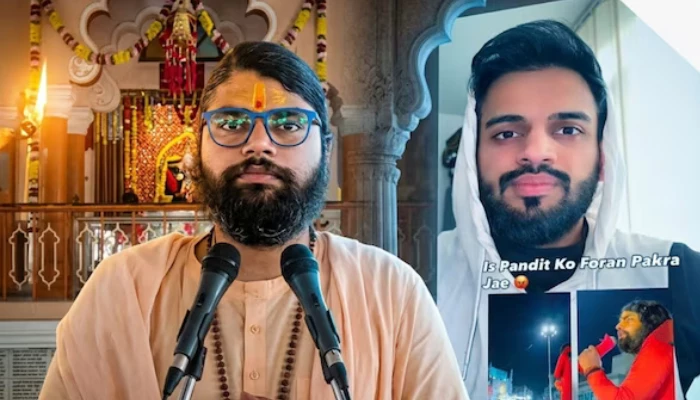
Case Summary
In Ujjain, Madhya Pradesh, Hindu kathavachak (religious preacher) Ramswaroop Brahmachari, a resident of Chardham Temple in Jaisinghpura, received explicit death and beheading threats (Sar Tan Se Juda) on social media from Muslims. He was targeted for opposing religiously motivated targeting and crimes against Hindu women by Muslim men (commonly described as “Love Jihad”), forced conversions and cow slaughter. Following this, he filed a complaint at the Mahakal Police Station. In the complaint, the Hindu religious preacher Ramswaroop Brahmachari stated that he had delivered a speech on the occasion of Ram Navami on 27 March 2026 in Hyderabad. During his address, he spoke on issues such as “Love Jihad”, coercive religious conversions, and cow slaughter, and called upon people to raise their voices against these practices. The event was attended by several dignitaries, including Shiv Pratap Shukla and saint Advaitananda Giri, among others. A video of his speech from the event was recorded and subsequently went viral on social media platforms, following which he became the target of hostile reactions. According to the complaint, offensive and threatening posts against him appeared on social media platforms, including an Instagram account identified as @dr_taha_cheemaa. The posts issued direct threats to kill him, including statements calling for “sar tan se juda” (beheading) and “separating him from his body”. The posts further escalated the threat by offering a reward to anyone who carried out the act, making the nature of the intimidation explicit and severe. The threatening content spread across platforms, with multiple Muslim users engaging in and amplifying the hostile messages directed at the Hindu preacher. The reaction followed directly from the circulation of his speech and escalated from disagreement to open calls for violence. Ramswaroop Brahmachari filed a complaint at the police station, based on which the police registered a First Information Report (FIR) against unknown Muslim perpetrators and initiated an investigation.
Why it is Hate Crime ?
This case has been added to the tracker under the primary category- Hate Speech against Hindus. The subcategory selected is- Violent Threats. Violent threats, explicit, implicit or implied, are the most dangerous form of hate speech since it goes beyond discriminatory and prejudicial language to express the intent of causing harm to an individual or a group of people based on their religious identity and faith. There could be several different kinds of threats that are issued to Hindus based on religious animosity. An explicit threat would mean the direct threat of violence towards an individual Hindu, a group of Hindus or Hindus at large. Physical violence, death threats, threats of destruction of property belonging to Hindus and threats of genocide would mean explicit threats against Hindus for their religious identity. Implicit threats may not be a direct threat but implied through the use of symbols of actions – for example, in the Nupur Sharma case, other than explicit threats, there were also implicit threats when Islamists took to the streets to burn and beat her effigies. It implies that they want to do the same to Nupur Sharma, which is considered an implicit threat. Violent threats can be delivered in person, through letters, phone calls, graffiti, or increasingly through social media and other online platforms. It would be important to understand that a threat – explicit or implicit, online or offline – to an individual who happens to be a Hindu does not qualify as a religiously motivated threat. Such a threat, while vile and dangerous, could be owing to non-religious reasons and/or personal animosity. To qualify as a religiously motivated threat, it would need to exhibit an indication that the individual is being targeted for religious reasons and/or owing to his/her religious identity as a Hindu. Another primary category selected here is - Attack not resulting in death. Within it, the sub-category selected is - Attacked for opposing radicals and trying to save the victim. In several cases, Hindus are attacked for opposing religiously motivated crimes being committed against a fellow Hindu or simply for voicing an opinion opposing radical elements, who either have in the past or continue to persecute Hindus. In such cases, the initial attack against the victim, against which the Hindu was trying to defend the victim, would also need to be classified as a religiously motivated hate crime. Since the initial crime itself was religiously motivated and the subsequent crime of attempting to save the victim or speaking against the radical elements ends up inviting a violent attack, it would also be classified as a religiously motivated hate crime under this category. This case is a clear example of a religiously motivated hate crime because the Hindu preacher was threatened and specifically targeted for opposing Muslim radicals who perpetrate religiously motivated crimes against Hindu women. Firstly, the term “Love Jihad”, which is commonly used in public discourse, refers to a pattern of relationships in which Hindu women are deceptively trapped by Muslim men, lured into emotional or marital bonds, and then pressured or forced into conversion to Islam for the sake of proselytisation or sexual exploitation. There have been numerous documented cases in which Hindu women have been sexually assaulted, lured into relationships or marriages, and then compelled to convert, often under coercion or manipulation. The Hinduphobia Tracker alone has documented more than one thousand cases of such targeting of Hindu women between 1 January 2023 and 1 May 2026, where Hindu women were targeted by Muslim men under the pretext of love and romantic relationships, only to be forcibly converted, sexually exploited, or compelled to consume beef and adopt Islamic practices against their will. The fact that Ramswaroop Brahmachari, the Hindu victim in this case, was targeted for verbally challenging and publicly opposing these practices, in defence of Hindu women and their right to religious autonomy and dignity, shows that the animosity directed at him stemmed directly from his Hindu identity and from his efforts to protect members of his own community and oppose Muslim radicals. The threats against him were not for any personal dispute but for his vocal opposition to crimes rooted in anti‑Hindu animus, where the victims’ Hindu identity itself is the basis of their vulnerability. Ramswaroop Brahmachari was also targeted for opposing forced religious conversions of Hindus, which have occurred repeatedly across the country through a variety of coercive and manipulative methods. There have been multiple incidences of Hindus being forcibly converted to Islam and Christianity under the pretext of financial inducements, such as offers of money or other material benefits, as well as through psychological pressure, including brainwashing, manipulation, physical force, harassment, threats, and subtle indoctrination. The Hinduphobia Tracker alone has documented more than 1,600 cases of forced conversions, also described as predatory proselytisation, between 1 January 2023 and 1 May 2026, highlighting an alarming pattern of Hindus being targeted with the intention of forcibly changing their faith. The fact that the Hindu preacher was specifically threatened for speaking out against these practices showcases the deep‑seated religious animosity of the perpetrators toward him, his Hindu identity, and his determination to protect his community from such coercive religious targeting. The victim was also targeted for opposing cow slaughter, which is regarded in Hinduism as a sacred and virtuous act. The cow holds a central place in Hindu religious consciousness as a symbol of life and purity, and opposing its slaughter is consistent with commonly held Hindu values. By attacking him for this stance, the perpetrators demonstrated hostility not only towards his activism but towards the Hindu religious worldview itself. The combination of threats issued for his opposition to “Love Jihad”, coercive conversions, and cow slaughter reveals that the attack on him was not incidental but a response to his defence of core Hindu beliefs and practices. Furthermore, the act of issuing beheading threats further underscores the severity of the violence and the depth of the religious hatred the perpetrators harboured. Such threats were directed at him simply for standing up for the rights of the Hindu community, protecting Hindu women, and defending vulnerable Hindus from forced conversions. The fact that he was threatened with beheading for also opposing cow slaughter, seen in Hinduism as a moral and religious duty, confirms that the hostility was religiously motivated rather than political or personal. The threats were a direct response to his defence of Hindu sentiments and practices, which the Muslim perpetrators viewed as an affront to their own religious worldview. This demonstrates how Hindus are targeted by Muslims whenever they assert their right to defend their faith and protect their community members, making this a clear case of a religiously motivated hate crime. Additionally, the use of the slogan “Sar Tan Se Juda” constitutes an explicit and religiously motivated threat directed at Hindus. This is a threat that the Hindu victim in this case received. “Gustakh-e-Rasool ki Ek hi saza, sar tan se Juda, sar tan se Juda”, which translates to “There is only one punishment for being disrespectful to Rasool (Prophet Muhammad), their head separated from their torso, their head separated from the torso”, is an Islamist clarion call, that has become a staple feature of violent protests that have so far claimed the lives of at least 6 Hindus, including Kanhaiya Lal in Udaipur and Umesh Kolhe in Amravati, after Muslim fundamentalists, egged on by the dog-whistling of Alt News co-founder Mohammed Zubair against former BJP spokesperson Nupur Sharma, resorted to violence for what they perceived as ‘blasphemy’ against Prophet Muhammad. From Kanpur in India’s northern plains to the southern metropolis of Bengaluru, from Kolkata in the east to Hyderabad in the south, protests in the name of blasphemy have erupted in almost every corner of the country as Islamists took to the streets running amok and shouting “Sar Tan Se Juda” chants over the perceived belief of blasphemy against their Prophet. Though a radical Muslim outfit in Pakistan coined this slogan, it has gained popularity among Islamists in regions beyond its geographical origins. Over the years, we have seen large crowds of Islamists chanting the “Sar Tan Se Juda” slogan, which is nothing but a direct incitement to violence against Hindus, leading to murders committed in the name of blasphemy. The radicalised outcry is not merely a statement of disapproval; it is a call for the execution of an individual through beheading, based on their religious identity. When this slogan is raised, it sends a clear and terrifying message not just to the individual targeted but also to anyone else who might share similar views or dare to express them. This tactic of intimidation aims to silence dissent and suppress freedom of expression, particularly in religious discourse. It aims to instil fear in the broader community. Islamists use this tactic to settle personal scores with non-Muslims, particularly Hindus, by levelling fabricated charges of blasphemy against them, which causes outrage and paints a target on them. The underlying hatred and animosity toward non-Muslims, especially Hindus, drive these false blasphemy accusations as a means to subjugate and victimise them. The appearance of this slogan in this case demonstrates how deeply this violent rhetoric has permeated public discourse and online spaces. Here, there was no blasphemy of any Islamic religious figure involved; the trigger was solely the Hindu preacher’s vocal opposition to Islamic conversions and to the targeting of Hindu women by predatory Muslim men under the guise of “Love Jihad”. This shows that even mere resistance to Islamisation, expressed in the form of criticism of coercive conversions and the exploitation of Hindu women, can render a Hindu individual a target for “sar tan se juda”‑style beheading threats. The slogan is not reserved only for perceived religious insults but is also deployed as a weapon of intimidation against those who defend Hindu religious autonomy and community dignity, underscoring the openly hostile and retaliatory nature of the threat in this context. Overall, since this case meets several key parameters of a hate crime, targeting a Hindu individual on the basis of religious identity, retaliation for defending members of his community, the use of religiously charged threats, and the broader context of religious animosity towards Hindus, it is being added to the hate crime database of the Hinduphobia Tracker. Disclaimer: The Hinduphobia Tracker records incident dates based on when the crime occurs, rather than when it is reported by the media. In this case, media reports did not specify the exact date on which the victim received the threats. Therefore, for documentation purposes, an indicative incident date of 30 April 2026 is being selected. In this case, even though multiple Muslim individuals were issuing or amplifying threatening messages, only one person, Dr Taha Cheema, was clearly and specifically identified by name in the available evidence. Therefore, the perpetrator count has been recorded as "1" for the purposes of documentation. Additionally, the identity of the perpetrators has been categorised as Muslims, reflecting the religiously charged and anti‑Hindu nature of the threats.
Victim Details
Total Victim
1
Deceased
0
Gender
- Male 1
- Female 0
- Third Gender 0
- Unknown 0
Caste
- SC/ST 0
- OBC 0
- General 1
- Unknown 0
Age Group
- Minor 0
- Adult 1
- Senior Citizen 0
- Unknown 0


Case Status
Complaint filed


Perpetrators Details
Perpetrators
Muslim Extremists
Perpetrators Range
One Person
Perpetrators Gender
male
 Sources




