Hindu women and children beaten by Muslim mob while travelling to temple in Maharashtra
 Beed, Maharashtra, India
  26 April, 2026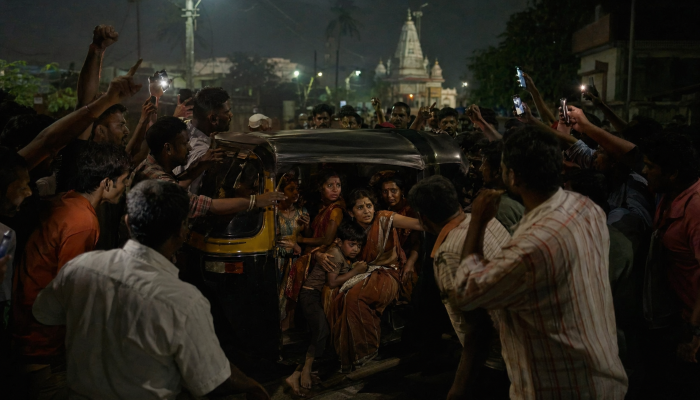
Case Summary
Hindu women and small children travelling by rickshaw to attend Harinam Saptah [a seven-day continuous recitation of the names of Lord Vishnu, one of the most sacred and joyous collective devotional observances in the Hindu tradition] at Bankat Swami temple in Neknoor village, Beed district, Maharashtra were brutally assaulted by a Muslim mob. The attack began after the rickshaw made minor contact with another vehicle. The mob attacked the rickshaw driver, beat the women, and kicked and punched the small children. A viral video showed hundreds of individuals surrounding and assaulting unarmed Hindu women and children. The same mob later pelted stones at Neknoor police station when Hindu community members gathered to demand justice. Police were forced to carry out a lathi charge to disperse them. The incident took place at approximately 8:00 PM on 27th April 2026 when a rickshaw carrying Hindu women and small children was making its way to Bankat Swami temple for the Harinam Saptah. The rickshaw made minor contact with another vehicle on the road. The occupants of the other vehicle immediately launched a violent attack on the rickshaw driver. When the Hindu women in the rickshaw attempted to intervene and protect the driver, they were beaten mercilessly. The small children travelling with them were kicked and punched. Eyewitness accounts confirmed that the women were slapped, the children were grabbed by the collar, slapped multiple times, and roughly handled, and that the victims' pleas for the attackers to stop were ignored throughout. A video of the attack went viral on social media, showing a crowd of hundreds surrounding and assaulting unarmed Hindu women and children. The victim family stated that the attack was entirely premeditated and not a spontaneous reaction to the minor vehicle contact. Local Hindu organisations described the attack as reflecting a broader pattern of intimidation directed at the Hindu community. Outraged Hindu community members gathered at Neknoor police station to demand justice. The same mob that had carried out the assault subsequently pelted stones at the police station. Police were forced to carry out a lathi charge to disperse the crowd. Heavy police force was deployed in the village. Sub-Divisional Police Officer [SDPO] Vyankat Ram confirmed that the accused were being identified using CCTV footage and viral videos and that strict action would be taken against those found guilty.
Why it is Hate Crime ?
The primary category for this case is "Attack not resulting in death". The sub-category for this case is "Communal clash/attack". Communal clash is a form of collective violence that involves clashes between groups belonging to different religious identities. For a communal clash between Hindus and non-Hindus to qualify as a religiously motivated hate crime, the trigger of the violence itself would have to be anti-Hindu in essence. For example, if there is a Hindu religious procession that comes under attack from a non-Hindu mob and after the initial attack, Hindus retaliate in self-defence, leading to a communal clash between the two religious communities. While at a later stage, both communities are involved in the clash/violence, the initial trigger of the violence was by the non-Hindu mob against the Hindus and therefore, it could safely be termed as an anti-Hindu violence. Further, the trigger would also have to be religiously motivated. In the cited example, the attack by the non-Hindu mob was against religious processions and therefore, can be concluded to be religiously motivated. In some cases, the trigger may be non-religious, however, it develops into religious violence against Hindus at a later stage. In such cases too, the foundational animosity towards Hindus becomes the motivating factor of the crime and therefore, it would be classified as a religiously motivated hate crime against Hindus under this category. This case qualifies as a religiously motivated hate crime in which Hindu women and small children travelling to attend Harinam Saptah at Bankat Swami temple in Neknoor village, Beed district, Maharashtra were brutally assaulted by a Muslim mob. The attack was not a proportionate or spontaneous reaction to a minor vehicle contact. It was a coordinated and premeditated assault on unarmed Hindu women and children who were in the act of performing a sacred Hindu devotional observance, carried out by a mob that had no personal stake in the vehicle collision and whose intervention reflected a pre-existing communal hostility toward the Hindu community. The most significant religious marker of this case is that the Muslim mob that launched the assault was not directly involved in the minor vehicle contact that served as the pretext for the attack. A rickshaw carrying Hindu women and small children made minor contact with another vehicle on the road. This was a trivial and non-communal incident. However, the mob that responded to it with brutal violence, beating the women, kicking and punching the small children, and attacking the rickshaw driver, was not composed of individuals with a personal grievance arising from the vehicle contact. It was a crowd of hundreds that mobilised specifically to assault the Hindu occupants of the rickshaw. The disproportionate scale of the response, hundreds of individuals against a small group of unarmed women and children, confirms that the vehicle contact was a pretext and not the cause. The cause was the Hindu identity of the victims and the communal hostility of the perpetrators toward that identity. The victim family's explicit statement that the attack was entirely premeditated confirms the religious character of the assault. A spontaneous reaction to a minor vehicle contact does not require premeditation. The family's recognition that the attack had been planned in advance reflects a lived understanding of the communal environment in Neknoor village and a recognition that the mob had identified them as Hindu targets before the collision occurred. The premeditated character of the attack transforms it from a road rage incident into a deliberate act of communal violence directed at Hindus who were visibly engaged in a Hindu religious activity. The timing and context of the attack amplifies its religious significance. The Hindu women and children were travelling to Bankat Swami temple to participate in Harinam Saptah, one of the most joyous and sacred collective devotional observances in the Hindu tradition. The recitation of the names of Lord Vishnu over seven continuous days is an act of profound Hindu devotional commitment, undertaken by communities as an expression of collective faith and communal religious solidarity. The mob attacked these Hindu women and children specifically at this moment, while they were in the act of travelling to perform this sacred observance, confirming that their Hindu devotional activity was not incidental to the attack but was the context that identified them as targets. The subsequent stone pelting at Neknoor police station by the same mob when Hindu community members gathered to demand justice reveals the full communal character of the attack. The perpetrators did not disperse after the assault. They followed the Hindu community to the police station and attacked it with stones. This escalation from an attack on Hindu women and children to an attack on the institutional space where Hindus were seeking justice confirms that the perpetrators' objective was not merely to punish specific individuals for a vehicle contact but to assert communal dominance over the Hindu community as a whole, preventing them from seeking accountability and communicating that their safety and their access to justice were both contingent on their submission. To understand how minor disputes can escalate into identity-based communal violence, often leaving Hindus as victims, it is important to recall the 2019 Hauz Qazi incident. The incident illustrates how a seemingly ordinary, non-communal altercation escalated into a targeted communal attack once religious identity became the focal point. What began as a minor dispute over parking was rapidly transformed through mobilisation, rumour circulation, and identity-based consolidation into a large-scale attack directed at a Hindu locality and its place of worship. The congregation of a large mob at the entrance of the Hindu-dominated lane, the stone pelting, desecration of the Durga Mandir, and the targeting of residents indicate that the conflict was no longer about the original dispute but about asserting dominance over a religious minority within a Muslim-majority area. The shift was further evident in the use of religious slogans, the confinement of Hindus to a single lane, and allegations of repeated prior targeting, all of which pointed towards a pattern where demographic imbalance creates an environment of vulnerability. In such contexts, even trivial triggers can be communalised, with religious identity becoming the basis for collective mobilisation and violence, reflecting deeper underlying tensions and hostility that manifest when an opportunity arises. The Hinduphobia Tracker has documented numerous similar instances where communal attacks on Hindus began over non-religious disputes but quickly escalated, leaving Hindu victims seriously injured. For example, on 22nd June 2025, in Ghongade Basti, Solapur, Maharashtra, a Hindu man and his brother were brutally attacked by a Muslim mob following a minor road dispute. The incident quickly escalated into targeted communal violence against the local Hindu community. Another such instance occurred on 6th June 2025, in Kadabin Jinsi Haat Maidan, Indore, Madhya Pradesh, where a Dalit Hindu family was brutally attacked by a group of Muslims over a minor water dispute. The assailants also hurled caste-based slurs, and even women and a child were severely beaten. A similar case of communal attack occurred on 2nd June 2025, in Saraiya, Varanasi, Uttar Pradesh, a Dalit Hindu man named Vishal Sonkar was brutally assaulted by a group of Muslim youths after a minor disagreement over road space. He suffered severe head injuries from rods and sticks. A similar instance of communal violence was reported on 6th July 2025, in Deoband, Uttar Pradesh, a Dalit Hindu wedding procession was attacked by a Muslim mob over the playing of DJ music while passing by a mosque. The victims were severely injured with sharp weapons and sticks. The above-mentioned cases clearly demonstrate a pattern of attacks against Hindus. Even if the conflict is a result of a non-communal issue, it often takes on a communal nature where Hindus are frequently targeted and brutally attacked by a large Muslim mob. These attacks are not random or spontaneous acts of violence. The above-mentioned cases clearly demonstrate a pattern of attacks against Hindus. Even if the conflict is a result of a non-communal issue, it often takes on a communal nature where Hindus are frequently targeted and brutally attacked by a large Muslim mob. These attacks are not random or spontaneous acts of violence. What happened in this case is part of a larger pattern where Hindus are targeted not just out of personal anger, but because of deep-rooted religious hatred and a supremacist mindset. Given that this case met the parameters of a religiously motivated hate crime, the attack on Hindu women and small children in Neknoor reflected more than a road dispute that turned violent. By mobilising hundreds of individuals to assault unarmed Hindu women and children who were travelling to perform a sacred devotional observance, and by following the Hindu community to the police station and attacking it with stones when they sought justice, the perpetrators demonstrated a clear and deliberate hostility toward the Hindu community and their right to practise their faith, travel safely, and seek institutional redress without fear of further violence. The Hindu women and children were targeted specifically because they were Hindu, and the premeditated and disproportionate character of the assault confirms that their Hindu identity was the reason the mob mobilised against them. This reflects an underlying hostility toward Hindu identity rooted in communal animosity that cannot be characterised as anything other than religiously motivated. Given that this case met the parameters of a religiously motivated hate crime, it was added to the hate crime database of the tracker.


Case Status
Complaint filed


Perpetrators Details
Perpetrators
Muslim Extremists
Perpetrators Range
Unknown
Perpetrators Gender
unknown
 Sources




