Hindu employees subjected to religious discrimination at their workplace; Hindu women say they were pressured into predatory relationships with Muslim men
 Mumbai, Maharashtra, India
  11 April, 2026
Case Summary
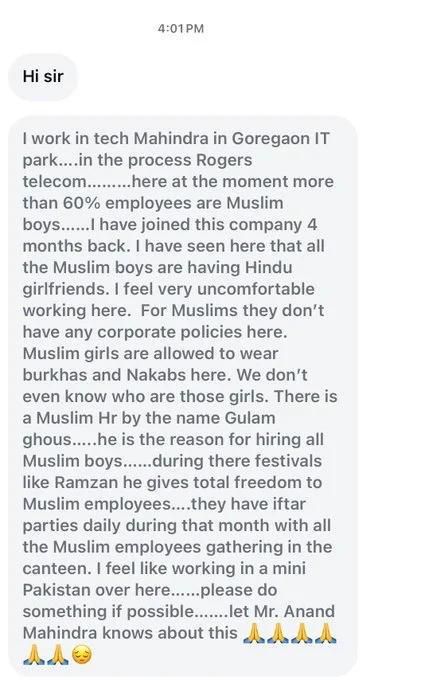
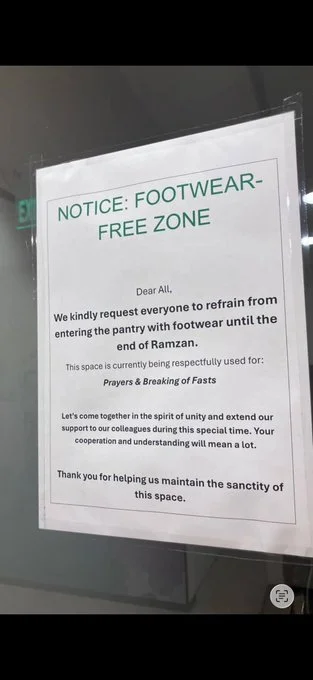
At a Tech Mahindra BPO unit in Goregaon, Mumbai, Hindu employees were subjected to religious discrimination by their Muslim seniors. Hindu women were specifically targeted and pressured into predatory relationships with Muslim men. While Muslim employees were permitted to wear their religious symbols, discriminatory hiring practices by a Muslim HR officer further skewed the office atmosphere in favour of Islam, leaving Hindu employees feeling marginalised and vulnerable. This incident came to light in April 2026 against the backdrop of the emerging TCS (Tata Consultancy Services) Nashik forced conversion and grooming gang case, which had already drawn widespread media attention. As documented earlier by the Hinduphobia Tracker, at the TCS office in Nashik, Hindu employees, particularly women, were systematically targeted on account of their religious identity by their Muslim colleagues and seniors, who were running a well-organised grooming and conversion racket. They were pressurised to convert to Islam, lured into sexual relationships, and subjected to rape and sexual assault. Even Hindu deities were insulted and mocked, and several victims were compelled to eat beef and wear Islamic attire such as Muslim caps and hijabs against their will. According to media reports, this current case related to a Tech Mahindra BPO came to light when a Hindu female employee sparked a heated debate in April 2026 by describing her workplace as a “Mini‑Pakistan”. She did this due to an overwhelming shift in demographics and cultural norms within the company. She stated that over 60% of the workforce in her process consists of Muslim youths, a shift she attributed to a Muslim HR official named Ghulam Ghaus, who prioritised hiring from his own community. The Hindu employee highlighted a concerning environment where Muslim women were permitted to wear religious attire such as the niqab, and extensive freedom was granted for Islamic activities such as Iftar parties, while Hindu women were targeted for predatory relationships with Muslim men. This testimony had raised alarms about the creation of religious ghettos within the Indian IT industry and the resulting discomfort for Hindu staff. The victim employee narrated all her ordeal to an advocate at the Bombay High Court, Ashutosh Dubey, by privately messaging him on X (formerly Twitter). He put up screenshots and a post on the platform X, stating that the Tech Mahindra office in Mumbai’s Goregaon practised unequal workplace policies and religious favouritism during festivals. Following this, Ashutosh Dubey put out another X post in which he stated that he had received a message from a female employee at a Tech Mahindra office in Telangana. The message included an Instagram post showing that the pantry at the office had been declared a “footwear‑free zone” until Ramzan, reserved for prayers and Iftar. This indicated that an entire area within the Tech Mahindra office was set aside and dedicated exclusively for Ramzan and Iftar, reinforcing the perception of religious favouritism in the workplace. Responding to the controversy, a Tech Mahindra spokesperson claimed: “This is with reference to recent social media posts alleging religious bias within Tech Mahindra. We take such concerns seriously and conducted an internal review, which found these claims to be inaccurate and unfounded. We confirm that the image titled ‘footwear free zone’ is not from any of our offices, and the anonymous post regarding hiring practices is false. “At Tech Mahindra, we are firmly committed to building an inclusive, respectful workplace where every individual is treated with dignity and fairness, without discrimination of any kind, including on the basis of religion. We will continue to review our policies and processes to ensure that our values are upheld consistently, and that no coercive or inappropriate conduct is permitted or carried out in any manner whatsoever.”
Case Images
Why it is Hate Crime ?
This case is added to the tracker under the primary category- Predatory Proselytisation. The subcategory selected is- Proselytisation by grooming, brainwashing, manipulation or subtle indoctrination. Religious brainwashing essentially means the often subtle and forcible indoctrination to induce someone to give up their religious beliefs to accept contrasting regimented ideas. Religious grooming or brainwashing also involves propaganda and manipulation. It involves the systematic effort, driven by religious malice and indoctrination, to persuade “non-believers’ to accept allegiance, command, or doctrine to and of a contrasting faith. Cases of such grooming or brainwashing are far more nuanced than direct threats, coercion, inducement and violence. In such cases, it is often seen that there is repeated, subtle and continual manipulation of the victim to induce disaffection towards their own faith and acceptance of the contrasting faith of the perpetrator. While subtle indoctrination is widely acknowledged as predatory, an element which is often understated in such conversions or the attempts of such conversion is the role of loyalty and trust which might develop between the perpetrator and the victim. Fiduciary relationships are often abused to affect such religious conversion. For example, an educator transmitting religious doctrine of a competing faith to a Hindu student. The Hindu student is likely to accept what the teacher is transmitting owing to existence of the fiduciary relationship. The exploitation of the fiduciary relationship to religiously indoctrinate victims would also be included in this category. Since the underlying animosity towards the victim’s faith forms the basis of predatory proselytization, such cases are considered religiously motivated hate crimes. In this case, Hindu employees were targeted specifically for their religious identity and subjected to religious discrimination in comparison to their Muslim colleagues. Within the Tech Mahindra workplace, Hindu women were particularly singled out and pressured into predatory interfaith relationships with Muslim men, relationships that exploited their religious vulnerability and cultural background. All of this, taken together, makes this incident a clear example of a religiously motivated hate crime, where hostility towards Hindus is expressed through systemic discrimination, marginalisation, and targeted coercion. The first element of this hate crime is the selective targeting of Hindu employees on religious grounds. A Muslim HR officer favoured hiring predominantly Muslim candidates, rejecting qualified and compatible Hindu applicants purely because of their Hindu identity. By systematically prioritising Muslim employees in recruitment, this HR officer discriminated against Hindu employees on the basis of their faith. This religiously biased hiring pattern amounted to structural exclusion, where Hindu employees were denied equal opportunity and professional dignity. The clear preference for Muslim candidates over Hindu ones makes this a textbook case of religiously motivated discrimination and hate‑driven workplace bias. The second dimension lies in how the Muslim perpetrator reshaped the entire office environment to favour Islam and the Muslim community. The office came to be dominated by Muslim employees, and Muslim women were granted full freedom to visibly practice their faith, including holding Iftar gatherings and other Islamic activities. These practices were openly encouraged and even celebrated within the office space, whereas Hindu religious observances received no comparable support or visibility. The office atmosphere was therefore tilted in favour of Islamic practices, normalising a Muslim‑centric culture and making Hindu employees feel like outsiders in their own workplace. The imbalance, where one religion is actively promoted while another is ignored, amounts to institutionalised religious discrimination and reinforces a hostile environment for Hindus, which fits the framework of a religiously motivated hate crime. A third layer of hate is visible in the coercive spiritual and psychological pressure on Hindu employees. In a workplace environment where Hindu employees are already vulnerable, and where only Islamic practices are openly visible and celebrated, they become vulnerable to future coercion and conversion. They begin to feel that adopting Islam is the only way to gain inclusion, respect, or professional safety. This subtle indoctrination, combined with continuous exposure to an Islam‑centric work culture, creates a form of religious brainwashing that pushes Hindu employees towards religious conformity. Such manipulation, built on religious animosity and systemic exclusion, intensifies the religiously targeted nature of the environment and turns the workplace into a space of religious coercion, conversion, and intimidation. Fourth, Hindu women in this setup faced especially targeted persecution through predatory interfaith relationships with Muslim men. In this context, “predatory” implies relationships that are not freely consensual but are engineered to exploit the woman’s religious identity and emotional vulnerability. Hindu women were targeted precisely because they were Hindu, and because their status as non‑Muslims made them vulnerable to religious manipulation and pressure. These relationships were not based on mutual respect or genuine affection, but on religious profiling, using Hindu women’s faith as a condition for acceptance, affection, or inclusion. When such interfaith relationships are used as a tool to push Hindu women into conversion, sexual exploitation, or loss of cultural autonomy, they become manifestations of religiously motivated hate. In many such cases, Hindu women in Muslim‑favouring office environments also face pressure or coercion to convert after entering these relationships, reinforcing the pattern of religiously targeted harm. To clarify the predatory‑relationship aspect further, the Hinduphobia Tracker has documented a large and alarming pattern of Hindu women being targeted in relationships with Muslim men. In most of these cases, Hindu women, including minor girls, are sexually exploited, often forced into conversion, compelled to eat beef, pressured to recite the kalma (Islamic declaration of faith), and in some instances sexually assaulted or even killed for refusing to convert. Between the year 2023 and April 2026, the Hinduphobia Tracker recorded over 1000 documented incidents of crimes against Hindu women in interfaith relationships with Muslim men. This highlights a systematic pattern of targeting Hindu women on the basis of their religious identity. A few illustrative examples underline the gravity. For example, in Kaithal, Haryana, on 7 April 2026, news emerged that several Hindu women were sexually exploited and harassed by a Muslim man, Mehrajuddin, who falsely posed as a Hindu Army officer. He lured them into relationships, sexually exploited them, and later financially exploited them as well. In a similar case from Basti, Uttar Pradesh, a Hindu woman was lured into a relationship and sexually exploited by a Muslim politician named Ajfarul Haq, who belonged to the All India Majlis-e-Ittehadul Muslimeen (AIMIM) party, an anti-Hindu radical Islamic party. The accused deceived the victim by wearing a kalava and pretending to be a Hindu man named Prince. He also brutalised the woman and similarly targeted three hundred Hindu women for prostitution. Another such example was from Pratapgarh district, Rajasthan, where a Hindu woman was deceived, sexually exploited and pressured for religious conversion by a Muslim man named Aavish, who posed as a Hindu man. After luring the victim by using a fabricated Hindu identity, he gradually gained her trust and recorded obscene photographs and videos of her. Thereafter, he used these materials to blackmail her and extorted more than ₹50,000 from her by repeatedly threatening to make the content viral. The accused also threatened to kill her and harm her family. Furthermore, he repeatedly pressured her to meet with him and also forced her to convert to his religion, under the threat of making her photos and videos viral. In another case from November 2025, a minor Hindu girl from Satna, Madhya Pradesh, met a man on Instagram who used the name 'Kashyap'. He was actually Hamid Khan from Rewa. He gained her trust through online conversations, using a fake Hindu identity and then raped her. He recorded videos and photos of the assault and used them to blackmail her. Against the backdrop of the extensive statistics and documented examples of Hindu women being targeted in predatory relationships with Muslim men, the Tech Mahindra case stands out as another clear link in a larger pattern of systematic targeting. The fact that Hindu women employees in the company were pressured and consciously channelled into such relationships with Muslim men shows that these are not isolated personal incidents but part of an organised framework of religiously driven exploitation. These relationships serve as a strategic entry point for future coercion, including forced conversion, cultural erasure, and sexual exploitation, all of which are rooted in religious hostility towards Hinduism and the Hindu community. Given that this case meets several parameters of a hate crime, it is added to the hate crime database of the Hinduphobia Tracker. Disclaimer: The Hinduphobia Tracker records the dates of incidents based on when the crime occurs or when the victims’ ordeal begins, rather than when the incident is reported by the media. In this case, media reports have not stated the exact date on which the victim’s ordeal began. Henceforth, the date on which this news came to light on social media, 12 April 2026, is being selected as the indicative incident date. This date is recorded for documentation purposes only. In this case, although multiple Hindu victims were targeted within the workplace environment, only one Hindu woman employee has come forward publicly and brought the matter to light. As a result, only she has been specified as the identified victim in this entry, and the victim count has been recorded as "1". This is a conservative estimate, reflecting only those victims whose experiences could be reliably documented at this stage, and is recorded for documentation purposes only. Similarly, only one Muslim perpetrator has been clearly identified and directly linked to the core pattern of discriminatory hiring and workplace bias: the Muslim HR officer Ghulam Ghaus. Though other employees may have been involved in creating a hostile environment, only he has been specifically named and associated with the central discriminatory actions in this case. Hence, the perpetrator count has been recorded as "1". This remains a limited, conservative count based on available evidence and is documented strictly for record‑keeping and analytical purposes.
Victim Details
Total Victim
1
Deceased
0
Gender
- Male 0
- Female 1
- Third Gender 0
- Unknown 0
Caste
- SC/ST 0
- OBC 0
- General 0
- Unknown 1
Age Group
- Minor 0
- Adult 1
- Senior Citizen 0
- Unknown 0


Case Status
Unknown


Perpetrators Details
Perpetrators
Muslim Extremists
Perpetrators Range
One Person
Perpetrators Gender
male
 Sources




