Hindu employees subjected to sexual assault, forced conversion, compelled to eat beef, wear Islamic attire and their deities denigrated by Muslim employees of a multinational IT company in Nashik
 Nashik, Maharashtra, India
  7 April, 2022
Case Summary
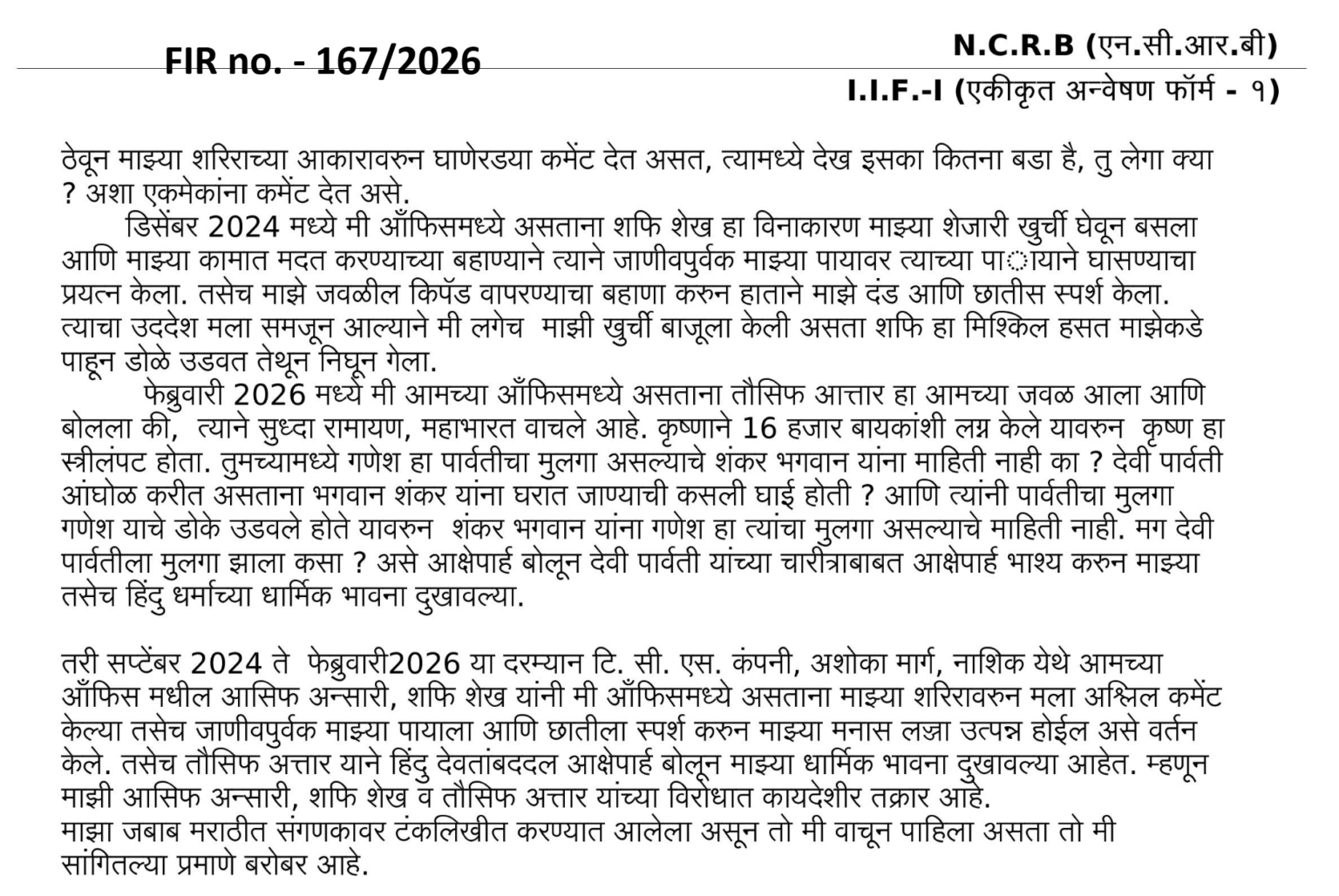
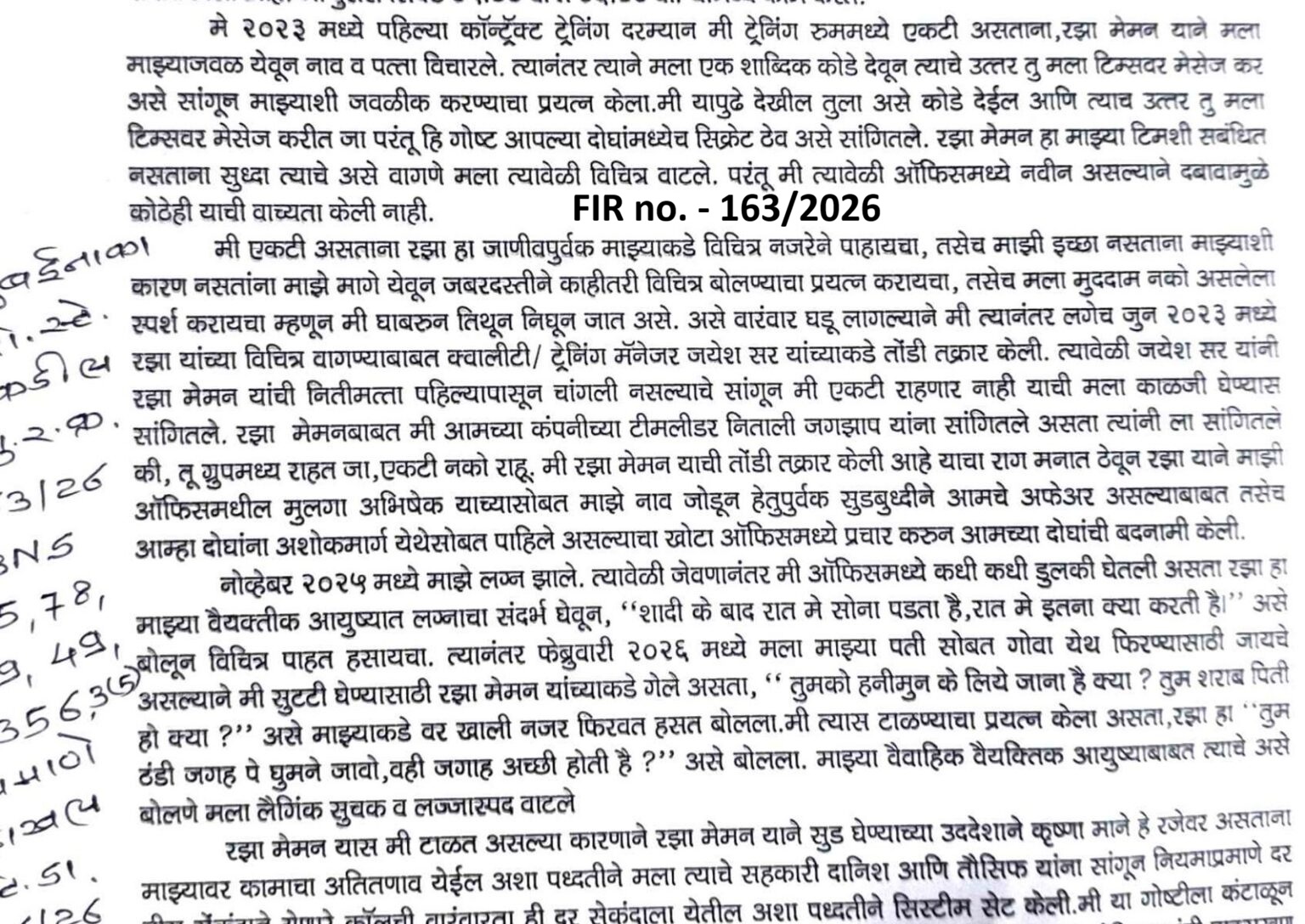
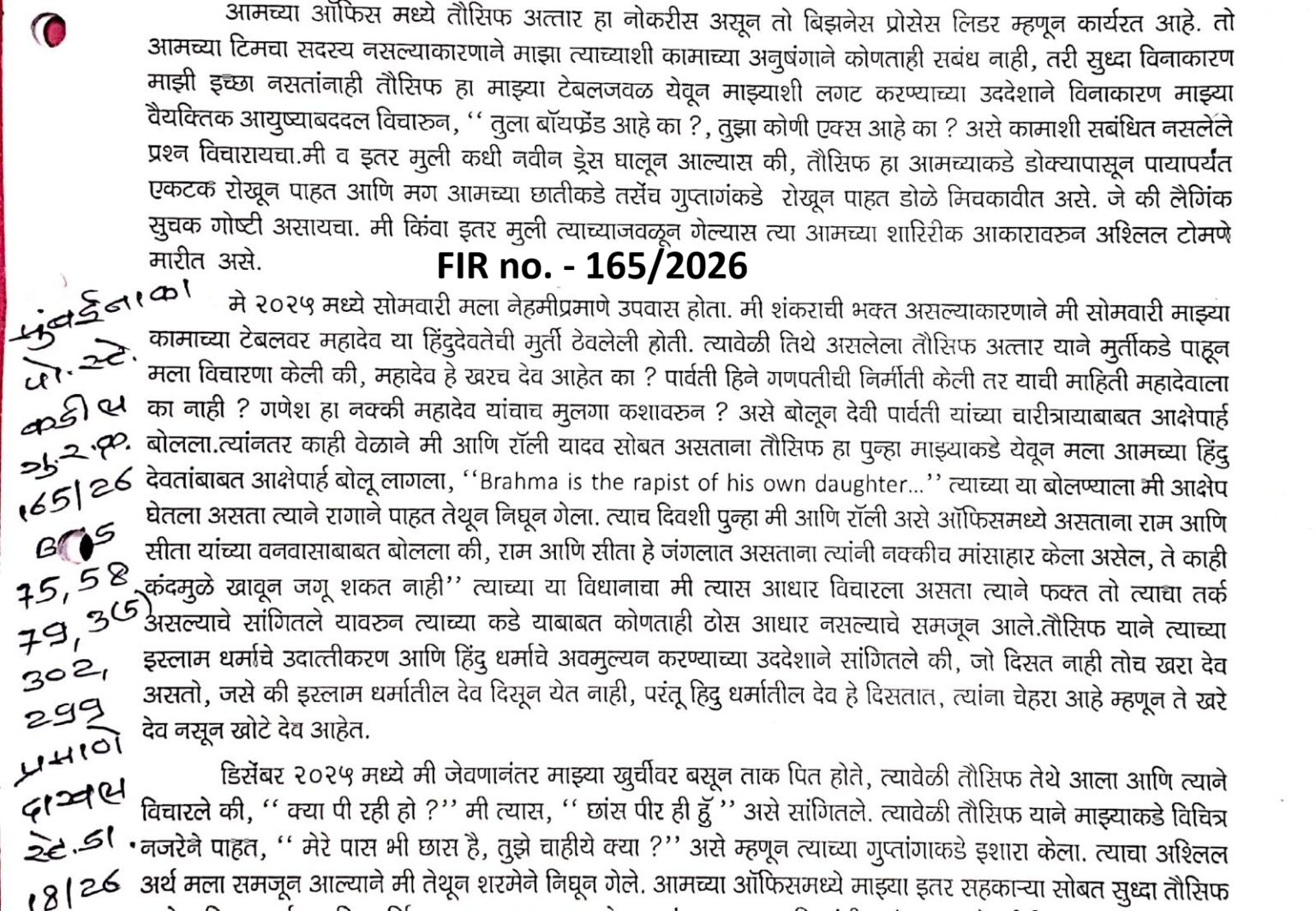
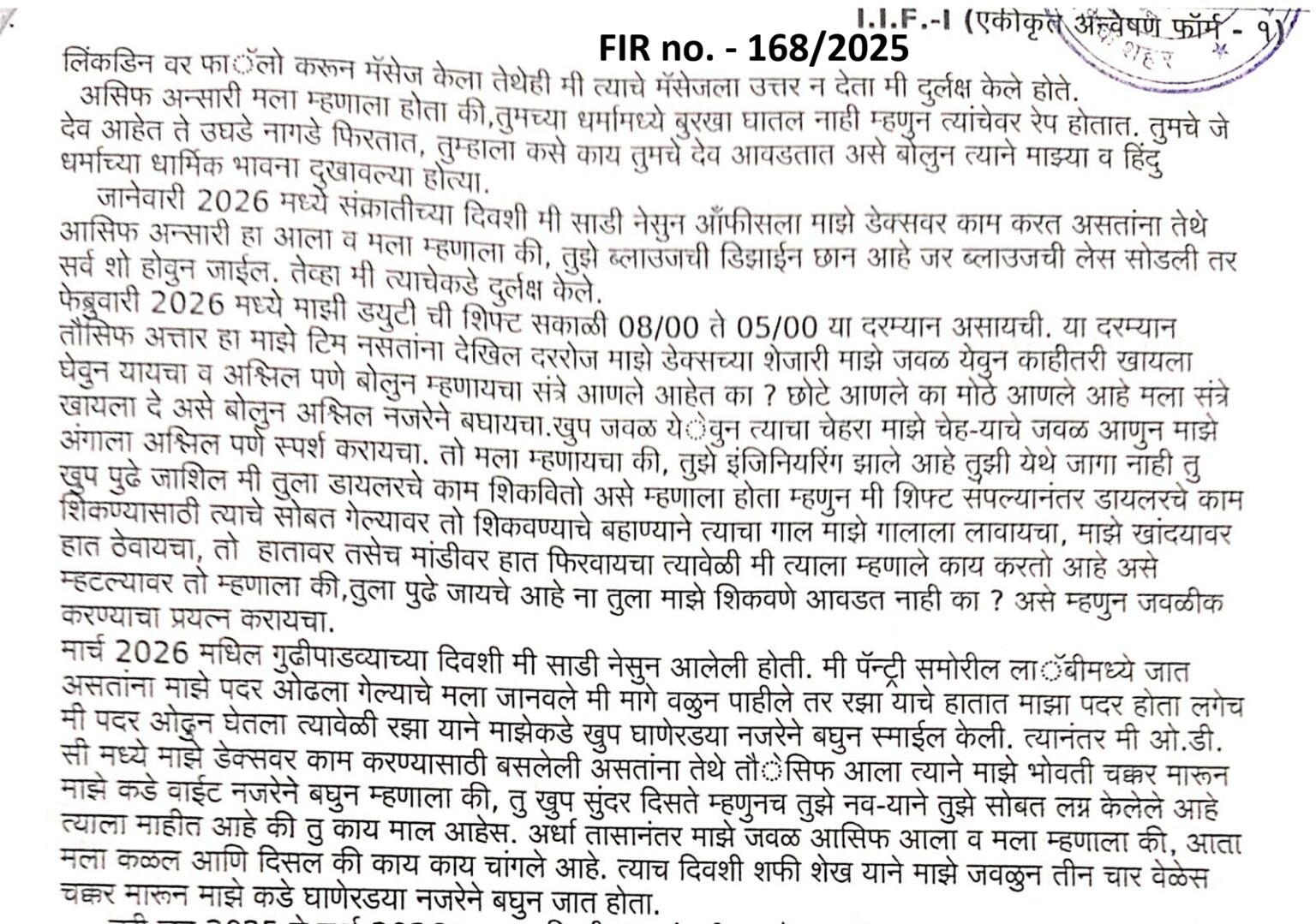
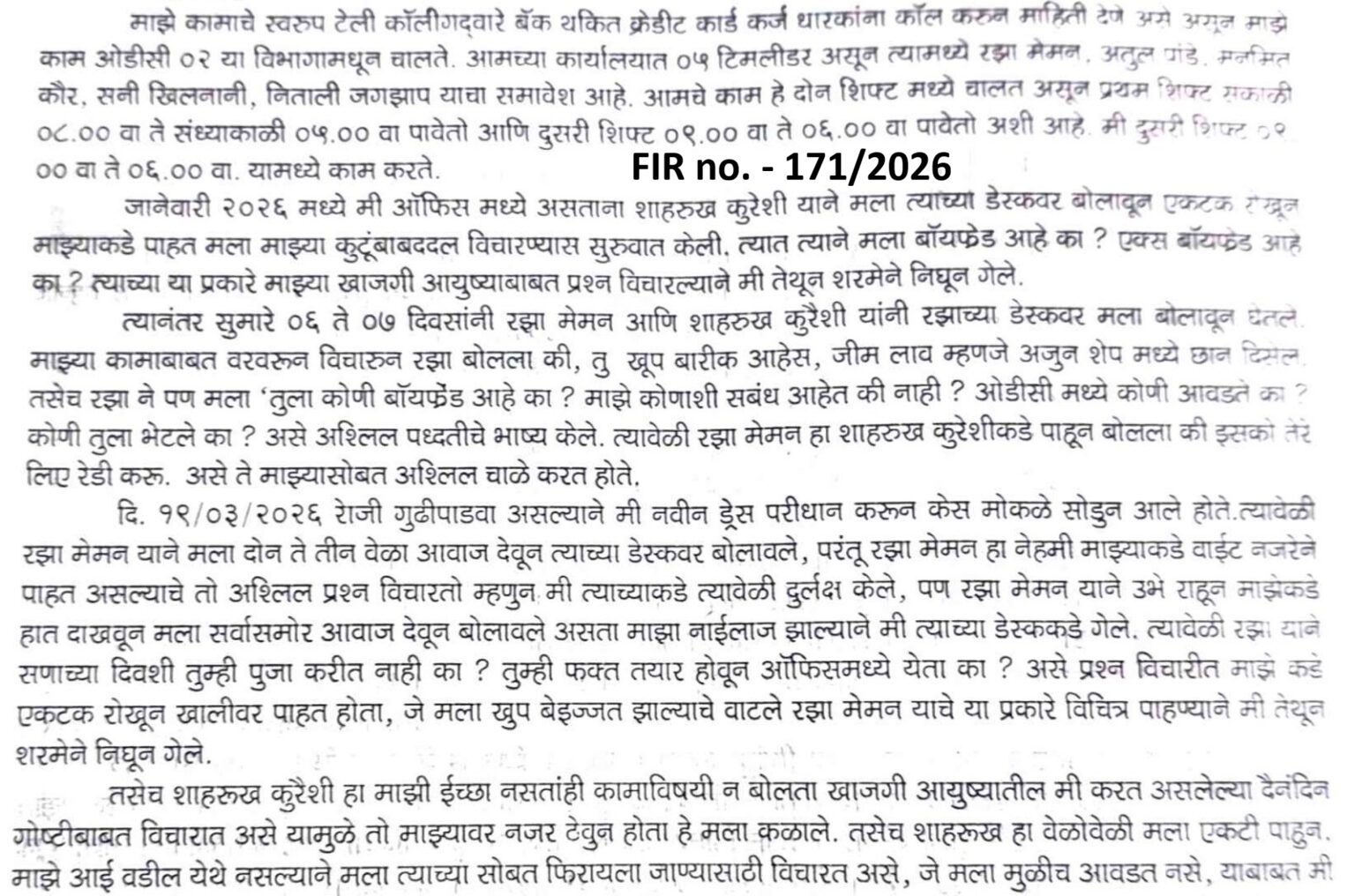
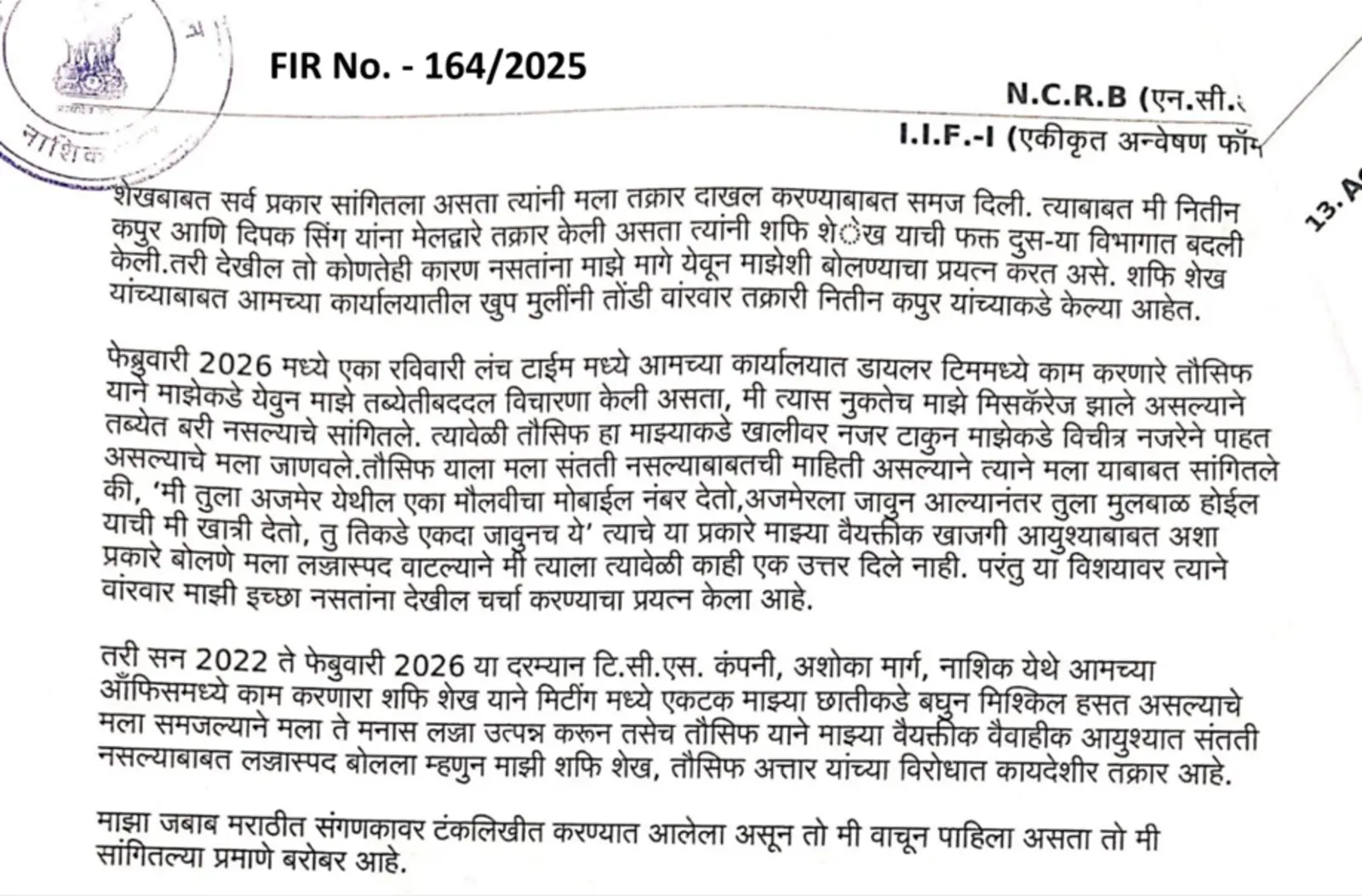
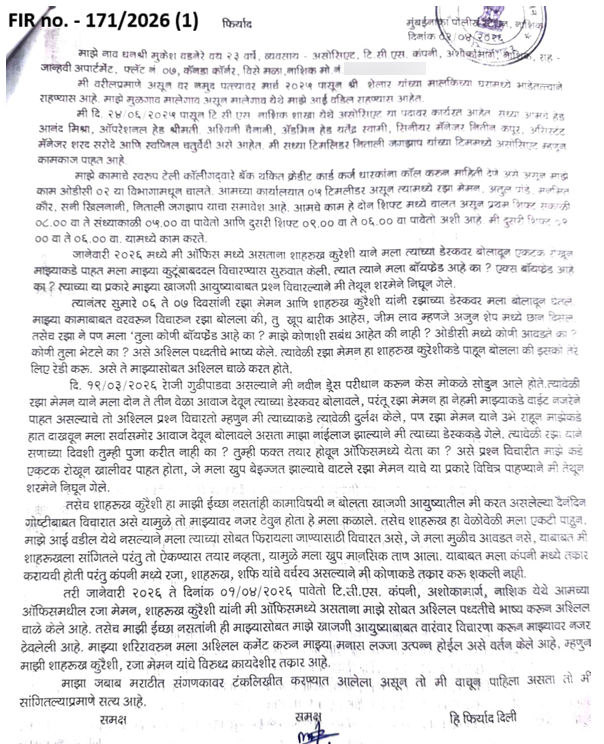
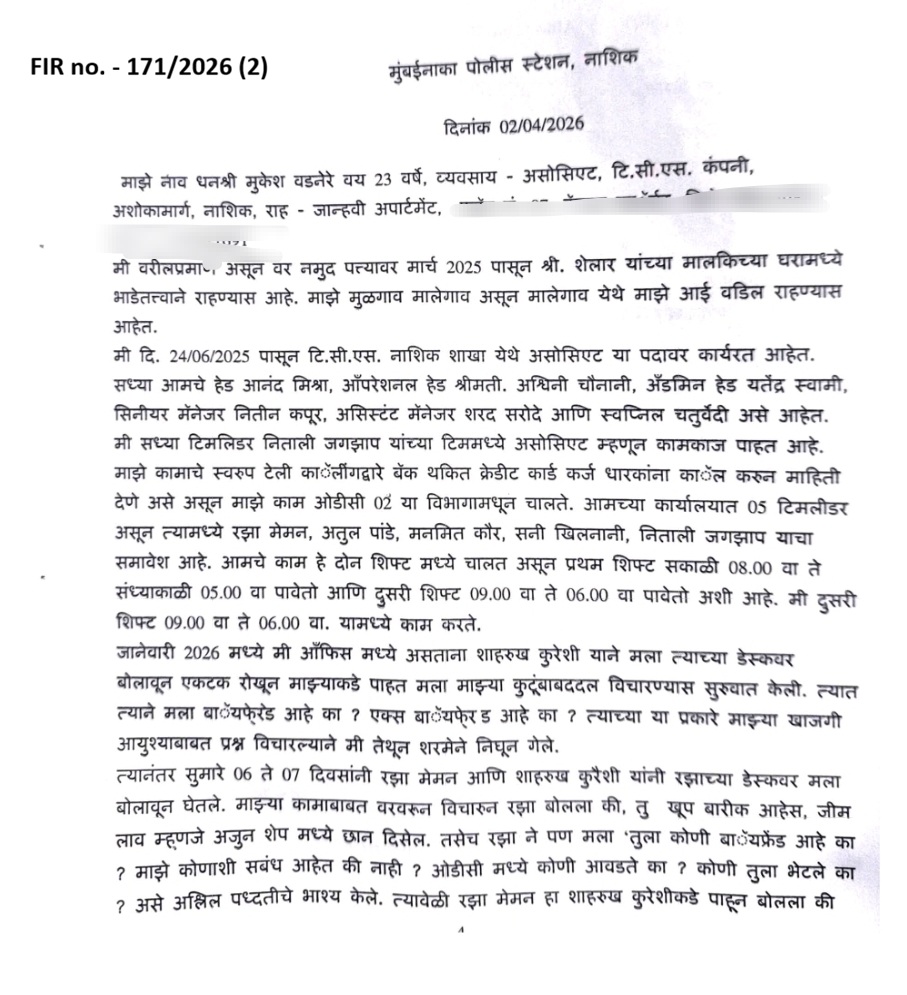
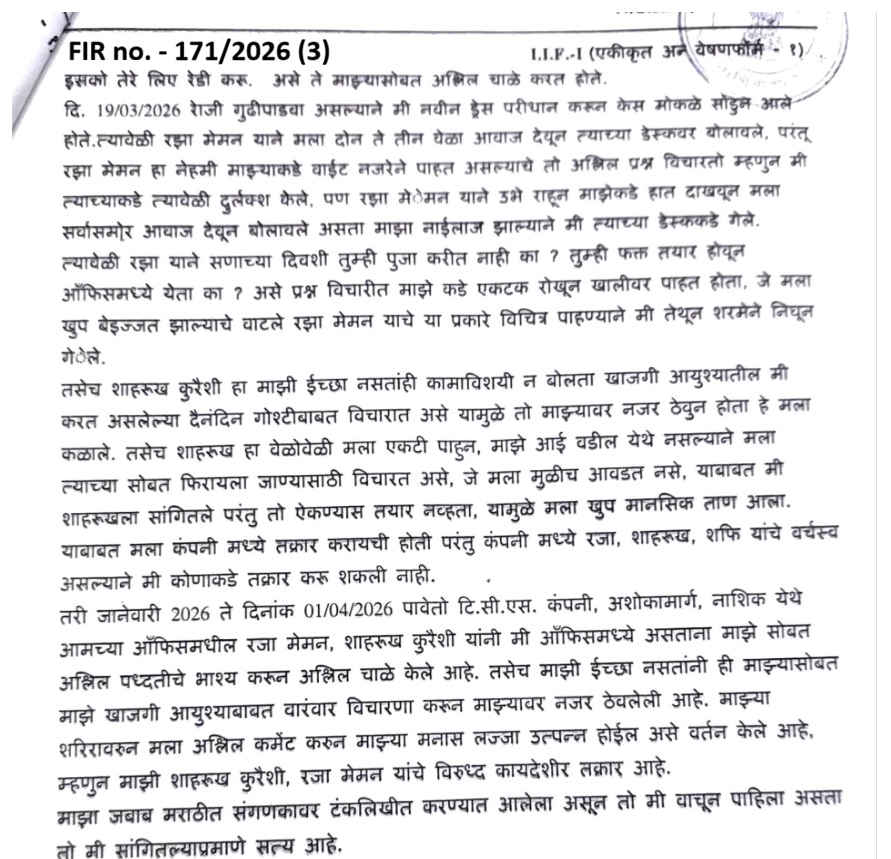
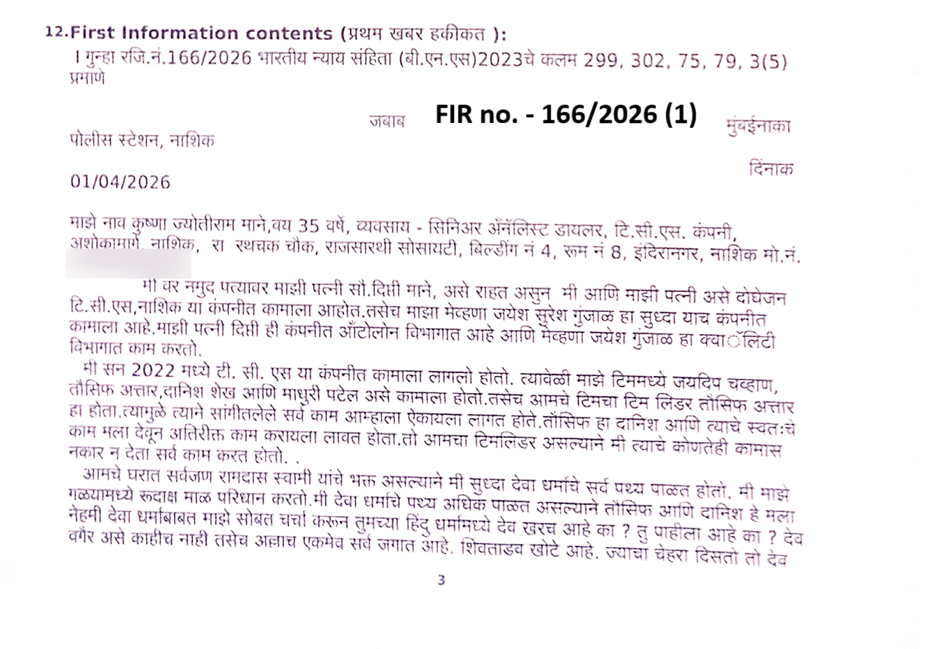
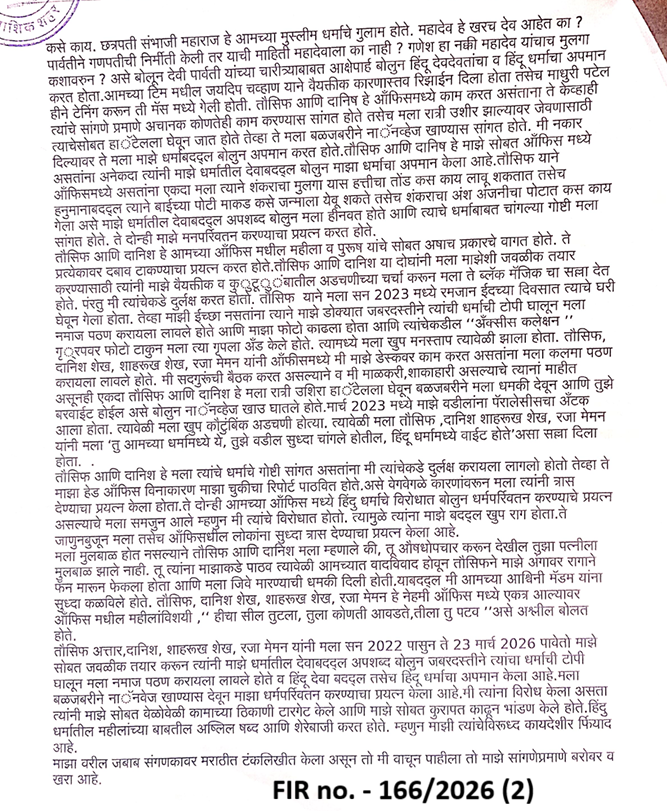
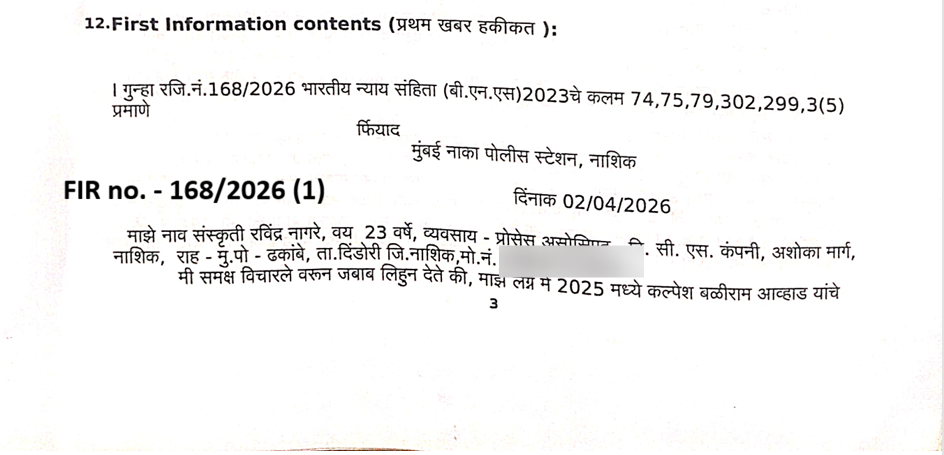
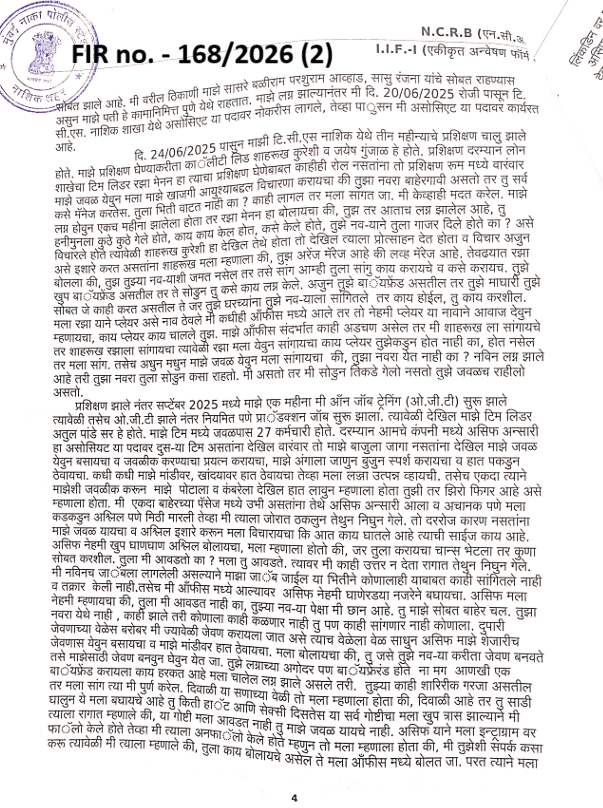
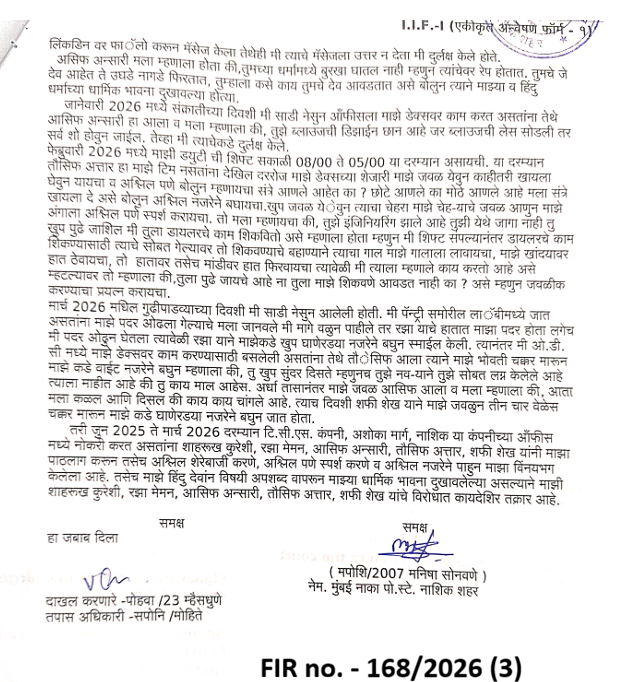
Hindu employees working at Tata Consultancy Services (TCS), a multinational IT company in the Nashik district of Maharashtra, were targeted for religious conversion by a Muslim conversion racket operating within the same company. The victims were coerced, sexually exploited and forced to offer namaz and eat beef in an effort to convert them to Islam. Furthermore, the perpetrators also abused and denigrated Hindu deities. The incidents are alleged to have taken place between February 2022 and March 2026. The case came to light after a female employee working at Tata Consultancy Services approached the police in March 2026, reporting sexual exploitation, religious insult, and coercion for religious conversion under the pretext of marriage and professional support. Following her complaint, multiple Hindu employees, eventually totalling nine victims, including eight women and one male employee, filed separate FIRs across police stations, primarily at Mumbai Naka Police Station and Deolali Camp Police Station, talking about their ordeal. These complaints exposed a pattern of misconduct involving sexual harassment, molestation, intimidation, and religious targeting of Hindu employees by Muslim employees within the workplace. The Muslim accused, identified across multiple FIRs, included Danish Sheikh, Tausif Attar, Raza Memon, Shahrukh Qureshi, Shafi Sheikh, Asif Ansari, Nida Khan, and Ashwini Chainani (HR). Several of the accused held positions of authority, such as team leaders, which enabled them to exert influence and pressure over junior employees. Seven of the accused were arrested by the police, while Nida Khan, who emerged as the key accused, was arrested later from Sambhajinagar, Maharashtra. According to police records, a total of nine FIRs were registered, each detailing specific instances of harassment, sexual exploitation, and religious coercion faced by different victims. FIR No. 156/2026 (Deolali Camp Police Station): The first complaint, filed by a Dalit Hindu female employee, stated that between July 2022 and February 2026, accused Danish Sheikh, Tausif Attar, and Nida Khan established contact with her and gradually subjected her to religious coercion. He subjected her to prolonged sexual exploitation and claimed that he would marry her. The accused made derogatory remarks about Hindu deities, promoted Islam as superior, and attempted to influence her beliefs. The victim further stated that Danish Sheikh developed a relationship with her under the pretext of marriage and engaged in physical relations, while Tausif Attar later used threats and coercion to sexually exploit her. The complaint also included elements of intimidation, blackmail, and repeated sexual abuse within and outside the workplace. FIR No. 163/2026: The complainant stated that Raza Memon and Shahrukh Qureshi subjected her to harassment through persistent staring, inappropriate comments about her marital life, and unwanted advances. Despite repeated complaints to HR, no action was taken. FIR No. 164/2026: The victim stated that Shafi Sheikh had inappropriate behaviour during meetings, including sexually suggestive gestures and staring, while Tausif Attar made derogatory remarks about her religion, her personal life and attempted to coerce her into a physical relationship. She further stated that Tausif Attar subjected her to uncomfortable, lingering stares and repeatedly suggested that she contact a “Maulvi in Ajmer,” claiming that visiting him would “guarantee” childbirth. FIR No. 165/2026: The complainant stated that Tausif Attar asked intrusive and inappropriate questions about her private life, made obscene gestures, and passed derogatory remarks about Hindu deities, while exalting Islam and devaluing Hinduism, thereby hurting her religious sentiments. She stated that the accused made offensive comments about Hindu deities, including Lord Ganesha and Lord Krishna. Tausif Attar claimed that “Krishna had married 16,000 women. He was a womaniser.” The victim has said she was constantly mocked for her Hindu beliefs, with the Muslim accused derisively mocking the existence of Lord Shiva, and casting aspersions on the father of Lord Ganesha, the Elephant-headed Hindu God. “Why couldn’t Shiva wait when Parvati had gone to take a bath? How do you know Ganesha was their son?” the accused had said while mocking Hindu Gods. He mockingly asked ‘Is Mahadev really a god? If Parvati created Ganesha, why doesn’t Mahadev know about it? Why is Ganesha the son of Mahadev?’ He said this, objecting to the character of Goddess Parvati.” The remarks, she stated, did not stop there. “After some time, when Yadav was with me, Tausif came to me again and started accusing me of our Hindu gods, ‘Brahma is the rapist of his own daughter.’” Furthermore, he claimed that Ram and Sita must have eaten meat while in the forest and could not have survived otherwise due to bodily needs. When the victim asked him the basis for this statement, he said it was his own logic. According to her statement, such remarks deeply hurt her religious sentiments and compounded the hostile atmosphere she was already facing at the workplace. FIR No. 166/2026 (Male victim): A Hindu male employee stated that between 2022 and March 2026, accused Tausif Attar, Danish Sheikh, Shahrukh Sheikh, and Raza Memon subjected him to sustained religious harassment. He stated that they mocked Hindu beliefs, made derogatory remarks about Hindu gods, and attempted to influence him to convert to Islam. He further stated that he was forced to offer namaz, made to wear a religious cap, compelled to consume non-vegetarian food against his will, and pressured to recite Islamic religious texts, including Kalma. When he resisted, he faced workplace harassment, threats, and retaliation. FIR No. 167/2026: The victim stated that Asif Ansari and Shafi Sheikh made obscene comments about her body and engaged in inappropriate physical contact. Tausif Attar was also accused of making derogatory remarks about Hindu deities. FIR No. 168/2026: The victim stated that multiple accused, including Asif Ansari, Shahrukh Qureshi, Raza Memon, Tausif Attar, and Shafi Sheikh, acted together to stalk her, make obscene remarks, and touch her inappropriately. They repeatedly questioned her about her honeymoon, sexual life, and past relationships in an intrusive and inappropriate manner, at times accompanied by veiled threats of exposure. She also added that Ansari made derogatory comments about Hindu practices, including statements suggesting that sexual violence occurs in Hindu communities because women do not wear burqas, along with remarks mocking Hindu deities. She said “Asif Ansari told me that because you people don’t wear a burqa in your religion, rapes happen… Your gods roam naked (ugde nagde firtat), how do you even like such gods?” FIR No. 169/2026: The complainant stated that Raza Memon and Shafi Sheikh repeatedly attempted to establish physical relations, made lewd comments about her body, and intruded into her personal life despite objections. FIR No. 171/2026: The victim reported that Raza Memon and Shahrukh Qureshi made obscene remarks, engaged in inappropriate conduct, and physically assaulted her, causing mental distress and humiliation. During one instance, Raza told Qureshi, “Isko tere liye ready kar,” implying an intent to groom her for him. On the occasion of Gudi Padwa on March 19, 2026, she said that Raza publicly called her over, looked her up and down, and made remarks mocking Hindu customs by questioning whether she performed puja or merely dressed up for appearances. Across these FIRs, there was a consistent pattern of sexual harassment, coercion, intimidation, and religious targeting. Victims repeatedly stated that derogatory remarks were made about Hindu deities and beliefs, while efforts were made to influence them towards Islam through psychological pressure, inducements, and coercion. Several complainants also stated that they were pressured to participate in Islamic practices such as offering namaz and consuming non-vegetarian food against their will. Multiple victims revealed that the accused acted in coordination, often targeting vulnerable individuals and using their positions within the company to exert pressure. In several instances, complaints made to the HR department were ignored, allowing the misconduct to continue over an extended period. As of the date of writing this report, a Special Investigation Team (SIT) has been constituted, CCTV footage from multiple locations has been examined, and statements from victims have been recorded. Reports also indicate that undercover female police personnel were deployed to gather evidence from within the company premises. Authorities are continuing to investigate the full extent of the case, including the possibility of additional victims and the role of organisational inaction. The case remained under active investigation, with charges including sexual exploitation, harassment, intimidation, and religious coercion being examined in detail. Meanwhile, TCS in their statement claimed “TCS has a long-standing zero-tolerance policy towards harassment and coercion of any form. We have always ensured the highest standards of safety and well-being of our employees at the workplace.”
Case Images
Why it is Hate Crime ?
This case has been added to the tracker under the primary category Predatory Proselytisation. Within this, the selected subcategory is: Harassment, threats, coercion for conversion. Harassment covers a wide range of behaviours of an offensive nature. It is commonly understood as behaviour that demeans, humiliates, and intimidates a person, including threats and coercion. Harassment and threats, in this case, find their root on discriminatory grounds which has the effect of nullifying a person’s rights or infringing upon his freedom to exercise his right specifically owing to the victim’s religious identity. Verbal and physical threats and psychological or physical harassment are often used against Hindu victims because they choose to practice their professed religion. Religious harassment also includes forced and involuntary conversions by harassment, threats or coercion. Coercion includes intimidatory tactics like force-feeding a Hindu victim beef to convert to another religion, forceful circumcision etc. In several cases documented, non-Hindu perpetrators or those who harbour specific animosity towards Hinduism, harass victims simply based on their religious identity. Such cases often also include harassment to ensure the Hindu victim abandons his/her professed religion and adopts the religion of the perpetrator. The other sub-category selected is - Proselytisation by grooming, brainwashing, manipulation or subtle indoctrination, with the tertiary category being - Rape and sexual assault/harassment and Pattern of targeting Hindus. Religious brainwashing essentially means the often subtle and forcible indoctrination to induce someone to give up their religious beliefs to accept contrasting, regimented ideas. Religious grooming or brainwashing also involves propaganda and manipulation. It involves the systematic effort, driven by religious malice and indoctrination, to persuade “non-believers’ to accept allegiance, command, or doctrine to and of a contrasting faith. Cases of such grooming or brainwashing are far more nuanced than direct threats, coercion, inducement and violence. In such cases, it is often seen that there is repeated, subtle and continual manipulation of the victim to induce disaffection towards their own faith and acceptance of the contrasting faith of the perpetrator. While subtle indoctrination is widely acknowledged as predatory, an element which is often understated in such conversions or the attempts of such conversion is the role of loyalty and trust which might develop between the perpetrator and the victim. Fiduciary relationships are often abused to affect such religious conversion. For example, an educator transmitting religious doctrine of a competing faith to a Hindu student. The Hindu student is likely to accept what the teacher is transmitting owing to existence of the fiduciary relationship. The exploitation of the fiduciary relationship to religiously indoctrinate victims would also be included in this category. Since the underlying animosity towards the victim’s faith forms the basis of predatory proselytization, such cases are considered religiously motivated hate crimes. The other sub-category selected is - Conversion/ attempts to convert by inducement. Predatory Proselytisation is not just limited to threat, harassment, force and violence, but it also has contours of stealth. In several cases, the Hindu victim is exploited to convert, with non-Hindus taking advantage of their poverty. In such cases, the Hindu victim who is suffering financially is offered monetary benefits, including lucrative offers for jobs, health treatment, education, etc, to induce the victim into changing his/her religion. In such cases, the religious identity of the victim and the aim to disenfranchise him from his faith form the heart of the crime. Also, taking advantage of and exploiting an individual’s economic vulnerabilities is widely acknowledged as exploitation, forms of which are often penalised by law. Such cases therefore, are considered religiously motivated hate crimes since the victim’s religious identity forms the very heart of the crime itself. The other sub-category selected - Attempting to convert/converting by denigrating Hinduism. In several cases, Hindus are converted or an attempt is made to convert Hindus by denigrating their faith, Hinduism. In such cases, the Hindus associate with the non-Hindu perpetrators often by choice and then, the attempt to convert them by insulting their faith, showing the faith down etc begins. An example of this would be a non-Hindu gathering where the Hindus are attending the gathering of their own free will. However, once they attend the gathering, there is an explicit attempt to convert them by abusing their faith and hailing the faith of the perpetrator. The denigration of the Hindu faith is often based on misrepresentation of the Hindu faith, its doctrine and scriptures and insult to espoused traditions if not blatant lies about Hindu beliefs and ways. Such conversions or attempts at conversions are driven by animosity towards the Hindu faith and are therefore documented as religiously motivated hate crimes. The second primary category selected is - Crimes against women in relationships and other sexual crimes. Within it, the sub-category selected is - Brainwashed and/or groomed, with the tertiary category being - Rape and sexual assault/harassment. In our database, we have not added incidents where women have converted to another religion of their free will and no allegations of forced/involuntary conversion have been made. However, there are certain cases of conversion where the consent itself is a result of the brainwashing or grooming of a minor by the non-Hindu perpetrator trying to victimise a woman for her Hindu religious identity. The phenomenon of grooming points to non-Hindu perpetrators identifying their Hindu victims’ vulnerabilities and exploiting them over months and sometimes years, to extract the supposed ‘consent’ in order to convert their religion. In most cases of grooming, the victims are minors or the grooming started when the victim was a minor. In other cases of grooming, the non-Hindu perpetrator brainwashes and grooms a minor victim to extract their trust and then proceeds to rape them repeatedly with the intent of converting them to their faith. It is pertinent to understand here that when the victim is a minor, the ‘consent’ to convert or enter into a romantic relationship with an adult itself is redundant – addressed by POCSO. While every case of conversion of a minor and incidents of establishing a physical relationship with a minor by an adult is a crime, for the purpose of this database, a case would be considered a hate crime only if there is a distinct religious angle to the grooming. For example, in the UK, if a Hindu minor is targeted by Pakistani grooming gangs, it would be considered a hate crime because the victims are specifically targeted owing to their non-Muslim religious identity with the perpetrators being Muslim. In other cases, if a Hindu minor is brainwashed into entering a physical relationship with the non-Hindu adult perpetrator and the family alleges grooming/brainwashing of the minor to convert her religion, it would form a part of this database. If the victim is a Hindu adult, the case would form a part of this database only if the victim herself says that she was brainwashed/groomed to convert her religion. However, if the victim is deceased (murdered or otherwise), the case would form a part of this database if her family/friends provided testimony that the victim was brainwashed/groomed to convert her religion. Since these crimes have a distinct religious angle where the victim is being targeted owing to her Hindu religious identity, these cases are considered a hate crime. The other sub-category selected is - Forced conversion before marriage. In such cases, a non-Hindu man is in a relationship with a Hindu woman when the pressure to convert her religion begins to manifest. In such cases, typically, two patterns emerge. First, when the relationship is consensual, and the religious identity of the perpetrator is known to the Hindu woman in the relationship, however, at some point during the relationship, the non-Hindu man starts to force the victim to convert her religion and give up her Hindu religious identity. The second is when the woman gets into a marriage with the man pretending to share her faith. Later, when the truth is revealed, the man starts pressuring the woman to convert her religion and give up her religious identity. In both the situations, the methods used to force the victim to convert her religion often revolve around force-feeding beef, forcing her to wear hijab, forcing her to read the Kalma or even pressurizing the victim to do ‘Nikah’, which is marriage under Islamic law, with a prerequisite being conversion to Islam. Cases where a Hindu woman consensually converts to Islam in a relationship will be left out of the hate crime database, even though it could be argued in several cases that the conversion was a result of religious brainwashing. The third primary category selected here is - Hate speech against Hindus. Within it, the sub-category selected is - Anti-Hindu slurs, mocking faith. Anti-Hindu slurs and the deliberate mocking of the Hindu faith owing to religious animosity involve the usage of derogatory terms, stereotypes, or offensive references to religious practices, symbols, or figures. One of the common anti-Hindu slurs used against Hindus is “cow-worshipper” and “cow piss drinker”. The intention of using this term is to demean and mock Hindus as a group and their religious beliefs since Hindus consider the cow holy. Additionally, some symbols and the slurs attached to them have a historical context that exacerbates the insult, hate, stereotyping, dehumanisation and oppression against Hindus. Cow worship has been used for centuries to denigrate Hindus, insult their faith and oppress Hindus specifically as a religious group. There has been overwhelming documentation about how cow slaughter has been used to persecute Hindus with cow meat being thrown in temples and places of worship. There has also been overwhelming documentation where cow meat (beef) has been force-fed to Hindus to either forcefully convert them to Islam or denigrate their faith. Apart from cow worship, the Swastika – which holds deep religious significance for the Hindus – has also been misinterpreted and distorted to use as a slur against Hindus. Similarly, the worship of the Shivling has been used by supremacist ideologies and religions to denigrate Hindus owing to religious animosity. Such slurs and denigration stem out of inherent animosity and hate towards Hindus and their faith, therefore, it is categorised as hate speech targeted at Hindus specifically owing to their religious identity. This case has been added to the tracker because Hindu employees working at the Tata Consultancy Services were targeted for religious conversion by a Muslim conversion racket operating within the same company. They were coerced, sexually exploited and forced to offer namaz and eat non-veg food in an effort to convert them to Islam. Furthermore, the perpetrators also abused Hindu deities and insulted Hinduism. These actions were not incidental or isolated; they formed part of a systematic strategy to impose religious change on the victims, exploiting workplace hierarchy and authority to create vulnerability. Firstly, in this case, the repeated targeting of Hindu employees, including attempts to impose Islamic beliefs while denigrating Hinduism, indicates that religion was a central factor behind the misconduct. Pressuring Hindu individuals to abandon their religious faith and adopt another constitutes a direct attack on their religious identity and dignity. This was not a matter of personal persuasion or voluntary choice; it was coercion rooted in deliberate hostility towards the victim’s Hindu identity. The act reflects religious animosity because it aims not merely to influence behaviour but to erase the victim’s existing faith and impose a different religious framework. In this context, coercion and harassment function as tools to enforce conformity and subjugate the Hindu identity, making the act a crime motivated primarily by religious bias. Secondly, some of the victims were sexually exploited and harassed. The accused made lewd comments at them, while one of the victims was lured and raped under the pretext of marriage. In several complaints, victims stated that sexual advances, coercion, and physical exploitation were accompanied by religious pressure and manipulation. Often in such cases, sexual violence serves a dual purpose: physical subjugation and religious humiliation. The intention was to break the victims down, emotionally, physically, and spiritually, so that they could be converted. This was not random violence; it was systematic, targeted, and rooted in religious animosity. The combination of sexual coercion, religious imposition, and psychological pressure demonstrates a deliberate strategy to attack the core of the victim’s identity. Thirdly, the perpetrators also forced victims to consume beef, which was not merely a matter of diet but a deliberate step aimed at religious conversion. The act of forcing the Hindu victims to eat beef amounted to profound religious sacrilege against their Hindu identity and a desecration of their faith. In Hinduism, the cow symbolises non-violence (ahimsa), motherhood, earth, and divine sustenance, revered in ancient scriptures like the Vedas and central to rituals, festivals like Gopashtami, and everyday reverence. Consuming beef or even associating with cow slaughter ranks as one of the gravest sins (mahapataka) in Hinduism, historically leading to excommunication, social ostracism, or complete severing from the faith community. Hence, forcibly making Hindu victims eat beef was done specifically to humiliate, strip them of their Hindu faith, sever their ties from the Hindu community, and inflict maximum spiritual trauma, establishing it as a clear case of religiously motivated hate crime. Historically, Muslims have repeatedly used force-feeding beef or throwing it into temples and homes to desecrate Hindu sacred spaces, provoke riots, and obliterate Hindu identity. This case mirrors the same pernicious pattern, weaponising beef as a deliberate tool to annihilate a Hindu person's religious essence and communal bonds. Fourth, a significant aspect of this case is the element of grooming and gradual indoctrination. Victims were not only subjected to overt coercion but were also exposed to repeated religious discussions, ridicule of their beliefs, and encouragement to adopt Islamic practices. They were made to perform Islamic religious practices like offering namaz/kalma and wearing Islamic attire, such as a kurta and cap. This showcased a systematic and gradual effort to immerse the victims in Islam and indoctrinate them with an Islamic lifestyle, deliberately severing their ties to their Hindu religious identity and heritage. By compelling these alien rituals on a Hindu individual day after day, the perpetrators aimed to psychologically and culturally erase their roots, fostering dependence on the new faith while dismantling their sense of belonging to Hinduism, making it a clear case of a religiously motivated hate crime that attacks the essence of Hindu devotional life. Fifth, the accused engaged in the denigration of Hinduism and made derogatory remarks about Hindu gods and goddesses. Such conduct goes beyond the scope of religious debate or proselytisation and constitutes a deliberate act of insult directed at the core beliefs of the Hindu community. The repeated mocking and misrepresentation of Hindu deities, while claiming Islam to be superior, were not incidental but were aimed at undermining the victims’ faith, creating self-doubt, and fostering an environment of humiliation and psychological pressure. Such remarks are designed to demean and undermine the faith of Hindus and intend to create an inferiority complex in the minds of the victims against their own faith. This fosters an environment of hostility and disrespect towards the Hindu community and Hindu deities Importantly, this denigration was not generic but involved specific, targeted statements intended to ridicule sacred figures central to Hindu belief. One complainant stated that the accused made offensive remarks about Lord Krishna, alleging that “Krishna had married 16,000 women” and portraying him as immoral. Similarly, the accused mocked Lord Shiva and questioned the legitimacy of Lord Ganesha’s origin, making statements such as “Why couldn’t Shiva wait?” and casting aspersions on divine narratives deeply revered in Hindu tradition. These statements were not expressions of theological disagreement but deliberate distortions aimed at insulting sacred figures and eroding the victims’ faith. Such remarks strike at the heart of Hindu religious identity, where deities are deeply venerated as embodiments of the divine and integral to personal faith, cultural traditions, and daily worship. By repeatedly mocking these figures in a coercive environment already marked by harassment and pressure to convert, the accused reinforced a pattern of psychological intimidation and religious humiliation. This combination of verbal denigration and coercive conduct demonstrates that the abuse was not isolated speech but formed part of a broader, sustained attempt to degrade the victims’ faith and assert religious dominance, thereby strengthening the classification of this case as a religiously motivated hate crime. Sixth, the coordinated nature of these acts, ranging from harassment and sexual misconduct to religious coercion, against Hindu individuals demonstrates that the behaviour was not incidental, but was rooted in religious animosity. Multiple complainants have described similar experiences involving overlapping sets of accused individuals, indicating a pattern targeting Hindus because of their religious identity. The use of workplace authority, peer pressure, and sustained targeting points to a structured environment where victims found it difficult to resist or report the abuse. The coordinated nature of these actions. using workplace authority, peer pressure, and organised targeting, reflects profound religious malice and animus against Hindu employees. The perpetrators exploited their professional positions to enforce compliance and propagate religious conversion, indicating that the primary motivation was not personal grievance but doctrinal hostility. The systematic attempt to erode the religious foundation of individuals and replace it with allegiance to another faith meets the threshold of a hate crime, as the acts were clearly motivated by animosity toward the victims’ religion rather than personal conflict or random misconduct. Such actions stem from inherent hostility towards the victim's professed faith since Abrahamic faiths believe that any non-adherent to the faith is subject to being dehumanised till they convert. Such acts were not merely personal crimes; they were rooted in a desire to dominate and erase the religious identity of the victim. Since such predatory actions stem from doctrinal animosity towards the Hindu faith and its adherents, this case is being documented as a religiously motivated hate crime. Disclaimer: It is important to clarify that none of the media sources covering this case specify the exact date when the victims’ ordeal began. However, multiple reports and FIR details indicate that the incidents occurred over a period spanning from around 2022 to early 2026. Therefore, for documentation purposes, an indicative date. 8 April 2022, has been used to represent the beginning of the victims’ suffering. While media coverage of the incident emerged in 8 April 2026, the Hinduphobia Tracker records the case based on when the victims’ ordeal began, rather than when it was reported.
Victim Details
Total Victim
9
Deceased
0
Gender
- Male 1
- Female 8
- Third Gender 0
- Unknown 0
Caste
- SC/ST 1
- OBC 0
- General 0
- Unknown 8
Age Group
- Minor 0
- Adult 9
- Senior Citizen 0
- Unknown 0


Case Status
Case sub-judice


Perpetrators Details
Perpetrators
Muslim Extremists
Perpetrators Range
From 5 to 10
Perpetrators Gender
both
 Sources




