Hindu employees’ ordeal in TCS Nashik scandal whitewashed; sexual harassment and religious persecution of Hindu brushed aside, Muslim perpetrators shielded
 Maharashtra, India
  11 April, 2026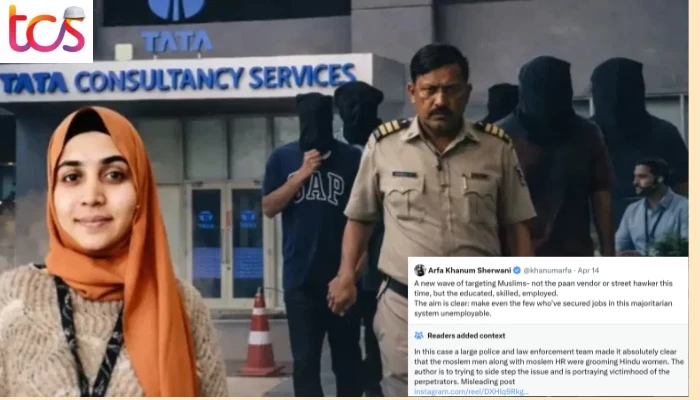
Case Summary
After the TCS Nasik scandal gained public attention, a section of the media, comprising mostly Muslim journalists, started publicly defending the Muslim perpetrators in the case. In doing so, they downplayed or completely dismissed the allegations of sexual harassment and religious targeting raised by the Hindu women complainants. Rather than centring the victims’ testimonies, they shifted the narrative to shield the accused and cast doubt on the victims’ accounts. On April 8, 2026, reports emerged that several Hindu employees working at Tata Consultancy Services (TCS), a multinational IT company in the Nashik district of Maharashtra, were targeted by a Muslim conversion racket operating within the same company. Complaints of sexual harassment and religious targeting surfaced. Multiple FIRs were registered at Mumbai Naka Police Station and Deolali Camp Police Station based on complaints made by Hindu women employees working in the same unit. Media reports stated that several Muslim employees, including team leaders and HR personnel, had been named in the complaints. The conversion and sexual harassment racket at the TCS BPO in Nashik, Maharashtra, had disturbed the nation and raised concerns about similar potential conspiracies operating in the country, targeting unsuspecting Hindu women and men. Danish Sheikh, Tausif Attar, Raza Memon, Shahrukh Qureshi, Asif Ansari, Shafi Sheikh, and Ashwini Chanani were arrested after nine FIRs were filed in the case. However, Nida Khan, who emerged as the key accused, remained at large when the incident was documented by the Hinduphobia Tracker. Troubling details about the case continued to surface each day, emphasising the extent to which the accused were active within the company in preying on their targets. Nevertheless, as the accused were Muslims, several Muslim and leftist voices emerged publicly to defend their co-religionists and ideological allies, as had been seen in similar incidents in the past. Following the emergence of the Nashik TCS case involving multiple FIRs relating to sexual harassment, workplace misconduct, and allegations of religious targeting of Hindu women employees, a section of media commentators and public personalities began reshaping the discourse around the incident. Instead of focusing on the complaints and the ongoing police investigation, the narrative in certain quarters shifted towards defending the accused and questioning the public reaction. Among the prominent responses, journalist Arfa Khanum Sherwani posted on social media: “A new wave of targeting Muslims, not the paan vendor or street hawker this time, but the educated, skilled, employed. The aim is clear: make even the few who’ve secured jobs in this majoritarian system unemployable.” This statement framed the issue primarily through the lens of the accused's religious identity rather than the allegations made by the complainants. Singer Chinmayi Sripaada also commented publicly on the matter, questioning the framing and raising concerns about the communalisation of the case, with her posts cited in discussions of the media response to the incident. The broader discourse by several public figures centred on the victimisation of the accused employees, rather than the substance of the FIRs and the complaints made by the Hindu women employees. Muslim journalist Faye D’Souza’s framing centred on obscuring the identities of the accused and minimising discussion of the Muslim employee's religious conversion tactics. Journalist and advocate Nasreen Khan crafted a narrative presented as rumours circulating among TCS employees, with the effect of not only glorifying the accused but also claiming a conspiracy against the Muslim men. She wrote: “Some Muslims at TCS had achieved great success through their hard work. These handsome boys who were growing in the company had friendly relations with their junior Hindu female colleagues. This did not sit well with some Hindus in the company, who were jealous of their progress.” She further wrote that the company's environment had been commendable and that Ramzan had been respected under the Muslim Human Resources manager, but this had agitated certain Hindu male staff members. According to the report, she alleged that they had contacted the Bajrang Dal and the Vishva Hindu Parishad in the name of love jihad and attacked the manager, following which the accused were arrested. Faheem Khan, who claimed to have worked in the field of Information Technology for five years, remarked: “Muslim men in IT are among the most disciplined, hardworking, and resilient professionals. They stay calm under pressure and consistently deliver at a high level.” He further stated that they only asked for time and space to perform namaz and even remained late to ensure that work was completed if the schedule was tight. Irena Akbar, a former journalist, sought to represent the incident as one in which Muslims were being unfairly singled out for their education and employment. She also criticised the female police personnel who had gone undercover at the firm during the investigation, stating that their attention should have been on maintaining law and order rather than listening to private office conversations. Besides the above-mentioned journalists and media persons, several left-leaning outlets either gave limited coverage to the matter or framed it primarily as a communal controversy, thereby shifting the focus away from the Hindu victims and their workplace harassment and religious persecution. The core of this incident, therefore, concerned the downplaying and whitewashing of the Nashik TCS matter by sections of the media and public commentators.
Why it is Hate Crime ?
This case has been added to the tracker under the primary category of - Hate speech against Hindus. The sub-category selected here is- Anti-Hindu subversion and prejudice. The tertiary category selected under it is: Anti-Hindu Fake news or Downplaying. Hate speech is defined as any speech, gesture, conduct, writing, or display that is prejudicial against a specific individual and/or group of people, which leads to or may lead to violence, prejudicial action or hate against that individual and/or group. Media plays a specific and overarching role in perpetuating prejudicial attitudes towards a community owing to unfair, untrue coverage and/or misrepresentation/misinterpretation, selective coverage and/or omission of facts of/about issues affecting a specific religious group. This type of bias can dehumanise the victim group, making it easier for others to justify harmful actions against them, which aligns with the objectives of hate speech laws aimed at preventing such harm. It is often observed that the media takes a prejudicial stand against the Hindu community, driven by their need to shield the aggressor community, which happens to be a numeric minority; however, that is the one perpetrating violence against Hindus. For example, the media is often quick to contextualise religiously motivated crimes against Hindus, omit or misrepresent facts that point towards religiously motivated hate crimes, justify and/or downplay religiously motivated hate crimes, or present fake news to stereotype Hindus. Such media bias leads to the denial of persecution and is often used to dehumanise Hindus, leading to justification for violence against them. For example, the media covered several fake allegations of Hindus targeting Muslims and forcing them to chant Jai Shree Ram. Most of these cases were proved false and fabricated after police investigation. These fake news reports were subsequently never retracted or clarified. Such fake news led to the justification of violence and dehumanisation of Hindus based on the argument that since Hindus targeted Muslims and forced them to chant Jai Shree Ram, the dehumanisation of Hindus and violence against them was par for the course and merely a retaliation. Such media bias leads to prejudicial portrayals of Hindus and offers a justification for violence against them and, therefore, is considered hate speech under this category. This case qualified for inclusion because the public response went beyond fair commentary. A section of Muslim journalists, self-styled commentators, and left-leaning voices did not focus on the seriousness of the complaints made by the Hindu women employees. Instead, they quickly shifted attention to the religious identity of the accused Muslim employees. The focus moved away from the serious charges of sexual harassment and forced religious conversions. Rather, it was redirected towards an unestablished and unverified claim that the accused were being targeted because they were Muslim. This changed the nature of the public discussion. The issue was no longer the complaint of harassment and coercive religious pressure. It became a debate about communal victimhood. This was especially concerning because the police had already registered multiple FIRs. Arrests had also been made. An investigation was already underway. At that stage, the fair approach would have been to let the investigation proceed. Instead, several voices described the case as a conspiracy, a communal fabrication, or a manufactured outrage. This was done in order to weaken the gravity of charges and to push a self-styled narrative. The most troubling aspect was the reversal of victimhood. The Hindu women who had come forward with complaints were gradually pushed into the background. Their suffering stopped being the centre of the discussion. Instead, the accused were presented as the real victims. This was done solely based on their minority identity. Such framing erased the experience of the Hindu complainants. This also reflected a familiar pattern. Rather than addressing the substance of the case, commentators shifted the discussion towards unrelated incidents and wider claims of communal bias. This did not help in finding the truth. It simply diverted attention from the immediate allegations and reduced scrutiny of the accused. In the present case, the conversation moved away from why coercive conversion attempts, harassment, or sexual misconduct had taken place. Instead, it turned towards claims that similar things had happened elsewhere and in different religions too. Further, they also attempted to shield the Muslims by stating that the case was part of a larger anti-Muslim narrative. These comparisons did not answer grave charges. They only weakened the legitimacy of the grievances raised by the Hindu victims. The role of media figures becomes especially important. Such voices shape public understanding. When they omit facts, shift the focus from the complainants, and foreground ideology over evidence, they contribute to a climate in which Hindu victims are easier to dismiss. This creates a wider atmosphere where harm faced by Hindus could be easily minimised. Here, it is important to note that the religious marker lay in the fact that the defence was not built on evidence, facts, or the merits of the charges, but on the religious identity of the accused. The accused were shielded because they were Muslim, while the Hindu complainants were immediately doubted, discredited, or blamed. The response was driven by community identity rather than objective scrutiny. By treating the grave charges against Muslim perpetrators as an attack on the wider Muslim community, and on the other hand by simultaneously undermining the credibility of Hindu victims, this discourse acquired a clear religious character. It was this identity-based defence and selective distrust of Hindu complainants that gave the incident its distinct religious marker. In such cases, hardline ideological voices shield the accused because they view the charges not as a complaint against the Muslim perpetrators, but as a challenge to the image of the Muslim religion and the moral standing of their Muslim community. Once the issue is viewed through this lens, the priority shifts from truth and accountability to protecting collective honour and preserving the perception that members of their side could do no wrong. This is why the focus was quickly moved away from the conduct of the accused and towards discrediting the Hindu complainants. By turning the victim into the supposed wrongdoer and presenting the accused as inherently righteous, they seek to preserve a sense of moral superiority and communal solidarity. This pattern helped explain why the perpetrators are repeatedly shielded rather than subjected to the same scrutiny the victims face. Moreover, this was also not the first time that such voices had emerged to shield Muslim accused persons by floating alternative narratives. A similar pattern had been seen in Tarun’s murder case, a cold-blooded murder of a Hindu neighbour because his niece had sprinkled water mistakenly on a Muslim lady, for which the family had apologised multiple times. In this case, to downplay the incident, multiple narratives were circulated almost immediately to deflect attention from the core issue. Some claimed that Tarun was a stalker, while others claimed that he had teased a Muslim girl. These shifting explanations appeared before the facts had been properly established, creating confusion about what had actually happened to the victim. Denial of religiously motivated persecution serves to re-victimise the victims of the crime and also facilitates the further victimisation of the victim group by providing a shield to the perpetrators of the hate crime. The denial or distortion of such religious persecution is often done to fuel further hatred, dehumanisation, or violence against the group that was targeted in the hate crime. Since the motivations of the denial of religiously motivated persecution also fuel further hate crimes against the victim group, this speech is classified as hate speech. Disclaimer: The Hinduphobia Tracker records incident dates based on when the anti-Hindu act, narrative, or campaign first came into public circulation. In this case, 12 April 2026 has been recorded as the indicative incident date, as this was the date on which the first social media post defending the TCS perpetrators was published. Disclaimer on Number of Perpetrators: This entry records individuals who publicly engaged in narrative framing that downplayed or questioned the allegations raised by Hindu victims in the case. While several such instances have been identified and documented, the number of perpetrators has been limited to 6, those whose statements are clearly evidenced and verifiable at the time of recording. Given the wider public discourse surrounding the incident, additional individuals who engaged in similar conduct may not have been captured in this entry and may be included as further evidence emerges.


Case Status
Unknown


Perpetrators Details
Perpetrators
Muslim Extremists
Perpetrators Range
From 5 to 10
Perpetrators Gender
both
 Sources




