Hindu youth’s murder trivialised: media influencers paints mob lynching as personal dispute, falsely brands victim a molester
 Delhi, Delhi, India
  7 March, 2026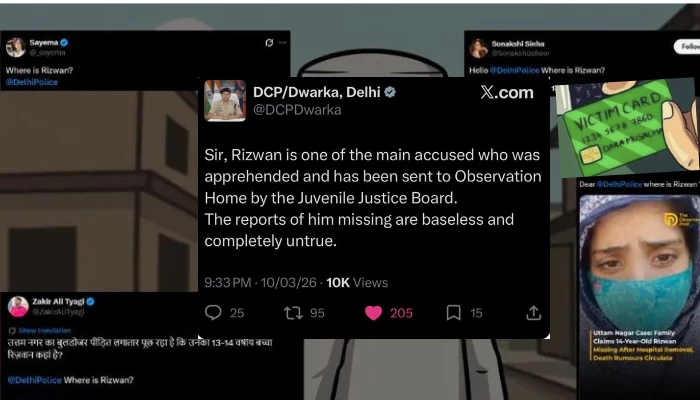
Case Summary
On 4 March 2026, Tarun Kumar, a 26-year-old Hindu youth, was brutally beaten to death in Delhi’s Uttam Nagar by a Muslim mob. The dispute began after a Holi water balloon thrown by the victim’s 11-year-old niece accidentally struck a Muslim woman. In the aftermath of the killing, several media reports and left-leaning commentators attempted to shield the accused Muslims, dilute the communal dimension of the crime and portray the murder as the result of a personal dispute. Some commentators even attempted to brand the victim himself as a molester. The murder of a Hindu youth during Holi celebrations in the Uttam Nagar area was followed by a wave of commentary from media figures and left-leaning commentators. Instead of focusing on the mob assault that resulted in Tarun Kumar’s death, several commentators framed the incident as the outcome of an old neighbourhood feud, “brittle social relations,” or alleged misconduct by the victim. Four days after the murder, a video circulated online in which a Muslim woman claimed that the dispute had begun when a “20-year-old named Prince had thrown dirty water balloons” and that “drunk men had misbehaved.” The video was amplified by All India Majlis-e-Ittehadul Muslimeen member Dr Shoaib Jamai, who declared that the woman’s account represented the “absolute truth.” Jamai further dragged the Rashtriya Swayamsevak Sangh (RSS) into the matter, claiming that it was attempting to vitiate the atmosphere. In this narrative, the Muslim woman was projected as the “victim” while the violence that followed was described as “self-defence.” Following the incident, actor Swara Bhaskar commented on social media and argued that the killing should not be framed through a communal lens. She described the episode as a reflection of “brittle social relations,” suggesting that attempts to view the incident as communal were misplaced. Her remarks were widely circulated and became part of the broader debate surrounding the murder. At the same time, another social media account falsely declared the deceased Tarun Kumar to be a molester who had forcibly played Holi with a Muslim woman. The account wrote, “Out of anger, both families had fought with each other. Both sides got injured. The main molester passed away. That Hindu family burned the house of the Muslim family. Is this justice?” This claim attempted to portray the victim himself as the perpetrator. However, this baseless allegation was subsequently debunked by Community Notes attached to the post. The clarification stated, “There is no evidence that Tarun molested anyone. He was not even in the area and was returning to his home when he found out Muslims were attacking his family.” Meanwhile, a parallel narrative began circulating on social media regarding a boy named Rizwan, who was mentioned in claims connected to the incident. The question “Where is Rizwan?” began trending across platforms as users attempted to construct a separate narrative around the Holi violence. The question was amplified by several commentators online, including RJ Saima and actor Sonakshi Sinha, who raised queries about the circumstances surrounding the Holi violence and the role attributed to the boy in circulating claims about the incident. However, this narrative quickly collapsed after the Deputy Commissioner of Police of Dwarka district responded publicly. The officer clarified that Rizwan, who was being portrayed online as “missing,” was in fact one of the main accused in the case. He had been arrested and sent to an observation home on the orders of the Juvenile Justice Board. This confirmed that the claims about his disappearance were false and misleading. Soon after the police disclosed this information, the same set of commentators began raising a new line of questioning, asking why the arrest of a 14-year-old boy had been necessary. Hindu social media users reacted with anger, condemning both the murder of the Hindu youth and the attempts to justify or obscure it. The hashtag questioning Rizwan’s role gained traction online, reflecting frustration with what many users described as selective silence and biased framing of the incident.
Why it is Hate Crime ?
The primary category selected in the case is: Hate speech against Hindus. The sub- category selected is: Anti-Hindu subversion and prejudice. The tertiary category selected is: Anti- Hindu Fake news or Downplaying. Hate speech is defined as any speech, gesture, conduct, writing, or display that is prejudicial against a specific individual and/or group of people, which leads to or may lead to violence, prejudicial action or hate against that individual and/or group. Media plays a specific and overarching role in perpetuating prejudicial attitudes towards a community owing to unfair, untrue coverage and/or misrepresentation/misinterpretation, selective coverage and/or omission of facts of/about issues affecting a specific religious group. This type of bias can dehumanise the victim group, making it easier for others to justify harmful actions against them, which aligns with the objectives of hate speech laws aimed at preventing such harm. It is often observed that the media takes a prejudicial stand against the Hindu community, driven by their need to shield the aggressor community, which happens to be a numeric minority; however, that is the one perpetrating violence against Hindus. For example, the media is often quick to contextualise religiously motivated crimes against Hindus, omit or misrepresent facts that point towards religiously motivated hate crimes, justify and/or downplay religiously motivated hate crimes, or simply present fake news to stereotype Hindus. Such media bias leads to the denial of persecution and is often used to dehumanise Hindus, leading to justification for violence against them. For example, the media covered several fake allegations of Hindus targeting Muslims and forcing them to chant Jai Shree Ram. Most of these cases were proved false and fabricated after police investigation. These fake news reports were subsequently never retracted or clarified. Such fake news led to the justification of violence and dehumanisation of Hindus based on the argument that since Hindus targeted Muslims and forced them to chant Jai Shree Ram, the dehumanisation of Hindus and violence against them was par for the course and merely a retaliation. Such media bias leads to prejudicial portrayals of Hindus and offers a justification for violence against them and, therefore, is considered hate speech under this category. This case was included in the Hinduphobia Tracker because the discourse that followed the killing was marked by a deliberate attempt to distort facts, minimise the communal dimension of the crime, and deny recognition of Hindu victimhood. Instead of acknowledging the gravity of the violence directed at a Hindu individual during a religious festival, several prominent voices shifted the discussion toward narratives of “old enmity,” “brittle social relations,” and neighbourhood disputes. By framing the episode through these explanations, the focus moved away from the act of violence itself and towards a portrayal of the incident as a routine social conflict. Such framing reflects a prejudicial pattern in which violence against Hindus is routinely contextualised or diluted through selective interpretation. Hate speech does not manifest only through direct insults or threats; it also emerges through the misrepresentation of events, omission of crucial context, and the propagation of narratives that delegitimise the grievances of a targeted community. When influential commentators use their platforms to present violence against Hindus as the outcome of vague social friction rather than acknowledging the hostility involved, it contributes to an environment where the suffering of the community is trivialised. The discourse surrounding the case also involved the circulation of claims that maligned the victim and attempted to reverse the roles of victim and perpetrator. Such accusations were presented without evidence and were later contradicted by factual clarifications. Nevertheless, the circulation of these narratives served to invert the roles of victim and perpetrator, portraying the Hindu victim as the instigator and the attackers as reacting to provocation. This form of narrative manipulation functions as anti-Hindu subversion because it delegitimises the grievances of the Hindu community and provides moral cover for violence against them. Another layer of distortion emerged through the viral circulation of a video in which a Muslim woman was projected as the primary victim of the episode while the mob violence that followed was framed as “self-defence.” The video was amplified by political commentators who asserted that her account represented the “absolute truth” and simultaneously attempted to shift blame onto unrelated organisations. By elevating an unverified narrative while dismissing the facts of the murder, the discourse contributed to the spread of misleading information that redirected public attention away from the killing itself. The pattern displayed in the aftermath of the incident reflects a broader ecosystem in which Hindu victims are frequently denied recognition and their grievances are reframed as illegitimate. Commentators sympathetic to Islamist or leftist positions often rationalise violence against Hindus by invoking social tensions, economic hardship, or long-standing neighbourhood disputes. By attributing acts of violence to abstract social causes, the responsibility of perpetrators is obscured, and the targeting of Hindus is presented as an unfortunate but understandable outcome of local friction. Such narrative strategies contribute to the normalisation of hostility against Hindus. When violence directed at the community is repeatedly contextualised, minimised, or justified through misleading explanations, it shapes public attitudes and reduces the likelihood that such crimes will be recognised for what they are. This process dehumanises the victim group by suggesting that their suffering is exaggerated, misplaced, or undeserving of attention. The parallel campaign surrounding the question “Where is Rizwan?” further demonstrated how misinformation was used to reshape the narrative. The claim suggested that a Muslim boy connected to the incident had disappeared and was being wrongfully implicated, thereby redirecting attention away from the violence itself. However, this narrative collapsed after the Deputy Commissioner of Police clarified that Rizwan had not gone missing at all. He had been identified as one of the main accused, arrested, and sent to an observation home on the orders of the Juvenile Justice Board. As soon as this claim of disappearance was exposed as false, the same voices that had amplified the question quickly shifted the focus to a new line of argument, asking whether the arrest of a 14-year-old boy was justified. This shift again attempted to redirect the conversation away from the crime and towards questioning the police action. Under the Bharatiya Nyaya Sanhita, the police are authorised to arrest any accused person above the age of seven if there is material indicating involvement in a crime. While children are dealt with under a separate legal framework through the Juvenile Justice system, the law does not automatically treat minors as incapable of committing offences. Instead, specialised juvenile forums examine the degree of intention, awareness, and maturity before determining culpability. In this case, the police identified Rizwan as a principal accused and produced him before the Juvenile Justice Board, which ordered that he be placed in an observation home in accordance with the law. The role of the police is to collect evidence and place the accused before the appropriate legal forum; the determination of guilt or the degree of liability rests with the courts. The attempt to portray the arrest itself as extraordinary or unjustified ignored the established legal procedure under which minors above a certain age can be detained and tried through juvenile courts. Numerous cases in India have involved juveniles being arrested and subsequently held liable for serious offences after judicial examination. The rapid transition from a false claim of disappearance to questioning the legality of the arrest illustrated how the narrative kept shifting once earlier assertions were disproved. Rather than acknowledging the clarification provided by the police, the discourse moved to another argument designed to sustain doubt and divert attention from the central issue of the violent attack. The reaction from Hindu users online highlighted growing frustration with this pattern of narrative manipulation. Many expressed anger not only at the killing itself but also at the attempts to obscure the circumstances surrounding it. This response reflected a perception that the suffering of Hindus is frequently dismissed or reframed through narratives that deny the legitimacy of their grievances. For these reasons, the case was documented as an instance where public commentary and information manipulation contributed to prejudicial attitudes against Hindus. The distortion of facts, victim-blaming, and the circulation of misleading narratives collectively functioned to downplay the gravity of violence against a Hindu individual and to erode recognition of Hindu victimhood, thereby reinforcing an environment in which hostility towards the community is normalised rather than challenged. Disclaimer: In this case, the media reports stated that multiple social media accounts launched the attack, but only 8 such accounts were specified. Therefore, the perpetrator count was recorded as eight (8). This is a conservative estimate, as the number of perpetrators could be higher.
Victim Details
Total Victim
1
Deceased
0
Gender
- Male 1
- Female 0
- Third Gender 0
- Unknown 0
Caste
- SC/ST 1
- OBC 0
- General 0
- Unknown 0
Age Group
- Minor 0
- Adult 1
- Senior Citizen 0
- Unknown 0


Case Status
Unknown


Perpetrators Details
Perpetrators
Muslim Extremists
Perpetrators Range
From 10 to 100
Perpetrators Gender
both
 Sources




