Ram Navami procession restricted and DJ use banned by state administration in Mahudi, Jharkhand
 Hazaribagh, Jharkhand, India
  17 March, 2026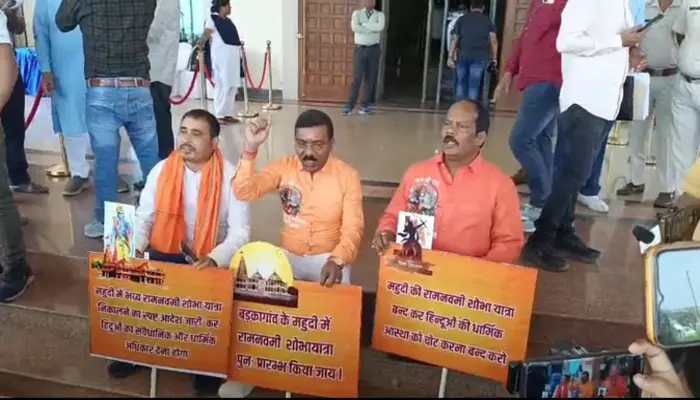
Case Summary
In Mahudi village in Hazaribagh district, Jharkhand, the Ram Navami procession was restricted and the use of DJs was prohibited by the state administration. This decision caused outrage and heightened tensions within the local Hindu community. According to media reports, this occurred on 18 March 2026, the final day of the budget session of the Jharkhand Legislative Assembly. The Assembly witnessed a controversy over the stopping of the Ram Navami procession in Mahudi village, which became the centre of escalating political tensions. Restrictions were imposed on the Ram Navami procession in Mahudi village, and DJ music was prohibited by the administration. The issue triggered a response within and outside the Assembly, with opposition legislators raising objections to the administrative measures and highlighting the matter as a point of contention in the state’s political discourse. The issue was raised prominently by legislators of the Bharatiya Janata Party and the All Jharkhand Students Union, who staged a protest outside the Assembly premises in Ranchi, holding placards and raising slogans against the state administration. The protesting MLAs characterised the restrictions on a major Hindu religious procession as a recurring pattern of curbs on Hindu festivals, stating that such measures interfered with religious practices and public expressions of faith. Participating leaders, including Roshanlal Choudhary, Nirmal Mahato, Lambodar Mahato, and Nira Yadav, stated that the continuation of such restrictions would prompt intensified agitation both within the Assembly and on the streets, signalling an escalation of the political response. The state government, represented by Minister Deepika Pandey Singh, rejected the accusations and claimed that the restriction on DJ music did not originate from an executive decision of the government but was implemented in compliance with judicial directives. The government claimed that it was bound to follow court orders and that attributing the restrictions to political intent was unfounded. The confrontation reflected a broader political divide over the regulation of religious processions and public celebrations, with the Mahudi incident intensifying discourse around administrative control, judicial compliance, and the balance between law enforcement and religious freedoms in the state.
Why it is Hate Crime ?
This case has been added under the primary category- Restriction/Ban on Hindu Practices. The first subcategory selected is- Restriction on expression of Hindu identity. An example of the state-affected prejudicial and targeted orders against the Hindu community would be a government denying the right of a Hindu or a group of Hindus to hold a religious procession owing to the animosity of non-Hindu groups. Denial of the religious right of the Hindus to assuage the non-Hindu group which harbours animosity to a point where it could lead to violence against Hindus is not only a failure of law and order but is a prejudicial order against Hindus, denying them their fundamental rights to express their religious identity. An example of a hate crime against Hindus by a non-Hindu would be a non-Hindu institution forcing its Hindu employees to abandon religious symbols that a Hindu would wear as an expression of faith owing to inherent prejudice against the faith professed by the victim or a non-Hindu group of people restricting a Hindu group from constructing a place of worship simply because the demography of the area in which the temple is being built is dominated by non-Hindus. Such actions are driven by religious animosity and/or prejudice against Hindus and their faith and would therefore be categorised as a hate crime. The second subcategory selected is- Administration disallows religious procession, and the tertiary category chosen within this is- Religious procession. In several cases, it is seen that the administration/state disallows a religious procession owing to prejudicial orders and concerns, targeted specifically against the Hindu community. Such restriction/prohibition would be considered documented as a hate crime because the orders are often a result of pressure by groups that harbour animosity towards Hinduism and Hindus. Often, the restriction by the authorities is driven by bias, hostility, or prejudice against the specific community being stopped from holding a religious procession, by pressure groups that harbour animosity towards Hindus, intrinsic to their faith. Since the religious procession is inherent to the faith of the Hindus, such prejudicial restriction is considered a curtailing of the fundamental rights of the Hindu community. In several cases, for example, the authorities ban a Hindu religious procession due to pressure from groups opposed to the religion. In other instances, the prohibition is selectively enforced against one religious group (Hindus) while others are allowed to proceed. There are still other cases where the authorities preemptively restrict a religious process by Hindus because those who hold animosity towards Hindus may get “provoked” leading to them being violent, thereby assuaging the sentiments of those who hold animosity towards Hindus by curtailing the religious rights of Hindus. Such acts and orders are prejudiced, indicating discriminatory motives owing to the capitulation to groups that harbour animosity towards Hindus and therefore, would be categorised as a religiously motivated hate crime since the original pressure leading to the order itself is a result of hatred/bias/prejudice/religious hate against Hindus. The other sub-category selected here is -Administration restricting religious practice. In several cases, it is seen that the administration/state disallows a religious practice owing to prejudicial orders and concerns, targeted specifically against the Hindu community. Such restriction/prohibition would be considered documented as a hate crime because the orders are often a result of pressure by groups that harbour animosity towards Hinduism and Hindus. Often, the restriction by the authorities is driven by bias, hostility, or prejudice against the specific community being stopped from holding a religious practice, by pressure groups that harbour animosity towards Hindus, intrinsic to their faith. Since practices are intrinsic to the faith of the Hindus, such prejudicial restriction is considered a curtailing of the fundamental rights of the Hindu community. In several cases, for example, the authorities ban a Hindu religious practice due to pressure from groups opposed to the religion. In other instances the prohibition is selectively enforced against one religious group (Hindus) while others are allowed to proceed. There are still other cases where the authorities preemptively restrict a religious practice by Hindus because those who hold animosity towards Hindus may get “provoked” leading to them being violent, thereby assuaging the sentiments of those who hold animosity towards Hindus by curtailing the religious rights of Hindus. Such acts and orders are prejudiced, indicating discriminatory motives owing to the capitulation to groups that harbour animosity towards Hindus and therefore, would be categorized as a religiously motivated hate crime since the original pressure leading to the order itself is a result of hatred/bias/prejudice/religious hate against Hindus. This case is a clear example of a hate crime, as restrictions were imposed on the Ram Navami procession in Mahudi village by the state administration. This act collectively curtailed the public expression of a significant Hindu religious festival. These measures, imposed specifically in the context of a Hindu celebration, reflected a pattern of administrative intervention that disproportionately affected Hindu religious practices. By imposing restrictions on a Hindu religious procession, the authorities effectively constrained the community’s ability to freely and openly practise their faith. Ram Navami holds profound spiritual and cultural importance for Hindus, marking the birth anniversary of Lord Rama, the seventh avatar of Vishnu and embodiment of dharma, righteousness, and moral victory. Families across India and beyond observe this day with fervent devotion through fasting, temple visits, recitations of the Ramcharitmanas, and joyous processions that reenact Rama's divine journey. For millions, it symbolises triumph over evil, family unity, and renewal, evoking deep emotional bonds to shared heritage. Communities pour into streets with vibrant celebrations, singing bhajans and chanting "Jai Shri Ram" to honour Lord Ram's ideals of truth and justice. This festival strengthens Hindu identity, passing sacred stories to younger generations and reinforcing resilience against adversity. Hindus incorporate DJ systems during Ram Navami processions to amplify religious songs, bhajans, and slogans like "Jai Shri Ram," filling the air with uplifting devotional music that unites participants in collective worship. These modern sound systems broadcast kirtans, Rama stutis, and rhythmic chants, transforming streets into living temples of praise and drawing crowds into shared spiritual ecstasy. DJs enable powerful playback of traditional tracks mixed with contemporary beats, ensuring the message of Lord Ram's glory reaches every corner. The administration's ban on this practice deliberately restricted playing bhajans and Lord Ram songs during Ram Navami, stifling a cherished mode of Hindu expression. The imposition of restrictions on such processions, particularly on elements like DJ music and the route of the procession, directly disrupted established religious customs and disrupted the celebration of the festival. Such constraints go beyond regulatory oversight and enter the realm of religious and cultural suppression. The justification of these restrictions on administrative or regulatory grounds does not negate their discriminatory impact when they are selectively enforced. When limitations are imposed on Hindu festivals in ways that are not uniformly applied across other religious practices, it demonstrates unequal treatment and institutional bias. In this instance, the targeting of a Hindu religious procession for restrictions contributed to a broader pattern in which Hindu expressions of faith are regulated more stringently. This selective application of authority fosters a sense of marginalisation within the community. Such patterns erode trust in governance, portraying Hindus as second-class citizens in their own cultural heartlands. This entrenched prejudice perpetuated cycles of marginalisation, confirming the incident as a hate crime sustained by state machinery. Furthermore, the timing and manner of the restrictions intensified their impact, as they disrupted preparations and participation in a major annual religious event. The use of state mechanisms to restrict Ram Navami procession signalled not merely regulation but active containment of a religious gathering, reinforcing perceptions of hostility towards Hindu public expression. Such actions demonstrate a pattern of prejudice that undermines the religious freedoms of Hindus and interferes with their cultural traditions. Consequently, the incident reflects elements of a hate crime, where state-imposed restrictions disproportionately targeted a Hindu religious practice, contributing to the erosion of equal rights and religious liberty. Notably, this was not the first time that the Jharkhand state administration had used similar measures against Hindu religious observances. The Hinduphobia Tracker has recorded two earlier instances in which Hindu processions, including those for Ram Navami, were specifically targeted and subjected to restrictive orders while equivalent practices by other religious communities faced no such controls. For example, on 12th March 2026, the Jharkhand government imposed a blanket ban on the use of DJs in Ram Navami processions across the state, citing “noise pollution,” even though no comparable restrictions were placed on the use of loudspeakers for the Azaan. The same yardstick was therefore not applied religiously, creating a clear pattern of selective enforcement against Hindu celebrations. In another instance, in April 2024, a Ram Navami procession organised in Barkagaon, Mahudi village, led to the arrest of Hindu activist Aman Kumar; such processions had already been effectively banned for around 40 years because the traditional route passed through a Muslim‑majority area, a justification not used similarly for other faith‑based processions. A state administration that repeatedly singles out Hindu celebrations such as Ram Navami for extra restrictions, while overlooking or allowing similar expressions in other religious traditions, presents a clear case of religious prejudice and discrimination carried out under the guise of routine administrative rules and regulations. The repeated targeting of Hindu religious processions and the pattern of banning or policing DJs and routes only around Hindu festivals indicate not neutral governance but a discriminatory framework that devalues Hindu religious expression. Given this pattern, the current incident in Mahudi village is being added to the hate crime database of the Hinduphobia Tracker as another instance of state‑level discrimination and religiously biased regulation against Hindus.


Case Status
Unknown


Perpetrators Details
Perpetrators
State and Establishment
Perpetrators Range
Unknown
Perpetrators Gender
unknown
 Sources




