Hindu festival targeted; Jharkhand government bans use of DJs in Ram Navami processions but imposes no similar restriction on Azaan
 Jharkhand, India
  11 March, 2026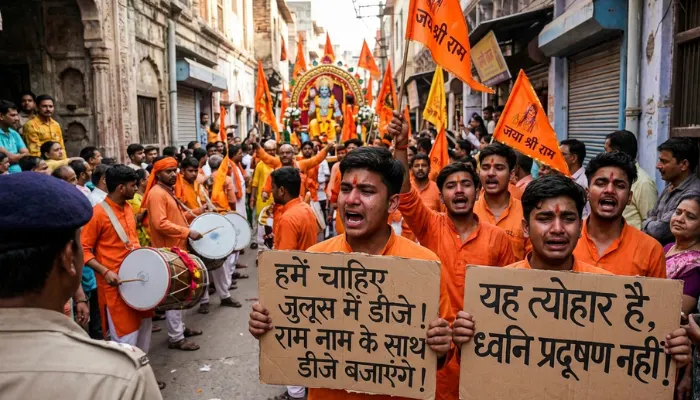
Case Summary
Ram Navami celebrations were targeted by the Jharkhand government, which imposed a ban on the use of the DJ during processions. This happened ahead of the Ram Navami festival. Notably, no such restrictions were made on azaans through loudspeakers by the government. According to media reports, this occurred just days before Ram Navami. The state government issued a decree prohibiting DJ music from being played during the festival under the pretext of curbing "noise pollution". The government argued that it took such decisions under the Noise Pollution Act. Meanwhile, the opposition attacked the government, asking, "If it is about law enforcement, why were only Hindu festivals restricted? Muslim festivals also occurred several times throughout the year, and prayers were offered five times daily. Why did the government remain silent in this situation?" The Jharkhand Assembly witnessed a major uproar over this issue. Hatia BJP Member of the Legislative Assembly Naveen Jaiswal raised his voice in the House, stating that the government targeted the Hindu faith by banning DJ music during Ram Navami processions. He stated that Hindu festivals were targeted, while such strictness was not observed during occasions for other communities. Bharatiya Janata Party Members of the Legislative Assembly raised loud slogans in the House regarding this matter, and after the matter escalated, the entire proceedings had to be adjourned for 20 minutes. Babulal Marandi, a BJP leader, said, "Ram Navami procession should be taken out without any hindrance on all the roads, streets and public places of Jharkhand, and the state government should ensure that there is no disruption in the Ram Navami procession. The government tried to appease the Muslim community by banning DJ music on Ram Navami. The Supreme Court clearly ordered that playing DJ music is prohibited from 10:00 pm to 6:00 am. If the government had to impose a ban, then it should also ban the Azaan (call for prayers) through loudspeakers in mosques from 4:00 am onwards." He also said that the Ram Navami procession in Jharkhand would be taken out with great pomp and show.
Why it is Hate Crime ?
This case has been added to the tracker under the primary category- Restriction/ban on Hindu practices. The subcategory selected is- Administration banning religious practice. In several cases, it is seen that the administration/state disallows a religious practice owing to prejudicial orders and concerns, targeted specifically against the Hindu community. Such restriction/prohibition would be considered documented as a hate crime because the orders are often a result of pressure by groups that harbour animosity towards Hinduism and Hindus. Often, the restriction by the authorities is driven by bias, hostility, or prejudice against the specific community being stopped from holding a religious practice, by pressure groups that harbour animosity towards Hindus, intrinsic to their faith. Since practices are intrinsic to the faith of the Hindus, such prejudicial restriction is considered a curtailing of the fundamental rights of the Hindu community. In several cases, for example, the authorities ban a Hindu religious practice due to pressure from groups opposed to the religion. In other instances the prohibition is selectively enforced against one religious group (Hindus) while others are allowed to proceed. There are still other cases where the authorities preemptively restrict a religious practice by Hindus because those who hold animosity towards Hindus may get “provoked” leading to them being violent, thereby assuaging the sentiments of those who hold animosity towards Hindus by curtailing the religious rights of Hindus. Such acts and orders are prejudiced, indicating discriminatory motives owing to the capitulation to groups that harbour animosity towards Hindus and therefore, would be categorized as a religiously motivated hate crime since the original pressure leading to the order itself is a result of hatred/bias/prejudice/religious hate against Hindus. This case is a clear example of a hate crime as the Jharkhand government imposed a ban on DJ use during Ram Navami celebrations just ahead of the festival, while taking no action against Azaan broadcast daily through loudspeakers across the state. This glaring disparity reveals clear religious discrimination and anti-Hindu prejudice embedded in state policy. By singling out a Hindu festival for restrictions under the guise of 'noise pollution control', the government demonstrated bias that penalised Hindu devotional practices alone. Daily Azaan calls, amplified five times from early morning, faced no scrutiny despite their pervasive volume, highlighting how Hindu expressions of faith became convenient targets. This unequal application of law stemmed from institutional animosity, fostering resentment among Hindus who felt their religious freedoms eroded while others enjoyed unchecked privileges. Such targeted suppression qualifies as a religiously motivated hate crime, as it weaponised state authority to diminish Hindu cultural life. Ram Navami holds profound spiritual and cultural importance for Hindus, marking the birth anniversary of Lord Rama, the seventh avatar of Vishnu and embodiment of dharma, righteousness, and moral victory. Families across India and beyond observe this day with fervent devotion through fasting, temple visits, recitations of the Ramcharitmanas, and joyous processions that reenact Rama's divine journey. For millions, it symbolises triumph over evil, family unity, and renewal, evoking deep emotional bonds to shared heritage. Communities pour into streets with vibrant celebrations, singing bhajans and chanting "Jai Shri Ram" to honour Lord Ram's ideals of truth and justice. This festival strengthens Hindu identity, passing sacred stories to younger generations and reinforcing resilience against adversity. Hindus incorporate DJ systems during Ram Navami processions to amplify religious songs, bhajans, and slogans like "Jai Shri Ram," filling the air with uplifting devotional music that unites participants in collective worship. These modern sound systems broadcast kirtans, Rama stutis, and rhythmic chants, transforming streets into living temples of praise and drawing crowds into shared spiritual ecstasy. DJs enable powerful playback of traditional tracks mixed with contemporary beats, ensuring the message of Lord Ram's glory reaches every corner. The Jharkhand government's ban on this practice deliberately restricted playing bhajans and Lord Ram songs during Ram Navami, stifling a cherished mode of Hindu expression. This prohibition extended beyond equipment to silence sacred sounds central to the festival, marking a calculated assault on religious customs and elevating the act to religiously motivated hate. This selective enforcement showcased institutionalised bias within the Jharkhand administration, where regulations were bent to favour non-Hindu religious practices over Hindu ones. Noise pollution laws applied rigorously to Ram Navami DJs but ignored comparable or louder Azaan transmissions, revealing a systemic double standard rooted in appeasement politics. Government officials framed the ban as neutral environmental protection, yet their inaction on daily loudspeaker use exposed the pretext, prioritising minority sensitivities over Hindu rights. Such patterns erode trust in governance, portraying Hindus as second-class citizens in their own cultural heartlands. This entrenched prejudice perpetuated cycles of marginalisation, confirming the incident as a hate crime sustained by state machinery. Under the pretext of noise pollution, the Jharkhand government targeted only Ram Navami celebrations with a DJ ban, while sparing Azaan, played five times daily on loudspeakers year-round. Genuine concern for decibel levels would demand equal measures against Azaan, which disrupts mornings from 4 am and echoes constantly, far outlasting Ram Navami's annual occurrence. Ram Navami processions, vibrant but fleeting, became scapegoats, while persistent Azaan faced no curbs, underscoring deliberate religious bias and institutionalised discrimination against Hindus. This selective outrage over the Hindu festival sounds portrayed deep-seated animosity towards the community, framing their devotion as pollution while normalising others' routines. Such targeting of Hindu festivals exemplified prejudice that stifled cultural vitality. The restriction's timing, announced just ahead of Ram Navami, signalled intent to disrupt the entire celebrations and dampen Hindu enthusiasm at the festival's peak. By springing the ban days before processions, the government sowed confusion and demoralisation, forcing last-minute alterations to age-old traditions. This premeditated move aimed to fracture communal joy, portraying Hindu festivities as disruptive burdens rather than joyous affirmations of faith. It reflected hatred for Hinduism, methodically undermining a pivotal event through bureaucratic hurdles. Given that this case meets the parameters of a religiously motivated hate crime, it is being added to the Hate Crime database of the Hinduphobia Tracker. Disclaimer: The Hinduphobia Tracker records incident dates based on when the crime occurred rather than when the media reported it. In this case, media reports did not specify the exact date of enforcement or occurrence. Therefore, 12 March 2026, the date when Babulal Marandi, a Bharatiya Janata Party member from Jharkhand, posted about it on social media, served as the indicative incident date. This selection aids documentation purposes only.


Case Status
Unknown


Perpetrators Details
Perpetrators
State and Establishment
Perpetrators Range
Unknown
Perpetrators Gender
unknown
 Sources




