Hindu activist restricted for leading Ram Navami procession in Muslim-dominated village, arrested
 Hazaribag, Jharkhand, India
  13 April, 2024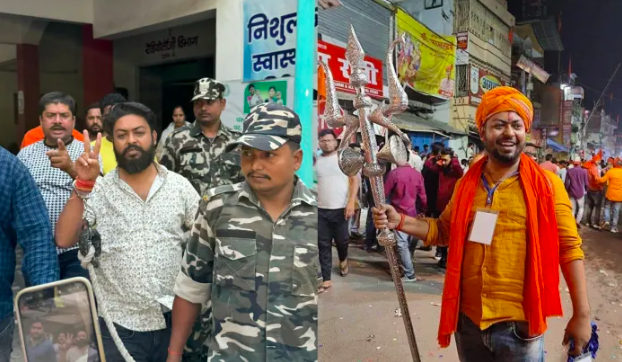
Case Summary
Aman Kumar, a Hindu activist from Hazaribagh, Jharkhand, was arrested by the local police for organising a Ram Navami procession on April 12 in Barkagaon-Mahudi village, where such processions have been banned for the last forty years. The event led to FIRs against him and several others, resulting in multiple arrests. Two months later, on June 12, Aman Kumar was taken into custody by Jharkhand police in Patna. The district administration has blocked the Barkagaon Mahudi procession path since 1985, barring the yatra from the Muslim-majority area during festivals like Ram Navami and Navratri. Hindu activists have repeatedly tried to break this ban. In April, the religious procession was blocked by police barricades in Mahudi village. The halted procession enraged the devotees, resulting in stone-throwing, vehicle damage, and injuries. Fires were set and the fire brigade was called. The police used force to control the situation, and Mahudi village became a police cantonment. Sub-divisional police officer Kuldeep Kumar claimed no procession occurred and that some people tried to use the disputed route under the guise of performing puja. However, videos showed people carrying flags and participating in the yatra before being stopped by the police. Aman's family, particularly his mother Poonam Devi, held a press conference at their home in Yashwant Nagar, condemning the arrest as a conspiracy. She described Aman as an activist for Sanatan Dharma, highlighting his efforts to revive the Ram Navami procession, which included building and pulling a chariot from Hazaribagh to Ranchi. Poonam Devi informed that Aman's growing popularity unnerved the government and local politicians, leading to his arrest under pressure from Barkagaon MLA. Poonam Devi noted that the arrest occurred only after the Lok Sabha elections, implying a political motive behind the timing. She also mentioned that the police failed to address recent violent incidents in Chatra, where radicals killed two members of a Birhor family, yet they prioritised arresting her son.
Why it is Hate Crime ?
In several cases, it is seen that the administration/state disallows a religious procession owing to prejudicial orders and concerns, targeted specifically against the Hindu community. Such restriction/prohibition would be considered documented as a hate crime because the orders are often a result of pressure by groups that harbour animosity towards Hinduism and Hindus. Often, the restriction by the authorities is driven by bias, hostility, or prejudice against the specific community being stopped from holding a religious procession, by pressure groups that harbour animosity towards Hindus, intrinsic to their faith. Since the religious procession is inherent to the faith of the Hindus, such prejudicial restriction is considered a curtailing of the fundamental rights of the Hindu community. In several cases, for example, the authorities ban a Hindu religious procession due to pressure from groups opposed to the religion. In other instances, the prohibition is selectively enforced against one religious group (Hindus) while others are allowed to proceed. There are still other cases where the authorities preemptively restrict a religious process by Hindus because those who hold animosity towards Hindus may get “provoked” leading to them being violent, thereby assuaging the sentiments of those who hold animosity towards Hindus by curtailing the religious rights of Hindus. Such acts and orders are prejudiced, indicating discriminatory motives owing to the capitulation to groups that harbour animosity towards Hindus and therefore, would be categorized as a religiously motivated hate crime since the original pressure leading to the order itself is a result of hatred/bias/prejudice/religious hate against Hindus. In Jharkhand, the police under the JMM government arbitrarily arrested a Hindu activist for organising a Ram Navami procession in a Muslim-majority area that had prohibited such processions for 40 years. This action is viewed as an attempt to suppress the religious rights of the Hindu community to appease the local Muslim population. By restricting Hindus from celebrating their festival and labelling the area as exclusively Muslim due to the demographic majority, the state is denying Hindus their fundamental right to freedom of religion, which includes the right to express one's religious beliefs openly. It also sends a message of intolerance and exclusion to the broader community. Such actions are discriminatory and indicative of religious bias. Consequently, this incident is being categorised as a religiously motivated hate crime against Hindus.
Victim Details
Total Victim
1
Deceased
0
Gender
- Male 1
- Female 0
- Third Gender 0
- Unknown 0
Caste
- SC/ST 0
- OBC 0
- General 0
- Unknown 1
Age Group
- Minor 0
- Adult 1
- Senior Citizen 0
- Unknown 0


Case Status
Unknown


Perpetrators Details
Perpetrators
State and Establishment
Perpetrators Range
N/A
Perpetrators Gender
unknown
 Sources




