

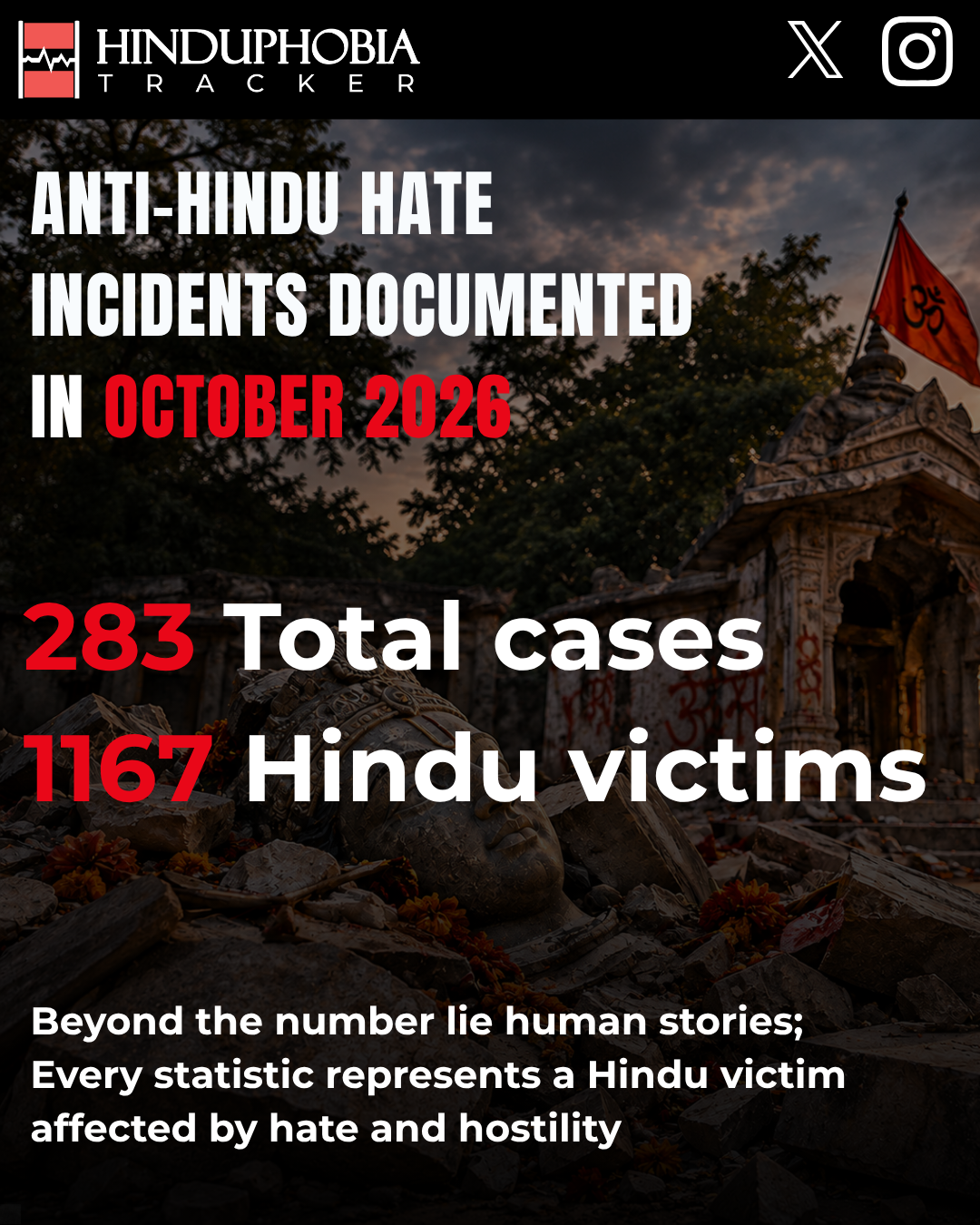
October 2026 saw a rise in the number of anti-Hindu incidents documented by the Hinduphobia Tracker. A total of 283 cases involving 1,167 victims were recorded during the month. From hate speech and predatory proselytisation to attacks on temples, desecration of Hindu religious symbols and hostility towards Hindu festivals, the incidents reflected multiple forms of religious targeting.
One of the most striking findings was the sharp rise in attacks on Hindu religious representations. With 102 cases, this became the most frequently recorded category in October, accounting for more than one in every three documented incidents. These included attacks on Hindu temples, desecration of religious symbols and other forms of hostility directed at Hindu religious representations.
The victim profile revealed another troubling dimension. Women accounted for 572 of the 1,167 victims, while 220 minors were recorded during the month. Together, these figures draw attention to the significant presence of women and children among those affected by religious hostility.
The geographical spread was not confined to India. Of the 283 cases, 231 were recorded in India and 52 outside the country. Bangladesh accounted for 35 of the international cases, making it the country with the largest number of documented incidents outside India.
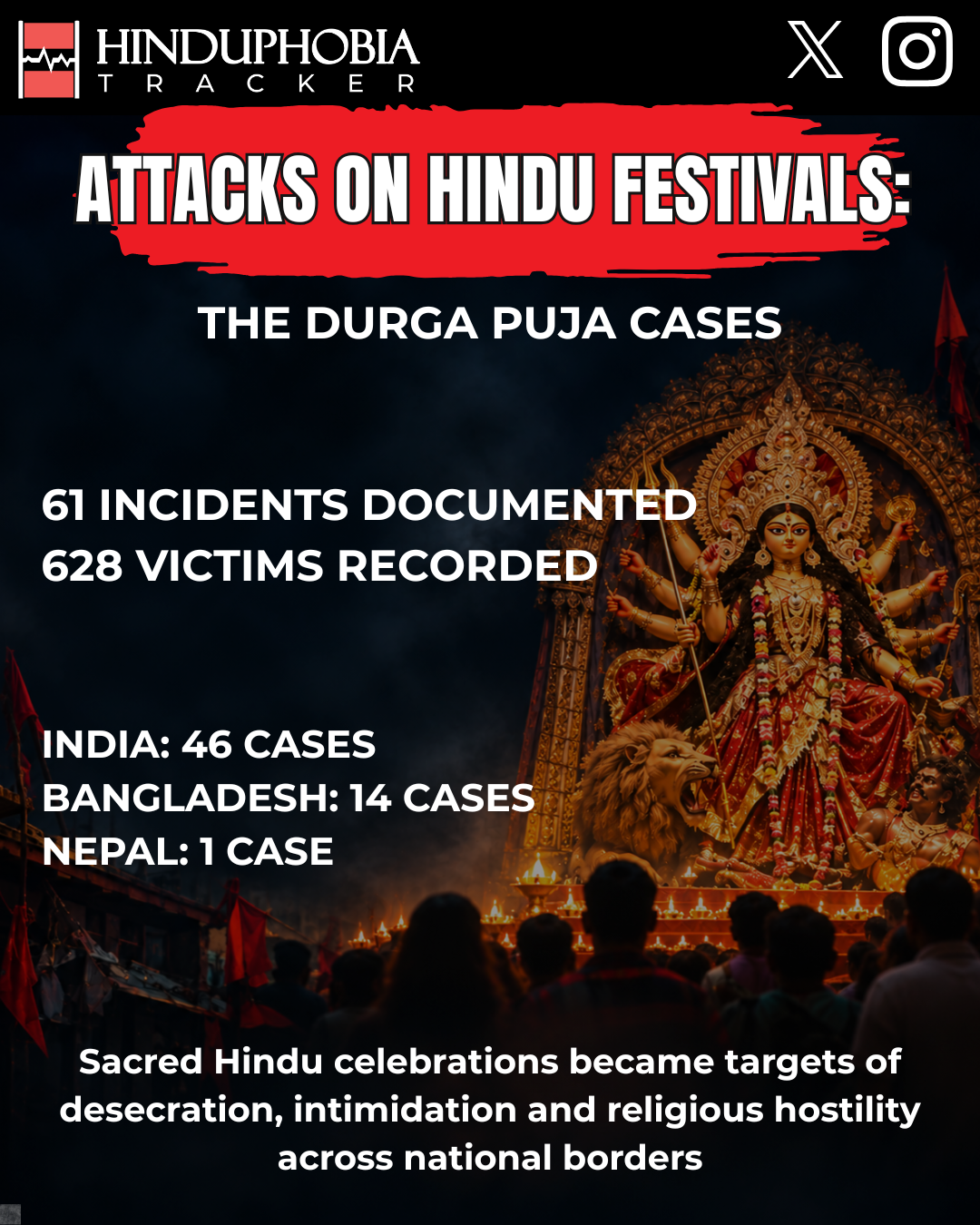
October also coincided with Durga Puja, one of the most important Hindu festivals. The Tracker documented 61 incidents involving 628 victims in connection with the festival across India, Bangladesh and Nepal. These included attacks on Hindu religious representations, hate speech, physical attacks and restrictions on Hindu practices. At Jagannath University in Dhaka, six cases involving anti-Hindu hostility were documented, highlighting the challenges faced by Hindu students during the festival period.
This report examines the patterns within October’s dataset, including the forms of hostility recorded, their geographical distribution, the victim profile and the perpetrators identified. It also takes a closer look at the Durga Puja incidents and the developments at Jagannath University.
October 2026 at a Glance
The Hinduphobia Tracker documented 283 cases involving 1,167 victims during October 2026.
- 283 cases documented.
- 1,167 victims recorded.
- 231 cases in India.
- 52 cases outside India.
- 102 attacks on Hindu religious representations.
- 71 cases involving hate speech.
- 55 attacks not resulting in death.
- 48 cases involving crimes against women.
- 45 cases of predatory proselytisation.
- 30 undecided cases.
- 220 minor victims.
- 24 cases involving identified Christian perpetrators and 141 involving identified Muslim perpetrators.
Categories at a Glance
Attacks on Hindu religious representations emerged as the most frequently documented category in October, with 102 cases. Hate speech followed with 71 cases, while attacks not resulting in death accounted for 55 cases.
The other major categories included crimes against women, with 48 cases, and predatory proselytisation, with 45 cases. The Tracker also documented eight cases involving restrictions or bans on Hindu practices and three cases involving men attacked for their association with non-Hindu women. Another 30 cases remained undecided.
The category-wise distribution was as follows:
| Category | Number of cases |
|---|---|
| Attacks on Hindu religious representations | 102 |
| Hate speech | 71 |
| Attacks not resulting in death | 55 |
| Crimes against women | 48 |
| Predatory proselytisation | 45 |
| Undecided | 30 |
| Restrictions/bans on Hindu practices | 8 |
| Men attacked for association with non-Hindu women | 3 |
Note: Some incidents fall under more than one category. Consequently, category-wise counts are not additive and do not represent mutually exclusive groups of incidents.
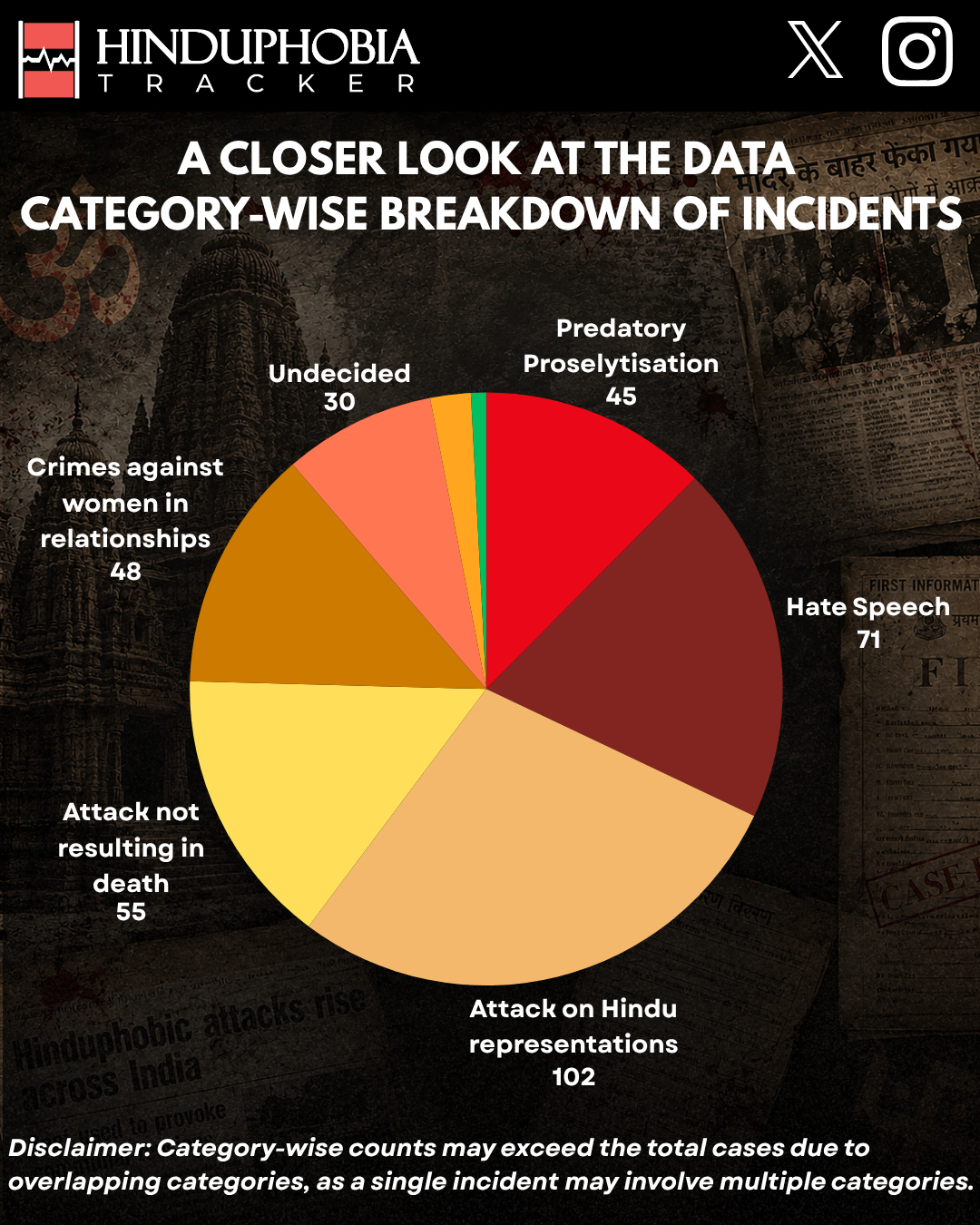
The prominence of attacks on Hindu religious representations is particularly significant. More than one in every three incidents documented during the month involved hostility directed at Hindu religious symbols, places of worship or other religious representations.
The figures also show that hostility took different forms. While hate speech accounted for 71 cases, 55 incidents involved physical attacks that did not result in death. The presence of these categories alongside attacks on religious representations reflects the range of incidents documented by the Tracker.
Geographic Distribution: India and Beyond
India accounted for 231 of the 283 cases recorded in October, representing approximately 81.6% of the total. The remaining 52 cases, or 18.4%, were documented outside the country.
Bangladesh recorded the highest number of international cases, with 35 incidents. Pakistan and the United States accounted for five cases each, followed by Nepal with three. Italy, Georgia, Sri Lanka and the United Kingdom recorded one case each.
The country-wise distribution was:
| Country | Cases | Victims |
|---|---|---|
| India | 231 | 1,134 |
| Bangladesh | 35 | 21 |
| Pakistan | 5 | 4 |
| United States | 5 | 3 |
| Nepal | 3 | 0 |
| Italy | 1 | 1 |
| Georgia | 1 | 1 |
| Sri Lanka | 1 | 1 |
| United Kingdom | 1 | 2 |
| Total | 283 | 1,167 |
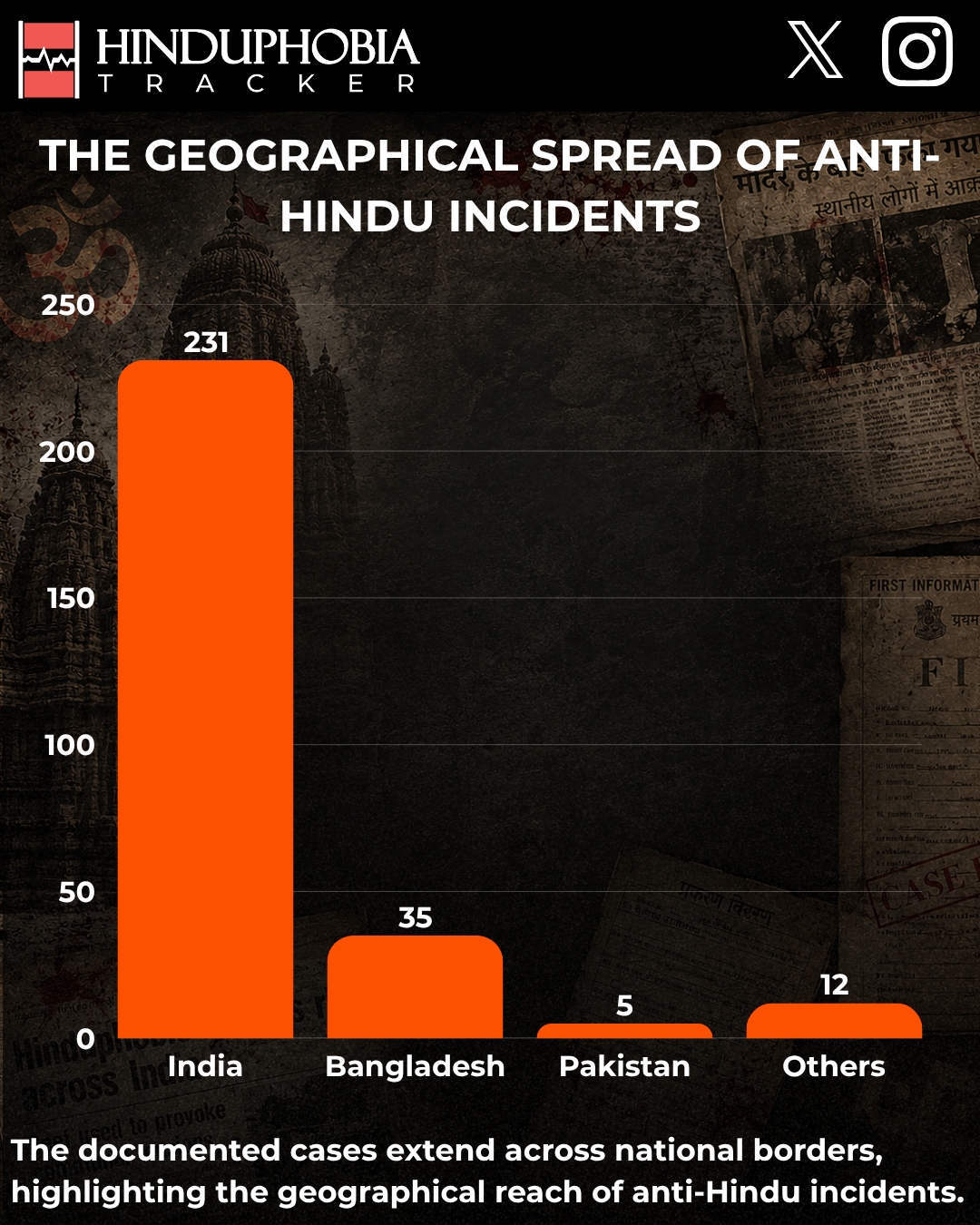
Bangladesh accounted for 35 of the 52 cases recorded outside India, or approximately 67.3% of all international cases. The figures highlight the geographical reach of the incidents documented by the Tracker, particularly in neighbouring countries where Hindus form religious minorities.
State-wise Distribution Within India
Within India, Uttar Pradesh recorded the highest number of incidents, with 63 cases. Maharashtra followed with 26, while West Bengal accounted for 22 and Madhya Pradesh for 20.
Chhattisgarh recorded 14 cases, followed by Telangana with 12 and Bihar with 11. Tamil Nadu accounted for nine cases, while Rajasthan and Karnataka recorded seven each.
The state-wise distribution was:
| State/UT | Cases |
|---|---|
| Uttar Pradesh | 63 |
| Maharashtra | 26 |
| West Bengal | 22 |
| Madhya Pradesh | 20 |
| Chhattisgarh | 14 |
| Telangana | 12 |
| Bihar | 11 |
| Tamil Nadu | 9 |
| Rajasthan | 7 |
| Karnataka | 7 |
| Uttarakhand | 6 |
| Gujarat | 6 |
| Delhi | 5 |
| Haryana | 5 |
| Assam | 3 |
| Jharkhand | 3 |
| Chandigarh | 1 |
| Kerala | 1 |
| Himachal Pradesh | 1 |
| Odisha | 1 |
Eight India-based cases did not have a state specified in the dataset.
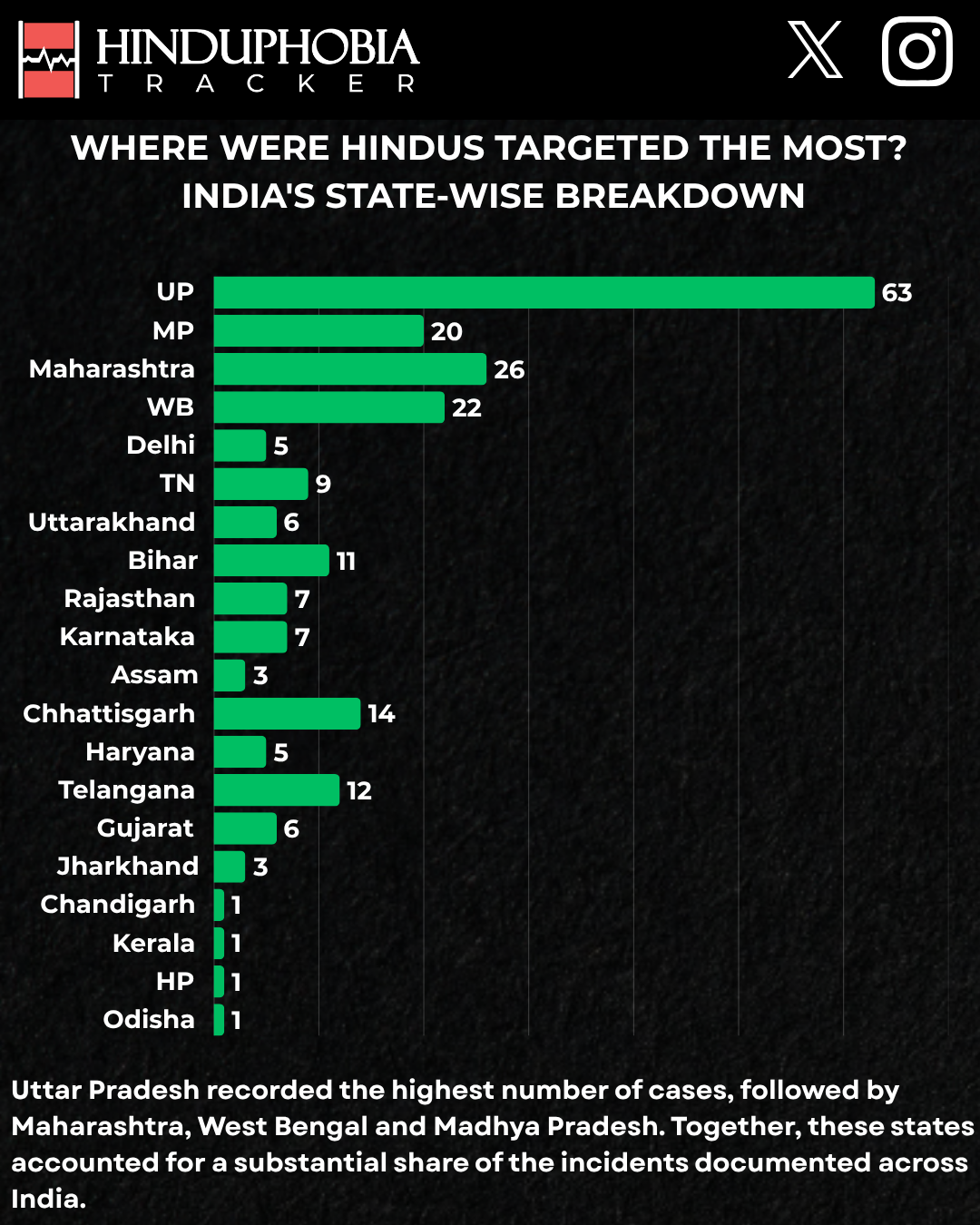
Uttar Pradesh alone accounted for approximately 27.3% of all cases recorded in India. The four states with the highest counts, Uttar Pradesh, Maharashtra, West Bengal and Madhya Pradesh, together accounted for 131 cases, or more than half of India’s documented incidents.
The concentration of incidents in these states is a notable feature of October’s geographical data. However, the numbers also show that documented cases were spread across several other states and Union Territories.
Victims and Their Demographic Profile
The 283 incidents recorded during October involved 1,167 victims. The victim profile shows that women and minors accounted for a substantial share of those affected.
Of the total victims, 572 were women and 372 were men. Seven victims were identified as belonging to the third gender, while the gender of 216 victims was not recorded.
The age profile included 545 adults, two senior citizens and 220 minors. Age information was unavailable for 400 victims.
Who Was Affected?
| Victim profile | Number |
|---|---|
| Female | 572 |
| Male | 372 |
| Third gender | 7 |
| Gender unknown | 216 |
| Total victims | 1,167 |
| Age profile | Number |
|---|---|
| Adults | 545 |
| Senior citizens | 2 |
| Minors | 220 |
| Age unknown | 400 |
| Total victims | 1,167 |
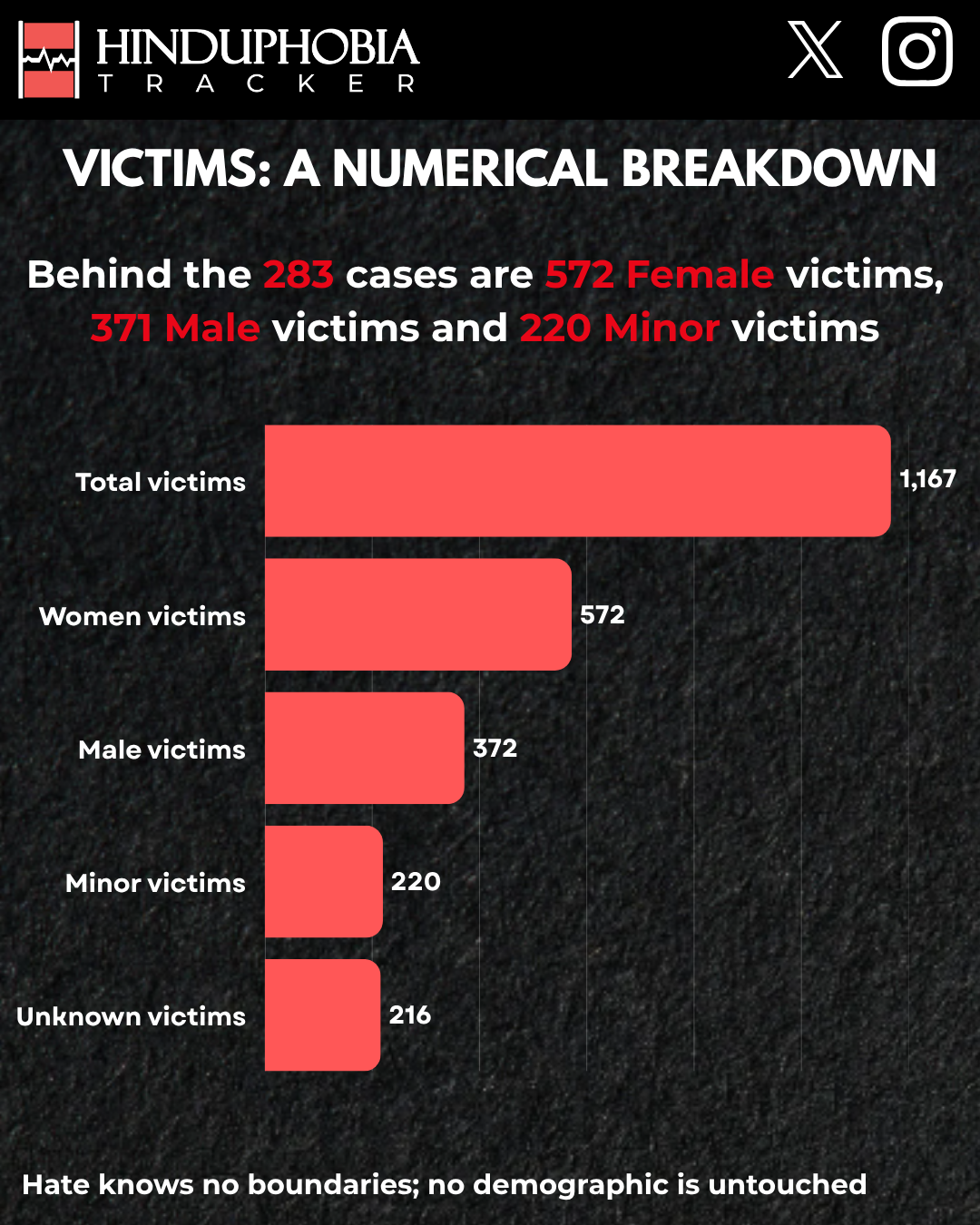
Women accounted for approximately 49% of all victims recorded in October. In other words, nearly one in every two victims was female. The 220 minor victims represented approximately 18.9% of the total, meaning nearly one in every five victims was a child.
These figures bring the experiences of women and children into sharper focus. They also underline the importance of examining the circumstances of individual cases, particularly where religious targeting intersects with gender-based exploitation, intimidation or coercion.
The gender and age classifications overlap. Some victims may belong to both groups, so their numbers should not be added together to calculate a separate combined victim count.
What Types of Incidents Were Most Common?
1. Attacks on Hindu Religious Representations
With 102 cases, attacks on Hindu religious representations were the largest category recorded in October. The category included 33 attacks on Hindu temples and 63 cases involving the desecration of Hindu religious symbols.
The remaining six cases fell under other subcategories within this broader classification.
The figures show that the targeting of Hindu religious representations extended beyond physical attacks on places of worship. Religious symbols, which carry deep spiritual and cultural significance for Hindus, were also repeatedly targeted.
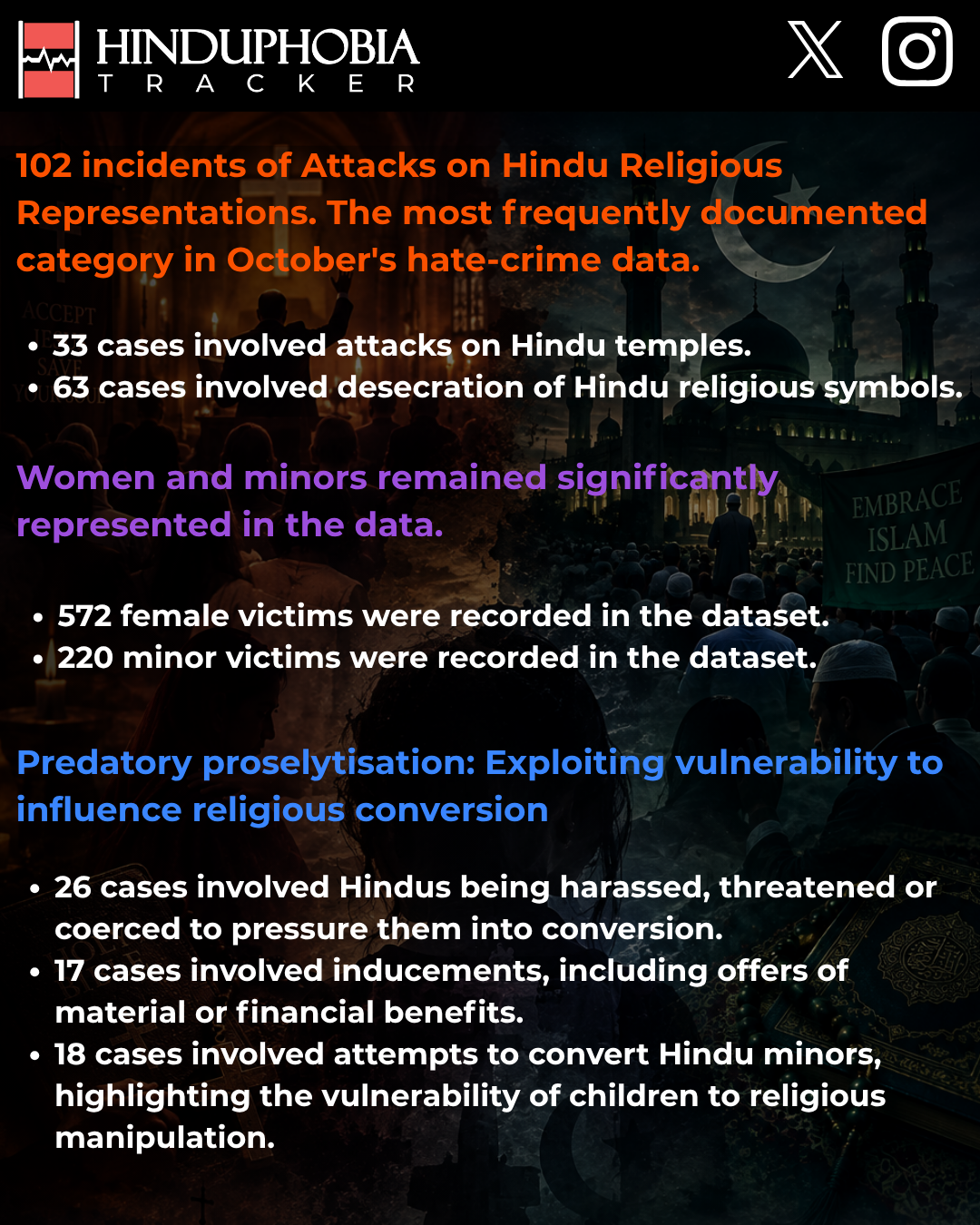
The 63 cases involving desecration of Hindu religious symbols accounted for nearly two-thirds of the incidents in this category. The 33 temple attacks further demonstrate that places of Hindu worship remained among the targets of documented hostility.
These incidents matter because temples and religious symbols are not merely physical structures or objects. They are central to Hindu religious practice, cultural continuity and community life. Their desecration or destruction affects not only the immediate site or object but also the devotees and communities for whom they hold religious meaning.
2. Hate Speech Against Hindus
Hate speech was the second most frequently recorded category in October, with 71 cases.
These incidents involved expressions of hostility directed at Hindus, Hindu religious beliefs and religious identity. Unlike physical attacks, hate speech may target an entire religious community rather than a particular individual. Consequently, the number of recorded cases does not necessarily correspond to an identifiable victim count.
The 71 cases show that speech-based hostility remained a significant part of the incidents documented during the month, alongside physical attacks and the targeting of religious representations.
3. Attacks Not Resulting in Death
The Tracker documented 55 attacks that did not result in death.
These cases represent another significant category of physical hostility directed at Hindus. While the incidents did not result in fatalities, the absence of deaths does not diminish the seriousness of the violence or the harm experienced by the victims.
Together with the 102 cases involving Hindu religious representations, these incidents highlight the different ways in which physical hostility can manifest, from violence against individuals to attacks on places and symbols of worship.
4. Crimes Against Women in Relationships and Other Sexual Crimes
October saw 48 cases involving crimes against Hindu women.
The 572 female victims recorded across the entire dataset make the gender dimension particularly important. However, the total number of female victims should not be confused with the number of women involved in this particular category. The two figures measure different aspects of the dataset.
The 48 cases warrant examination through their individual circumstances, particularly where the reported conduct involves deception, exploitation, intimidation or religious targeting within relationships.
5. Predatory Proselytisation
The Tracker documented 45 cases of predatory proselytisation in October.
The available breakdown identifies several methods used in reported attempts to influence or pressure Hindus into religious conversion:
- 26 cases involved harassment, threats or coercion to pressure Hindus into conversion.
- 17 cases involved inducements, including offers of material or financial benefits.
- 18 cases involved attempts to convert Hindu minors.
The figures reveal the different circumstances covered by this category, including pressure, inducements and attempts directed at children.
The 18 cases involving minors are particularly concerning because children are a vulnerable group and may be more susceptible to manipulation or pressure. These cases deserve close examination in the context of the conduct documented in the underlying records.
Note: These subcategory figures overlap. A single incident may involve more than one method or target group, so they should not be added together.
Who Were the Perpetrators?
The October dataset records 141 cases involving identified Muslim perpetrators and 24 involving identified Christian perpetrators. Another 34 were classified under Others, while 72 had an unknown perpetrator affiliation. Twelve were recorded under State and Establishment.
| Perpetrator classification | Number |
|---|---|
| Muslim | 141 |
| Christian | 24 |
| Others | 34 |
| Unknown | 72 |
| State and Establishment | 12 |
| Total | 283 |
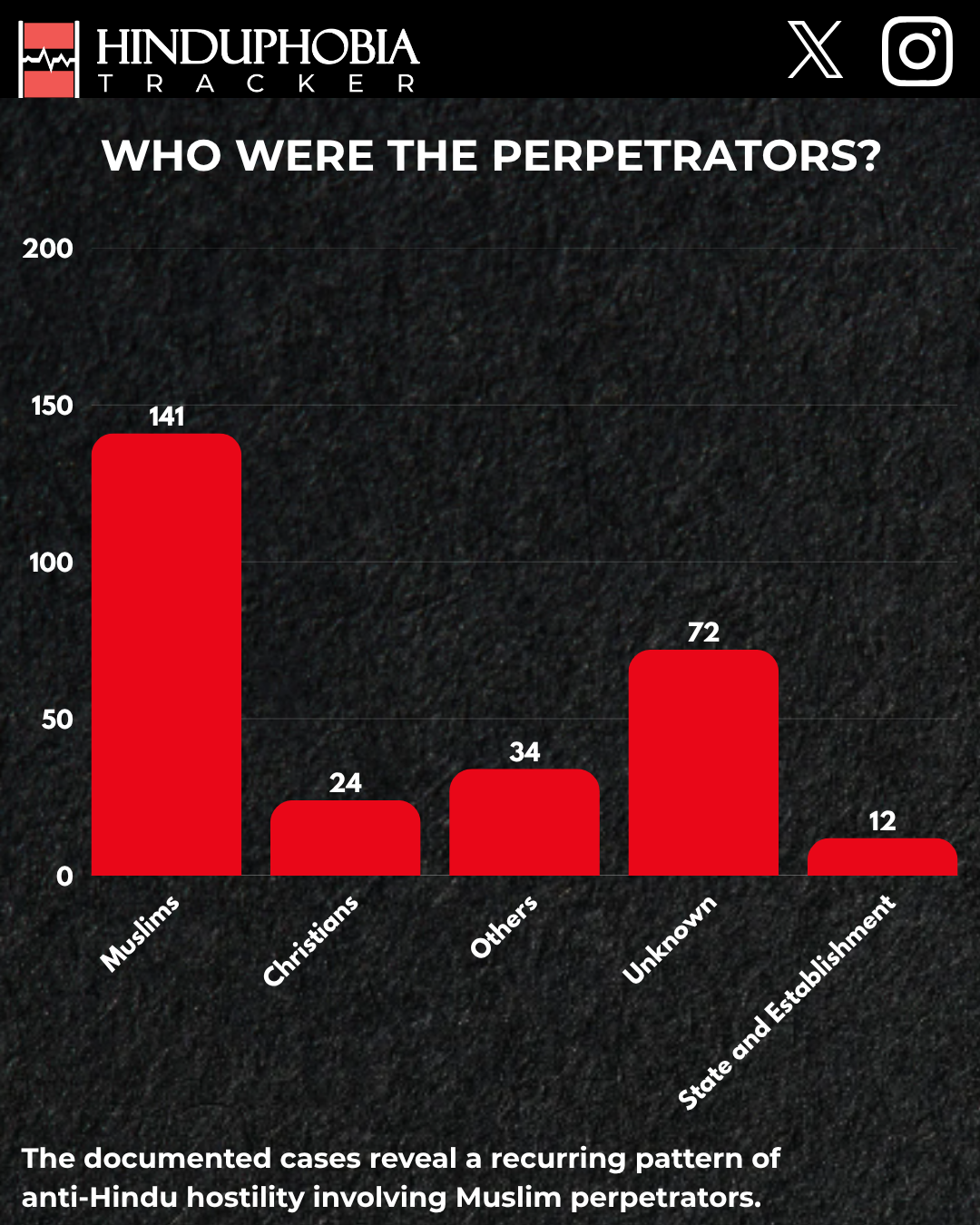
Among the perpetrators whose religious affiliation was identified as Muslim, Christian or Other, Muslims accounted for approximately 71%. Christians accounted for around 12%, while Others represented approximately 17%. 12 incidents were those where perpetrator was State and Establishment.
What Stands Out in October?
1. Attacks on Hindu Religious Representations Became the Largest Category
The most striking finding in October was the number of incidents involving attacks on Hindu religious representations.
With 102 cases, this category accounted for approximately 36% of all documented incidents. The 63 cases involving desecration of Hindu religious symbols and 33 temple attacks demonstrate the different forms of hostility recorded under this classification.
The repeated targeting of religious symbols and places of worship deserves particular attention because these representations hold deep significance for Hindu communities. Their desecration or destruction is not simply an attack on an object or structure. It strikes at the religious and cultural spaces through which communities express and preserve their faith.
2. Women and Children Accounted for a Significant Share of Victims
The victim profile presents another important pattern. Women accounted for nearly half of all recorded victims, while minors represented almost one-fifth.
The 572 female victims and 220 minor victims highlight the presence of women and children across the October dataset. The figures also warrant closer examination of incidents involving gender-based exploitation, coercion and attempts to influence the religious identity of minors.
These numbers should not be viewed in isolation. Behind them are individual cases involving people whose experiences and circumstances differ, but whose accounts form part of the broader picture of religious hostility documented during the month.
3. More Than One in Six Cases Occurred Outside India
Of the 283 cases recorded in October, 52 occurred outside India. Bangladesh alone accounted for 35 of these incidents.
This means that more than one in every six cases documented during the month occurred beyond India’s borders. The concentration of international cases in Bangladesh is particularly notable, given the country’s Hindu minority population.
The international distribution also included Pakistan, the United States, Nepal, Italy, Georgia, Sri Lanka and the United Kingdom.
4. Four States Accounted for More Than Half of India’s Cases
Uttar Pradesh, Maharashtra, West Bengal and Madhya Pradesh together accounted for 131 of the 231 cases recorded in India.
Uttar Pradesh led with 63 cases, followed by Maharashtra with 26, West Bengal with 22 and Madhya Pradesh with 20.
This concentration is an important feature of the October dataset. At the same time, incidents were documented across several other states, indicating that the geographical spread was not limited to these four regions.
5. Hindu Religious Symbols Remained a Major Target During Durga Puja
The Tracker documented 61 incidents involving 628 victims in connection with Durga Puja across India, Bangladesh and Nepal.
Nearly seven in every ten incidents in this dataset involved attacks on Hindu religious representations. This finding is particularly significant because Durga Puja is a period of worship, cultural expression and community celebration.
The incidents show how hostility towards Hindu religious life extended into a period of religious observance, affecting the symbols, spaces and practices associated with the festival.
Attacks on Hindu Festivals: The Durga Puja Cases
Durga Puja is one of the most important festivals in the Hindu calendar. It brings together communities for days of worship, cultural performances and celebrations dedicated to Goddess Durga.
However, the incidents documented by the Hinduphobia Tracker during October show that these celebrations were not spared from religious hostility.
The Tracker recorded 61 incidents involving 628 victims in connection with Durga Puja across three countries:
| Country | Cases |
|---|---|
| India | 46 |
| Bangladesh | 14 |
| Nepal | 1 |
| Total | 61 |
Category-wise Breakdown of Durga Puja Incidents
Attacks on Hindu religious representations accounted for the largest share of the Durga Puja incidents, with 43 cases. Hate speech and attacks not resulting in death accounted for 16 cases each, while three incidents involved restrictions or bans on Hindu practices.
| Category | Cases |
|---|---|
| Attacks on Hindu religious representations | 43 |
| Hate speech | 16 |
| Attacks not resulting in death | 16 |
| Restrictions/bans on Hindu practices | 3 |
Note: These categories overlap. A single incident may be recorded under more than one category, which is why the category-wise total exceeds the 61 incidents documented.
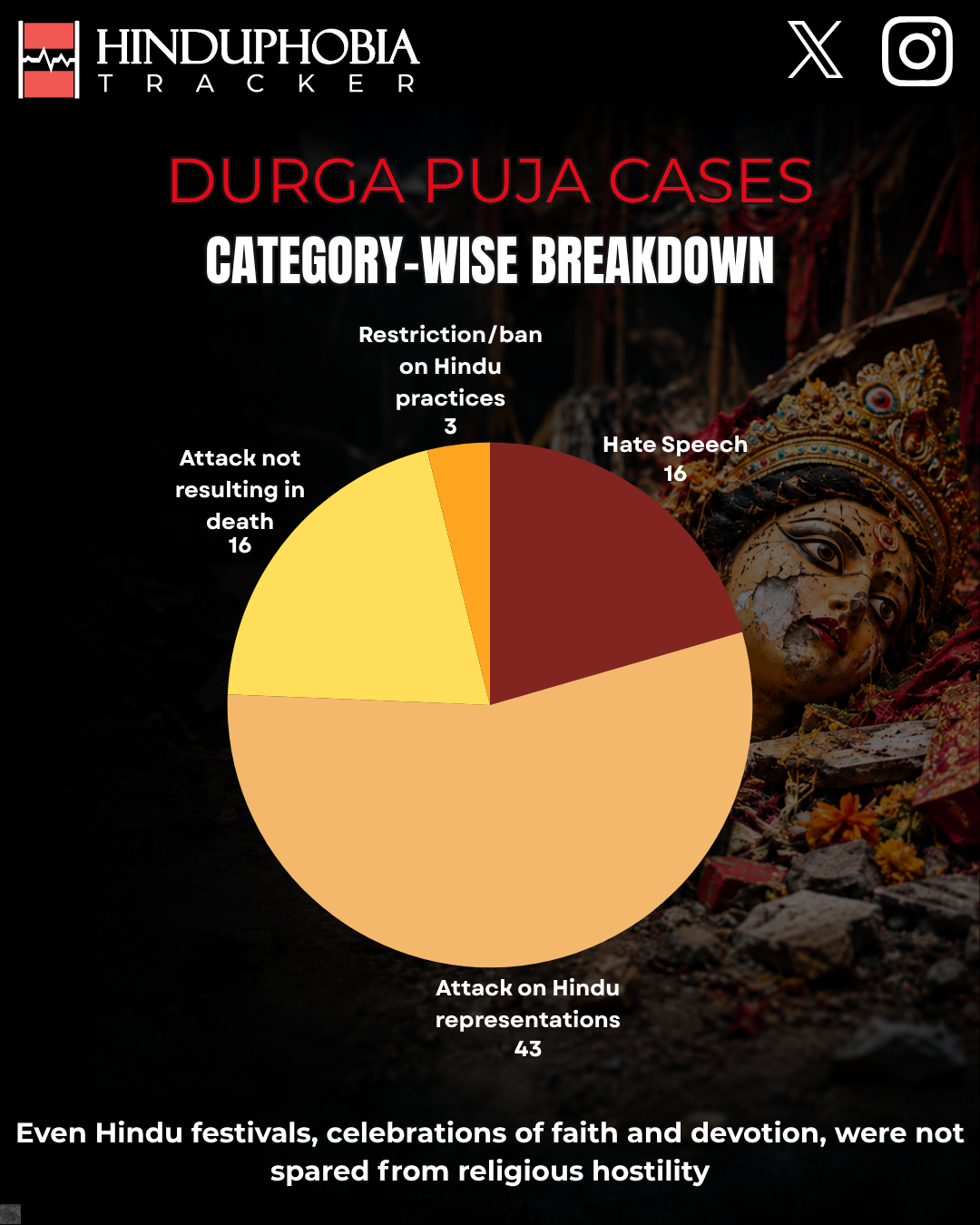
The figures reveal that attacks on Hindu religious representations were particularly prominent during the festival. Forty-three of the 61 incidents fell under this category, accounting for approximately 70.5% of the Durga Puja dataset.
The remaining categories also reflect the different forms of hostility recorded during the festival period, from hate speech to physical attacks and restrictions on Hindu practices.
These incidents are significant because festivals are not merely occasions for public celebration. They are central to the religious and cultural life of Hindu communities. Hostility directed at religious symbols, worship spaces or festival practices can affect the ability of devotees to observe their faith without intimidation or disruption.
Jagannath University: Six Cases of Anti-Hindu Hostility
Among the incidents documented during Durga Puja, the developments at Jagannath University in Dhaka, Bangladesh, stood out.
In October 2026, the Hinduphobia Tracker documented six cases involving anti-Hindu hostility at the university. The incidents centred on Hindu religious identity, the treatment of Hindu students and the use of university premises during the Durga Puja period.
The controversy began on 12 October, when beef khichuri was cooked near the university’s Central Hindu Temple. Hindu students objected to the location, stating that bricks belonging to the temple had been used to construct the cooking stove.
The dispute was followed by a series of developments that further heightened tensions on campus.

The incidents included:
- Anti-Hindu slogans demanding that Hindus leave Bangladesh.
- Threats of severe consequences if Hindus refused to convert to Islam.
- The temporary expulsion of a Hindu student following accusations of blasphemy after he opposed anti-Hindu abuse.
- Cow slaughter and beef feasts organised on campus on 16 and 17 October, during Durga Puja.
The sequence of incidents brought the treatment of Hindu students and the observance of Hindu religious practices at the university into sharp focus.
Six cases at one university point to a series of developments that cannot be understood merely as isolated disagreements over campus activities. The reported threats, anti-Hindu slogans, treatment of a Hindu student and events around the Central Hindu Temple placed religious identity at the centre of the controversy.
A university is expected to provide an environment where students can pursue their education without discrimination or intimidation on the basis of their faith. The incidents documented at Jagannath University raise serious questions about the safety, dignity and equal treatment of Hindu students on campus.
October Compared with September 2026
October recorded more incidents than September, but the total number of victims declined substantially.
The Hinduphobia Tracker documented 283 cases in October, compared with 239 in September. However, the victim count fell from 7,187 to 1,167.
| Measure | September 2026 | October 2026 |
|---|---|---|
| Total cases | 239 | 283 |
| Total victims | 7,187 | 1,167 |
| Cases in India | 194 | 231 |
| Cases outside India | 45 | 52 |
| Predatory proselytisation | 68 | 45 |
| Hate speech | 63 | 71 |
| Attacks on Hindu religious representations | 62 | 102 |
| Attacks not resulting in death | 49 | 55 |
| Crimes against women in relationships | 44 | 48 |
More Cases, but Fewer Recorded Victims
The number of documented cases increased from 239 in September to 283 in October, a rise of approximately 18.4%.
In contrast, the number of victims fell by 6,020, from 7,187 to 1,167, representing a decline of approximately 83.8%.
The difference is largely explained by the eight mass conversion cases documented in September, which alone accounted for 6,735 victims. October’s dataset did not show a comparable concentration of victims in a small number of mass incidents.
This distinction is important. A higher number of incidents does not necessarily translate into a higher number of victims. The two measures capture different dimensions of the documented cases and must be examined separately.
Attacks on Hindu Religious Representations Increased Sharply
One of the most significant changes between the two months was the rise in attacks on Hindu religious representations.
The category increased from 62 cases in September to 102 in October, a rise of approximately 64.5%. It moved from the third most frequently recorded category in September to the largest category in October.
Hate speech also increased, from 63 to 71 cases, while attacks not resulting in death rose from 49 to 55.
Crimes against women increased slightly from 44 to 48 cases. In contrast, predatory proselytisation declined from 68 cases in September to 45 in October.
The figures show that the distribution of documented incidents changed considerably between the two months, with attacks on Hindu religious representations becoming particularly prominent in October.
These movements reflect changes in the cases recorded under the respective categories. They should not, on their own, be treated as proof of corresponding changes in the overall prevalence of these forms of hostility.
Geographical Distribution Remained Broadly Similar
India accounted for 231 of October’s 283 cases, compared with 194 of September’s 239 cases.
The proportion of India-based cases increased marginally from approximately 81.2% in September to 81.6% in October. Cases outside India increased from 45 to 52.
Thus, while the total number of incidents rose, the broad geographical distribution remained similar, with around four out of every five cases recorded in India.
Conclusion
October 2026 recorded 283 cases involving 1,167 victims. The number of incidents increased compared with September.
The most prominent finding of October was the rise in attacks on Hindu religious representations. With 102 cases, this category accounted for more than one in every three incidents documented during the month. The 63 cases involving desecration of Hindu religious symbols and 33 temple attacks highlight the repeated targeting of spaces and symbols central to Hindu religious life.
The victim profile presented another troubling dimension. Women accounted for nearly half of all recorded victims, while 220 minors were documented during the month. The presence of women and children across the dataset reinforces the need to examine the circumstances of these incidents and the forms of vulnerability involved.
October also saw religious hostility extend beyond India’s borders. Bangladesh accounted for the largest share of international cases, while the incidents recorded during Durga Puja demonstrated that even periods of worship and community celebration were not free from hostility. The six cases documented at Jagannath University further brought attention to the treatment of Hindu students and the challenges surrounding the observance of their faith on campus.
Taken together, October’s figures reveal a month in which attacks on Hindu religious representations became particularly prominent, while incidents involving women, children, physical violence and religious conversion continued to feature in the dataset.
The numbers provide an important starting point, but they do not capture the full human impact of each incident. Behind every entry are individuals, families and communities whose religious identity and freedom to practise their faith have been affected. Documenting these incidents, examining their patterns and bringing the underlying cases to public attention remain central to the work of the Hinduphobia Tracker.