Hindu family assaulted with rods and stones, gun fire shot by Muslim men for celebrating India's victory in T20 Cricket World Cup
 Alwar, Rajasthan, India
  7 March, 2026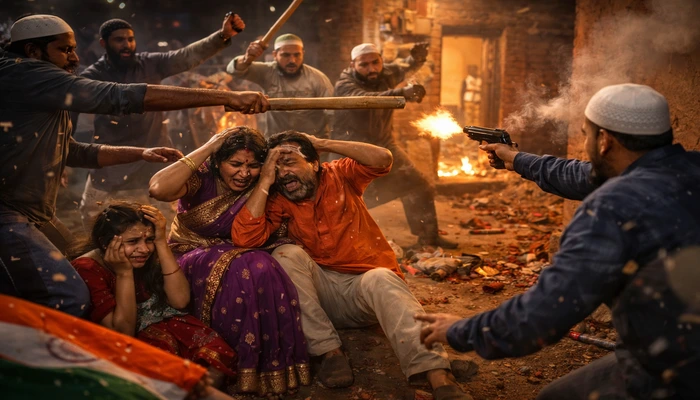
Case Summary
In Alwar, Rajasthan, Hindus were brutally attacked, stoned and shot at by Muslim men for celebrating Bumrahs wicket in the ICC Men’s T20 World Cup final. On 8 March 2026, a violent incident took place in Badhoda Ghumakkad village under Kishangarh Bas police station in Khairthal–Tijara district of Alwar, Rajasthan, during celebrations linked to a cricket match between India and New Zealand. The incident occurred at around 10:30 PM, when members of a family were watching the match from the roof of their house. During the match, when Indian fast bowler Jasprit Bumrah took two consecutive wickets in one over, members of the family clapped and celebrated the moment. Their celebration was objected to by Muslim men present nearby, who began abusing the family. This led to an argument between the two sides. Soon after, around 15 to 20 people gathered outside the family's house and launched an attack using sticks and rods. Stone pelting also took place during the assault, creating panic in the area. During the attack, one of the assailants climbed onto the roof of the house and opened fire. During the assault, a 30-year-old woman named Bhajno Baiwas sustained serious injuries to her head. She sustained serious injuries and was immediately taken to Kishangarh Bas Hospital for treatment. Due to the severity of her injury, she was later referred to Alwar District Hospital, where doctors gave her nine stitches on her head. Another individual, identified as Riku, the maternal uncle of the injured woman, also sustained injuries during the attack. Following the incident, the victim’s family approached the police and filed a complaint regarding the attack. Police officials initiated an investigation based on the complaint and began efforts to identify the accused and take further action in the matter. In a similar incident in Ujjain, Madhya Pradesh, Hindus were attacked by a Muslim mob for bursting crackers during celebrations of India’s victory in the ICC Men’s T20 World Cup final. This incident occurred late Sunday (8 March 2026) night in Raj Royal Colony under the jurisdiction of the Chimanganj Mandi Police Station, leaving several Hindus severely injured. A video of local Hindus sharing details about the incident also went viral on social media.
Why it is Hate Crime ?
This case is being added to the tracker under the primary category "Attack not resulting in death". The sub-category is: “Attacked for Hindu identity.” In several cases, Hindus are attacked merely for their Hindu identity without any perceived provocation. A classic example of this category of religiously motivated hate crime is a murder in 2016. 7 ISIS terrorists were convicted for shooting a school principal in Kanpur because they got ‘triggered’ seeing the Kalava on his wrist and the tilak that he had put. In this, the Hindu victim had offered no provocation except for his Hindu religious identity. The motivation for the murder was purely religious, driven by religious supremacy. Such cases where Hindus are targeted merely for their religious identity would be documented as a hate crime under this category. The other sub-category is " Attacked for opposing radicals or trying to save a victim". In several cases, Hindus are attacked for opposing religiously motivated crimes being committed against a fellow Hindu or simply for voicing an opinion opposing radical elements, who either have in the past or continue to persecute Hindus. In such cases, the initial attack against the victim, against which the Hindu was trying to defend the victim, would also need to be classified as a religiously motivated hate crime. Since the initial crime itself was religiously motivated and the subsequent crime of attempting to save the victim or speaking against the radical elements ends up inviting a violent attack, it would also be classified as a religiously motivated hate crime under this category. This case represented a clear instance of a religiously motivated hate crime in which a group of Muslim men launched a violent attack on a Hindu family over a trivial act of clapping during a cricket match in appreciation of a wicket. The trigger for the violence was the Hindu family clapping and celebrating. Celebrating a sporting moment for the national team is a common and harmless expression of joy. When a crowd gathers and directs violence at members of a specific community over a celebration marking the victory of their own nation in an international sporting event, it reveals a level of hostility that goes far beyond an ordinary disagreement. Celebrating a national team’s success is not a religious act, nor is it directed against any other community. It is a common and unprovocative expression of joy shared by people across the country regardless of faith. The fact that such a moment became the basis for collective violence showed that the reaction was not about the act itself but about the identity of those celebrating. It therefore reflected animosity that went beyond a personal dispute and instead targeted the Hindu identity of the victims. The violent reaction to celebrations of India’s cricket victory also reflects a deeper ideological dimension. Within Islamist political thought, India is often perceived not merely as a modern nation state but as a civilizational entity historically associated with Hindu identity, culture and religious tradition. Expressions of national pride linked to India can therefore become symbolically associated with Hindu collective identity. In this context, when Hindus publicly celebrate India’s sporting victory, the act may be interpreted by Islamist elements not simply as enthusiasm for a cricket match but as an affirmation of that Hindu civilizational identity. Such displays can provoke resentment among those who view the rise or assertion of Hindu identity with hostility. The attack therefore represented more than anger at a moment of celebration. By targeting individuals who were expressing pride in India’s victory, the perpetrators effectively targeted members of the Hindu community whom they perceived as embodying that national and civilizational identity. When individuals are attacked inside or around their own homes for celebrating a national moment, it sends a message intended to silence and discourage similar expressions by others in the community. Such actions demonstrate how violence can be used as a tool of intimidation to suppress the cultural and social expression of Hindus within a locality. Even if tensions later drew in more people from the surrounding area, the origin of the confrontation lay in the Muslim group's objection to the Hindu family’s celebration. The violence that followed, therefore, cannot be reduced to a routine neighbourhood clash. Instead, it represented an instance where hostility towards Hindus manifested in mob aggression and the use of force against them. The incident, therefore, fulfilled the parameters of a religiously motivated hate crime and was recorded in the Hinduphobia Tracker database. It is important to mention here that this instance marks a recurring pattern of religiously motivated violence. In a similar incident, a Muslim mob launched a brutal assault on the entire Hindu community in Ujjain's locality over a minor dispute involving the bursting of firecrackers during celebrations of India’s victory in the ICC Men’s T20 World Cup final. Similarly, last year, in March 2025, a similar incident unfolded in Indore, Madhya Pradesh, as documented in the Hinduphobia Tracker's hate crime database. There, a Muslim mob viciously attacked Hindus celebrating India's ICC Champions Trophy victory. The assault erupted after Muslims objected to firecrackers and celebrations near a mosque in Mhow. As Hindus chanted "Jai Shri Ram" and "Bharat Mata Ki Jai", the mob pelted stones, hurled petrol bombs, committed arson, and selectively targeted Hindu homes, shattering doors and windows. The Muslim rioters shouted "Allahu Akbar", "Nara-e-Taqbir", anti-India slogans, and taunts like "Call your Ram; let us see who saves you now". They also attacked a Shitala Mata temple in the area. Even the Jama Masjid Imam admitted that Muslims initiated the violence by grabbing and assaulting Hindus. These similar instances showcase that such attacks on Hindus are not isolated cases but are clearly motivated by deep-seated hatred and animosity towards Hindus and their community identity, qualifying them as hate crimes. Given that this case meets the necessary parameters of a hate crime, it has been added to the hate crime database of the Hinduphobia Tracker. Disclaimer: Media reports stated that Muslim perpetrators targeted multiple Hindu victims; however, the total number of victims was not specified. Only two victims were specified. Therefore, these two were recorded as the victims, with the victim count kept at two (2). This is a conservative estimate, as the total number of victims could be higher. Similarly, reports stated that multiple Muslims men launched the attack, but only 20 Muslims were specified, and only one Muslim man climbed onto the roof and shot the victim. Therefore, the perpetrator count was recorded as twenty (20). This is a conservative estimate, as the number of perpetrators could be higher.
Victim Details
Total Victim
2
Deceased
0
Gender
- Male 1
- Female 1
- Third Gender 0
- Unknown 0
Caste
- SC/ST 0
- OBC 0
- General 0
- Unknown 2
Age Group
- Minor 0
- Adult 2
- Senior Citizen 0
- Unknown 0


Case Status
Complaint filed


Perpetrators Details
Perpetrators
Muslim Extremists
Perpetrators Range
One Person
Perpetrators Gender
male
 Sources




