Hindus brutally attacked by Muslim mob over bursting crackers during cricket victory celebrations in Ujjain
 Ujjain, Madhya Pradesh, India
  7 March, 2026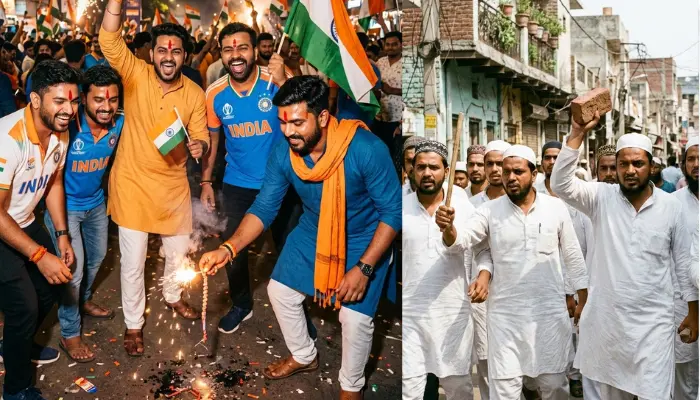
Case Summary
In Ujjain, Madhya Pradesh, Hindus were attacked by a Muslim mob for bursting crackers during celebrations of India’s victory in the ICC Men’s T20 World Cup final. This incident occurred late Sunday (8 March 2026) night in Raj Royal Colony under the jurisdiction of the Chimanganj Mandi Police Station, leaving several Hindus severely injured. A video of local Hindus sharing details about the incident also went viral on social media. As per the video, a Hindu family was celebrating India’s victory by bursting crackers outside their home. As a result, a large group of Muslim youths objected to bursting crackers and began assaulting the Hindu family. When local Hindus objected to this assault, the Muslim mob launched a violent assault on all Hindus in the locality. According to reports, the conflict began with an argument over bursting firecrackers during the victory celebrations, as the Muslims objected to it. The dispute quickly escalated into a physical clash between Hindu and Muslim groups. Station House Officer (SHO) Gajendra Pachoriya confirmed that police had registered First Information Reports (FIRs) from both sides and detained several individuals involved in the incident. “A dispute arose between two parties over bursting firecrackers in Raj Royal Colony under Chimanganj Mandi police station limits on Sunday. A few people from both sides were injured. First Information Reports had been registered from both sides, and we had also rounded up some individuals,” Pachoriya said. He added that five individuals from one group and three from the other, along with several associates, had been identified as accused in the case. Police teams had begun examining CCTV footage from the area to identify additional individuals involved in the clash. Authorities had also deployed additional personnel in the locality to prevent further tensions. Officials said a peace committee meeting would be organised to help restore calm and prevent escalation of the dispute. “CCTV footage is being reviewed, and those found involved in the incident will be treated as accused. Adequate police personnel have been deployed at the site,” the SHO said. Reports also confirmed that the Hindus were attacked with sticks and pipes, in which Ravindra Hada, Drishti Hada, Manish Mehrale, Anita Mehrale, Vimala Malviya, Laila Singh, Manvendra Hada, and Vishal Malviya were injured. As a result of the clash, from the Muslim side, Shadab Khan, Wahid Khan and a Muslim woman from the other side were also injured. Chimanganj police reached the spot after receiving information. Based on a Hindu man, Sanjay Namdev's complaint, the police had registered a case against Wahid Khan, Zakir, Sultan, Shadab, and other associates under sections 331, 294, 115, 351, and 3 of the Indian Penal Code (IPC). On the other hand, based on Wahid Khan's complaint, a case had been filed against Ravindra, Pankaj, and others.
Why it is Hate Crime ?
The primary category selected in this case is- Attack not resulting in death. The first subcategory selected is- Communal Clash/Attack. Communal clash is a form of collective violence that involves clashes between groups belonging to different religious identities. For a communal clash between Hindus and non-Hindus to qualify as a religiously motivated hate crime, the trigger of the violence itself would have to be anti-Hindu in essence. For example, if there is a Hindu religious procession that comes under attack from a non-Hindu mob and after the initial attack, Hindus retaliate in self-defence, leading to a communal clash between the two religious communities. While at a later stage, both communities are involved in the clash/violence, the initial trigger of the violence was by the non-Hindu mob against the Hindus and therefore, it could safely be termed as an anti-Hindu violence. Further, the trigger would also have to be religiously motivated. In the cited example, the attack by the non-Hindu mob was against religious processions and therefore, can be concluded to be religiously motivated. In some cases, the trigger may be non-religious, however, it develops into religious violence against Hindus at a later stage. In such cases too, the foundational animosity towards Hindus becomes the motivating factor of the crime and therefore, it would be classified as a religiously motivated hate crime against Hindus under this category. The second subcategory selected is- Attacked for opposing radicals or trying to save victim. In several cases, Hindus are attacked for opposing religiously motivated crimes being committed against a fellow Hindu or simply for voicing an opinion opposing radical elements, who either have in the past or continue to persecute Hindus. In such cases, the initial attack against the victim, against which the Hindu was trying to defend the victim, would also need to be classified as a religiously motivated hate crime. Since the initial crime itself was religiously motivated and the subsequent crime of attempting to save the victim or speaking against the radical elements ends up inviting a violent attack, it would also be classified as a religiously motivated hate crime under this category. This case represented a clear instance of a religiously motivated hate crime as a Muslim mob launched a brutal assault on the entire Hindu community in Ujjain's locality over a minor dispute involving the bursting of firecrackers during celebrations of India's victory in the International Cricket Council Men's Twenty20 World Cup final. The fact that such a minor dispute, simply bursting crackers, resulted in a large-scale Muslim mob attack on a Hindu family, followed by an assault on the entire Hindu community, showcased deep-seated communal animosity. This occurred under the pretext of a minor instance of bursting crackers, yet the local Hindus did nothing wrong or provocative to harm the Muslims. They were simply celebrating a victory for India in the International Cricket Council Men's Twenty20 World Cup final and stated that they were just marking the occasion by bursting firecrackers, a practice deeply embedded in Hindu religious and cultural traditions for joyous events. The Muslim community took objection to this and then launched a violent assault on the Hindu family, celebrating by bursting crackers outside their home, which demonstrated deep-seated religious animosity towards the Hindu family due to their faith identity and the fact that they were marking a proud moment for India. This showcased clear-cut animosity towards Hindus and India. This hatred for India and its victories stems from deep-seated anti-Hindu animosity. Muslim extremists harbour profound hostility not only towards Hindus and their faith but also towards India as a Hindu-majority nation. This perspective leads them to view India as a Hindu collective rather than a shared national entity. The foundation of India's partition also rested on the belief that Islam constituted a distinct nation incapable of coexisting within a Hindu-majority country like India. Additionally, Muslims adhere to the concept of transnational unity, known as the Ummah, which asserts that all Muslims worldwide form a single nation. This ideology frequently fosters divided national loyalty, placing allegiance to the global Muslim community above devotion to a nation-state perceived as Hindu-majority. Hostility towards Hindus celebrating India's victories manifests repeatedly, as Muslim radicals reject national identity in favour of the Islamic Ummah. Such attacks on Hindus marking national success arise from the same contempt for India, seen through the lens of a Hindu collectivity by the Muslim groups. This showcases the anti-Hindu nature of the crime even more clearly. When Hindu locals objected to the assault on the Hindu family, they too faced attacks. These religiously motivated assaults targeted fellow Hindus who opposed the violence. This demonstrates that the Muslim mob aimed to silence Hindu celebrations and crush any resistance to their attacks, making the religious hatred behind the crime very clear. Here, the Muslim community launched a premeditated attack; it was not merely a spontaneous outburst, as evidenced by the mob arriving armed with weapons. The fact that a large mob was mobilised so quickly further underscored this premeditation, showcasing a clear-cut case of religious animosity and making it a religiously motivated hate crime. In this case, even though both communities eventually became embroiled in a communal clash, that fact did not change the reality that the assault began with the Muslim side attacking Hindus over a minor celebration of India's victory in the International Cricket Council Men's Twenty20 World Cup final. The act of forming a mob to assault Hindus and then attacking other Hindus who opposed the initial assault all showcased not just a random act of mischief or violence. It demonstrated Muslim dominance, street power and muscle power used to suppress Hindus, making it a clear case of a religiously motivated hate crime. This marked a recurring pattern of religiously motivated violence. Last year, in March 2025, a similar incident unfolded in Indore, Madhya Pradesh, as documented in the Hinduphobia Tracker's hate crime database. There, a Muslim mob viciously attacked Hindus celebrating India's International Cricket Council Champions Trophy victory. The assault erupted after Muslims objected to firecrackers and celebrations near a mosque in Mhow. As Hindus chanted "Jai Shri Ram" and "Bharat Mata Ki Jai", the mob pelted stones, hurled petrol bombs, committed arson, and selectively targeted Hindu homes, shattering doors and windows. The Muslim rioters shouted "Allahu Akbar", "Nara-e-Taqbir", anti-India slogans, and taunts like "Call your Ram; let us see who saves you now". They also attacked a Shitala Mata temple in the area. Even the Jama Masjid Imam admitted that Muslims initiated the violence by grabbing and assaulting Hindus. A similar instance in 2026 showcased that such attacks on Hindus were not isolated cases but were clearly motivated by deep-seated hatred and animosity towards Hindus and their community identity, qualifying them as hate crimes. Given that this case met the necessary parameters of a hate crime, it was added to the hate crime database of the Hinduphobia Tracker. Disclaimer: Media reports did not specify the total number of perpetrators, naming only Shadab Khan, Wahid Khan, Zakir, Sultan, a Muslim woman and many others. With these five explicitly identified, Hinduphobia Tracker recorded a perpetrator count of five as a conservative estimate for documentation purposes..
Victim Details
Total Victim
8
Deceased
0
Gender
- Male 4
- Female 4
- Third Gender 0
- Unknown 0
Caste
- SC/ST 0
- OBC 0
- General 0
- Unknown 8
Age Group
- Minor 0
- Adult 0
- Senior Citizen 0
- Unknown 8


Case Status
Complaint registered


Perpetrators Details
Perpetrators
Muslim Extremists
Perpetrators Range
From 2 To 5
Perpetrators Gender
both
 Sources




